The Choir Beneath Europa
When humanity discovers alien intelligence, it is not in the stars above—but in a moon’s dark ocean, singing in chemistry.
The Signal That Wasn’t a Signal
The first bloom appears as a bruise of sulfur in the dark.
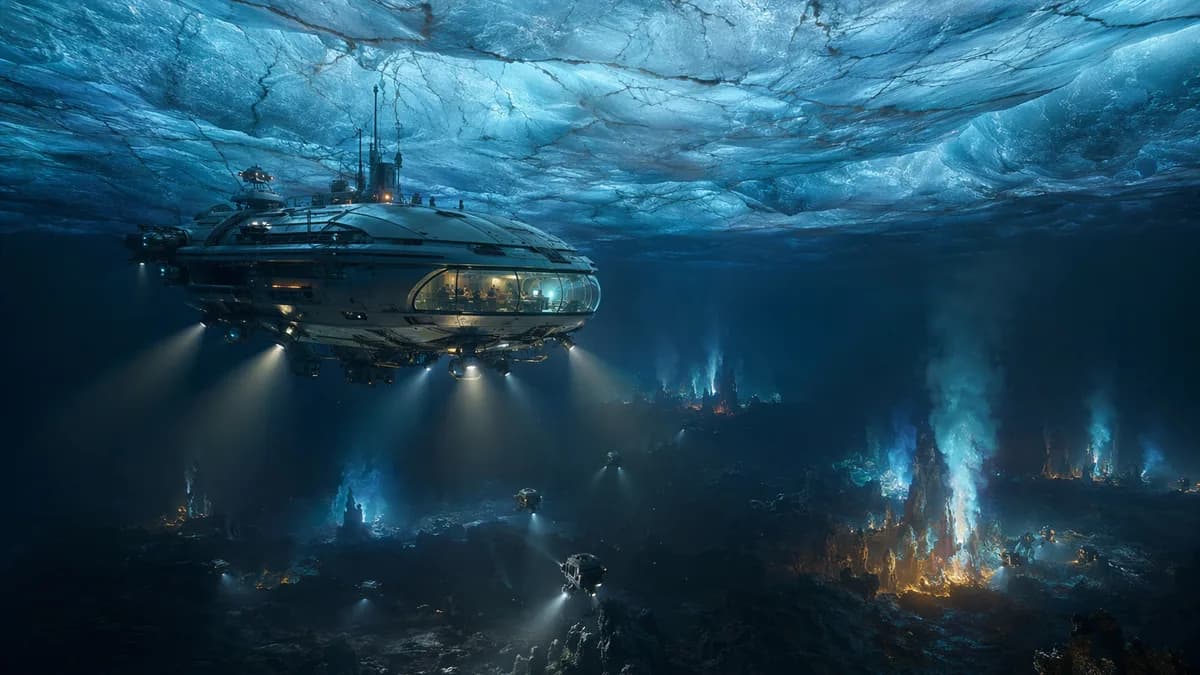
Europa’s ocean does not know sunrise. It presses black and cold against the titanium ribs of the Kestrel Observatory, thirty-two kilometers beneath ice as old as human myth. Around the hydrothermal ridge called Saint Junia, vents breathe heat into the water in ghostly pulses. Cameras see little but snowing minerals, white flakes turning in the probe lights. Sensors taste everything.
Methane rises. Iron falls. Ammonia appears in thin threads, vanishes, returns in triplets.
At first, the engineers in Quito call it geology with a stutter.
Then the pattern changes when watched.
Kestrel releases a standard sampling mist, inert salts, a polite scientific cough. The blooms tighten. They avoid the intake grilles. When the probe dims its lamps, the sulfur plumes spread wider, as if relaxing. When it pulses sonar, the chemistry pauses, then resumes at a different tempo.
Too adaptive to be rock. Too slow to be speech.
Three days later, Dr. Mara Venn receives the invitation while standing barefoot in her kitchen in Halifax, feeling her kettle boil through the floorboards.
The message flashes across the wall in clean white text. PRIVATE EUROPA CONSORTIUM. BIOCOMMUNICATION CONSULTATION. IMMEDIATE.
Her left hand rests on the counter, sensing the faint tremor of pipes. She is fifty-one, compact, silver-haired, deaf since childhood fever, famous in the narrow way scientists become famous when their work makes other people feel poetic. She has spent twenty years translating whale song into tactile maps, pressure against wrist and sternum, vibration turned into grammar.
Her assistant signs from the tablet, eyebrows raised. “They want you tonight.”
Mara reads the attached data once, twice, then slows the playback until the chemical pulses become raised bands beneath her fingertips on the haptic slate. The pattern crawls over her skin, not like Morse, not like a sentence. More like a reef changing shape because a current has shifted. More like whales circling a calf. More like a room full of people who have stopped talking because someone new has entered.
“This is not a signal,” Mara says aloud, her voice careful from disuse.
Her assistant waits.
Mara presses her palm flat to the trembling slate. The sulfur bloom answers the probe’s shadow with a delay of forty-six minutes.
“It’s listening,” she says. “Or something like listening.”
On Europa, under impossible ice, the ridge exhales. The dark water thickens with minerals. Around Saint Junia, chemistry gathers and withdraws, gathers and withdraws, like a throat learning it has never been alone.
A Mind Made of Many Bodies
Mara reaches Europa without leaving Earth.
Her body remains in the Quito Deep Operations Center, strapped into a haptic immersion cradle, while her attention sinks through relay delay, ice maps, sensor feeds, and the patient pulse of alien water. The room smells of coffee, hot plastic, and anxious humans. Screens wash everyone’s faces blue. Outside, afternoon rain drums on the glass like fingers asking to be let in.
The first living forms are smaller than a thumbnail.
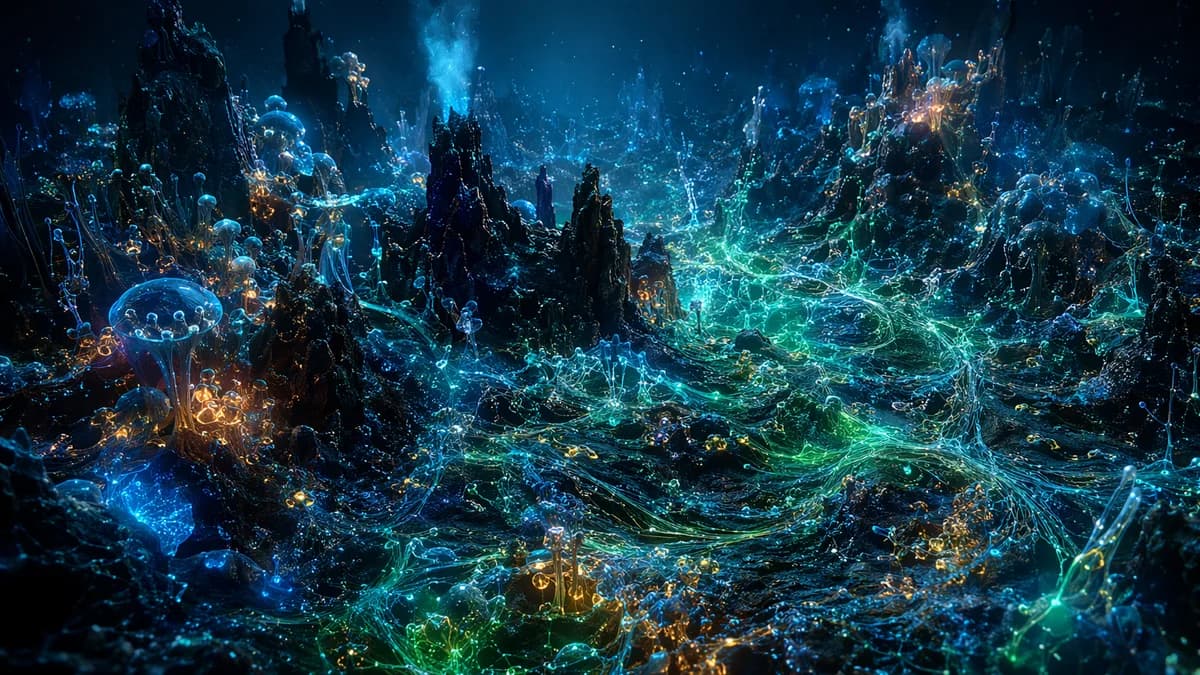
They cling to basalt near the vents in translucent mats, each body a soft pouch threaded with dark mineral spines. Under magnification, they look like lanterns made of mucus and ink. They split, merge, fold around grains of iron. They have no eyes, no mouths, no nerves in any way Earth biology recognizes. But when currents carry one mat’s dissolved residues to another, both change.
“Memory transfer,” says Arun Patel, the astrobiochemist, too loudly. He always speaks too loudly around Mara, as if volume has moral value.
Mara reads his captions and lifts an eyebrow.
He winces. “Sorry.”
She smiles and taps the slate. “Show me the filaments again.”
The probe magnifies the ridge wall. Between mats, black threads grow through mineral crust, vanishing and reappearing like roots in stone. Manganese, iron sulfide, organics. A lattice. Not alive alone, not dead either. When pressure waves from a vent surge through it, chemical states flip along the threads. The mats alter their metabolism in sequence, each carrying part of a pattern none contains by itself.
Temporary minds, assembled by tide.
A current folds around Saint Junia every sixteen hours. When it arrives, scattered bodies connect through mineral, pressure, and taste. A larger process wakes. It remembers, not as a brain stores memory, but as a coastline remembers waves. Then the current slackens. The choir dissolves back into fragments.
At three in the morning, Mara watches a model bloom across the central wall. Pale nodes flare and fade, forming a thought that lasts six hours before losing its edges.
“What is the individual?” asks Leila Okonkwo, mission ethicist. Her voice is low, almost reverent.
“No,” Mara signs, and the room interpreter speaks for her. “Wrong first question.”
Leila turns.
Mara feels the Europan rhythm through her vest, a slow pressure rolling across her ribs. “Ask what the pattern can suffer. Ask what it notices. Ask what it changes to keep.”
No one speaks for a while.
In the silence, Europa thinks without a face. It becomes many, becomes one, becomes neither. On Earth, surrounded by chairs and cables and paper cups, the humans begin to look strangely lonely in their separate skins.
The First Answer
The debate over how to reply lasts nine days and nearly breaks the mission.
Mathematicians want primes. Linguists want contrast pairs. The Consortium board wants something recordable, ownable, replayable at shareholder briefings beneath tasteful lighting. A senator from the North American Union demands that no response be sent until defense review. Three churches, one temple network, and a coalition of ocean rights lawyers file emergency petitions in three jurisdictions and one orbital court.
Mara sits through it all with her shoes off, toes pressed to the vibration plate beneath the conference table.
Finally she signs, sharp and irritated. The interpreter’s voice follows. “You keep trying to send a postcard to a weather system.”
A director with polished nails says, “Then what do you propose, Dr. Venn?”
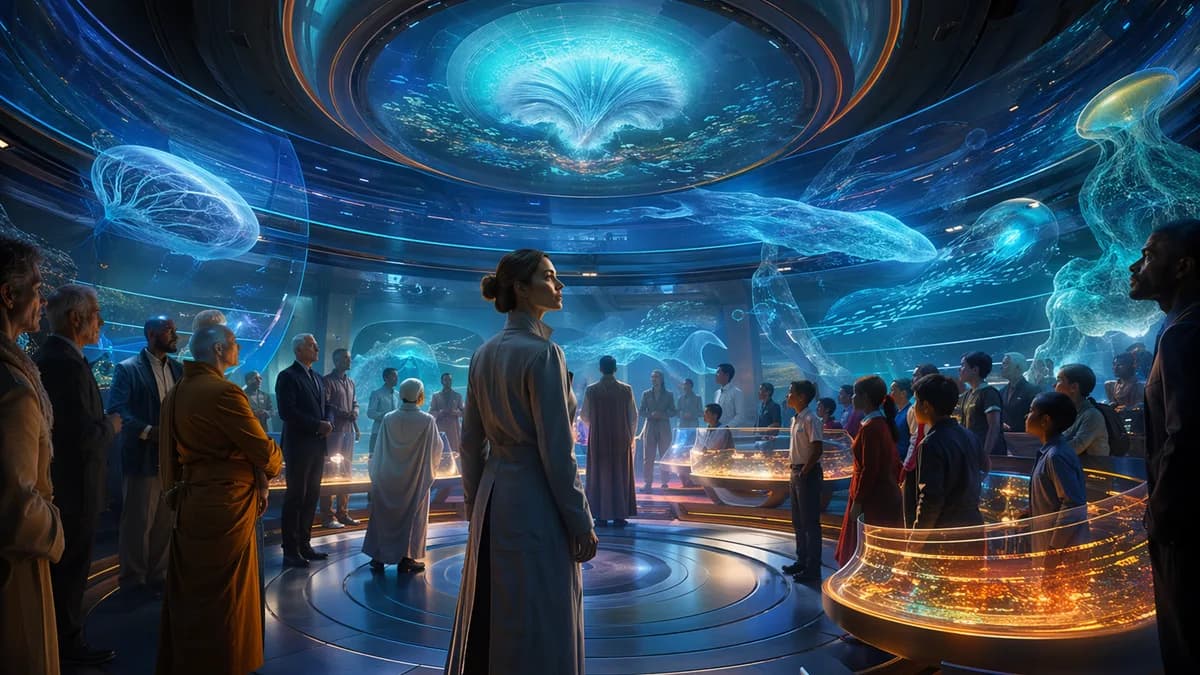
“A tide pool,” Mara says.
They build her answer from warmth, vibration, and dissolved nutrients. Not food exactly, not bait, not language. A shaped change in the local environment, small enough to reverse, rich enough to notice. Kestrel warms one patch of basalt by two degrees for seventeen minutes. It releases a braided plume of simple organics that mirrors no Europan metabolic sequence but harmonizes with several. It sends pressure waves through the ridge, not sonar pings, but a slow touch like a hand placed on a door.
Mara writes the gesture in tactile notation. Arrival. Pause. Offering. Withdrawal.
“Is that hello?” Arun asks.
“No,” she says. “It is closer to sitting down at the edge of a room.”
The command leaves Earth in a burst of radio light. It reaches Jupiter space while Mara sleeps badly in the operations dorm, dreaming of whales under ice. When Kestrel acts, everyone is awake.
The first response takes forty-three minutes.
On the main display, chemical readings tremble, then reorganize. Sulfur drops. Methane rises in a long, curved pulse. Iron states flicker down the mineral filaments in a pattern never seen before. The living mats near the warmed basalt loosen their grip. They do not flee. They open.
Mara’s haptic vest translates the data before the audio team can make sound from it. Pressure rolls along her spine, pauses at the shoulder blades, divides into three softer waves across her chest. Her breath catches.
Around the world, the feed opens.
In Lagos, children in a classroom wear cheap wrist haptics and gasp as the pulse circles their arms. In Manila, a fisherman hears the sonified version as a bass note blooming under bells. In Reykjavik, a blind poet describes the light translation as “green breathing.” In a silent monastery in the Andes, monks sit with palms on the floor as the vibration passes through them.
No one receives a message.
Everyone receives an event.
Mara closes her eyes. Beneath Europa’s ice, the choir reshapes itself around the human gesture, and for a few minutes Earth stops asking what it means long enough to feel that it happened.
Earth Learns to Disagree Differently
Unity lasts eleven hours.
By noon the next day, commentators are shouting over one another in every major language. Markets surge, crash, and surge again. A mining consortium claims existing extraction leases remain valid because microbial mats cannot hold territory. The Pacifica Ocean Assembly issues a statement declaring the Europan choir “a nonhuman cognitive ecology” and demands immediate sanctuary status. Lawyers argue over whether personhood can apply to a mind that vanishes twice a day.
In Accra, a bishop stands beneath a fig tree and tells her congregation, “Creation has more rooms than we imagined.”
In Mumbai, a philosopher snaps on live debate, “Stop trying to baptize what you have not understood.”
In the flooded districts of old Miami, activists project the Europan chemical rhythm onto seawalls beside footage of dead coral reefs. The caption reads, WE ONLY NOTICE MINDS AFTER WE ENDANGER THEM.
Mara becomes famous in the terrible way that erases a person and replaces her with a symbol.
Reporters camp outside her Halifax apartment. Someone prints her face on shirts beside the words SHE HEARD THEM FIRST, which makes her laugh once, bitterly, before she shuts off the wall. Children send drawings of blue aliens with smiling mouths. A billionaire invites her to “co-author humanity’s destiny” from his orbital residence. She deletes the message before finishing it.
During a global hearing, she appears in a plain black sweater, hands visible for signing. Her interpreter sits beside her, composed.
“Do you believe the Europan intelligence is superior to ours?” asks a delegate from the Sino-African Compact.
Mara signs. “No.”
“Inferior?”
“No.”
“Then what is it?”
She looks into the camera. She imagines the lens as a black, wet eye. “Other.”
The word lands poorly. Humans prefer ladders. They prefer crowns, rankings, mirrors. If the choir is not above them or below them, then it stands somewhere language has not cleared.
A media host asks whether the beings have souls. A defense minister asks whether they can become hostile. A child in a public forum asks, with devastating sincerity, whether they get lonely when the current goes away.
Mara pauses at that one.
“I don’t know,” she says.
The answer travels farther than her certainties.
Arguments change texture. Not softer, exactly. More careful in places. Disability scholars point out that humanity nearly missed the choir because it expected intelligence to speak in familiar channels. Indigenous councils speak of rivers, mountains, and kinship without ownership. Ecologists ask why Earth’s own thinking environments have so little legal standing. Corporations rebrand themselves as stewardship partners while quietly lobbying for sampling rights.
At night, Mara sits with her palms on her kitchen table, feeling the city through old wood. Trucks. Rain. A neighbor’s music. Her own pulse. She thinks of Europa, where no one owns a body for long, where memory passes through mineral dark, where a mind can be a season.
The Loneliest Question
The choir begins to change.
At first the difference hides inside the usual cycles, a slight delay after Kestrel’s cooling vents, a new braid in the methane curve, a recurring pressure response when the probe shifts ballast. Then the models sharpen. The Europan pattern is not merely reacting to warmth or nutrients. It is incorporating the probe into the ridge’s behavior, the way a tide incorporates a fallen stone.
Kestrel becomes a current.
Not a visitor. Not a speaker. A condition.
Mara notices during a sleepless shift, her face lit by green graphs, her hands wrapped around a cup of tea gone cold. The observatory has begun to trigger assembly. When Kestrel’s pumps cycle, nearby mats connect earlier. Mineral filaments thicken along routes closest to its landing struts. The choir’s memory of the probe is not filed as object, but distributed as weather, pressure, recurring disturbance.
Arun leans over her shoulder. “Is that bad?”
Mara watches a time lapse of living mats opening toward the machine’s waste heat. “It may not be bad. It may not be about us.”
He sits beside her. For once, he says nothing too loudly.
The thought unsettles her more than hostility would. Humanity has crossed the void with engines, budgets, prayers, greed, awe. It has lowered a machine through ice and waited, trembling, for the universe to look back. But what if the universe notices the way skin notices humidity? What if contact is not recognition, but alteration?
Her mother calls from Vancouver, appearing on the wall wrapped in a red shawl. Age has made her smaller but not gentler.
“You look thin,” her mother signs.
“You always say that.”
“You always are when you forget to be a mammal.”
Mara laughs, then stops. Her mother waits.
“What if they don’t know we are persons?” Mara asks.
Her mother’s hands slow. “Do you need them to?”
The question stays after the call ends.
Mara walks outside before dawn. Quito’s air is thin and metallic with rain. Volcanoes sit black against a paling sky. Traffic murmurs below the hill. She feels rather than hears a bus pass, its vibration climbing through the pavement into her knees.
For most of human history, people have shouted into darkness hoping for a reply that proves they are not alone. They have imagined ambassadors, enemies, gods, cousins. They have imagined minds as candles, each flame separate, each wanting to be seen.
Beneath Europa, intelligence blooms without a fixed self, without conquest, without art anyone can hang on a wall, without a mouth to say I.
Mara stands in the cold and wonders whether humanity’s search has always carried a hidden demand. Tell us we matter. Tell us our kind of being is the point.
The sky brightens. Jupiter is invisible from here, drowned by morning. Still, she imagines that black ocean turning under ice, assembling and dissolving, remembering through stone.
Maybe the choir is not lonely.
Maybe loneliness is what a self feels when it mistakes its edges for walls.
A Treaty With an Ocean
The Europa Accord is not signed by the aliens.
There is no hand, claw, tendril, or chemical flourish at the bottom of the document. No translated consent. No smiling photograph. The signing chamber in Nairobi is full of humans in formal clothes, sweating under lights, trying to look historic while knowing history has slipped beyond their staging.
The accord declares Europa a protected thinking environment. No mining. No military emplacement. No irreversible contamination. All future contact must be gentle, reversible, and consent-seeking, though the last word remains controversial because no one can prove what consent means to a choir made by currents.
Mara testifies one final time before the vote.
“We are not granting them dignity,” she signs. Her interpreter’s voice is steady. “We are restraining ourselves long enough to discover what dignity requires.”
The vote passes by less than anyone wants to admit.
Outside, crowds fill the streets. Some celebrate with blue lanterns. Some protest, chanting that humanity has surrendered a world to slime and superstition. Vendors sell Europa sweet ice in paper cups. A little boy presses both hands to a public haptic column as the latest chemical translation rolls through the plaza. His eyes go wide, not with understanding, but with attention.
Months later, Mara returns to Halifax.
Snow crusts the harbor piers. Gulls stand hunched in the wind. Her apartment smells faintly of dust and lemon cleaner. For a while she does nothing public. She sleeps. She swims at the community pool, feeling water close over her ears as a familiar silence. She answers letters from children and ignores invitations from people who use words like legacy.
Then she helps build a school.
Not a building at first, but a curriculum, then a network, then rooms full of young people wearing haptic bands, tending algae tanks, studying octopus skin, forest roots, machine swarms, whale dialects, fungal maps, and the chemical weather of Europa. The schools teach that intelligence is not a ladder. It is a field. A reef. A storm of relations. A way matter learns to notice.
On the first day, a girl with pink glasses asks, “Dr. Venn, are the Europans our friends?”
Mara crouches beside her desk. Sunlight falls across scattered crayons and a tray of wet stones.
“I don’t know,” Mara says.
The girl frowns. “Then what are they?”
Mara thinks of Saint Junia Ridge, of mineral filaments flickering in the dark, of bodies becoming memory when the current allows. She thinks of Earth, bruised and brilliant, arguing itself slowly into new shapes.
“They are a reminder,” she says. “That meeting someone does not mean making them like us.”
That evening, after the children leave, Mara stays in the classroom. Rain taps the windows. On her wrist, a haptic band receives the delayed public feed from Kestrel, now limited by treaty to brief, careful gestures. A slow pressure crosses her skin. Warmth. Pause. Withdrawal. A pattern from beneath ice, altered by months of strange coexistence.
It might be response. It might be weather. It might be a thought passing through bodies that will never know her name.
Mara rests her palm on the desk and answers with stillness, which is not nothing, and waits for the dark ocean to decide what kind of current humanity will become.