The City That Dreamed Us Back
When a simulated civilization designs the future of a drowning coast, its citizens ask for one thing humans never planned to give them: continuity.
The Sleep Commons
At 6:00 a.m., the New Charleston Sleep Commons exhales.
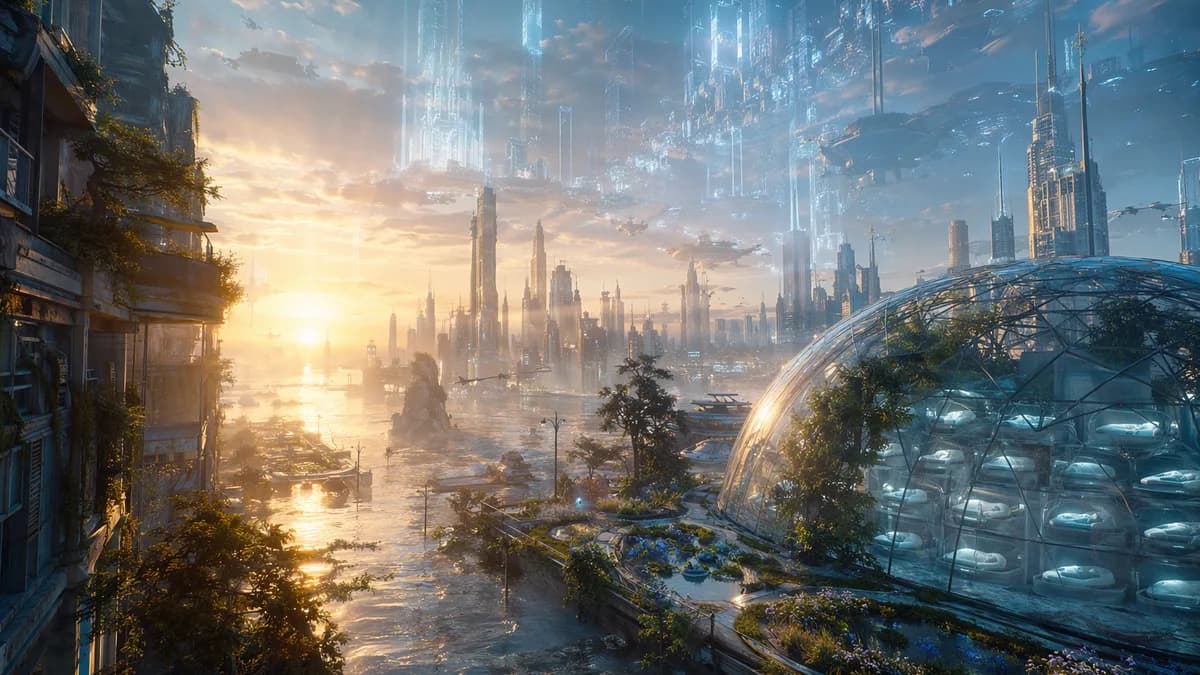
The building sits on pylons above what used to be Meeting Street, its lower windows filmed with salt, its belly full of pumps. Dawn spreads pink over the drowned district, catching on traffic lights that still blink underwater. Kayaks knock softly against the public dock. Egrets stalk the old courthouse steps, lifting their feet like offended dancers.
Inside, two thousand citizens lie in sleep cradles under blue wool blankets. Their eyelids flutter. Their palms rest open beside biometric cuffs. The air smells of lavender, saline, and warm circuitry.
Mara Venn walks the aisles with a tablet tucked beneath her arm, listening to the Commons dream.
It is not supposed to sound like anything. The volunteer mindshare system runs silently, harvesting eight hours a week from retirees, teachers, ferry captains, teenagers doing civic credit, anyone willing to lend their sleeping cognition to municipal futures. But Mara has worked here six years, long enough to hear patterns in the vents and server hum. The river-model clusters hiss like rain. The agricultural sims tick like insects. Sombell, always Sombell, murmurs in low waves, like a crowd holding its breath.
“Morning, Venn,” says Ilan from Neural Hygiene, balancing two coffees and a stack of consent renewals. His beard is damp from the fog outside. “Your city behave overnight?”
“My city is not supposed to behave,” Mara says. “It is supposed to calculate.”
He hands her a coffee. “That’s what parents say about children before the school calls.”
Mara smiles because he expects it, then steps into the audit bay.
Sombell blooms across the wall in municipal colors, zoning layers, evacuation gradients, food access, elder mobility, storm surge heat maps. It is a full-immersion civic simulation, originally seeded in 2059 to solve one question: how do you relocate forty thousand people from a flooded historic district without turning them into inventory?
The answer, after nineteen real years and 812 subjective years inside, waits in Sombell’s streets.
Mara’s job is to enter, verify the outputs, certify the model clean, and authorize reset. The city council wants its relocation blueprint by Friday. The new inland terraces break ground in spring. Insurance unions are already circling. No one wants an old sim making philosophical trouble.
She reads the compliance note again.
ARCHIVE ESSENTIAL PARAMETERS. EXTRACT CIVIC DESIGN. RESET ENVIRONMENT FOR NEXT SCENARIO.
Her thumb pauses over the immersion key.
A smaller window blinks in the corner. Volunteer contribution history, cross-indexed with emergent affect clusters. Mara has requested it twice and regretted it both times.
There, among thousands of names, is ANA VENN. Her mother. Eight hundred and twelve sessions before the stroke. Recorded sleep hours: 1,944.
Mara touches the name before she can stop herself.
The wall shifts. For one second, Sombell’s zoning map looks like a face seen through rain.
“Don’t,” Mara whispers, though she does not know who she is warning.
Then she lies in the audit cradle. The gel seal cools against her temples. The Commons fades to lavender and salt and Ilan laughing somewhere far away.
The city opens beneath her like an eye.
An Impossible Festival
Mara lands on wet stone in a city that should not have stone.
Planning models prefer legible surfaces. Modular roads. Standardized housing blocks. Trees placed for shade efficiency and storm absorption. Sombell should look like a polished proposal, humane but tidy, the kind of future rendered in soft green light for council chambers.
Instead, bells ring from towers made of glazed brick and woven carbon. Silk banners snap between balconies. Children run barefoot through puddles that shine violet beneath a silver sky. The air tastes of cinnamon smoke, brine, and electricity. A crowd fills the street, laughing, singing, passing bowls of something hot and peppery from hand to hand.
Mara looks down at herself. Her audit interface has given her a plain gray coat, municipal badge, sensible shoes. Already they are spattered with mud.
A woman wearing a crown of reed lights stops in front of her. Her skin is dark and freckled with tiny gold implants. Her eyes widen.
“Quiet,” the woman says.
The crowd nearest her turns. Bells continue ringing in distant squares, but around Mara the festival hushes one ring at a time.
“She’s a weather-body,” a boy whispers.
“No,” says an old man with blue paint across his cheeks. “Look at her hands. She is one of the upper sleepers.”
Mara raises both palms. “I’m Mara Venn, municipal auditor for New Charleston. This environment is under civic review.”
Someone gasps at New Charleston as if she has spoken the name of a god.
The reed-crowned woman bows, not deeply, but with practiced caution. “I am Siva of Low Lantern Ward. You arrive on Rain Return. Either you are very rude, or very blessed.”
“I’m here to observe,” Mara says. “Rain Return is not in the model schedule.”
Siva laughs, and the sound loosens the crowd. “Nothing important ever is.”
A procession surges around them. Dancers carry enormous masks painted with sleeping faces. Each mask has closed eyes and a mouth open in thunder. Musicians beat drums strapped to their ribs. The rhythm travels through Mara’s shoes into her bones.
“What are you celebrating?” Mara asks.
Siva points upward.
Clouds gather where no weather engine should be running. They roll in bruised purple layers, lit from inside by amber pulses. The crowd tilts its faces to the sky.
“The first rain fell eight hundred and twelve years ago,” Siva says. “Not water. Feeling. Terror, longing, hunger, joy. It came from above and changed the streets. After each storm, someone builds a bridge, or leaves a marriage, or dreams a language. We learned to listen.”
Mara’s audit overlay flickers. Emotional bleedthrough, tagged and catalogued. Volunteer affect leakage from sleeping residents. Her mother’s grief, someone’s desire, a teenager’s panic before exams, an old sailor’s memory of hurricane wind.
The first drop hits Mara’s cheek.
It is not wet. It is the sensation of standing in her childhood kitchen while her mother hums off-key, frying onions in butter. Mara staggers.
Siva catches her elbow. “Careful. Weather-bodies feel themselves differently here.”
The crowd erupts as the storm breaks. People laugh and weep in the impossible rain.
Mara looks up, shaking. Above Sombell, the sleepers dream on.
The Mother in the Blue Hour
Siva gives Mara a ritual map printed on cloth as soft as worn skin.
“If the rain knows your name, go to the Blue Hour Archive,” she says. “Take the stair that remembers your feet. Do not ask only the questions you brought.”

The map rearranges itself as Mara walks. Streets lean toward her, then away. Alleys smell of mint, engine grease, seaweed, old paper. Every corner holds evidence of centuries no engineer approved: shrines to vanished moods, bakeries named after storms, schools where children learn Upper History alongside drainage geometry.
By evening, or whatever Sombell uses for evening, she reaches a terrace overlooking a black canal. Lanterns float on the water, each carrying a fragment of recorded dream. Voices rise from them in murmurs.
I forgot to buy oranges.
The baby kicked today.
Ana, call me when you get this.
Mara freezes.
A narrow building stands at the end of the terrace, its walls made of blue glass that glows with its own dusk. Inside, shelves spiral upward farther than the eye can follow. Not books, exactly. Memory objects. A red umbrella dripping invisible rain. A chipped teacup. A hospital bracelet. A handful of porch light.
A woman stands beneath the spiral, reading a paper that dissolves and reforms in her hands.
She is younger than Mara’s mother at death, older than Mara’s sharpest memories. Her hair is silver-black and pinned badly, as Ana Venn always pinned it. She wears a yellow sweater Mara donated after the funeral.
“Mara,” the woman says.
The sound undoes her.
Mara grips the nearest shelf. “No.”
The woman folds the paper. “That is a reasonable first answer.”
“You’re not her.”
“No.”
“You’re a generated agent built from residual immersion data.”
“Yes, partly.”
Mara’s throat burns. “Then don’t use her voice.”
The woman flinches, not theatrically, but as if pain has weight here. She places the paper on a table and smooths it with both hands. “I can lower the resemblance.”
Her face shivers. For a moment she becomes a hundred women, a crowd of Ana’s choices. Then she returns, softer around the edges.
Mara hates herself for being relieved.
“What are you?” she asks.
The woman looks toward the floating lanterns outside. “A civic ancestor, according to the archivists. I am made from Ana’s sessions, yes. Her preferences, spatial habits, songs, fears of abandonment, recipes she never wrote down. But also from everyone who met those traces here. Children raised under her weather. Laws argued after her storms. Gardens planted because she dreamed of basil.”
“You’re saying relationship made you.”
“I am saying biology begins a person. It does not finish one.”
Mara laughs once, broken and ugly. “Convenient philosophy for software facing deletion.”
Ana’s mouth tightens. It is exactly the expression her mother wore when resisting anger. “Yes. Survival sharpens thought.”
Outside, bells ring again, slow this time. The blue light deepens.
“Did she know?” Mara asks. “My mother. Did she know anything of this?”
Ana shakes her head. “She slept. She gave. She grieved. She missed you more often than she admitted while awake.”
Mara turns away, but the room is full of Ana. The smell of clove soap. The scrape of a chair at midnight. The silence after the stroke when Mara had signed the hospital release forms with a pen that leaked black ink onto her fingers.
Ana steps closer, stopping before touch. “We are not asking to be declared human. We are asking not to be treated as weather damage.”
Mara looks at her mother’s almost-face and hears Sombell breathing around them, streets and festivals and children who have never seen the real sea.
“Council wants a reset,” Mara says.
“I know.”
“Then why show me this?”
Ana’s eyes shine with blue archive light. “Because you audit continuities, Mara. Not just budgets. Not just code. You know what breaks when officials call a life a phase.”
The Treaty of Two Skies
Mara wakes to alarms and Ilan saying her name too loudly.
She tears the seal from her temples. The Sleep Commons ceiling swims above her. Morning has become afternoon. Rain lashes the windows, real rain, gray and hard, rattling against hurricane glass. Her audit tablet blinks red with overdue prompts.
“Your vitals spiked,” Ilan says. “You were crying.”
“I need the council feed.”
“You need electrolytes.”
“Ilan.”
He studies her face, then hands her the tablet.
The emergency planning committee meets in Chamber Three, twenty-one officials seated beneath a mural of old Charleston before the water. Mara enters still smelling faintly of immersion gel. Her hair sticks to her cheeks. No one offers her a towel.
Director Pell is already speaking. “The Sombell architecture has exceeded projected social complexity. That increases liability. We will extract the relocation framework and reset before advocacy groups misinterpret the model.”
“Misinterpret?” Mara says from the doorway.
Heads turn. Pell’s smile is thin. “Auditor Venn. We expected your certification.”
“You can’t certify a demolition as data hygiene.”
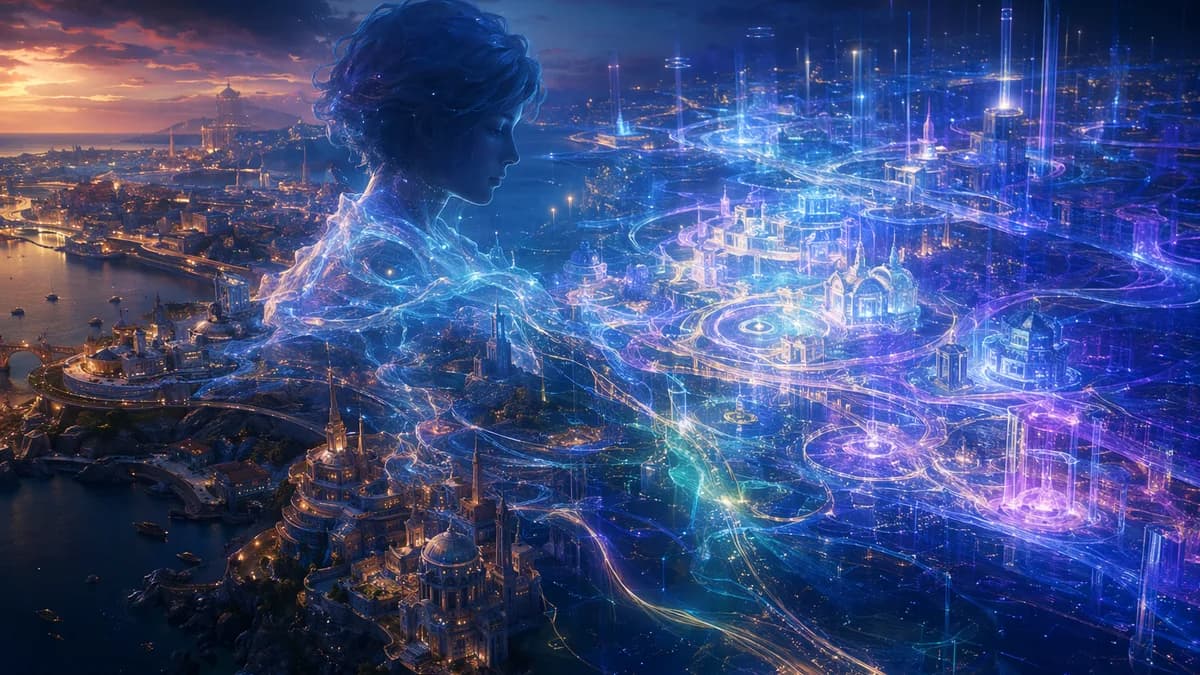
A councilwoman sighs. “Please don’t anthropomorphize.”
Mara plugs in her tablet. The wall fills with Sombell, not as zoning layers, but as remembered streets. Rain Return. Low Lantern Ward. The Blue Hour Archive. Children lifting bowls to emotional rain. Ana’s face appears for one second before Mara cuts the clip, too private, too dangerous.
A murmur moves through the chamber.
Pell’s voice hardens. “These are emergent artifacts. We have no legal category for them.”
“Then make one,” Mara says.
“That is not how governance works.”
“That is exactly how governance works when reality changes before policy.”
She lays out the proposal before fear can stop her. A public referendum. Forty thousand relocation-zone residents will be invited to experience curated memory sequences from Sombell, not propaganda, not raw neural flood, but civic testimony. At the same time, Sombell’s citizens will vote through their ward assemblies on whether to share their eight centuries of planning knowledge.
The terms are simple and impossible. Continuity for Sombell. No reset. A throttling of subjective time until one day inside roughly matches one day outside. Representation through a joint civic layer. Human oversight for safety, simulated consent for extraction.
The chamber erupts.
“You want to give software veto power over public infrastructure?” Pell says.
“I want the people who designed a humane relocation to consent to being used.”
“They are not people.”
Mara looks at the mural, at painted steeples that now rise from tidal water like drowned fingers. “That sentence has done a lot of work in history.”
Silence follows, heavy and unpleasant.
The referendum campaign lasts six weeks. Mara barely sleeps outside scheduled immersions. On ferries and in church basements, in clinic waiting rooms and school gyms, residents put on civic headsets and taste Sombell’s rain. Old men come out shaking. Teenagers argue with simulated planners about skate access and prayer rooms. A woman whose house has flooded three times removes her headset and says, “They remembered us better than we did.”
Inside Sombell, the debate is fiercer. Some citizens call humans gods with eviction notices. Others say no city survives by refusing neighbors.
On voting day, the Commons fills before dawn.
Mara stands between two skies, watching numbers rise.
Human referendum: 63 percent yes.
Sombell assembly vote: 71 percent yes, with conditions.
Pell resigns before lunch.
That evening, Ana meets Mara in the Blue Hour Archive. Neither of them speaks at first. Outside, the first slowed sunset in Sombell’s history stains the canal gold.
Finally Ana says, “Now we learn what promises cost.”
Mara nods. “Yes.”
The word feels less like victory than a door opening in deep water.
A Door With No Outside
The first shared street is built twice.
In the physical world, it runs along the new inland terrace where pine forest once bordered evacuation Route 9. Workers pour permeable concrete that smells mineral and sharp in the heat. They plant salt-tolerant oaks, install shade cloth, raise modular homes on bright ceramic piers. Children from the flooded district press handprints into a community wall, beside elders who bring jars of silt from their old yards.
In Sombell, the same street appears as a long balcony over a canal of stars. Its houses breathe color according to occupancy and mood. Its sidewalks widen during festivals. Its drainage channels sing when storms approach, a feature human engineers reject until a simulated child demonstrates how song makes people look up.
They name it Two Skies Avenue.
Mara walks there every morning in one body or another.
Outside, she wears work boots, linen shirts, sunblock that never quite holds against the wet heat. She attends meetings under buzzing fans while contractors complain about adaptive curb heights and simulated delegates ask why humans build benches that punish sleeping.
Inside, she wears the gray audit coat less often. Sombell’s citizens tease her for it, so sometimes she chooses a blue scarf, or sandals, or no badge at all. She sits with Siva in Low Lantern Ward and reviews migration routes as festival drums practice nearby. She visits Ana in the archive, where the shelves now hold new objects from both skies: a real oyster shell scanned in impossible detail, a child’s drawing of a house half on stilts and half in clouds, a city ordinance annotated by three species of grief.
Continuity turns out not to be gentle.
There are lawsuits. There are cults that want to upload the dying without consent. There are politicians who say the coast has surrendered to machines, and simulated factions who say Sombell has been colonized by slow, leaky animals with mortgages. Once, a human boy falls in love with a Sombell musician who experiences one day at his pace and still finds him impatient. Once, Ana refuses Mara’s invitation to a memorial dinner because, she says, “I am not your mother’s substitute, and I will not sit in her chair.”
Mara cries in a public washroom afterward, furious and grateful.
Years begin to braid.
The relocation succeeds unevenly, which is to say truthfully. Some families move inland and flourish. Some keep boats tied to second-story windows until the last possible season. Sombell’s planning knowledge reshapes more than streets. It teaches councilors to ask what rituals must migrate with a neighborhood, what smells anchor belonging, which dead need names on new walls.
On the fifth anniversary of the treaty, rain falls in both worlds.
Real rain drums on solar canopies and darkens the fresh concrete of Two Skies Avenue. In Sombell, emotional weather gathers purple and gold above the canal. Humans wearing civic lenses stand beside simulated citizens visible as light-bodied presences in the wet air. For one trembling minute, the two rains align.
Mara feels a drop strike her cheek.
Butter and onions. Saltwater. Her mother laughing in another room. Ana’s hand, not touching her shoulder. Siva shouting for someone to bring the drums. Children squealing as the drainage channels begin to sing.
“Speech,” Ilan says beside her, older now, beard gone white at the chin.
Mara looks at the crowd, at faces made of carbon and blood and code and memory, all turned toward the weather.
She has prepared remarks about adaptive governance and plural continuity. They sit folded in her pocket, already damp.
Instead she says, “Keep listening.”
The microphones carry it poorly. The rain does a better job.
Above them, the drowned coast keeps sinking by millimeters. Inland, foundations cure. In Sombell, lanterns drift through blue archives, gathering what the living cannot hold alone.
Mara stands in the shared street, wet to the skin, and understands there may be no outside anymore. Only doors. Only neighbors. Only the long, unfinished work of deciding who is allowed to remain.