The Rainwright of Pelagos Nine
In a drowned archipelago city, a former storm engineer must decide whether to save one home by stealing weather from another.
A City Below the Blue Line
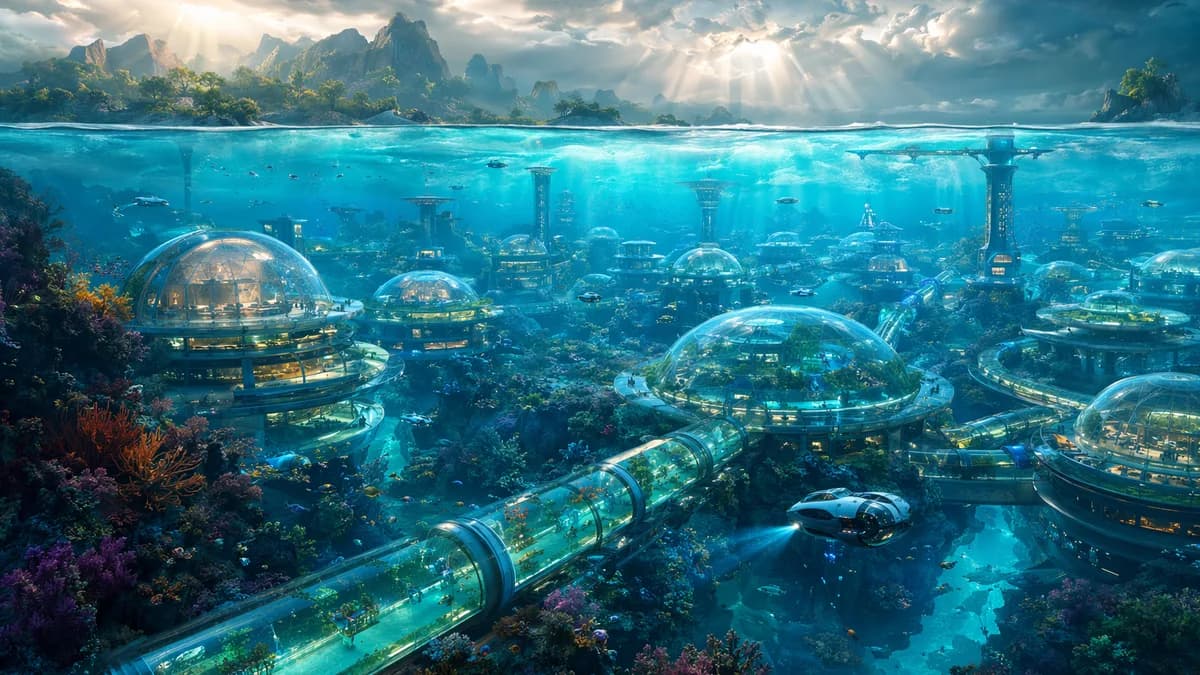
Pelagos Nine hangs thirty meters under the Indian Ocean, beneath the place where maps still print the Maldives in pale green, though most of those islands now exist as reef bones, legal memories, and songs. From a distance the city looks like a lantern caught in coral, its glass avenues glowing amber and blue, its anchoring cables descending into darkness like roots that forgot soil.
Mara Venn walks the East Current Arcade with a toolbox in one hand and a packet of dried mango in the other. Outside the transparent wall, fusiliers turn in a silver sheet, flashing in the city light. A manta ray glides above the avenue roof, its belly white as paper. Children press their palms to the glass and shriek when it passes.
“Was that wild?” one asks Mara.
“Mostly,” she says. “It still files a migration notice when it crosses the nursery fields.”
The children laugh because they think she is joking.
Pelagos smells of salt seals, warm plastic, frying shallots, and wet rope. It hums constantly. Pumps breathe in the walls. Tidal turbines grind softly in their housings. In the algae corridors, green tubes pulse with light, feeding oxygen gardens and protein vats. Families from old island lines live in stacked apartments beside people who came from drowned deltas, burned plains, and camps where dust got into the lungs and never left.
Everyone in Pelagos knows the blue line, the shimmer above them where water becomes air. Children draw it as a ceiling. Elders still call it the surface.
Mara works three days a week at the city museum, maintaining obsolete storm models nobody trusts but everyone likes to watch. The biggest one fills an entire chamber, a curved projection of the world as weather used to move before the treaties, before cloud seeding fleets, orbital shade patches, and cooling gyres. In the display, storms spin free across oceans, huge and bright, unlicensed.
“Did people really just wait?” asks a boy with a shaved head and reef ink on his cheek.
“They watched,” Mara says. “They prayed. They built roofs. Sometimes they ran.”
“But they didn’t negotiate with the rain?”
“Not at first.”
She does not tell them that she once negotiated for a living. She does not tell them about the years she spent inside cloud orchestras, riding sensor feeds through boiling sky, moving pressure like music. She does not tell them that storms have tempers, or that the first lesson of weather work is this, the atmosphere never forgets where it has been touched.
Instead, she taps the model and summons an ancient monsoon. Rain blooms over the Indian Ocean, blue and generous.
The children go quiet. Their faces shine with reflected water.
The Bloom That Should Not Happen
The warning begins as a color no one wants to see.
It spreads through the south reef shield at dawn, visible from the nursery galleries as a pale bruise whitening across the coral crowns. The reef should be rust, rose, violet, gold. It should be crowded with darting fish and cleaning shrimp, with polyps opening like tiny hands. Instead, whole shelves turn ghost-white under the morning light that filters down from above.
By noon, the oxygen alarms start murmuring.
Not screaming, not yet. Just a low repeated chime in the farming levels, soft enough to make people look at one another before looking away. The reef shields are not decoration. They break surge, shelter fisheries, buffer currents, host the bacteria that keep Pelagos breathing. They are city wall, pantry, lung, and graveyard, all grown together.
Mara stands in Nursery Bay Four with her daughter Ilya, both of them barefoot on the wet mesh floor. The water beyond the glass trembles with heat shimmer. It should not shimmer underwater.
“It slipped past Benguela Control and the Arabian dampers,” Ilya says. Her voice is rough from crying, or from not crying. “A heat pulse. Three degrees above tolerance.”
Mara watches a school of juvenile snapper scatter over a coral rack. The rack is Ilya’s work, branching hybrids bred through twelve patient years. Heat-tough, acid-tough, disease-tough, every grant report says so. Now the tips are bleaching.
“How long?” Mara asks.
“Forty-eight hours before mass die-off. Maybe less if the currents stall.”
Mara closes her eyes. Behind her lids she sees old maps of pressure and vapor. She hears thunder through headset static. She smells the metallic tang of aircraft cabins above storm towers.
Ilya turns to her. She is thirty-two, but in this moment she looks eight again, furious at a broken kite.
“You still have credentials,” she says.
“No.”
“You do. Museum access runs through archival weather channels. You told me that.”
“For models. For teaching.”
“For entering the Commons.”
Mara opens her eyes. “Ilya.”
“We need shade. One week of cloud cover, maybe five days. Rain at the surface, cold downdraft, enough to stir the upper layer and break the heat cap.”
“You’re describing a redirection.”
“I’m describing keeping our home alive.”
Outside, a parrotfish noses a white coral head and drifts away, confused.
Mara feels the old refusal rise in her body, hard as a shell. She retired after Cyclone Lata, after a correction became a flood in a valley that had not consented to rain. Weather work is never just weather. Every cloud has a shadow somewhere.
Ilya grips her wrist. Her fingers are cold.
“Ma,” she whispers, “if this reef dies, people will say Pelagos was always temporary. They’ll say we should have known better than to build a city under the sea.”
Above them, through thirty meters of warming water, the surface glitters like hammered glass.
The Weather Ledger
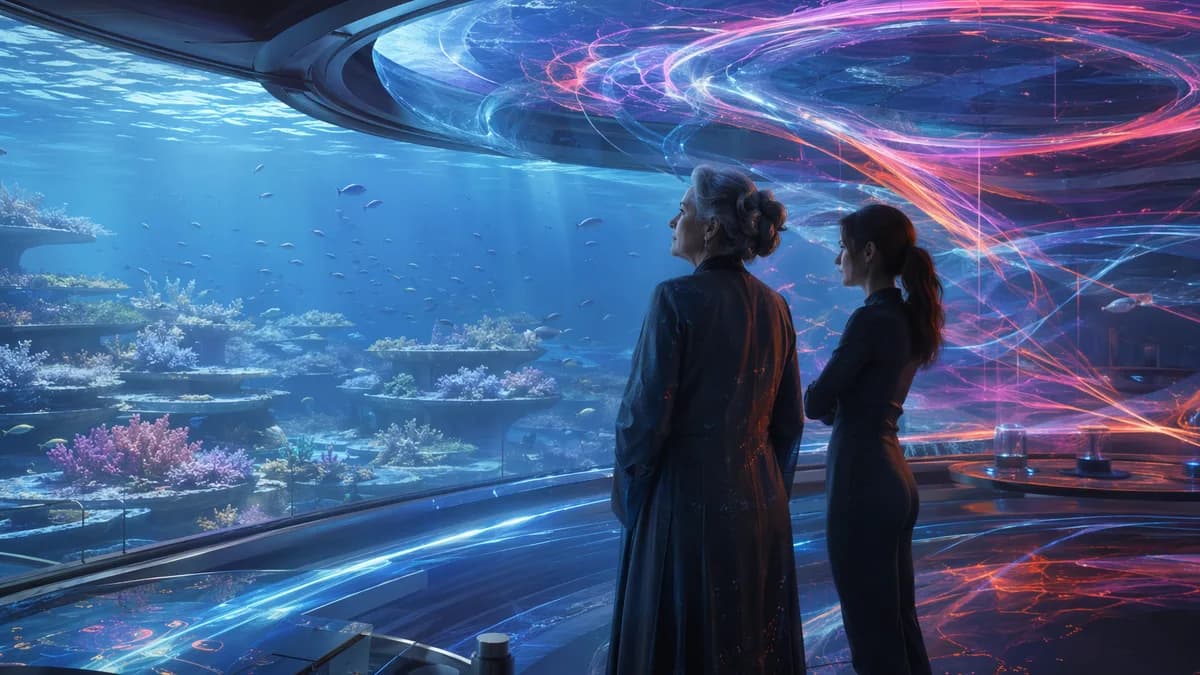
Mara enters the Global Precipitation Commons through a museum terminal shaped like an old captain’s desk. It is absurd, polished teak veneer over quantum-linked treaty hardware, but the children like it. They think serious decisions once came from wooden rooms and brass lamps.
The chamber is closed now. No children. No teachers. Only Mara, the hum of archival servers, and the slow spin of Earth on the wall.
Her retired credentials open like a reluctant eye.
WELCOME, VENN, MARA. STATUS: INACTIVE PILOT, CLOUD ORCHESTRA AUTHORITY, CONDITIONAL ACCESS.
“Conditional is enough,” she mutters.
The Commons unfolds in layers. Ocean heat. Soil moisture. Cryosphere debt. River pulse schedules. Flood trauma zones. Mosquito bloom forecasts. Political alerts. Sacred weather corridors. Every liter of redirected rain has a history, a claimant, a cost.
She searches the Indian Ocean storm train. There are small systems near Sumatra, too warm and ragged. A weak convection band south of Sri Lanka, already allocated to cyclone suppression. A clean chain of monsoon towers rising east of Madagascar, fat with vapor and moving northwest.
Large enough.
Mara leans closer.
The allocation tag loads.
SAHELIAN GRAIN ARC, GUARANTEED PLANTING SEASON, YEAR SEVEN OF DEFERRED DELIVERY.
Her mouth goes dry.
Images attach to the claim. Cooperatives in Niger, Mali, Chad, and Burkina Faso, fields terraced with solar shade cloth, seed vaults opened after years of waiting. Millet, sorghum, cowpea, engineered fonio with roots like nets. People standing in brown fields under a white sky, holding tablets that show a promised rain window in green.
A message blinks, recorded twelve hours ago.
A woman appears, maybe Mara’s age, face lined by sun and wind. Her headscarf is indigo. Behind her, children carry seed sacks from a truck.
“This is Cooperative Kourma-Seventeen,” the woman says in French-accented trade speech. “Soil temperature within range. Seed stock awake. We are ready for first water.”
First water. The phrase lands inside Mara like a stone.
She calls Ilya.
Her daughter’s face flickers above the desk, framed by nursery light. “Did you find one?”
“Yes.”
Ilya sees Mara’s expression. “Who?”
“The Grain Arc.”
Silence.
“How much do they need?” Ilya asks.
“All of it, by treaty accounting.”
“And how much do we need?”
“Enough to matter.”
“That isn’t an answer.”
“It’s the only honest one.”
Ilya looks away. In the feed behind her, technicians move through blue water, carrying emergency shade cloth like black sails.
Mara enlarges the storm simulation. If redirected fully to Pelagos, the surface cools. The reef survives at sixty-seven percent probability. If left untouched, the Grain Arc receives long-awaited rain, enough for a planting season that could feed millions.
The ledger offers no column for daughter. No column for home. No column for the guilt of choosing strangers because they are farther away.
Mara places both hands on the desk. The wood is smooth, fake, and warm.
“Then we don’t steal it whole,” she says.
A Theft Measured in Millimeters
By evening, Pelagos Nine becomes a workshop of illegal weather.
Mara stands in the storm room beneath the museum, surrounded by people who have no time to ask whether they are becoming criminals. Ilya’s reef team floods the main screen with thermal maps. Dock crews wake autonomous sail drones from their barnacled cradles. Kite handlers test spools of high-altitude line, each thread thin as hair and stronger than bone.
“You can’t split a monsoon cleanly,” says Tarek, the city’s chief systems advocate. He is a narrow man with tired eyes and the treaty code projected over his sleeve. “The Commons will flag deviation.”
“It already has,” Mara says.
“That was not comfort.”
“We are not taking the storm train. We are combing it.”
Ilya looks up from a basin of coral larvae glowing faintly under violet lamps. “Explain it like I’m not still angry at you.”
Mara points to the simulation. “Salt kites here, here, and here, above the western flank. They seed brightness, not full condensation. Mist towers on the surface add aerosols in a narrow band. Sail drones ride the pressure edge and drag shade toward us. We cool the water without collapsing the main rain body.”
“And the Grain Arc?”
“They receive less peak rainfall, but over more days. If the storm tolerates the split.”
Tarek exhales. “Storms do not tolerate. They obey physics.”
Mara almost smiles. “That is something people say before physics humiliates them.”
They launch at midnight.
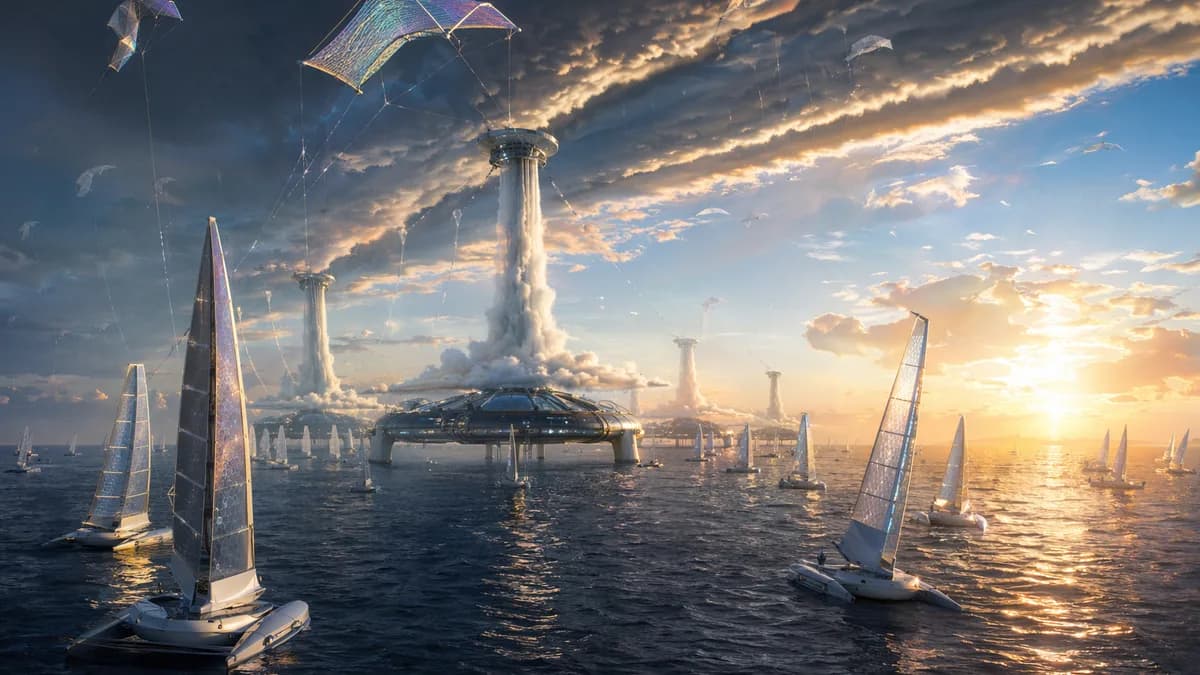
On the surface, Pelagos maintenance platforms rise from the sea like black teeth. Mist towers unfold, skeletal and wet, breathing vapor into the moonlit air. Drones skim away on triangular sails, their hulls hissing through chop. Far above, balloons carry salt kites into the troposphere, where they bloom silver under starlight.
Mara enters the pilot well for the first time in fourteen years.
The chair molds to her spine. Old sensors kiss the skin behind her ears. The room falls away, replaced by pressure gradients, moisture streams, thermal lift. She feels the sky as texture, rough in places, slick in others. The monsoon train is not a machine. It is a crowd at a station, restless, shouldering forward, remembering mountains, deserts, warm seas.
“Pilot link stable,” Ilya says over comms. Her voice trembles. “Ma?”
“I’m here.”
The first kite opens too sharply. A condensation tongue curls south, wrong direction.
“Adjusting,” Mara says.
Her fingers move through air controls no one teaches anymore. She does not command the storm. She suggests. She coaxes the humid flank to loosen, persuades a band of cloud to thicken over Pelagos without pulling the whole body away from Africa.
The atmosphere answers in shivers.
On another screen, Grain Arc representatives enter the emergency channel. The woman in the indigo scarf appears again.
“Pelagos Nine,” she says, cold and clear, “why is our rain moving?”
Mara swallows.
“Because our reef is dying,” she says. “And I am trying not to kill your fields to save it.”
The woman stares at her through a chain of satellites, ocean, and law.
“Then do not try alone,” she says. “Show us the wind.”
The Day the Sky Answered Back
Morning comes dark.
For the first time in weeks, Pelagos looks up and sees shadow. From the observation galleries, residents crowd shoulder to shoulder, faces tilted toward the blue line. Children sit on parents’ shoulders. Elders grip the railings with both hands. Above the city, the surface loses its hard silver glare and turns pewter. Cloud bands gather like slow animals.
When the first rain strikes the ocean, no one hears it directly. Thirty meters of water swallow the sound. But hydrophones carry it down, and the galleries fill with a soft, impossible drumming. People begin to cry before the temperature sensors change.
Mara remains in the pilot well, eyes bloodshot, lips cracked from dehydration. The storm presses against her mind as a hundred thousand moving weights. She feels the pull toward the Grain Arc, the ache of heated sea, the stubborn lift over East Africa, the salt-bright wounds she has made in the cloud flank.
“Surface current down point six degrees,” Ilya says.
“Not enough.”
“Down point eight.”
In Nursery Bay Four, cameras show the reef under emergency shade. The whitening does not reverse. Not yet. But it slows. Polyps that had clamped shut begin to test the water with translucent mouths.
A cheer rises in the gallery, distant through the comms.
Then the Grain Arc feed opens across the main wall.
The sky there is not dramatic. No cinematic wall of water rolls across the land. Rain falls thinly on dust, then steadily, stitching dark spots into the soil. Farmers stand in it without moving. A boy laughs and opens his mouth. The woman in the indigo scarf kneels and pushes her fingers into the wet earth.
“Our peak is reduced,” she says.
Mara grips the chair. “I know.”
“But infiltration is better. Less runoff.” She looks offscreen, listening to someone. “Kourma-Seventeen confirms seed beds holding. Kourma-Twelve also. We continue measuring.”
Tarek, watching from the storm room, whispers, “That’s not in the model.”
“No,” Mara says. “It wouldn’t be.”
The treaty alarms arrive next, sharp red blocks filling the margins. UNLICENSED DISTRIBUTION EVENT. PRECIPITATION DEBT DISPUTED. ECOLOGICAL CLAIMS UNREGISTERED. CULTURAL PRESERVATION VALUE NOT FOUND.
Mara laughs once, not because it is funny, but because the machine sounds offended by reality.
For three days the split storm walks two paths. Pelagos receives shade, surface rain, and chilled turbulence. The Grain Arc receives a thinner rain than promised, but slower, kinder to soil hardened by years of waiting. Not all fields germinate. Not all corals survive. In Pelagos, some reef shelves remain white as bone. In the Sahel, some cooperatives file losses before the clouds even pass.
Yet both places remain possible.
On the fourth day, Ilya comes into the pilot well and places a small jar in Mara’s hand. Inside, coral larvae flicker like captured stars.
“Survivors,” Ilya says.
Mara watches them pulse against the glass. Her hands are shaking too much to hold the jar safely, so Ilya steadies them with her own.
Above them, the rain keeps falling where it was not supposed to, and not falling where it was owed in full.
A New Kind of Citizenship
The tribunal convenes six weeks later in a chamber that is not anywhere in particular.
Mara sits in Pelagos, in a white shirt still smelling faintly of brine. The Grain Arc delegates sit under a canvas roof in Niger, where rainwater tanks gleam behind them like dull moons. Treaty judges appear from Geneva, Jakarta, Lagos, and Quito. A reef ecologist from Tuvalu speaks beside an empty chair reserved for nonhuman claimants, a symbolic gesture that makes half the room uncomfortable and the other half impatient.
They offer Mara a formal commendation first, because institutions often try gratitude before blame.
She refuses it.
“I broke the treaty,” she says. “Do not make that heroic. Make it useful.”
The woman in the indigo scarf, whose name is Aïcha Barka, smiles slightly. “For once, the pilot speaks sense.”
The hearings last twelve days. Data pours in until the walls glow with it. Millimeters of rainfall. Coral mortality. Soil absorption. Fish spawning. Food projections. Psychological displacement risk. Songs recorded in Pelagos that name islands no child there has touched. Planting rituals in the Grain Arc timed to thunder that had not arrived in seven years.
The old treaty knows how to count water delivered. It knows how to price flood damage and drought relief. It does not know what to do with a reef that is also a neighborhood, or a storm that carries obligations in more than one direction.
So they begin writing new columns.
The Blue Line Amendments are drafted in language dry enough to make Mara’s eyes ache, but beneath the legal phrasing something strange and alive pushes upward. Underwater cities gain standing not merely as infrastructure, but as continuing cultures. Dryland farms gain protection from last-minute atmospheric withdrawals. Reefs, mangroves, glaciers, and migratory weather systems become recognized parties in climate decisions, represented by councils of scientists, residents, and appointed guardians.
“Citizenship?” Tarek says when the draft reaches Pelagos. “For storms?”
“Not citizenship like ours,” Mara says.
“What, then?”
She looks out through the avenue glass. The repaired reef is patchy, half ghost, half color. Fish move through new coral frames. Children swim above it in bright fins, their laughter clicking through the water.
“A claim,” she says. “A way to be heard before we put our hands on everything.”
Pelagos survives, but not as proof that humans have mastered the sea. The city leaks, adapts, argues, mourns its dead coral, plants new gardens, and teaches its children to read currents the way old islanders read clouds. In the museum, Mara updates the storm model. She adds the split monsoon, its double path drawn in blue over ocean and land.
A child watches the projection, frowning.
“So who owned the rain?” she asks.
Mara considers the bright, turning Earth, the clouds moving like thoughts across its skin.
“Maybe that was always the wrong question,” she says.
Outside, beyond glass and reef and the shimmer of the blue line, the weather gathers itself again.