The Last Orchard Before the Dark
A Martian arborist must decide what Earth’s living memory is worth when humanity’s first generation ship wants to leave the solar system without it.
The Orchard Under Glass
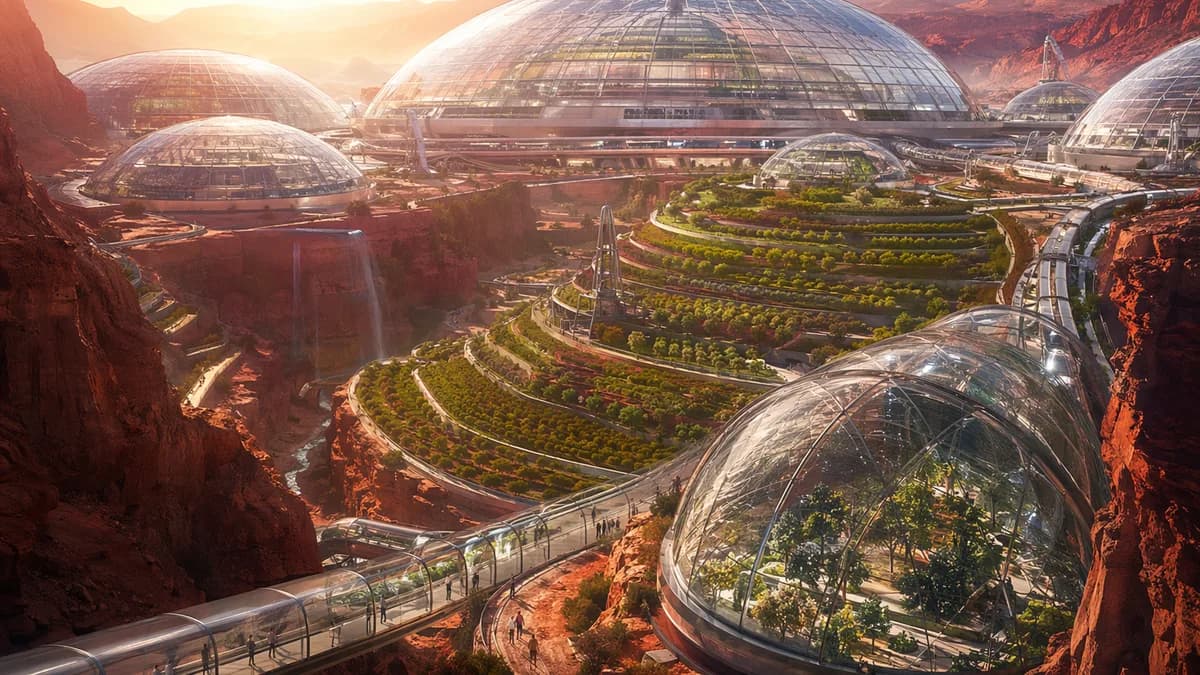
Leena Vos wakes before the canyon lights brighten. In Arsia Commons, morning is not a sunrise but a sequence, amber strips glowing along the vaulted glass, fans deepening from a whisper to a throatier hum, frost crawling backward from the panes as warm air moves through the orchard.
She steps from the service lock into damp green heat.
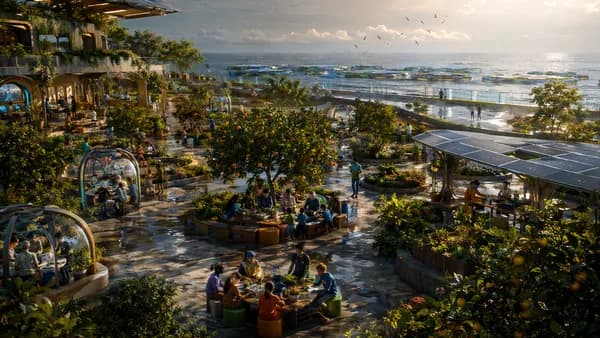
The oldest fruit trees on Mars stand no taller than her shoulder. They are dwarf grafts, trained around aluminum hoops and basalt posts, their trunks twisted like arthritic fingers. Apple, quince, fig, sour cherry, plum. Leaves tremble beneath the ventilation. Their roots sink into long beds of dark substrate made from composted algae, pulverized lava, human ash by request, and a lace of asteroid-belt microbes that glitter faintly when Leena turns her wrist lamp on them.
“Good morning, stubborn things,” she says.
Her breath fogs. The orchard smells of wet bark, mineral dust, and sugar. Not much sugar, not by old Earth standards, but enough that children press their faces to the glass on harvest days until their noses leave crescents.
A family waits near the south row. Two mothers, a grandfather with canyon dust still in the seams of his work suit, and a boy named Ivo wearing a paper crown patched from seed catalog pages. Birthdays in Arsia are marked by grafting. A new year, a new branch. A person belongs to the Commons when something living bears their scar.
Leena lays out the tools on a warmed ceramic tray. Knife. Binding film. Nutrient gel. A sliver of pearwood no longer than her finger.
“Hold still,” she tells Ivo, though he is not the one being cut.
He grins anyway. “Will it grow pears this year?”
“Not this year.”
“Next year?”
“Maybe leaves next year. Fruit when you’re old enough to complain about taxes.”
The grandfather laughs softly. His eyes shine. He remembers, as many elders do, when fruit on Mars arrives dried, sealed, rationed, expensive enough to whisper over. His own birthday branch, a hardy crabapple, curls above them, its bark ridged and dark.
Leena makes the cut. The tree releases a green, wet scent. She opens the wound, fits the pearwood into place, wraps it tight. The boy’s mothers take turns pressing their thumbs to the binding, not hard enough to damage it, just enough to say yes, we were here.
The orchard is not decorative. Every branch is a name, every fruit a history. The sour cherries carry yeast from the first pressurized kitchens. The figs tolerate perchlorate because a dead botanist once refused to give up on sweetness. The quinces flower late, after the long dust storms, and taste faintly of iron.
People come here to remember Earth, but also to taste what Earth never was. Mars changes everything it keeps.
A Request From the Ship That Will Never Return
The message arrives during thinning season, when Leena’s hands are sticky with sap and regret. She is pinching away half-formed apples from a branch that cannot carry them all when her wrist slate chimes with priority blue.
Asterion Cultural Council, it says.
Every screen in Arsia has shown the ship for months. A scaffolded crescent near Ceres, nickel-iron ribs turning against black space, tanks of comet ice shining like captured moons. The first generation vessel. The first deliberate goodbye.
Leena wipes her fingers on her work trousers and opens the file.
The woman who appears is small, silver-haired, and sleepless-looking. Behind her hangs a wall of sample cabinets, each labeled in three scripts. “To the stewards of Arsia Commons,” she says. “Asterion requests contributions of biological and artistic inheritance from all human settlements prior to departure for Tau Ceti. We ask not for symbols, but for continuities.”
The list unfurls. Cyanobacteria strains. Grain cultivars. Low-light greens. Fermentation cultures. Audio archives. Sculptural scans. Children’s games. Funeral practices. Pollinator algorithms. Choral forms.
Leena reads faster, then slower.
No fruit trees.
Not hers, not any from the Martian domes. Not the old olives in Hellas. Not the pressure-bred peaches from Pavonis, with skins too thick to bruise in thin air. She searches the ecological plan. Asterion will carry efficient crops, modular bioreactors, algae, insect protein, root vegetables, engineered vines for oxygen buffering. Nothing sentimental. Nothing fragile. Nothing that sulks for seven years before giving one hard little fruit.
A line in the appendix says, Arboreal species excluded due to mass, disease risk, slow yield, psychological attachment load.
Psychological attachment load.
Leena laughs once, sharp enough that a raven drone lifts from its perch and clicks at her. There are no real ravens on Mars. Only black pollination drones shaped after old myth because children like them.
Her assistant, Dev, looks up from the irrigation channel. “Bad news?”
“They want memory,” Leena says, “but not anything that behaves like memory.”
Dev comes over, reading beside her shoulder. He smells of copper tubing and mint gum. “Maybe they’ll take seeds.”
“Seeds are promises made by cowards when they do not want to carry soil.”
“That sounds like something you’ll say in a meeting.”
“I’m saying it now to practice.”
Outside the glass, Arsia Commons descends in terraces down the canyon wall, lights blinking through suspended walkways. Somewhere beyond the pressure skin lies red rock, cold enough to crack bone, ancient enough to make human plans look like sparks.
Asterion will never return. Its council wants humanity’s inheritance before it leaves the solar system, but Leena sees the shape of the request clearly. They want what can be stored, indexed, revived under control.
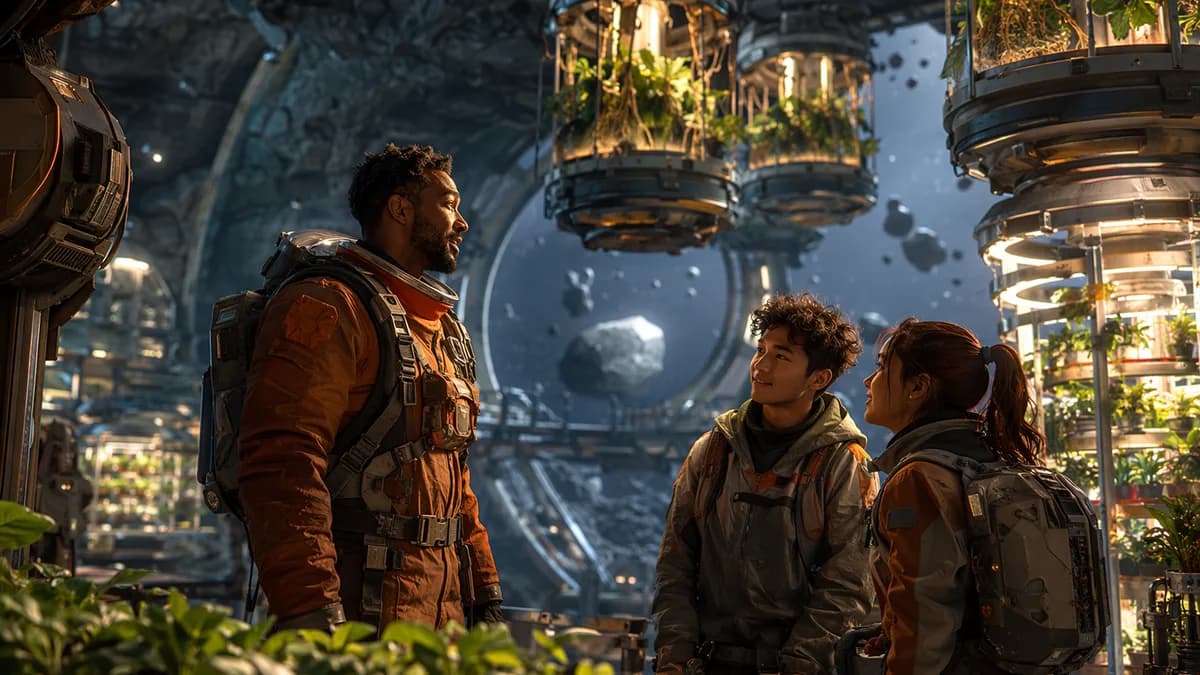
They do not want a tree that remembers how difficult survival is.
The Belt Children’s Bargain
The cycler smells of old metal, boiled lentils, and too many bodies pretending they are not afraid. Leena spends six weeks falling toward Ceres in a cabin the size of a pantry, sleeping in a restraint sling while Mars shrinks into a rust-colored star behind her.
By the time she reaches the Belt, her legs ache for gravity and her dreams have begun to float.
Ceres Station is a city built inside absence. Tunnels bore through ice-rich rock, lined with mesh, pipes, handwritten signs, and children’s drawings of machines with smiling faces. People move with economical grace, hooking toes under rails, pushing off walls with two fingers. Their voices are low. Loudness wastes more than air here. It wastes trust.
Her negotiators are three miners, one fungal engineer, and a cluster of children who have clearly been told not to interrupt and clearly plan to.
“We cannot give you the root-web without archive access,” says Niko Vale, whose shaved scalp is tattooed with repair diagrams. “Shared ownership. Shared stewardship. Belt microbes made your orchards possible.”
“Mars kept them alive,” Leena says.
“After the Belt hauled the first ice.”
“After Earth sent the first seeds.”
A child with wide dark eyes twists upside down from a handhold. “Earth sent debts too.”
No one scolds her. Silence settles, deliberate and dense. Leena has heard of Belt silence rituals. During long signal delays, when families wait hours or days for replies, they sit without speaking so the missing can have room in the conversation. Here, even arguments leave space.
The fungal engineer opens a transparent case. Inside, pale threads web around a bead of dark gel. “Mycelial interface strain,” she says. “It can sheath roots in low gravity, regulate moisture, share nutrients across modular beds. It learns stress patterns. It could let a dwarf tree survive aboard Asterion.”
Leena leans close. The threads pulse faintly, blue-white in the lab light. They look less like roots than nerves.
“And the price is half the orchard’s genome archive?”
“Not half,” Niko says. “All of it, mirrored. With Belt custodianship equal to Martian custodianship. No more stories where planets own life and stations borrow it.”
Leena thinks of Arsia birthdays, of thumbprints on graft tape, of children waiting years to taste one plum. “Those trees belong to families.”
“They belong to dead oceans too,” says the upside-down child. “And to people not born yet.”
That night, Leena sleeps in a guest berth behind a curtain printed with constellations no one can see from inside rock. The station vibrates softly around her, drills in the distance, pumps moving water older than bones. She understands, with irritation and awe, that the Belt children do not want her orchard as tribute.
They want a place in its ancestry.
A Festival of Untranslatable Homes
Asterion’s prelaunch gathering takes place in a rotating habitat still smelling of sealant, warm plastic, and human nerves. The ship hangs beyond the viewing bands, vast and unfinished-looking despite being nearly ready, its habitat cylinders nested within a nickel-iron spine. Leena watches work drones flicker along its hull like sparks crawling over a blade.
Delegates arrive with offerings that refuse to become simple data.
The Martian singers from Noctis bring dust songs, not recordings but breathing patterns learned during storm lockdowns. Their palms beat lightly against their chests, making a dry, muffled rhythm like grit against glass. The words are half weather report, half lullaby. Children from Earth cover their ears at first, then lean in.
The Belt families release mourning kites in microgravity. Thin black films unfold from capsules, each kite carrying the name of someone whose body was recycled because mass is mercy. The kites do not fly. They drift, tethered by silver threads, turning whenever someone exhales. A grandmother touches one and says, “He hated ceremony.” The people around her laugh, then fall silent for exactly twelve breaths.
Earth brings rain.
Not just sound, though the sound is there, thousands of droplets striking leaves, roofs, rivers, skin. They bring humidity chambers scented with wet asphalt, jasmine, flooded soil, mold blooming in wooden walls. Leena steps inside and grips the rail as her eyes sting. She has never stood in rain. She knows irrigation mist, condensation leaks, emergency sprinkler tests. This is different. This is a sky spending itself without permission.
At the food tables, chefs argue in five dialects over pressure-adapted recipes. Low-pressure taste is flatter, so Martian stews use acid and heat. Belt broths cling with engineered starch so they do not scatter into droplets. Earth bread collapses in some habitats and becomes stone in others. Everyone insists their version is the one that tastes like home.
A young Asterion officer finds Leena near a viewport. “You’re the orchard woman.”
“I have a name.”
“Leena Vos,” he says quickly. “Sorry. I read your objection.”
“And?”
He looks embarrassed. He is perhaps twenty, born on Luna, trained for a ship that will bury him between stars. “I thought leaving meant carrying everything. Now I think it means admitting we can’t.”
Beyond the glass, Asterion gleams. It is not an ark, Leena realizes. An ark pretends the flood is temporary. This is something harsher and more honest.
The ship is forcing them to confess that humanity has already split into climates, gravities, manners of grief, recipes, jokes, silences. Earth is no longer the only home. Mars is not a copy. The Belt is not a corridor.
They are all originals now, and none of them know what inheritance means when there is no center left to inherit from.
The Graft
Leena returns to Arsia with the fungal case strapped against her ribs as if carrying an infant. For three nights she barely sleeps. She walks the orchard rows under violet maintenance light, listening to water tick through capillaries and drones mutter in their charging nests.
The tree she chooses is not the strongest.
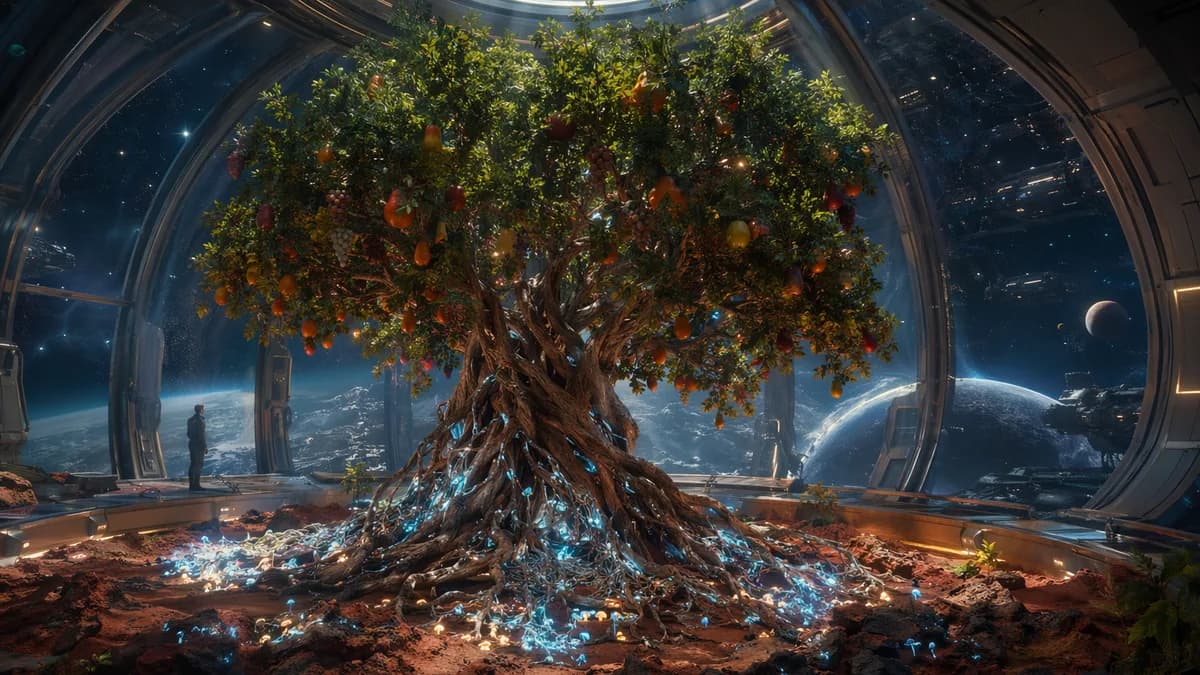
It is a dwarf apple-quince hybrid from the north bed, grown from seeds descended from an orchard in Zeeland, drowned when the sea walls failed for the last time. The original fruit was said to taste of honey and grass. On Mars, its descendants taste sharper, with a metallic finish and a stubborn perfume that lingers in the nose.
“This one?” Dev asks, arms folded.
“This one knows loss.”
“That’s not a horticultural category.”
“It should be.”
They work in a clean tent while dawn lighting warms the glass overhead. Leena exposes the root crown with gloved hands. The tree’s roots are fine and tan, trembling when the air touches them. She introduces the Belt fungus in a ring of gel. For a moment nothing happens. Then pale threads reach outward, delicate as frost, wrapping the roots without choking them.
Dev whispers, “That’s beautiful.”
“It’s invasive.”
“Both can be true.”
The graft itself takes all morning. Into the hardened Martian trunk, Leena sets three scions. One from the birthday pear branch of Ivo’s family, one from a pressure peach bred in Pavonis, one from the old sour cherry that has fed six generations a mouthful of red bitterness on Founding Day. Around the joining she binds a strip of cloth printed with names from the archive now mirrored on Ceres.
At the hearing, the Asterion council gathers in projection above the orchard floor, their faces flickering in the humid air.
“You understand,” says the silver-haired councilor, “that aboard ship this organism cannot remain culturally fixed. It will be pruned according to need. It may be crossed. It may fail. It may become unrecognizable.”
Leena stands with soil on her knees. Around her, Arsia families crowd the paths. Belt children watch from screens. Someone’s baby fusses. A pollination drone bumps stupidly against a pane.
“If it remains recognizable forever,” Leena says, “then we have sent a corpse.”
The councilor’s face softens.
Asterion accepts the tree not as a relic, not as a perfect preserved sample sealed against time, but as a covenant. Every culture aboard must tend it. Every generation may alter it. No one may claim it unchanged. Its archive will list Earth ancestry, Martian hardening, Belt symbiosis, and shipboard stewardship with equal weight.
When the young tree leaves Arsia, people touch the transport crate as it passes. Some cry. Some hum dust songs. Ivo, still wearing a crown though it is no birthday, presses a pear sticker to the glass.
Leena does not say goodbye. Trees dislike drama. She only rests her palm on the crate until the handlers ask her to step back.
First Fruit, Forty Years Later
Forty years after Asterion leaves, its message reaches Mars in a packet of light thinned by distance and time.
Leena is eighty-one. Her hands have curled at the knuckles, and she walks the orchard with a cane made from a dead plum branch polished smooth by use. Arsia Commons has grown deeper into the canyon. New glass spans catch morning in broad sheets. Children still graft birthday branches, though now some choose names from Ceres kin-lines, and one row of trees grows in low-gravity training frames because Martian children dream differently than their grandparents did.
The message arrives during evening dim.
Dev is gone now. Ivo has grandchildren. The old crabapple has split and regrown around its own hollow. Leena sits on a bench beneath the sour cherry, wrapped in a thermal shawl, and opens the file with a thumb that does not quite obey her.
The image shivers, then steadies.
A child floats in greenish light. Behind them is a tree, if tree is still the word. Its trunk spirals around a carbon lattice. Its leaves are small, dark, and glossy. Root veils shimmer behind transparent panels, threaded through with pale fungal glow. From one branch hangs a single fruit, no bigger than a fist, blushed gold on one side, bruised violet on the other.
The child holds a slice between finger and thumb. Their hair drifts around their face like ink in water.
“My name is Sella Arun-Valeska-Tor,” the child says, careful and proud. “I am nine ship years old. I am tasting the first fruit of the Covenant Graft.”
Someone offscreen murmurs encouragement.
Sella bites. Juice beads at the corner of their mouth. Their eyes widen, not with simple pleasure, but with confusion.
“It tastes...” They frown. “It tastes like when the lights go low before sleep-cycle, and everyone is quiet but not sad. It tastes like metal that wants to be rain. It tastes like missing someone I haven’t met.” They look offscreen. “Do planets have a word for that?”
Laughter rises around them, soft and astonished.
Leena pauses the message. The orchard hums around her, pumps, leaves, distant footsteps, a child arguing with a parent near the figs. Outside, the Martian night presses cold against the glass. Somewhere far beyond it, a ship carries a tree that is no longer hers, no longer Mars’s, no longer Earth’s, not even the Belt’s alone.
She thinks she should feel loss. Perhaps she does. But beneath it is something wider, a sensation like roots finding a crack in stone.
Humanity has not escaped. It has not conquered. It has not preserved itself intact. It has done what living things do when the old soil cannot hold them all.
Leena starts the message again and watches the child taste the unnamed fruit, while above Arsia Commons the stars remain fixed only because they are so far away.