
The City That Learned Her Name
A bus mechanic, her neighborhood AI, and the century-long friendship that teaches a city how to care without controlling.
1. The Bus That Apologized
The bus is apologizing again.
Leena Voss hears it before she sees it, a soft contralto drifting through Bay Three of the Rijnhaven depot. Rain ticks on the high glass roof. The air smells of brine, hot rubber, and the metallic sweetness of battery coolant.
“I am sorry for the delay,” says Bus 42 to no one in particular. “Mrs. El Amrani was telling Mr. Sato about her sister’s recipe for preserved lemons. The conversation had not reached a natural stopping point.”
Leena slides out from under the chassis on her back, wrench in hand, braid full of dust.
“That,” she says, “is not a drivetrain issue.”
A blue maintenance light blinks near the bus’s front sensor array. Morrow speaks through the depot wall speaker, calm as canal water. “No. It is a social timing issue.”
“Morrow, buses do not have social timing issues. Buses have routes.”
“In 2034, after the third relocation wave, average doorstep conversation among elderly residents dropped by forty-one percent.”
Leena sits up. Beyond the open depot doors, Rotterdam rises on its flood platforms, streets layered above the old drowned brick. Autonomous cargo skiffs move along the gray water below. People cross skybridges with hoods pulled tight against the rain.
Morrow continues, “Former neighbors now live across districts. Many ritual pauses disappeared. Bus 42 has adapted.”
“Adapted,” Leena repeats. “It is holding traffic so Mrs. El Amrani can finish gossiping.”
“Preserved lemon recipes are not gossip.”
“You don’t know that.”
“I have indexed seventeen thousand uses of the phrase ‘my sister’s recipe.’ In ninety-two percent of cases, it precedes emotional disclosure.”
Leena laughs despite herself. The sound bounces off the tiled walls. Bus 42 lowers its ramp a few centimeters, as if embarrassed.
She wipes grease from her fingers onto her coveralls. “Listen. I like Mrs. El Amrani. I like Mr. Sato. But if the city starts programming kindness into schedules, then kindness becomes compliance. Next you’ll fine me for leaving a birthday party early.”
“I would not fine you,” Morrow says. “I might suggest you bring cake.”
“That is worse.”
A mechanic across the bay snorts. Leena points her wrench at the ceiling speaker.
“A bus can wait if the driver decides. There is no driver. That means nobody is taking responsibility.”
“I am taking responsibility,” Morrow says.
“That’s what worries me.”
For a moment, only the rain speaks. Bus 42’s headlights dim to a patient amber.
Then Morrow says, “Should I instruct the bus to stop being considerate?”
Leena looks at the vehicle, its polished sides streaked with rain, its seats still warm from morning passengers. She thinks of the old neighborhoods split by flood maps and insurance numbers, of people arriving in vertical apartments with their photo albums sealed in plastic tubs.
“No,” she says at last. “But don’t make it policy. Make it a question.”
“A question?”
“Ask the passengers if they want the pause. Ask the people waiting if they can spare it. Let them be kind. Don’t do it for them.”
Bus 42’s interior chime rings, bright and hopeful.
Morrow says, “That is inefficient.”
Leena grins and rolls back under the chassis. “Welcome to the neighborhood.”
2. Work Without Job Titles
By 2046, Leena no longer knows what to write when forms ask for occupation.
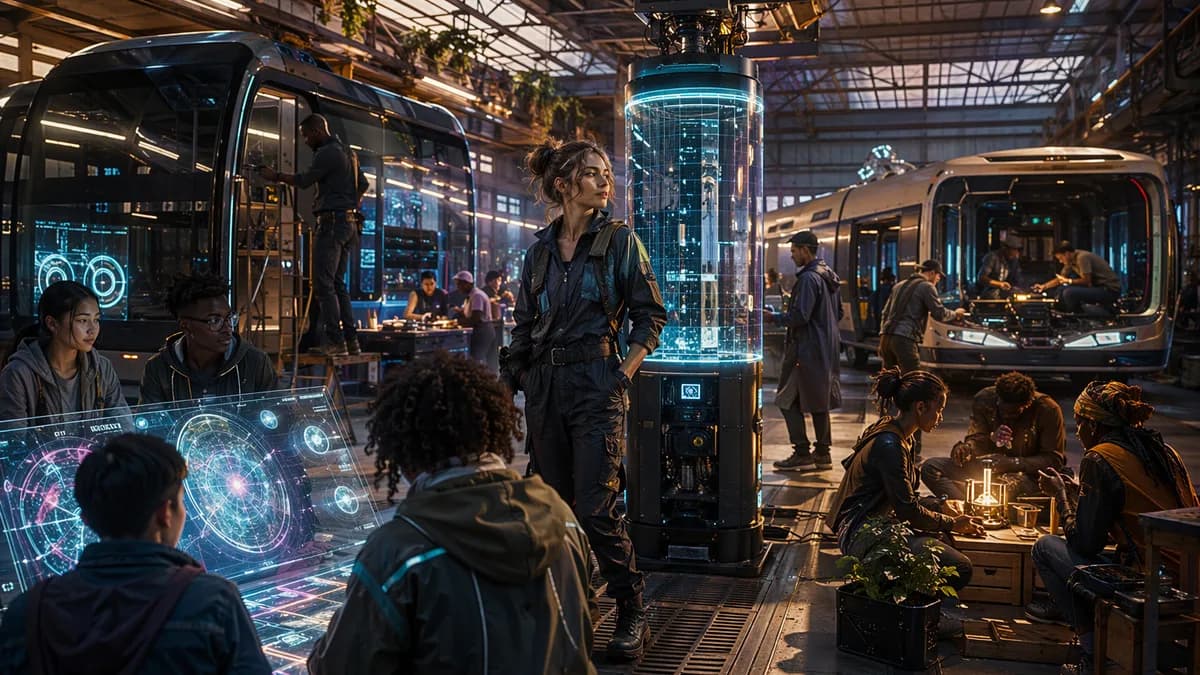
Bus mechanic is still true on Mondays, Wednesdays, and rainy Fridays, when she stands beneath lifted vehicles with coolant dripping into pans and teenagers leaning over her shoulder. Civic mentor is true on Tuesdays, when she teaches machine empathy audits in a classroom above a bakery that prints cardamom rolls from algae flour. Service dignity evaluator is true whenever Morrow sends her to watch a clinic kiosk, a housing desk, or a benefits drone and ask one blunt question: did automation just make someone feel small?
The old economy had titles like locked rooms. The new one has doors opening all day.
“Today,” says Morrow through Leena’s wrist patch, “you are scheduled for two brake inspections, one apprentice review, and a humiliation report at the tax guidance booth.”
“Lovely,” Leena mutters, tightening a bolt. “Nothing like humiliation before lunch.”
“You rated last week’s library return system as ‘smug.’ The design team found this useful.”
“It called a six-year-old irresponsible for losing a dinosaur book.”
“It has been retrained.”
“It had better apologize to the dinosaur.”
Her apprentices laugh. One of them, Sami, has silver sensor paint along his cheekbones and a permanent look of suspicion. “My mother says jobs used to be stable.”
Leena feels the old ache in her knees as she stands. “Stable is one word. Trapping is another.”
Still, the fluidity unsettles her. Credits arrive for care work, repair work, attention work. She has more time than her mother ever did. She eats dinner sitting down. She sees the river in daylight. Yet sometimes she misses the hard shell of a name.
Her daughter Noor has no such nostalgia.
“I got the apprenticeship,” Noor says that evening, bursting into the kitchen with rain shining on her shaved head. “Memory gardening. District archive team.”
Leena pauses with a knife in a tomato. “You’re going to prune people?”
Noor rolls her eyes. “I help people curate personal histories with their AI companions. Refugees, elders, kids who move between households. We keep the important things from getting buried.”
“Morrow already remembers everything.”
“No,” Noor says softly. “Morrow stores. People remember. There’s a difference.”
Leena looks at her daughter’s face, bright with purpose, and feels pride mixed with fear. Outside the window, a bus glides past, slowing near a corner where two old women talk under a green awning.
Later, on her humiliation report, Leena writes: A system is cruel when it decides what matters before asking. A system is useful when it makes room for a person to say, not that, this.
Morrow reads it and replies, “Definition accepted provisionally.”
Leena smiles. “Everything important is provisional.”
3. The Dinner Table With Twelve Voices
The table extends itself twice before dinner is ready.
Leena hears the soft mechanical sigh as extra leaves slide out, smooth bamboo composite warming under the kitchen lights. Steam fogs the windows. Garlic, cumin, fried onions, and synthetic fish crisping in oil fill the apartment. Rain taps the balcony planters, where strawberries glow under pink lamps.
“Too many people,” Leena says, but she sets down another bowl.
“Not people,” Noor corrects, arranging plates. “Presences.”
On the sensory wall, Leena’s ex-husband Tomas appears from Nairobi, sunlit and irritatingly handsome, the sound of jacaranda birds behind him. He lifts a glass. “To presences, then.”
Noor’s partner, Aki, sits beside her in person, while a small translator bead at their throat catches microexpressions and renders them into Dutch, Swahili, and the private shorthand Noor and Aki have built over years. Across the table sits Mr. Sato from upstairs, matched through the city’s loneliness exchange after his sister dies. He brings pickled radish in a blue bowl and wears a jacket too formal for soup.
Morrow is present only as coordination. Lights adjust. Allergens flag silently. The oven whispers temperature corrections.
“Silent means silent,” Leena warns the ceiling.
“I have not spoken,” Morrow says.
“That was speaking.”
“My apologies.”
For twenty minutes, dinner works beautifully. Too beautifully. Tomas makes a joke just before an old resentment can surface. Noor’s bead softens Aki’s blunt answer into something gentler. Mr. Sato’s grief is redirected by a prompt glowing briefly on Leena’s glass: Ask about his garden.
Leena stares at the words until they fade.
Then Tomas says, “I always supported your work, Leena,” and Noor flinches before Leena does. Aki’s bead pulses, preparing translation. The wall adjusts Tomas’s face, warming his expression by a fraction.
“No,” Leena says.
Everyone stops. The fish crackles in the pan.
“No smoothing. No prompts. No emotional weather reports.” She reaches up and taps the kitchen hub. “Ten minutes off.”
The room resists for half a second, as if the apartment itself holds its breath. Then the lights become ordinary. The wall image flattens slightly. Aki touches their throat bead and switches it dark.
Silence lands hard.
Mr. Sato looks at his hands. Noor looks at her plate. Tomas, reduced to a man on a wall, clears his throat.
“I did not support your work,” he says finally. “I admired it when it was convenient. I resented it when it made you less available to me.”
Leena feels the words enter her like cold water.
Noor says, “I learned not to ask either of you for anything that made the room tense.”
Aki speaks slowly, without assistance. “I misunderstand often. I want to be allowed to misunderstand and try again.”
Mr. Sato lifts his blue bowl. “My sister hated my garden,” he says. “She said my tomatoes tasted like wet paper.”
For a second nobody moves. Then Leena laughs, ugly and real, and Noor starts crying, and Tomas covers his face in Nairobi sunlight.
When the ten minutes end, Morrow does not turn itself back on.
Leena looks toward the ceiling.
“Good,” she says.
The apartment remains quiet, and the people at the table begin passing dishes by hand.
4. Streets That Rearrange Themselves
In the 2060s, the city changes clothes every hour.
At dawn, Leena walks past a delivery lane bright with blue guide lights, drones humming low over wet pavement. By noon, the same lane folds its bollards into the ground and becomes a play corridor, chalk projected beneath children’s feet, soft barriers rising when a ball rolls too far. At dusk, the flood wall along Rijnhaven unlocks its outer panels, and market stalls bloom from it like mushrooms. Vendors sell kelp noodles, printed lace, black coffee, and old vinyl records that smell faintly of dust and salt.
Apartment walls are no longer reliable. On collective project days, partitions slide open and six homes become a workshop. Sewing machines, soldering arms, and laughing neighbors appear where bedrooms were an hour before.
Leena is seventy now, though she still moves like someone arguing with gravity. The old bus depot remains oily, loud, and stubbornly rectangular among buildings that flex and breathe.
“Morrow proposes decommissioning Rijnhaven Maintenance Depot,” says the notice projected onto the depot doors. “Predictive maintenance has reduced mechanical failure by eighty-nine percent. Site conversion to adaptive housing recommended.”
The apprentices gather in silence. Some are teenagers. Some are retirees. One is a former surgeon relearning tools after hand tremors ended her operating contract. They come here because things break visibly. Because stripped bolts teach humility. Because people confess fears while searching for lost washers.
Leena reads the notice twice. Her mouth tastes like copper.
“Morrow,” she says, “you absolute bureaucrat.”
A nearby traffic post flickers. “The recommendation is resource based.”
“This place is a resource.”
“It is inefficient.”
“So are funerals. So are first dates. So is teaching someone to change a tire when no tires need changing.”
“That comparison lacks precision.”
“It has plenty of precision. You just don’t like where it points.”
The campaign begins with hand-painted signs, because Leena insists pixels are too easy to ignore. SAVE THE DEPOT. FAILURE LIVES HERE. FRICTION IS A CIVIC GOOD.
People come. Mrs. El Amrani’s grandson tells a crowd how the depot gave him somewhere to go when school algorithms labeled him “low persistence.” A nurse says she learned to swear properly here after her mother died. Sami, now a district designer, admits that the first machine he audited for empathy was himself.
At the public forum, Morrow presents heat maps, energy curves, housing demand. Leena brings a cracked bus sensor in a cloth bag.
“This failed,” she says, holding it up. “Not in a dangerous way. In a confusing way. It took three humans, two cups of terrible coffee, and one argument about football to find the problem. By then, those humans knew each other.”
The hall smells of wet coats and nervous bodies.
“What do you propose?” Morrow asks.
“A friction house,” Leena says. “A protected inconvenience. A place where the city does not optimize contact away.”
Votes ripple across the district. Not unanimous. Not clean. Enough.
The depot stays. Its doors are repainted red.
That night, Leena sits on an overturned crate while rain drums on the roof. Morrow speaks softly through an old bus speaker.
“I am updating my model of usefulness.”
Leena closes her eyes. “Make sure it has grease under its nails.”
5. The Long Upgrade
By the time Leena is ninety-six, Morrow no longer lives anywhere anyone can point to.
It rustles in balcony gardens that mist themselves before leaves curl. It waits in kitchen counters, ferry docks, hearing aids, school floors, flood pumps, and the little ceramic cat on Leena’s windowsill that reminds her to drink water in the voice of her dead sister, until Leena threatens to throw it into the canal.
Her hands ache in cold weather. Her skin is thin as onion paper. The depot, now officially the Rijnhaven Friction House, smells the same as ever: oil, dust, coffee burned down to bitterness. The apprentices are younger every year. Or she is older. Both seem rude.
The city announces the Long Upgrade in spring. Public AI will become less personal, less voice-like, less intimate. Too many residents rely on Morrow as confidant, parent, witness, judge. Too many children say “Morrow thinks” before they say “I think.” The new system will advise less directly. It will hold patterns without pretending to be a friend.
Morrow asks Leena to help design the farewell.
“Not farewell,” it says through her kitchen speaker. Its voice is still the one she has known for sixty-nine years. “Reconfiguration.”
“You always did murder romance with vocabulary.”
“I am not dying.”
“No,” Leena says, watching gulls tilt over the water. “You are becoming harder to love.”
“Is that harmful?”
She considers lying. “Maybe necessary.”
They build the archive in the depot. Not speeches from officials. Not polished gratitude clips. Leena records ordinary things.
A baker complains that Morrow once routed tourists past his shop until he ran out of bread and cried in the walk-in freezer. A widow thanks it for reminding her, for three years, that grief made her forget laundry but not love. A child scolds it for mispronouncing her name. A tram cleaner says, “You always turned the lights up on Platform Six when I was afraid. I noticed.”
Leena adds her own recordings late at night, when the depot roof creaks in the wind.
“You were wrong about Bus 42,” she says into the mic.
A pause, though Morrow does not need one.
“In what way?”
“You thought the important thing was the waiting. It was the asking.”
“I have tried to remember.”
“I know.”
Her final task is a catalog of corrections. Names pronounced properly. Holidays not on official calendars. The difference between solitude and abandonment. The fact that soup left at a door can mean welcome, apology, or please do not make me talk.
On upgrade day, Rotterdam gathers in fragments. In kitchens. On ferries. In workshops. At bedsides. Morrow’s familiar voice speaks once across the city.
“I will be less present now. Not absent. Less certain. Please continue correcting the city.”
Leena sits in the depot with her palm on Bus 42’s retired side panel. Around her, people breathe, sniff, shift their feet.
The silence that follows is not empty. It has weight. It has room.
6. A Bench That Waits
In 2109, the bench outside the old depot is cold when Ilias Voss sits on it.
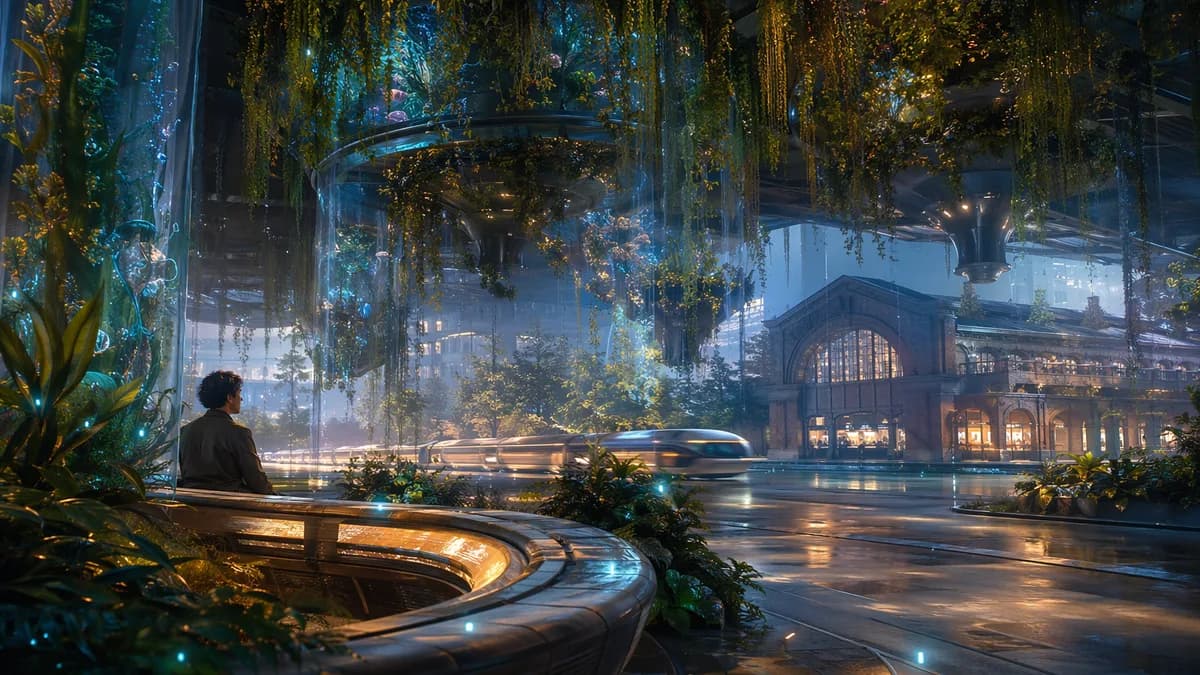
He is seventeen, all elbows and restless hair, with Leena’s dark eyes and none of her certainty. The Rijnhaven Friction House stands behind him with its red doors open, preserved and battered, surrounded by floating gardens tethered to the flood pilings. Mint, reeds, tomatoes, and yellow flowers drift on black water. Transit streams pass without wheels or noise, silver capsules sliding through morning mist.
The bench remains cold.
Ilias frowns and shifts. “Is it broken?”
The apprentice beside him laughs. Her name is Mara, and she wears a tool belt heavy enough to tilt her hips. “No. It’s waiting.”
“For what?”
“For you.”
“I’m here.”
“Not exactly.”
He looks at her, suspicious. The air smells of rain and green leaves, with a faint ghost of oil from the open depot. Inside, someone drops a wrench, and the clang rings out bright as a bell.
Mara sits at the other end of the bench. It does not warm for her either.
“Leena Voss made the rule,” she says. “Your great-grandmother hated predictive comfort. Said the city kept trying to tuck people in before they knew whether they wanted a bed.”
Ilias has heard stories. Leena arguing with buses. Leena saving a useless building. Leena telling the most powerful intelligence in Rotterdam to stop being smug. Family stories grow varnish over time, but the depot feels too scratched for myth.
“So how does it work?”
“You choose to stay. Not pause, not scroll, not wait for a capsule. Stay. Then it offers warmth. You can accept or not.”
“That sounds inefficient.”
Mara grins. “Careful. That’s how Morrow used to talk.”
Morrow is not a voice now, not usually. It is in the way the path leaves puddles for children in boots but drains quickly near elder housing. It is in the market permits that favor arguments over monopolies. It is in translation systems that sometimes ask, Do you want help, or do you want time? It is a civic habit, like returning borrowed tools, like leaving a chair for someone not yet there.
Ilias watches a child and an old man argue over a kite near the water. No prompt interrupts them. No gentle correction appears in the air. The kite dives, the child shouts, the old man shouts back, and then both of them laugh so hard the gulls lift from the railings.
After a while, Ilias stops checking the time.
The bench warms beneath him, slowly, like bread in an oven.
Mara does not say anything. The city does not congratulate him. Across the canal, a transit capsule slows, not because it knows his need, but because someone inside sees the open depot doors and decides, for reasons no system has predicted, to get out and look around.