
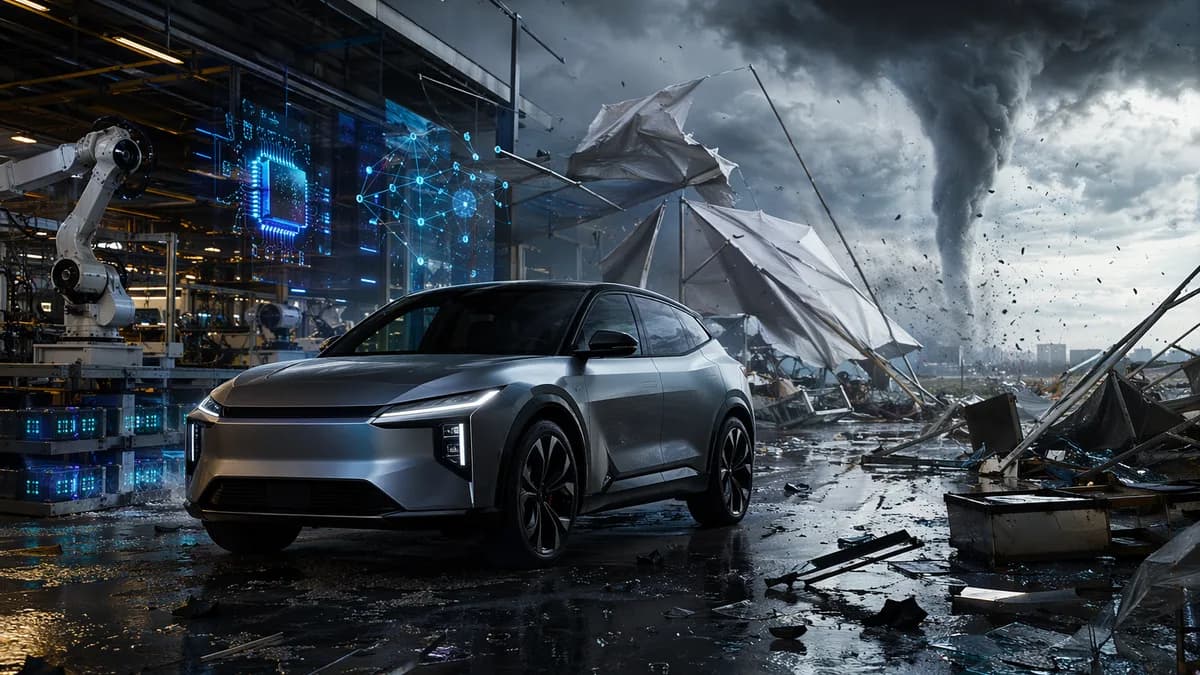
Rivian’s tornado-damaged factory roof was the visible crisis, but the real test is whether the Rivian R2 can carry the company from admired EV niche player to durable mass-market automaker. A tornado hit the company’s Normal, Illinois plant on April 17th, tearing open the roof and flooding pits under the assembly line just as Rivian was preparing to start production of its most important vehicle, according to The Verge.
TechnologyJuly 1, 2026· 12 min read· By XOOMAR Insights Team
Tornado Shoves Rivian R2 Into Its Brutal Make-or-Break Test
Updated on July 1, 2026
XOOMAR Intelligence
Analyst Take
73/ 100
4 sources analyzedMedium confidenceTrend10Freshness100Source Trust88Factual Grounding96Signal Cluster20
The physical damage looked severe. The timing was worse. The storm struck the section of the factory where Rivian R2 production was set to begin in days, turning a manufacturing ramp into an emergency cleanup job.
XOOMAR analysis: the tornado matters less as a natural disaster than as a stress test. Rivian says the roof can be repaired, the water pumped out, and the line brought back. The harder repair job is financial and operational. The R2 has to prove that Rivian can build at volume, protect demand beyond its core fans, and survive an EV market that has become hostile to expensive mistakes.
Rivian's tornado damage exposed the bigger storm around the R2 launch
The April 17th storm started as a supercell over west central Illinois, then turned into a squall line. One of the quick-forming tornadoes landed directly on Rivian’s factory in Normal. It knocked down a wall, ripped through the roof, cut power, and triggered the sprinkler system.
CEO RJ Scaringe was in Southern California when texts started coming in. At first, the basic questions were safety and structural integrity. Then he saw video of the damage. The factory roof had a giant hole. Water was rushing. Floodlights showed slick concrete and wreckage.
Rivian’s manufacturing vice president, Bobby Dean Parker, got the call at home in Normal.
“Hey, it’s not good,” the person on the phone told him.
That sentence could apply to the whole company’s position. Rivian has built a brand people care about. It has earned credibility with the R1T pickup and R1S SUV. It has heavyweight backers and partners. But the company is still losing money, still chasing scale, and now trying to launch the one product that has to pull the whole model together.
The R2 is not another product cycle. It is the hinge. If it works, Rivian has a path toward becoming America’s most credible EV company after Tesla. If it stumbles, Rivian may still exist, but likely as a smaller, more dependent, more constrained company.
The R2 must turn Rivian from an $80,000 adventure brand into a real volume automaker
Rivian’s first act proved something important but limited: wealthy buyers would pay for electric adventure vehicles with distinctive design. The R1T and R1S gave Rivian a profile that most EV startups never achieved. They also tied the brand to a customer base that could absorb vehicles starting in the low-$80,000 range.
The Rivian R2 changes the assignment. It is a midsize SUV starting around $45,000, aimed at families and mainstream buyers rather than early adopters with premium budgets. The lowest-priced version will not be available until late 2027, according to The Verge, but the commercial target is clear: Rivian needs to move downmarket without losing the design and product identity that made people care.
That is why comparisons to Tesla’s Model 3 and Model Y are unavoidable. Tesla’s Model 3 arrived in 2017, followed by the Model Y in 2019. Four years later, the Model Y became the best-selling car in the world, a title it reportedly retained for the next two consecutive years. In 2025 alone, Tesla sold more than 1 million Model Ys, according to The Verge.
Rivian does not have Tesla’s scale, margin history, or installed cultural force. It also does not have the same room for a messy ramp. A modestly successful R2 may not be enough if the company needs volume to absorb fixed costs, fund AI and autonomy, and support the case for a new Georgia factory.
| Vehicle or milestone | Source-supported significance |
|---|---|
| R1T and R1S | Proved Rivian could make desirable premium electric trucks and SUVs |
| R2 at around $45,000 | Rivian’s first serious mainstream volume play |
| Tesla Model 3 | Drew 450,000 reservations, a benchmark for EV launch demand |
| Rivian R2 | Drew an estimated 200,000 reservations, strong but not Tesla-level |
| Tesla Model Y | Sold more than 1 million units in 2025 alone |
Ed Kim, president and chief analyst at AutoPacific, put the moment plainly:
“This is arguably their biggest make-or-break moment yet.”
Rivian's EV math is unforgiving: reservations, losses, sales targets, and factory capacity
The reservation number gives Rivian hope. The financials explain why hope is not enough.
Rivian quickly gathered an estimated 200,000 reservations for the R2. That signals real interest, especially for a company still far smaller than Tesla. But reservations do not pay suppliers, fix quality issues, or fund a factory ramp. They become meaningful only when they convert into delivered vehicles at margins that stop bleeding cash.
The recent numbers are rough:
- 2025 sales: Rivian sold 42,247 vehicles
- Year-over-year decline: Sales fell 18 percent from 2024
- Profitability: Rivian has never posted an annual profit
- Gross profit problem: The company continues to lose more than $8,000 in gross profit for every vehicle it builds and delivers, according to its earnings reports cited by The Verge
- 2026 target: Rivian projects sales of up to 67,000 vehicles
- R2 contribution: With R1 sales expected to remain flat, that could mean as many as 25,000 R2s before the end of 2026
That last number is the stress point. As TechCrunch noted in The Verge’s account, such a launch would be one of the fastest new EV ramps ever recorded. Rivian has to do it after a tornado, during heavy investment, and in a market where automakers have booked more than $70 billion in EV-related write-downs over the past year.
Policy has also turned against the sector. The source notes the end of the $7,500 federal EV tax credit, tariffs that make affordable Chinese EV imports nearly impossible, and the collapse of regulatory credits that had generated hundreds of millions of dollars in quarterly revenue for pure EV companies like Tesla and Rivian.
The Georgia plan adds another constraint. Rivian recently broke ground on a $5 billion factory in Stanton Springs North, about 45 miles east of Atlanta, designed to build up to 400,000 EVs annually. But the company had to scale back after the Energy Department cut a loan agreement from $6.5 billion to $4.4 billion.
XOOMAR analysis: Rivian’s problem is not demand alone. It is timing. The company needs its most affordable vehicle to ramp just as incentives fade, capital discipline tightens, and every operational miss becomes more expensive.
Tesla's production hell and China's EV surge show how narrow Rivian's path has become
The modern EV market has already taught one brutal lesson: a good product can still nearly kill a company if manufacturing breaks.
Tesla’s Model 3 made the company a global force, but its launch also pushed Tesla into what Elon Musk called “production hell.” Tesla was bleeding cash, overcommitted to automation, and eventually used a makeshift assembly tent to hit production milestones. Demand did not save Tesla by itself. Execution did.
Rivian knows that danger. Scaringe told The Verge that supply chain risk is the biggest threat to the R2 ramp.
“The biggest risk for ramp-up is the supply chain.”
That explains Rivian’s push toward vertical integration. The company writes its own operating system software, designs and manufactures its own electric motors, makes its own battery packs and fast-charging cooling systems, and plans to design its own AI chips for autonomous driving. Scaringe argues that this spending creates variable cost advantages at scale.
The counterpoint is obvious: vertical integration is expensive before scale arrives. Rivian is betting that the R2 will unlock the volume needed to justify the fixed cost. If it does not, the same strategy that looks disciplined in success becomes a cash burden in failure.
China sharpens the pressure. The Verge reports that China manufactures roughly 75 percent of all EVs worldwide, with many selling for less than $20,000. Rivian does not sell in China, the world’s largest EV market. Tariffs and software restrictions shield it from direct Chinese competition in the US for now, but that shield also keeps American buyers from seeing the full force of global EV price competition.
Scaringe is not convinced Chinese automakers have some untouchable manufacturing secret.
“We’ve taken the cars apart … there’s no magic,” he says. “They’re using stampings, they’re using castings.”
Maybe. But Rivian still has to prove it can match the cost discipline that Chinese automakers have forced into the global benchmark.
Workers, fans, investors, partners, and policymakers all need a different Rivian to win
The R2 has become bigger than a car because too many stakeholders now need Rivian to become something it has not yet been.
In Normal, Illinois, Rivian is not just a brand. It is a major employer and a local industrial bet. Heartland Community College runs an apprenticeship program with the company, and dean Adam Campbell told The Verge that Rivian has shifted the Bloomington-Normal community toward advanced manufacturing.
Fans have a different stake. Rivian clubs gather around the company’s outdoorsy design language, less polarizing CEO, and community identity. But that loyal base is not enough for the R2. Mainstream buyers will not join a lifestyle club to justify a vehicle. They will judge price, reliability, service, charging behavior, and whether the car fits daily life.
The buyer psychology is real. A 2026 NBER working paper on range anxiety used high-frequency data from 188,000 EV trips, 26,000 charging events, and 8,000 EVs in Shanghai. It estimated average range anxiety at about $1,900 in 2021, falling to $1,200 in 2024 as range and charging improved, according to NBER. The study is not a US Rivian survey, but it helps quantify what automakers often treat as vibes: perceived range constraints carry an economic cost.
Investors and partners add another layer. Volkswagen has committed $5.8 billion to a software joint venture and now owns nearly 16 percent of Rivian, surpassing Amazon as the largest shareholder. Uber has agreed to buy 10,000 autonomous R2 vehicles in a deal that could bring Rivian $1.25 billion in new investment, but Uber CEO Dara Khosrowshahi said Rivian has to hit milestones, including testing without a safety driver.
That autonomy angle links Rivian directly to a crowded robotaxi fight. As XOOMAR covered in Waymo Uber Phoenix Split Leaves Uber Chasing Robotaxis, Uber’s autonomy ambitions are strategic, not casual. Rivian is now part of that bet.
Policy is the last stakeholder, and the least predictable one. Rivian is trying to scale American EV manufacturing while incentives shrink and federal support becomes less stable. That kind of government-technology mismatch is not limited to autos, as our analysis of Trump’s 2028 Quantum Computer Bet Crashes Into Reality showed in another hard-tech context.
For EV buyers and the auto industry, the R2 will test whether American EV innovation still scales
For buyers, the R2’s promise is simple: a more attainable electric SUV from a company with genuine design appeal. The risk is also simple. Rivian has to prove reliability, service quality, software maturity, and manufacturing consistency at higher volume than it has handled before.
The source notes that Rivian’s R1S has faced criticism over technical issues and hardware faults. That matters because mainstream buyers are less forgiving than early adopters. A loyal fan may tolerate rough edges. A family replacing a gas SUV probably will not.
Rivian’s autonomy strategy complicates the picture. Scaringe says autonomy is the company’s largest area of investment and his biggest focus inside the business. Rivian plans a Level 4 system eventually, has rolled out Universal Hands-Free driving across 3.1 million miles of roads in the US and Canada for second-gen R1 vehicles, and expects point-to-point hands-free driving later this year.
But early reviews have been mixed, and Rivian faces a lawsuit from R1 owners alleging false claims about autonomous driving capabilities. XOOMAR analysis: autonomy could become a revenue engine if Uber milestones are met, but it could also distract management from the one job that matters most right now: building high-quality R2s at scale.
The practical thesis is narrower than the hype. The R2 does not need to dominate every EV spec sheet. It needs to be dependable, desirable, manufacturable, and priced close enough to mainstream reality that buyers outside the Rivian fan base show up.
Rivian's next two years will decide whether the R2 becomes a Model Y rival or a rescue asset
Scaringe gave the clearest version of the stakes himself.
“R2 is the most important thing we have because it’s what takes us from being subscale to being a scaled manufacturer.”
If Rivian hits early production targets, limits quality problems, and keeps demand alive after the first reservation wave, the R2 can become the scale engine the company needs. That would support the Georgia factory plan, strengthen the Volkswagen software relationship, and give Uber a clearer path toward autonomous R2s.
Even in that upside case, the next phase will not be clean. Margins, warranty costs, supplier stability, service capacity, and autonomy spending will matter as much as reservation headlines. A successful launch can still strain cash if the company pays too much to deliver it.
The downside is harsher. If R2 delays mount or quality issues spread, Rivian may have to cut deeper, slow Georgia, lean harder on Volkswagen and Uber, or accept a future where independence is more limited. Scaringe admitted as much when he told The Verge that if the R2 is not successful, Rivian will need to “resize how we’ve set up the business.”
That is the watch item now. Not whether the tornado damage gets patched. It will. The real test is whether Rivian can repair the gap between cult favorite and mass-market manufacturer before the next storm hits.
The Bottom Line
- Rivian’s tornado damage hit just as the company was preparing to start Rivian R2 production.
- The R2 launch is a major test of whether Rivian can move beyond a niche EV audience.
- The incident highlights how fragile manufacturing ramps can be in a tougher EV market.
Sources

Written by
XOOMAR Insights Team
Research and Editorial Desk
The XOOMAR Insights Team pairs automated research with human editorial judgment. We track hundreds of sources across technology, fintech, trading, SaaS, and cybersecurity, cross-check the facts, and explain what happened, why it matters, and what to watch next. We do not just rewrite headlines. Every article is fact-checked and scored for reliability before it goes live, and we link back to the original sources so you can verify anything yourself.
Explore More Topics
Related Articles
 Technology
Base Power Undercuts ComEd to Dodge PJM's Grid Jam
Base Power is using home batteries to undercut ComEd by 25% and bypass PJM's clogged interconnection queue.
Jun 25, 20268 min
 Technology
Polestar US Ban Freezes 2027 EVs in China Crackdown
Washington blocked Polestar’s 2027 EV pipeline, turning Chinese ownership into a U.S. market liability.
Jun 25, 20268 min
 Technology
Xbox Price Increase Shoves Series S Into $499 Shock
Microsoft is raising Xbox console prices worldwide, pushing the Series S 512GB to $499 as memory and storage costs squeeze margins.
Jun 26, 20267 min
 Global Trends
Supreme Court Throws Assault Weapons Bans Into Peril
The Supreme Court will test whether AR-15-style rifle bans in about a dozen states can survive the Second Amendment.
Jun 30, 20268 min
 Technology
Great Hardware Can't Save Google Home Speaker From Gemini
Google's speaker hardware looks ready, but Gemini for Home still feels too unfinished for a device meant to run the household.
Jul 1, 20267 min
 Fintech
Deadline Bites as EU Rewrites MiCA Crypto Regulation
MiCA is fully live after July 1, but Brussels is already weighing changes as stablecoins and tokenization test Europe's crypto rulebook.
Jul 1, 20268 min
 Trading
USDJPY Blasts to 40-Year High as Dollar Grips Markets
USDJPY hit a 40-year high as the dollar, yields and risk-off positioning tightened pressure before major U.S. data.
Jul 1, 20267 min
 Technology
Decade Away Can't Dull Rhythm Heaven Groove's Weird Magic
Rhythm Heaven Groove returns after a decade and still feels brutally precise, proving Nintendo’s strangest series didn’t need to grow up.
Jul 1, 20267 min
 Cybersecurity
10/10 Adobe ColdFusion Vulnerabilities Threaten Servers
Adobe patched seven 10/10 flaws in ColdFusion and Campaign Classic that could let attackers run code on exposed systems.
Jul 1, 20264 min
 Global Trends
Deadly Antwerp Apartment Fire Forces High-Rise Rescues
A fire in Antwerp's Linkeroever district killed residents, injured others and forced crews to search a 10-storey block flat by flat.
Jul 1, 20265 min
Don't miss the signal
Get our weekly roundup of the stories that matter across tech, fintech, and trading. No noise, just signal.
Free forever. No spam. Unsubscribe anytime.