Fatal fire tears through 10-storey apartment block in Antwerp's Linkeroever district
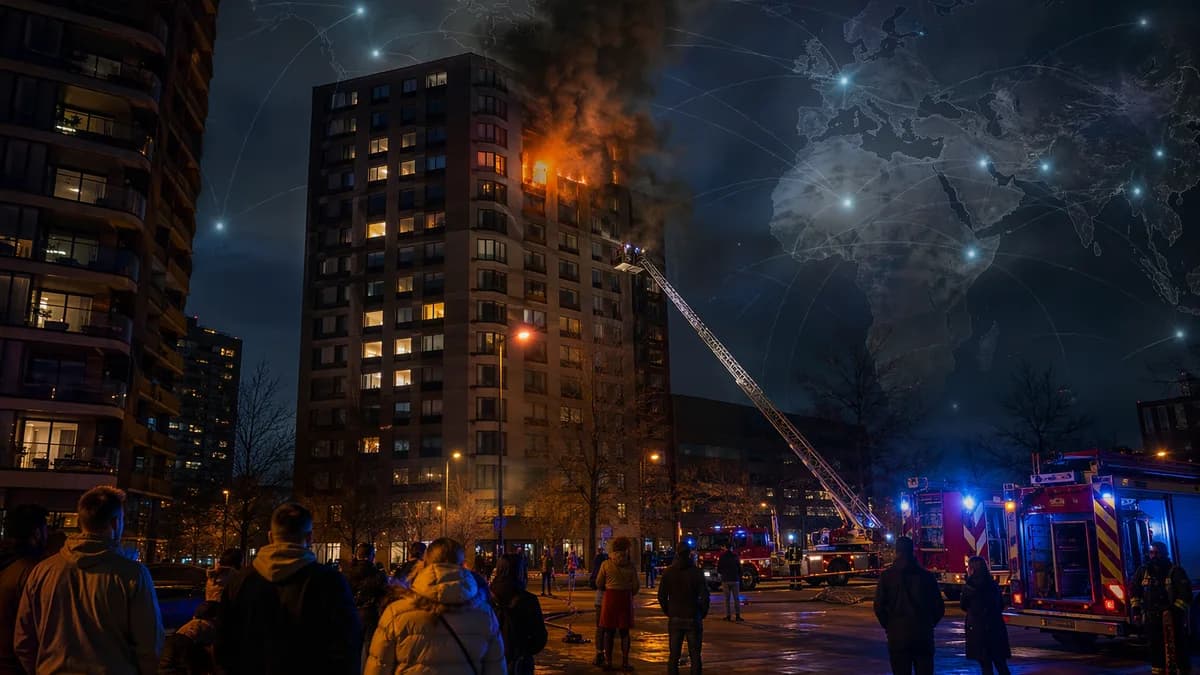
The Antwerp apartment fire has killed a number of people and injured others after flames broke out high inside a 10-storey block of flats in the city’s Linkeroever district on Wednesday morning.
XOOMAR Intelligence
Analyst Take
The blaze started just before 10:00 local time (08:00 GMT) on the eighth floor of the residential building, according to BBC World. Reuters, citing local police, reported that the fire department received a call at 9:53 a.m. local time about a “raging fire.”
Police said more than 200 people live in the building. They also said bodies of a number of victims had already been found, while others were injured. The final casualty figure may change because crews were still searching the block flat by flat.
Thick black smoke was seen pouring from the building. Video cited by the BBC showed a man climbing from his balcony through a neighbour’s window to get away from the smoke.
The response involved Antwerp police, the Antwerp fire brigade, several fire brigades from different districts, first responders and, according to the Associated Press account, a specialized drone unit. The building was being evacuated as crews worked in difficult conditions.
Resident Geert Dewulf told Belgian public TV: “We barricaded ourselves into our flat and waited on the balcony. The fire brigade came to rescue us from the balcony 10 minutes or so later with their ladder.”
Prime Minister Bart De Wever said his thoughts were with the victims and evacuated residents of the “terrible fire” in Linkeroever.
Residents evacuated as firefighters battle smoke and flames in Antwerp high-rise
The immediate threat in the Antwerp apartment fire was not only flame. It was smoke, speed and height.
Firefighters said smoke spread quickly through the building, making evacuation harder. That detail matters. In a multi-storey residential block, poor visibility can turn stairwells, corridors and upper-floor rescues into a race against time. Antwerp fire brigade spokeswoman Marie de Clercq called it a complex fire and said thick smoke and poor visibility made it difficult to extinguish.
Police asked nearby residents affected by smoke to protect themselves indoors.
“We ask local residents affected by the smoke to close windows and doors and, if necessary, switch off ventilation,” police said, according to Reuters.
One man told the BBC his parents-in-law, one of them former Antwerp mayor Bob Cools, had been evacuated from the building and taken to hospital. He added: “We tried our utmost to save the cat but unfortunately in the end we were unable to.”
Officials have not provided a full breakdown of the injured, their conditions or how many people were taken to hospital. They also have not said whether all residents have been accounted for.
No confirmed information has been provided on road closures, safety cordons or emergency accommodation for displaced residents. That leaves a practical gap for people in the area: the official advice currently confirmed in the reporting is to avoid smoke exposure by closing windows and doors and turning off ventilation if needed.
For readers following XOOMAR’s broader coverage of emergency response and crisis management, recent reports include Tomblaine Plane Crash Wipes Out Skydiving Flight in France and Australia Vanuatu Military Deal Boxes Out China in Pacific. Those stories are separate from the Antwerp fire, but sit in the same file of fast-moving events where official updates shape the public picture hour by hour.
Antwerp investigators face urgent questions over the fire's cause and building safety
Police said it was too early to identify the cause of the Antwerp apartment fire. Witnesses told De Standaard newspaper that work was being carried out on the roof, but officials have not connected that work to the blaze.
That distinction is important. A witness account can point investigators toward a line of inquiry. It does not establish causation.
The next phase will likely turn on a few hard questions:
- Origin: Where exactly did the fire start inside or around the eighth floor?
- Spread: How did smoke move so quickly through the building?
- Evacuation: Were residents able to reach exits, or were some trapped by smoke?
- Accounting: Are all residents, visitors and injured people identified?
- Re-entry: Can anyone return to the building, or does the structure remain unsafe?
Officials have not yet released the identities of the victims. They also have not provided a final number of deaths, a full injury count, or confirmation on whether anyone remains missing.
The confirmed facts leave a narrow but serious investigation path
XOOMAR analysis: The most consequential confirmed fact is the rapid spread of smoke through a building housing more than 200 people. Even before the cause is known, that sets up the central safety issue investigators and city officials will have to address: whether the building’s layout, evacuation routes and internal fire protections limited or worsened the emergency.
There is no confirmed evidence yet of a safety failure. There is also no confirmed cause. But the combination of an eighth-floor ignition point, black smoke, balcony rescues and floor-by-floor searches explains why officials are moving carefully.
The practical watch item now is the official update sequence. Antwerp police, the fire service, city officials, hospital authorities and potentially prosecutors will need to clarify casualty figures, victim identities, the condition of the injured and whether the building can be occupied again. Until then, the Antwerp apartment fire remains an active emergency with a death toll that authorities have not yet finalized.
The Stakes
- The fire caused deaths and injuries in a densely occupied 10-storey residential building.
- Rapid smoke spread and the building’s height made evacuation and rescue especially difficult.
- The final casualty count may rise as crews continue searching the block flat by flat.
Primary Sources & Disclosures

Written by
XOOMAR Insights Team
Research and Editorial Desk
The XOOMAR Insights Team pairs automated research with human editorial judgment. We track hundreds of sources across technology, fintech, trading, SaaS, and cybersecurity, cross-check the facts, and explain what happened, why it matters, and what to watch next. We do not just rewrite headlines. Every article is fact-checked and scored for reliability before it goes live, and we link back to the original sources so you can verify anything yourself.