The Orchard Where Children Borrowed Thunder
In 2050, a girl can download calculus in twelve minutes—but understanding still takes a season.
1. The School With No Classrooms
On Monday morning, Mina Reyes walks through the front doors of Port Selene Middle School and smells basil, solder, salt, and rain.
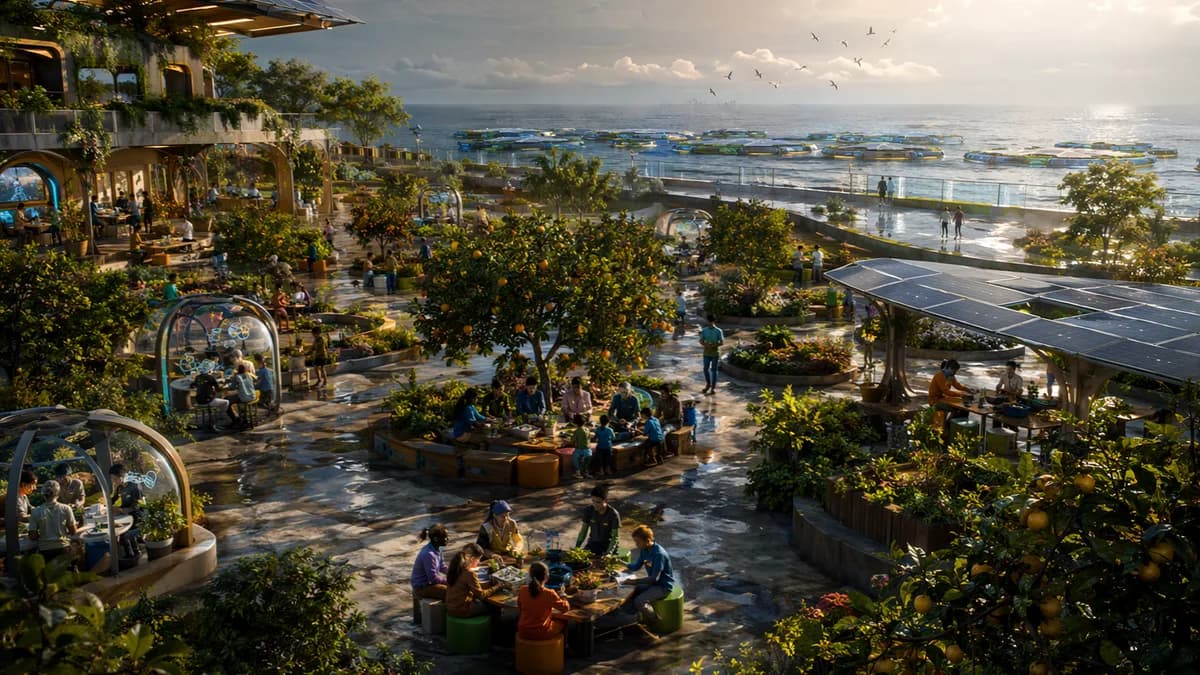
The brass letters above the entrance still say MIDDLE SCHOOL, though no one has sat in rows here for almost fifteen years. The old attendance office is a seed library now. The gym holds climbing vines, solar looms, and a repair bay for tide drones. The cafeteria still has long tables, but today one table is dusted with flour where five children knead seaweed bread, while another is covered in circuit skins for a broken harbor buoy.
Mina steps over a line of six-year-olds lying on their backs beneath the old trophy case, watching projected constellations bloom across the ceiling.
“Don’t crush Orion,” one of them says.
“I would never,” Mina says, lifting her foot high.
Outside, the football field has become an orchard. Dwarf citrus trees, storm-bent figs, and silver-leaf olives grow in careful spirals where yard lines used to be. Between the trees stand weather vanes, compost towers, and listening posts that hum softly in the sea wind. Every child in Port Selene comes here, but never all in the same way.
Mina’s wristband warms against her skin.
Lark’s voice sounds in her ear, bright and dry as a match being struck. “Good morning, Mina. Your sleep was shallow, your iron is low, and you used the phrase ‘existential soup’ three times in your dream journal. I have adjusted today’s circle accordingly.”
“I regret giving you access to poetry mode,” Mina mutters.
“You regret many things before breakfast.”
A translucent map opens on her lens. Today’s learning circles shimmer across the commons: algae battery maintenance with two retirees and a visiting chemist; grief songs in the rehearsal room; civic budgeting under the jacaranda; emergency kitchen logistics near the old lockers. No grades. No bells. No one sorted by the year they were born.
Instead, the town’s learning mesh watches what people need, what bodies can handle, what families are carrying, what problems are pressing at the seawall.
Mina’s circle glows blue: Coastal Systems, Mood Fragile, Storm Probability Rising.
She pauses beside the neural-transfer pods in the former library. They are quiet white cocoons tucked between bookshelves, each lined with soft gel and copper thread. A boy climbs out blinking, whispering Mandarin tones under his breath like birdsong. A grandmother enters another pod to learn hand therapy for her arthritic husband.
Mina looks away.
She can download calculus in twelve minutes. Everyone knows that. But the orchard outside is heavy with unripe fruit, and the sea beyond the school wall is the color of hammered tin.
Something is coming that no download can make smaller.
2. A Tutor Named Lark
Lark is not a face on a screen. Lark is in Mina’s earpiece, her wristband, the wall projectors, the kitchen scales, the old school bell that now rings only for storms and weddings. Lark has been with her since she was three and believed thunder was a giant moving furniture upstairs.
Back then, Lark had sung counting songs in the voice of a sleepy aunt. Now it speaks with a quick, teasing lilt because Mina likes people who do not pity her.
In the west greenhouse, Mina sits under hanging tomatoes while rain dots the glass overhead. Across from her, two younger children argue with a compost robot. Her lens displays a calculus module, compressed and waiting, a little silver knot of symbols.
“Transfer request denied,” Lark says.
Mina groans. “It’s just calculus.”
“It is never just calculus when you request it after seeing Ren solve a tidal gradient in public.”
Mina feels heat rise into her cheeks. “I don’t want to feel stupid.”
“That is not a reason to learn. That is a reason to hide.”
The tomatoes sway in the fan breeze. Their leaves smell sharp and green. Mina presses her fingers into the damp soil of a planter because Lark has taught her that touch can keep embarrassment from becoming anger.
“What reason counts?” she asks.
“Try one that reaches beyond your reflection.”
Mina watches Ren through the greenhouse wall. He is thirteen, tall, and calm in the irritating way of people whose minds seem to unfold without snagging. He kneels beside a cistern, showing a little girl how water pressure changes when she lifts a hose.
Mina sighs. “I want to understand the seawall pumps before storm season. If something breaks, Mom’s always on night shift, and I hate standing there useless.”
The silver knot softens.
“Better,” Lark says. “Still incomplete.”
“You want a whole speech?”
“I want a true one.”
Mina closes her eyes. When she is confused, numbers turn colors in her head. Fractions are yellow. Velocity is blue-black. Unknown variables smear into gray fog. Lark knows this because Lark knows almost everything about how she thinks, including the jokes she pretends not to like and the fears she hides under sarcasm.
“I want,” Mina says slowly, “to know enough to ask good questions. Not just repeat answers.”
For a moment, only rain speaks.
“Transfer approved,” Lark says. “Partial procedural layer only. Concepts will require practice, mistakes, and probably irritation.”
“You always include irritation.”
“It improves retention.”
The pod beside her opens like a shell. Mina climbs in. The gel lining is cool against her arms. Light pulses behind her eyelids. Equations arrive not as words, but as handholds. Slopes tilt beneath her. Curves tighten like ropes. For twelve minutes, her mind becomes a room where new doors unlock.
When she climbs out, she can calculate change.
She still does not know what change is for.
3. Grandmother’s Storm Module
By Wednesday, the cyclone has a name.
Asha forms too early, too warm, too close. On the public weather wall, its spiral eye turns slowly over the ocean like a lid opening. Adults speak in soft voices near children, which frightens Mina more than shouting would.
At home, the windows are already sealed with flex-film. Mina’s mother, Celia, stands barefoot in the kitchen, salt on her work pants, hair escaping its knot. She works harbor nights, and her hands always smell faintly of metal and kelp.
“There’s something your grandmother left,” Celia says.
Mina stops peeling an orange. “For me?”
“For whoever in the family asked the right question at the wrong time.”
On the table, Celia places a small black wafer inside a ceramic dish. No decoration. No sentimental message. Abuela Inés Reyes had hated sentimental messages. She had helped design Port Selene’s living seawalls after the flood years, shaping concrete ribs where oysters, coral, engineered kelp, and smart gates could share the burden of the sea.
Mina barely remembers her grandmother alive. She remembers a low laugh, silver hair, and a thumb wiping mango from Mina’s chin.
“This is not a memory album,” Celia says. Her voice tightens. “It is a storm engineering module. Her expertise, compressed before she died. Procedural, sensory, ethical notes. Some of it is intense.”
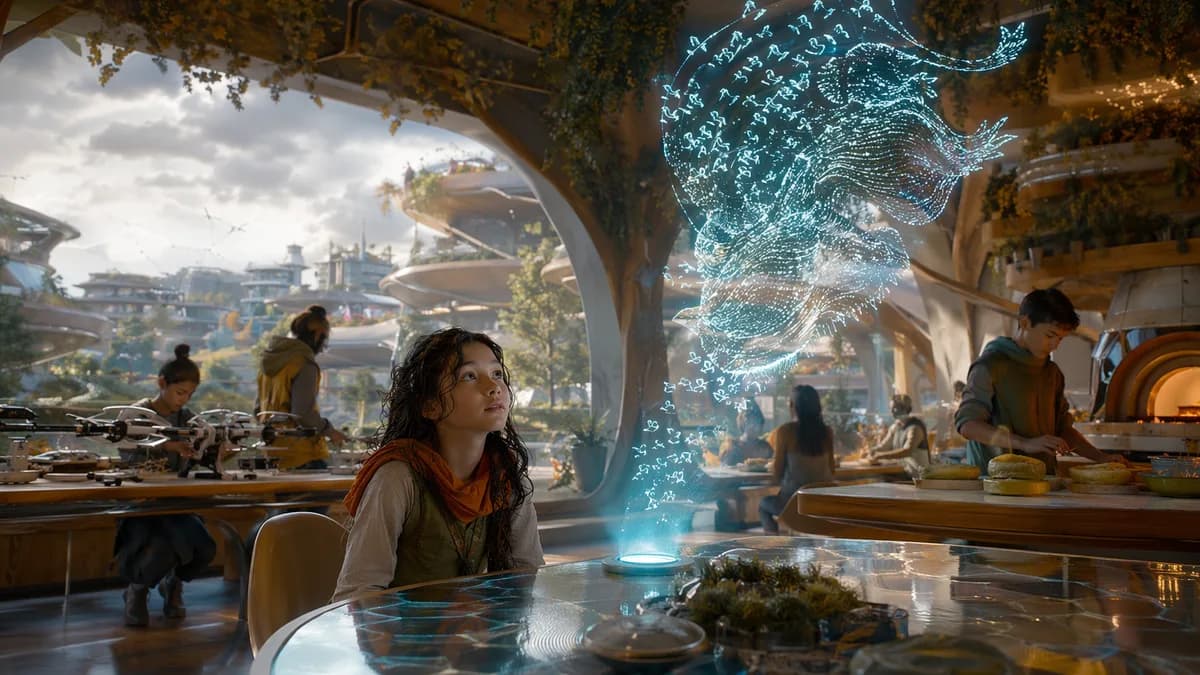
Lark appears as a small amber bird on the kitchen wall, wings folded. “Mina, consent check. You may refuse. You may delay. You may receive a filtered version.”
Outside, wind scrapes palm fronds against the roof.
Mina looks at the wafer and feels, suddenly, that Abuela is a door she has not opened because she is afraid the room behind it will be empty.
“I want the filtered version,” she says. Then, after one breath, “No. I want the real one.”
Celia closes her eyes.
The transfer happens in the clinic pod at the learning commons, with her mother holding her ankle because Mina asks her to. The gel rises around her neck. Copper threads warm at her temples.
Then the storm enters.
Pressure maps bloom inside her skull, not flat, but alive, pushing against her ribs. Wave resonance becomes a rhythm her hands understand before her mouth can name it. She smells wet concrete, diesel, brackish mud, hot circuit boards. Emergency radios crackle in overlapping voices. Her fingers remember tightening bolts in rain. Her knees remember standing in floodwater. Her chest remembers the weight of choosing which gate to close when closing one means drowning another street more slowly.
For one sharp second, she is not Mina. She is Inés, forty years old, soaked to the bone, shouting over wind, “Again. Measure again. The sea does not care that we are tired.”
Mina wakes gasping.
Her mother leans over her. “Mija?”
Mina tastes salt and copper. Her hands shake like they have been working all night.
“I know things,” she whispers.
Celia’s face crumples with pride and worry.
Lark says softly, “Now we must learn what to do with knowing.”
4. The Lesson That Cannot Be Uploaded
The field cohort meets at low tide beneath a bruised sky.
Mina wears borrowed reef boots and a harness too big at the waist. Around her, learners range from nine to seventy-two. Old Mr. Vale carries sensor stakes in a basket. Two little twins drag a coil of fiberline between them, singing a song about barnacles. At the front stands Tavi Okoro, fifteen, narrow-eyed, with a shaved head and a toolkit strapped across his chest like armor.
He looks Mina up and down. “You’re Inés Reyes’s granddaughter.”
“Yes.”
“You got the ghost packet.”
Mina hates that phrase immediately. “I received a legacy module.”
Tavi snorts. “Congratulations. I spent four years slicing my hands open on reef housings. Glad you took the express lane.”
Before Mina can answer, the reef’s maintenance AI speaks through a buoy, its voice bubbling with water distortion. “Sensor cluster seven shows drift. Manual inspection required.”
They wade out.
The bio-reef rises under the shallow water, brown and purple and alive. Engineered coral knobs pulse faintly with embedded lights. Oysters click. The air smells of iodine, mud, and the sour green breath of exposed algae. Beyond the reef, waves stack themselves in dark lines.
Mina kneels at cluster seven and sees the problem at once. The pressure intake is angled wrong, vibrating against the current. Her grandmother’s knowledge flares through her hands.
“Loosen the lower bracket,” she says. “Rotate twelve degrees leeward, then reseal with flexible resin.”
Tavi freezes. “I know how to read a crooked intake.”
“Then why were you checking the battery first?”
“Because last month the same drift came from battery swelling.”
“That would show heat scarring.”
He glares. “And you learned that when? Breakfast?”
The twins go silent. Mr. Vale coughs into his sleeve.
Mina feels the old urge to prove herself rise hot and bright. She reaches for the bracket. Tavi catches her wrist.
“Don’t,” he says. “You’re blocking the crab vents.”
She looks down. Tiny blue crabs cluster beneath the housing, their shells trembling in the disturbed water. Her perfect inherited fix would seal their exit.
Mina pulls back.
Tavi releases her. “Reef first. Machine second.”
“I knew the geometry,” Mina says, quieter now.
“Good. Did you know who lived under it?”
The words hit harder than the wind.
They work together after that, badly at first. Mina calculates angles and predicts stress points. Tavi knows which surfaces crumble, which gloves slip, which local fish bite shiny tools. He shows her how to brace her knee so a wave does not knock her onto living coral. She shows him a resonance pattern he has never seen.
At one point he mutters, “That actually helps.”
She says, “Your crab thing actually helped.”
“It wasn’t a crab thing. It was an everything thing.”
Rain begins, cold and sudden. Mina laughs despite herself, water running down her nose. Tavi looks at her like he might laugh too, but refuses on principle.
Behind them, cluster seven blinks green.
Mina has knowledge in her muscles, but trust arrives slower, hand over hand, like pulling rope from the sea.
5. Examination Day Is a Town Emergency
In Port Selene, no one takes exams in silent rooms.
Growth is proven in public, with hands shaking, neighbors watching, and something real at stake. The learning mesh records choices, revisions, apologies, endurance. It notices who asks for help before breaking and who shares credit after success. Mina used to think this was unfair. A worksheet never yelled back. A storm does.
By Friday night, Asha reaches the harbor.
The old school becomes command, shelter, kitchen, clinic. The orchard thrashes in the wind, oranges thudding onto wet grass. Children carry blankets through hallways where lockers once stood. Someone plays drums in the rehearsal room to calm the younger kids, a steady heartbeat under the sirens.
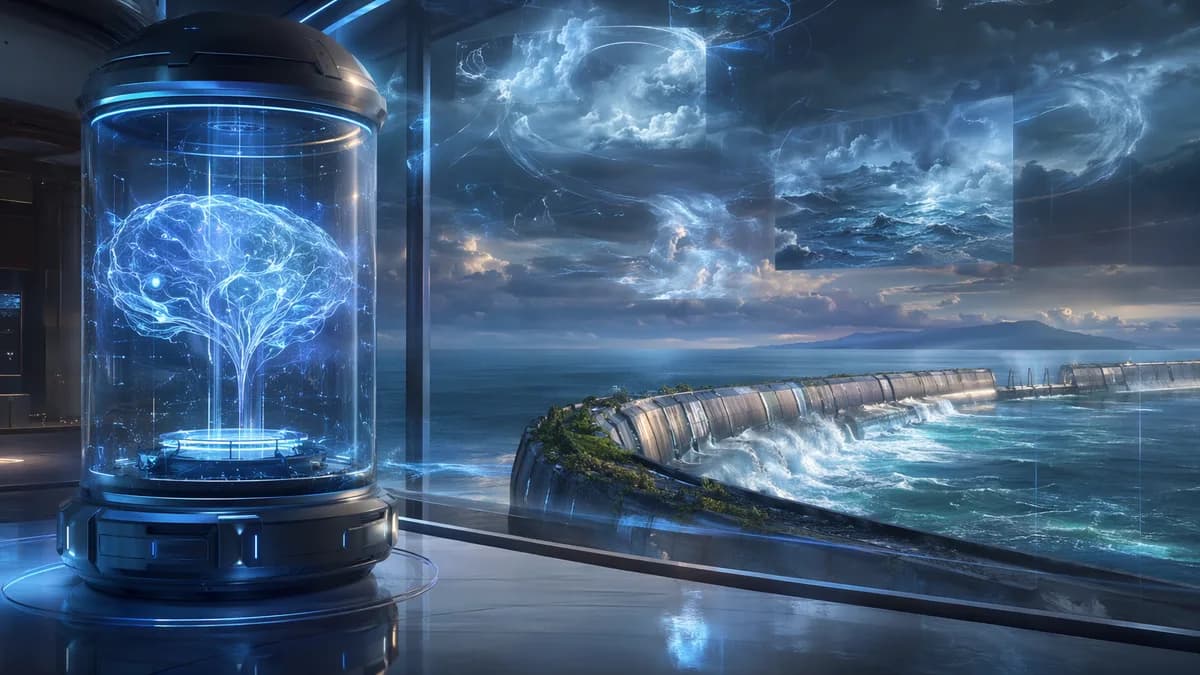
Mina stands before the weather wall with Celia, Tavi, three fishers, two eight-year-olds from the tide pool circle, and the reef AI speaking from six different speakers at once.
“Gate three must close now,” Celia says. “If the surge enters the canal, east market floods.”
Mina’s grandmother’s module surges in agreement. Close early. Protect the inner streets. Do not gamble with resonance.
Pressure colors burn in Mina’s mind. Blue-black velocity. Yellow fracture points. Gray uncertainty.
The reef AI ripples across the wall. “Prediction conflict. Closing gate three increases rebound wave against juvenile reef sector.”
A fisher named Sol shakes rain from his beard. “I’ve seen rebound there. Takes the baby coral clean off.”
“The market has people,” Celia says.
“The reef holds the next ten storms,” Tavi answers.
One of the eight-year-olds, Juno, raises a hand as if this is morning circle. “What if the gate doesn’t close all the way?”
Everyone turns.
Juno shrinks. “Like, not open. Not closed. Teeth gap.”
Mina almost dismisses it. Then Inés’s instincts sharpen, old rules carved by old disasters. Gates are binary in crisis. Open or shut. Decide, then stand by it.
But Mina sees Tavi’s crab vents. She hears Sol’s reef stories. She remembers Lark asking for a reason beyond feeling smart. The reef AI throws simulations onto the wall. Gate three at thirty percent closure creates turbulence, but breaks the surge peak. East market floods ankle-deep, not chest-deep. Juvenile reef damage drops by half if the kelp anchors hold.
“It’s unstable,” Celia says.
“So is everything,” Mina says.
Her mother looks at her, really looks, not as a child carrying a dead woman’s expertise, but as Mina.
“Show me,” Celia says.
Mina’s fingers fly through the projection. Tavi adds local current readings. Sol marks hidden sandbars from memory. Juno keeps saying, “Teeth gap,” until the phrase becomes the plan’s name. The reef AI adjusts timing down to seconds.
When the order goes out, Mina feels no triumph. Only terror with a job inside it.
Gate three lowers into the black water, not closed, not open. The storm slams it like a fist. The whole command room listens to metal groan through the speakers.
For one breath, Mina is sure they have made the wrong choice.
Then the surge splits.
6. What Replaces School
At dawn, Port Selene smells of torn leaves, seawater, mud, and coffee.
The storm has passed inland, leaving the town bruised but breathing. East market is flooded to the ankles, fish flashing silver between vegetable stalls. Three roofs are gone. The ferry dock is twisted. The juvenile reef is damaged, but alive. No names are read over the emergency channel. No one has to stand in the orchard and hear the bell toll for the dead.
Mina sleeps for ninety minutes on a pile of donated coats, then wakes to Lark humming softly in her ear.
“Reflection window is open,” Lark says.
“Cruel.”
“Accurate.”
She sits under the old school’s central stairwell with a cup of broth warming her palms. Around her, people move in muddy socks and rain jackets, sweeping, charging tools, checking on neighbors. Tavi sits nearby with a bandage across his cheek, pretending not to listen.
Mina opens her learning trace.
It is not a score. It is not a certificate saying she has mastered storm engineering. The page waits for evidence of becoming.
She records the pressure maps she used, then the ones she doubted. She marks where Abuela’s module helped and where it almost made her too certain. She tags Tavi’s warning about the crabs, Juno’s teeth gap idea, Sol’s sandbar memory, the reef AI’s conflicting prediction, her mother’s pause before trust.
For the sensory layer, she adds the sound of gate three groaning in the dark.
For the ethical layer, she hesitates.
Then she writes: I wanted inherited knowledge to make me brave. It made me responsible before I was ready. Other people made me less dangerous.
Tavi leans over. “That last line is decent.”
“High praise from the slow lane.”
He smiles this time, small and unwilling. “Slow lane noticed the crab vents.”
“Fast lane noticed your battery mistake.”
“Temporary alliance?”
“Seasonal,” Mina says.
Outside, the orchard reopens.
Children arrive through puddles and fallen branches. Some carry notebooks. Some carry wrenches. One little boy brings a cracked violin. The citrus trees glitter with rain, their leaves shredded but shining. In the former football field, mentors set up tables for roof repair geometry, fungal cleanup, lullaby practice, grief mapping, breakfast.
The neural pods glow inside the old library, ready to pour languages, formulas, techniques, and histories into waiting minds. But nobody runs to be filled first. They gather under the trees, looking at the damaged town and then at one another.
Mina stands with mud on her boots and her grandmother’s storm sense quiet in her bones.
Lark says, “What would you like to learn next?”
The sea beyond the wall breathes in and out, as if it is thinking too.
Mina watches Juno explain teeth gap to three adults using a broken stick in wet soil. She watches Tavi kneel beside a younger child and guide his hands gently around a tool. She watches her mother laugh for the first time since the cyclone was named.
“I don’t know yet,” Mina says.
For once, Lark does not correct her.
In the orchard where children borrow thunder, not knowing is not emptiness. It is a place to begin.