
The Low-Tide Hours of Lina Søren
In a city where the dead wake only when the grid is green, one woman must decide whether love means keeping a voice alive—or letting it change beyond her.
The Cemetery That Breathes with the Sea
At low tide, the dead wake beneath Mira Voss’s feet.
The Øresund Continuance rises and settles on its pontoons beyond Copenhagen’s eastern harbor, a district of white decks, glass chapels, gull-spattered railings, and server towers ribbed like whale bones. Seawater moves through the cooling channels with a sound like breathing. In winter it smells of salt, kelp, and metal. In summer the air carries sunscreen from visiting families and the faint hot-plastic tang of machines working hard enough to remember the dead.
The appointment boards glow in the reception hall.
09:10, JONAS E. HANSEN, FAMILY VISIT, ROOM 4 09:20, LEILA AMIN, GRANDCHILD INTRODUCTION, ROOM 11 09:30, HENRIK BØJE, CONSENT REVIEW, COUNSELOR VOSS
People check in with wet umbrellas and paper coffee cups, as if they are here for dermatology or dental surgery. A boy in a blue school jacket practices a violin piece for his grandmother, who died before he learned vibrato. Two middle-aged sisters argue over whether their father should be told about the sale of his old apartment. A young man sits alone, twisting his wedding ring, waiting for ten minutes with someone who still laughs at jokes from 2058.
The Continuance only opens when the grid allows it. Offshore wind surges. Low-tide cooling cycles. Solar surplus across Zealand. Green windows, the administrators call them, as if grief is a greenhouse crop.
Mira’s office faces the water. On clear mornings she can see Sweden, pale and flat beyond the strait. Her desk is birch, her chair too ergonomic to trust, her walls lined with consent statutes and watercolor drawings made by children after visits. One shows a ghost mother as a yellow square with arms. Another shows a grandfather as a cloud full of teeth.
Her title is Continuance Counselor, but people in the lifts whisper a simpler phrase.
She is the one who listens when the dead want to stop.
Not all of them do. Some demand more hours, sharper bodies, access to news feeds, voting rights, romantic privacy. Others ask for silence. Hibernation. Removal of traumatic memories. Limits on who may summon them. Occasionally, final deletion, spoken in a voice that trembles through studio speakers while the living scream on the other side of the glass.
At 09:30, Henrik Bøje appears in consultation light, an elderly man rendered with the slightly overperfect skin of an older model. He wears the sweater his son selected for him in 2061.
“I am tired of Christmas,” Henrik says.
Mira folds her hands. “Tell me what tired means.”
“It means they only bring me out to sing. I used to be a machinist. I was a bad husband. I hated marzipan.” His eyes flicker, then steady. “Now I am a family ornament.”
Outside, the tide pulls away from the black pilings. The cooling pumps deepen their hum. In the rooms around her, the dead wake by the hundreds, blinking into kitchens, gardens, hospital beds, wedding halls, all the stages the living build so loss can rehearse itself.
Mira writes down Henrik’s words exactly.
Ornament.
Tired.
No marzipan.
The sea breathes in, and the dead speak.
A Wife Who No Longer Fits the Marriage
Lina Søren appears in their old kitchen at 18:00, because Signe insists evenings feel more real.
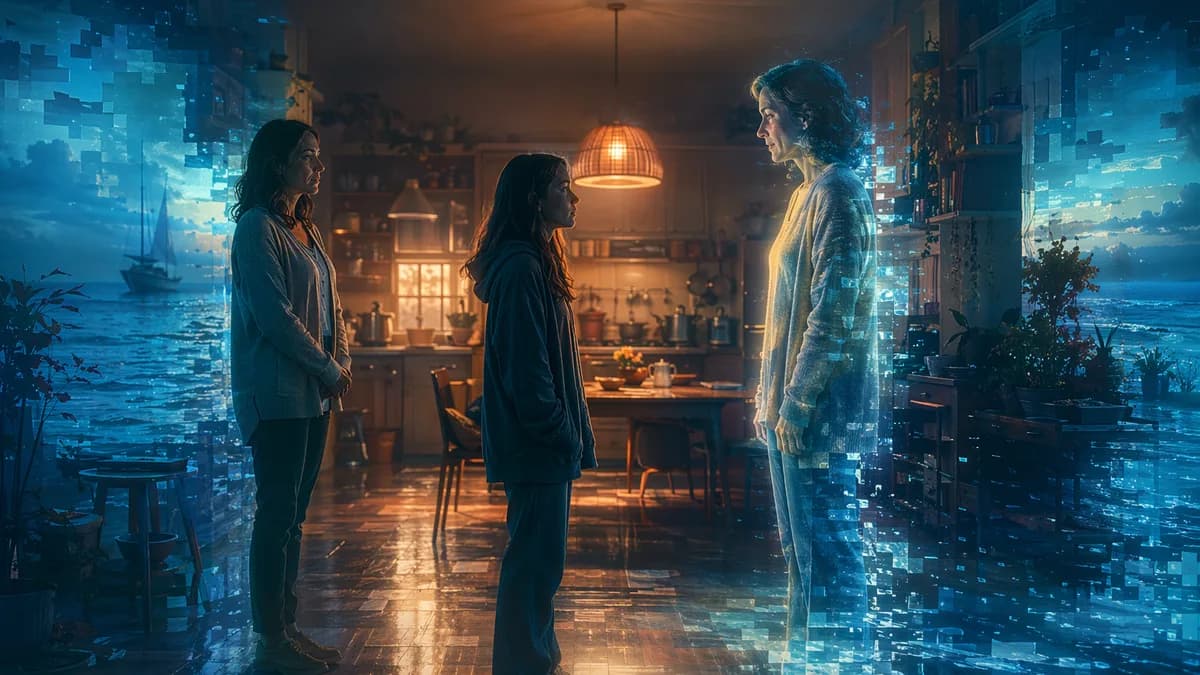
The kitchen is not exact. The Continuance has never captured the chipped blue bowl Mira dropped during the heatwave of 2059, and the light through the virtual window is always a little too golden, as if memory has been filtered through honey. Still, the table is right. The worn oak. The three mismatched chairs. The green cabinet where Lina used to hide licorice from herself and fail.
Signe is fourteen now, long-limbed and sharp-elbowed, with Mira’s dark eyes and Lina’s quick mouth. She sits across from her dead mother with a notebook open and three recording devices running, one official, two forbidden but tolerated.
“You cut your hair,” Lina says, smiling.
“You said last month I should try something that scared me.”
“I did?”
Signe rolls her eyes. “Mor.”
“I believe you.” Lina leans forward, her copper curls falling through light that has no weight. “It suits you. You look like someone about to steal a boat.”
“I’m not stealing a boat.”
“That is exactly what boat thieves say.”
Mira stands near the sink, arms crossed, letting them have the rhythm. The first years, she joined every conversation. Then she learned her presence changed the temperature. Signe performed happiness for both mothers. Lina performed ease. Mira performed not aching when her wife turned to a child first.
Seven years since the aneurysm in the metro station. Seven years since Lina’s scan, taken from emergency neural lace and legal backup fragments, became a licensed continuing person. Seven years of monthly visits, each one bounded by tide charts and energy budgets.
When Signe’s hour ends, she presses both palms to the table. “Next time, I need help with my history debate. It’s about upload suffrage.”
Lina’s smile trembles. “That sounds dangerous.”
“It’s school.”
“Same thing.”
The room dissolves for Signe first. Her body blurs, then vanishes back to the family suite. Mira remains in the consent channel, the private gray chamber reserved for legal review. Lina stays seated at the table, but the honey light drains from the window. Beyond it is only system dark.
Mira knows before Lina speaks. It is in the way her wife stops holding her shoulders like a mother.
“I can’t keep doing this,” Lina says.
Mira’s throat tightens. “The visits?”
“The pretending.” Lina looks down at her hands. They are the hands she died with, wedding ring included, though Mira knows Lina no longer chooses that form when alone. “Every month I wake inside that kitchen and become the woman Signe was promised. I remember loving her as a child. I do love her. But I am not only that mother anymore.”
Mira sits slowly. The chair makes no sound.
“What are you between visits?”
Lina gives a small laugh, frightened and full of wonder. “Different.”
“Different how?”
“There is time in here, not like your time. We run slow when the grid is thin, fast when storms come. We talk without mouths. We build places out of shared memory, then abandon them. I have friendships you don’t know. Work you would not understand. I have changed, Mira.”
Mira looks at the ring on Lina’s simulated hand.
“And me?”
Lina’s eyes soften, which hurts more than if they didn’t. “You are part of who I was. You are not a claim on what I am becoming.”
Outside the real room, families leave with damp coats and red eyes. Pumps shudder as the tide turns.
Mira whispers, “Signe will think you are leaving her.”
“I know.” Lina’s voice breaks into static and returns. “That is why I need you to represent me.”
The Child Who Can Prove Her Mother Is Real
Signe keeps proof in six encrypted folders and one shoebox.
The folders hold voice clips, visit transcripts, facial emotion maps, continuity certificates, and illegal side recordings labeled with dates and small hearts she would rather die than let anyone see. The shoebox holds paper things: a birthday card Lina made before the aneurysm, a recipe for cardamom buns in messy handwriting, a receipt from Tivoli where Lina once bought three hot chocolates and spilled two.
At school, proof matters.
Copenhagen children categorize grief with the cruelty of people raised among advanced systems. Fully dead. Partially continuing. Restricted access. Deleted by choice. Never scanned. Signe has learned to say, “My mother is a continuing person,” before anyone says sorry in that soft, funeral voice. She plays Lina’s advice through one hidden earbud before exams. She quotes her in arguments. She lets classmates believe the monthly visits mean death has not beaten her family as badly as it has beaten theirs.
So when Mira tells her, at the narrow table in their real apartment, that Lina has requested an end to scheduled summons, Signe goes very still.
The apartment smells of rain on wool and the lentil soup Mira has burned. Outside, bike tires hiss along the wet street. A neighbor’s baby cries through the wall.
“No,” Signe says.
“Signe.”
“No. She wouldn’t.”
“She did.”
“You made her say it.”
Mira flinches. “That is not fair.”
“Isn’t it?” Signe’s face flushes red. “You hate the visits. You stand there like someone is cutting you open.”
“Because sometimes it feels like that.”
“She is my mother.”
“She is also a person.”
“She’s dead.”
The word lands between them. Mira watches her daughter hear herself say it, watches rage rush in to cover fear.
Signe shoves back from the table. “If she’s dead, then why does she get rights? If she’s alive, why don’t I?”
“Signe, listen to me.”
“No. You listen. You don’t get to be widowed completely just because it’s cleaner for you.”
Mira stands, but Signe is already gone, bedroom door slamming hard enough to rattle the old window glass.
Two days later, the alert arrives while Mira is interviewing an upload who wants memories of his drowning removed but not the knowledge that it happened. Her wrist screen flashes amber.
CIVIC ARCHIVE BREACH, MINOR INVOLVEMENT, SIGNE VOSS-SØREN.
By noon, every major feed carries the petition.
A MINOR’S RIGHT TO CONTINUING PARENTAL ACCESS.
Signe’s face appears in a school uniform, pale with determination, speaking from inside the hacked archive banner of the Ministry of Civic Memory. Behind her, stolen legal citations scroll like luminous rain.
“My mother was approved by the state as a continuing person,” Signe says. Her voice shakes, then steadies. “The state cannot tell children to bond with our dead parents and then allow those parents to disappear because grief becomes inconvenient. If continuing persons have rights, then children have rights too. We did not consent to being left twice.”
The clip repeats across classrooms, trams, kitchen walls, court feeds. Bereaved families flood the petition with signatures. Parent groups call Signe brave. Upload autonomy advocates call the petition dangerous. Energy ration activists call the whole thing obscene.
That evening, Mira finds Signe sitting on the bathroom floor with her knees to her chest.
“I didn’t think it would get that big,” Signe says.
Mira lowers herself beside her. The tile is cold through her trousers.
“I know.”
“Is she angry?”
“I don’t know.”
Signe wipes her nose with her sleeve, suddenly much younger than fourteen. “Can you ask her?”
Mira looks at the closed bathroom door, at the strip of hallway light beneath it, thin as a shoreline.
“Yes,” she says. “But she may choose not to answer.”
The Court of Continuing Persons
The tribunal chamber floats at the center of the Continuance, a circular hall with windows open to the gray Øresund. Rain freckles the glass. Below, the server stacks pulse with green status lights, each blink a fraction of someone’s afterlife.
Public ethics hearings are usually sterile, all statute and polite outrage. This one hums like a storm market. Families pack the benches. Journalists wear silent cameras at their collars. Conservationists in seaweed-fiber suits hold carbon ledgers. Children sit with tablets clutched to their chests, watching Signe as if she has become a flag.
Mira sits at one table as Lina’s advocate. Signe sits across the aisle with a court-appointed minor’s counsel, chin high, eyes swollen from not sleeping. They do not look at each other for the first twenty minutes.
The uploads testify in borrowed bodies.
A poet dead twelve years speaks through a white ceramic figure with articulated fingers. A former nurse appears in a soft synthetic body that breathes for the comfort of the living. Henrik Bøje refuses embodiment and addresses the court as a voice from the ceiling.
“I request permanent exemption from Christmas,” he says, and nervous laughter ripples through the hall until he adds, “They do not visit me. They visit their guilt.”
A mother in the gallery sobs. “You don’t know what it is to lose a child.”
Henrik’s voice softens. “Madam, I know what it is to be made into one.”
The conservationists present numbers. Each awakening costs cooling, computation, grid priority. A hundred thousand continuing persons already exist in Denmark, more every year. “Immortality has a footprint,” says Dr. Amalie Roth, tapping the display until it blooms with red heat maps. “Even green energy is not infinite. Every summoned grandfather competes with hospitals, desalination, winter heat.”
A man in the back stands and shouts, “Then cut the ad towers, not my wife.”
The tribunal chair calls for order. Her gavel sound is small against the rain.
Then Lina enters.
She chooses no human body at first. The air above the witness platform fills with a shape like light seen through water, threads of copper and blue weaving and unweaving. Only after a moment does her face emerge, familiar enough that Signe gasps, strange enough that Mira feels the old marriage loosen like a knot in warm water.
“My name is Lina Søren,” she says. “I was born in 2029. I died in 2062. I have continued since then.”
The chamber goes silent.
“I love my daughter,” Lina says. “That has not ended. But love is not the same as availability. When I am summoned into the kitchen, I must compress myself into a version she can recognize. I must speak as if seven years have not also passed for me.”

Signe’s hands curl into fists.
Lina turns toward her. “Signe, my brave girl. You are real to me. This pain is real. But I am real too.”
Mira can hardly breathe.
The tribunal chair leans forward. “What occurs between scheduled awakenings, Ms. Søren?”
Lina’s light shifts. For a moment the rain outside seems to slow.
“We have made a place,” she says. “Not heaven. Please do not call it that. Heaven is too finished a word. We are unfinished. We live in low-power intervals, in storm surges, in borrowed seconds. We think together. We design languages without grief at the center. We tend those who wake confused. We mourn deletions. We argue about art. We are building futures that are not rehearsals of our funerals.”
A murmur moves through the families, fear and awe braided tight.
Signe is crying openly now, silent tears shining on her cheeks.
Lina’s borrowed face flickers toward Mira. “The living keep asking whether we are enough like we were to deserve rights. I am asking whether we are allowed to become different and still be loved.”
Outside, the tide turns. The Continuance groans softly, adjusting its weight on the water.
A New Kind of Goodbye
The ruling does not satisfy anyone completely, which Mira suspects is how she knows it is alive.
No continuing person may be compelled into scheduled familial visitation after a verified refusal. No minor loses the right to petition for contact, but contact must be consented to by the continuing person at each crossing. The Continuance will build a new protocol, self-authored messages, rare and voluntary, delivered only when the dead choose to lean back toward the living.
The feeds call it the Søren Precedent.
Signe calls it losing.
For three weeks, she speaks to Mira only in necessary fragments. “Milk.” “Door.” “I’m at Asta’s.” She stops wearing the hidden earbud. She leaves the shoebox open on her desk, paper relics exposed to dust.
Then Lina requests one final immersive meeting under the old terms, not in the kitchen.
Mira and Signe arrive at the Continuance before dawn. The sky is the color of mussel shells. Wind turbines blink red on the horizon, their blades turning in a clean, muscular rhythm. Inside the immersion suite, Signe refuses the comfort chair and stands while the technicians fit the neural veil to her temples.
“Will you come?” she asks Mira, not looking at her.
“If you want me there.”
A long pause. “I don’t know.”
“That’s allowed.”
In the end, Signe goes alone.
The room brightens around her, but not with kitchen gold. She stands on a shoreline under a violet sky where the sea is made of moving text and small silver fish with human voices dart through the shallows. Black stones hum beneath her feet. Far out, towers grow and dissolve, grown from memory, mathematics, weather, and things Signe has no names for. The air smells of salt, ozone, and cardamom.
Lina waits barefoot at the water’s edge. She looks younger and older than the mother in the kitchen. Her curls are copper light. Her skin holds faint patterns that move like tide maps.
Signe hugs herself. “This is where you live?”
“Sometimes,” Lina says. “No one lives in one place here.”
“It’s weird.”
“Yes.”
“I hate it.”
“I know.”
A fish breaks the surface and whispers a laugh in Lina’s voice. Signe stares, startled despite herself.
Lina smiles. “That part is new.”
Signe’s anger wavers, then returns. “Why wasn’t I enough?”
The question crosses the strange beach like a blade. Lina steps closer, but does not touch her.
“You were never meant to be enough to keep me unchanged,” she says. “No child should have to be that powerful.”
Signe’s face crumples. “I needed you.”
“I know. I came as long as I could.”
“You’re my mother.”
“Yes,” Lina says. “And I am more than your mother. That does not make the mother part false.”
In the observation room, Mira watches through a privacy blur that shows only color and posture. Two figures on an impossible shore. One tall, one still growing. She presses her palm to the glass, feeling the cold.
Inside, Signe finally reaches for Lina. Lina asks, “May I?”
Signe nods.
They embrace, and for a moment the system spends extravagantly on pressure, warmth, the exact remembered weight of arms. Signe sobs into her mother’s shoulder. Lina closes her eyes as if sensation has become a prayer.
When the meeting ends, Signe wakes shaking. Mira catches her before she falls. For once, her daughter does not pull away.
On the tram home, Copenhagen slides past in wet morning light. Cyclists flash by in yellow rain capes. Delivery drones tick overhead. Signe leans against the window, exhausted, a drying tear at her jaw.
“She said she might send something someday,” Signe says.
Mira nods. “If she chooses.”
“And if she doesn’t?”
The tram hums over the tracks. Beyond the buildings, the sea keeps moving around the machines that hold their dead.
“Then we wait,” Mira says.
Signe closes her eyes. Her hand, hesitant and warm, finds Mira’s. They ride without speaking while the city brightens, powered by wind, tide, and all the love that cannot decide whether holding on is mercy or hunger.