
The Courtesy of Waiting Stars
When an alien message is found hiding in the silence between broadcasts, humanity must decide what kind of listener it wants to become.
The Quiet Minute
At 03:00 UTC, the world holds its breath.
Leena Or stands barefoot on the chilled concrete floor of the Pacific Acoustic Observatory, one hand wrapped around a mug of kelp coffee gone bitter, the other hovering above a wall of signal streams. Outside, rain hisses over the black cliffs of the Oregon coast. Below the observatory, the ocean chews stones in the dark. Hydrophones listen to whales. Antennas listen to satellites. Weather buoys blink red and green through mist like small, patient animals.
Every year, for sixty seconds, the orbital companies perform the Quiet Minute. It began as maintenance theater, a coordinated diagnostic pause to recalibrate crowded bands. Then the ecologists proved that even one minute of relief changed whale movement, improved ionospheric readings, and gave rural skies a brief reprieve from the pale insect trails of low orbit. Now it is ritual, regulation, and public relations in equal measure.
“Thirty seconds,” says Mateo from the next console.
Leena watches the orbital clutter thin. Navigation chatter dims. Broadband constellations drop into standby. Advertising balloons over the equator mute their endless auctions. For once, the spectrum does not look like a city at noon. It looks like snow before footprints.
“Ten,” Mateo says.
Leena closes her eyes. She thinks of whales turning under moonless water, of farmers in Nepal seeing a clean starfield, of all the machines obeying one small act of discipline.
Then the pause arrives.
The room changes. Not in sound, because the observatory is never loud, but in pressure. The monitors soften into spaciousness. The hydrophone feed carries a blue whale’s low note, so deep Leena feels it in her ribs. Atmospheric noise flickers. Solar wind scratches.
And there, in the microwave scatter from interplanetary dust, something answers by not answering.
Leena opens her eyes.
A lacework of reflections blooms across the screen, faint as breath on glass. Dust between Earth and Mars glints in timed sequence, not emitting, not transmitting, only shaping what little radiation remains. The pattern bends around the silence like a hand testing water.
“Mateo,” she says.
“I see it.”
“No, you don’t.” Her voice goes dry. “Zoom on the gap after second thirty-four.”
He does. The reflection repeats in nested intervals, prime-like but not primes, musical but not melody. Too structured to be natural. Too delicate to be a beacon. It vanishes the instant the satellites wake, swallowed by commerce, navigation, weather, gossip, everything human beings fling outward without listening first.
The room fills again with signals.
Leena stares at the empty place where the impossible thing had been.
Mateo whispers, “Was that ours?”
Leena feels the old grief stir under her sternum, sharp and familiar.
“No,” she says. “I think it was waiting.”
## A Message Made of Absence
They try to make it repeat, and it refuses.
For six months, Leena lives between wet dawns and stale midnight noodles, between government calls and lab arguments that leave coffee rings on every flat surface. The pattern from the Quiet Minute sits in secured archives, replicated in simulations, challenged by every crank and genius allowed near it. No known satellite constellation produces it. No military exercise accounts for it. No solar phenomenon imitates its manners.
It appears only when humans stop shouting.
A second pause, authorized secretly by three space agencies and one terrified insurance consortium, produces a clearer structure. Not louder. Never louder. Clearer, like a face seen when fog thins. A third pause, requested voluntarily by observatories, rural broadband cooperatives, and two monasteries with old radio telescopes, reveals something stranger still.
“It’s not content,” says Dr. Hana Vey, a linguist whose hearing aids glow pearl-blue behind her ears. She taps the projection with a stylus. “It’s turn-taking.”
Around the table sit people Leena would never have invited into an astrobiology crisis if the universe had been more conventional. A Benedictine monk in hiking sandals. A Deaf accessibility engineer from Nairobi named Sefu, who thinks in timing diagrams and signed grammar. Three children’s game designers from Manila who specialize in cooperative play for ages four to seven. A Tibetan nun with a laugh like a struck bell. Two negotiation theorists. One exhausted whale biologist.
The pattern changes depending on the quality of the silence. If the pause is coerced, riddled with secret military chatter, the structure blurs. If communities choose quiet and emergency channels remain clean and protected, the pattern sharpens. If broadcasters leave a small courtesy interval before resuming, the dust reflections form loops that resemble acknowledgment.
“It is testing whether we interrupt,” Sefu signs, while an interpreter speaks beside him. “Not whether we can calculate. Toddlers can calculate, if you give them enough machines. Can we wait?”
One of the game designers, Imani, lays colored tokens across the table. “It behaves like a child at the edge of a circle. It joins when the circle makes space.”
The monk smiles. “Or like a guest at a door.”
Leena dislikes the softness of that. Guest. Door. It makes the thing sound small enough to host, when it may be older than continents.
At night, she replays the intervals alone. The signal is a message made of absence, grammar carved from restraint. No numbers proclaiming hydrogen. No star map, no portrait of alien anatomy, no triumphal greeting across the void.
Only this: I speak when you leave room.
Leena sits in the blue light of the console and hears her daughter’s voice from years ago, impatient in the back seat. Mama, you never let the song finish.
She takes off her glasses and presses her palms to her eyes until stars burst behind them.

## The First Public Listening
The announcement does not show a saucer, a tentacle, or a burning message from God.
It shows an empty spectrogram.
Leena stands behind the secretary-general in Geneva while the world watches through cracked phone screens, classroom walls, subway panels, temple projectors, market kiosks, and illegal rooftop feeds. Her hands tremble at her sides. The secretary-general, an old woman with a voice like paper rubbed smooth, explains that an extraterrestrial etiquette structure has been detected in the intervals of global radio quiet. Not a command. Not a threat. An invitation to participate in silence.
One hour, locally chosen within a twenty-four-hour window. Emergency channels protected. Hospitals, aviation, disaster warning, and assistive devices exempt and shielded. No government is to cut civilian speech by force. Communities must choose.
The world reacts like a kicked anthill.
Markets dive, recover, dive again. Influencers sell anti-alien signal hats lined with copper mesh. Conspiracy groups scream that quiet is censorship wearing a halo. One minister calls it “surrender to the vacuum.” A pop star releases a track with fifty-seven seconds of silence between heartbeats and it becomes the most shared song in Brazil. Imams, rabbis, priests, monks, shamans, atheists, and philosophers argue in livestreamed panels about whether restraint can be prayer if no one is being addressed.
Teenagers understand first, or at least they pretend to.
In Lagos, they paint listening circles on basketball courts. In Seoul, students design black-and-silver festival masks with antennae folded politely downward. In Kansas, a high school astronomy club convinces three counties to dim their sky ads and hosts a picnic called First Shut Up. The name trends for nine hours before educators replace it with First Listening, which no one uses.
On the appointed day, Leena returns to the observatory. Staff bring soup, blankets, and old analog radios turned off for symbolism. Outside, volunteers line the cliff path with shielded lanterns. The sea is pewter under low clouds.
Mateo nudges her shoulder. “You ready to be historic?”
“No.”
“Good. Historic people are unbearable when they’re ready.”
At 19:00 local time, the coastal towns begin. First the tourist drones settle in their nests. Then the harbor routers dim. Then private uplinks, entertainment bands, delivery beacons, weather advertisements, hobby relays. Not all of them. Never all. Somewhere a pirate station plays a recording of a goat screaming. Somewhere a man transmits scripture at full strength. Somewhere a billionaire refuses to mute his vanity constellation until regulators threaten to publish his tax shelters.
Still, the noise falls.
On Leena’s screen, the space between planets brightens with impossible courtesy.
In the room, no one cheers. They have learned that cheering can wait.
## Leena’s Untranslatable Grief
Leena’s daughter dies in 2049, on a highway outside Fresno, while the sky is the color of rusted metal.
Her name is Nia. She is eight years old. She has a gap between her front teeth, a passion for sea slugs, and a habit of asking whether clouds feel crowded. During the Cascadia Heat Migration, when inland temperatures climb past survivable limits, evacuation orders move through overloaded networks in fragments. Navigation satellites stutter under emergency demand and private traffic. Local towers fail, reboot, fail again. Rumors outrun instructions. Roads clog in patterns no planner predicts because every app is screaming a different truth.
Leena is in Oregon, helping reroute oceanic emergency bands to coastal shelters. Her husband, Ravi, drives with Nia and his mother through smoke and heat shimmer. They receive three evacuation routes in seven minutes. Two are obsolete. One sends them toward a service road already locked by fire crews. By the time a clean message reaches them, Nia’s asthma has become a small animal trapped in her chest.
The official report says cascade failure, thermal stress, communications congestion, delayed triage.
Leena says nothing for almost a year.
Now reporters want to make Nia into a symbol. They find old photos, her painted cardboard whale, her school essay about wanting to teach jellyfish to read. They ask Leena whether first contact feels like a message from her child.
“No,” Leena says, too sharply, on a panel watched by half a billion people. “My daughter is not a metaphor you can use to make history feel kind.”
The clip loops for days.
Privately, the question of Earth’s first reply becomes unbearable. Nations draft statements. Poets submit lines. Mathematicians propose elegant sequences. Corporations lobby to include brand-neutral signatures, which fool no one. A coalition of bereaved parents asks to send names of children lost to climate disasters, wars, floods, heat, hunger, broken warnings.
Leena reads the request at her kitchen table. Rain taps the window. Ravi, older now in the face than in the hair, washes two bowls slowly.
“They mean well,” he says.
“I know.”
“You don’t want her name sent?”
Leena looks at the dark glass and sees herself layered over the room, ghosted and thin. “I want her to have lived in a species that learned in time.”
Ravi turns off the water.
At the next assembly, Leena stands before ministers, engineers, clergy, and CEOs with polished shoes.
“If we answer with a sentence, we will lie,” she says. “We are very good at sentences. We are good at memorials, apologies, anthems, slogans. But this protocol did not ask what we can say. It asked whether we can change our behavior without being forced.”
Someone mutters that behavior is not a language.
Leena hears Nia in the back seat, demanding the end of a song.
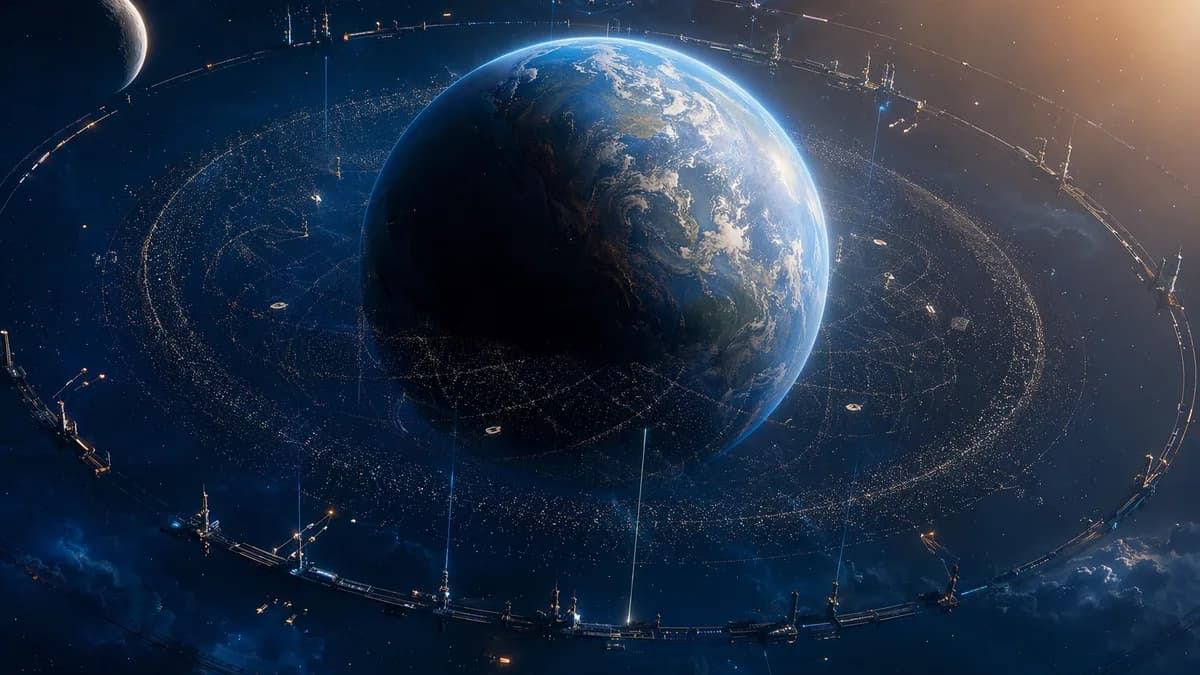
“It is the first language,” she says.
## The Listener Laws
The treaty takes sixteen months, three walkouts, one orbital sabotage attempt, and countless bowls of bad conference soup.
They call it the Listener Accord at first. Then activists call it the Listener Laws, and the name sticks because it sounds less like diplomacy and more like something parents teach children before crossing a street. No one may compel spiritual silence. No state may use the quiet intervals to suppress dissent. Emergency speech is sacred. Assistive technologies are protected. Orbital networks must include low-noise modes, transparent audits, and shared pauses. Advertising visible from dark-sky zones is taxed into extinction. Acoustic sanctuaries expand around whale routes, bat caves, bird migrations, and human neighborhoods where sleep has become a luxury good.
The companies resist until the engineers begin defecting.
“You can build quieter,” Leena tells a satellite executive in a hearing room that smells of carpet glue and raincoats. “You chose cheap noise.”
He smiles with porcelain teeth. “Consumers chose connection.”
A young systems architect behind him says, very softly, “We gave them addiction and called it connection.”
The clip becomes another anthem.
Cities adapt in uneven, beautiful ways. Nairobi installs listening towers that glow only when bands are clean. Mumbai’s trains keep running during quiet intervals, but their ad panels go dark and commuters look at their own reflections with startled embarrassment. Reykjavik turns old data centers into aurora labs. In the Amazon, Indigenous councils negotiate spectrum sovereignty and teach visiting regulators that quiet has never meant emptiness.
Social networks change last and worst. Delay-respecting platforms emerge, designed to prevent instant outrage from trampling thought. Before replying, users must wait through a visible breath, a ripple on the screen, a recorded sound from their own region. Frogs. Traffic. Wind in dry grass. Many hate it. Many leave. Some return after discovering that a slower insult often becomes no insult at all.
Schools teach listening as civics. Children practice taking turns with radios, drums, and silence. They learn that an unanswered moment is not a failure. It can be a chair left open.
Leena visits classrooms sometimes. She brings spectrograms, whale calls, and a small brass bell Nia once used to summon dinner guests during pretend restaurants.
A boy in Vancouver raises his hand. “Are the aliens nice?”
Leena considers lying.
“I don’t know,” she says. “But they are patient.”
“Is patient the same as nice?”
Outside, low-noise satellites cross the afternoon sky invisibly, doing their work without glittering over everything.
“No,” Leena says. “It may be harder.”
## The Second Turn
Three years after the first public listening, Earth becomes known to itself by its pauses.
They do not happen everywhere at once anymore. That was spectacle. Now quiet moves like weather, like migration, like lantern light passed from hand to hand. A fishing village in Chile. A hospital district in Jakarta after surgeries end. The night side of Europe in staggered bands. A chain of desert observatories. A prison library. A refugee settlement where children guard the emergency radio with solemn pride while adults sit outside tents and listen to wind comb dust across plastic.
The pattern in the interplanetary dust grows denser.
Leena is sixty-one when the second turn unfolds. Her hair, once black, is silver at the temples. Her knees dislike stairs. She still works too late. On a clear winter night, the observatory roof opens and cold air pours in, smelling of salt, cedar, and metal. The Milky Way lies overhead, no longer washed pale by careless machines.
Inside, the team watches the dust reflections resolve into relational geometry. Not a map in the imperial sense, no arrows saying go here, no coordinates begging conquest. It is a choreography of pauses associated with stars. Civilizations marked not by volume, but by the shape of their restraint. Some wait in long intervals like deep-sea pulses. Some flicker in communal clusters. Some have gone still, perhaps dead, perhaps listening beyond anything humans can parse. Many are young. Many are old.
Mateo, now rounder and slower, wipes his eyes with his sleeve. “We’re not alone.”
Leena looks at the display and feels the sentence fail. Not wrong, just too small.
The shock is not that others exist. The shock is that they have been courteous. That intelligence, across gulfs of radiation and dust, may not be measured first by engines, weapons, monuments, or speed, but by how gently it occupies what it touches.
“What do we send?” Hana asks.
Leena stands before the recorder. The reply has been debated for years, but its final form is simple. No speech. No anthem. No flag encoded into stars.
At the appointed interval, Earth leaves room.
Emergency channels remain alive, bright threads in the hush. Around them, the planet softens. Ocean microphones carry whale song, shrimp crackle, the groan of ice. Cities contribute low breath, elevators resting, tires on wet streets, a baby crying and being soothed in Quito, prayer beads clicking in Dakar, a kettle cooling in Dublin, teenagers laughing once and then remembering.
Leena places Nia’s brass bell beside the console but does not ring it.
The pause travels outward at light speed, filled with unforced attention. Somewhere far beyond the planets, dust receives the shape of it. Somewhere, perhaps, patient listeners notice that Earth has learned not to begin by speaking.
Leena watches the quiet leave them and wonders what else in the universe has been waiting for room.