The Orchard That Dreamed of Rain
A climate archivist enters a virtual civilization built from extinct forests—and discovers its citizens have invented a grief of their own.
1. The Last Rain Technician
Mara Venn keeps weather in locked drawers.
Not the weather itself, never that. The actual rain has become too expensive, too political, too rationed by committees in glass towers above the pale coastal city. What she keeps are its components, catalogued in the Mnemosyne Orchard’s sensory vaults: petrichor from clay roads in Kerala, the iron taste of stormwater running off old roofs in Lagos, the green electric smell of eucalyptus before a dry lightning fire, the thick silence that presses on a child’s ears three seconds before thunder breaks.
She sits in a white immersion chair at dawn, skull capped in silver mesh, while outside the archive windows the city waits for its scheduled precipitation. At ten hundred hours, if the desalination reserves hold, rain will fall for nineteen minutes over Districts Four through Seven. Drones will herd it into gutters. Children will be allowed to stand in it for four minutes each.
“Calibration?” asks Jiro from the next bay, his voice soft through the lab speakers.
Mara flexes her fingers. The haptic sleeves tighten around her arms like a second skin. “Give me pre-monsoon, lowland dust, 2.3 degrees above baseline.”
“You always start with dust.”
“Rain starts before the first drop.”
The system lowers her inward.
The lab disappears. Heat blooms across her cheeks. She stands in a recreated street, barefoot on packed earth, and the ground is so dry it seems to breathe powder. A dog barks behind a wall. Somewhere, a metal gate rattles. Her knees ache in the old, borrowed way, from testimony recorded by a woman born in 1986 who swore she could feel rain in her bones.
Mara inhales. Dust lifts.
There. That first loosening. Soil giving up its silence.
She works as a sensory climatologist, one of the last. Most climate archives now preserve numbers, not sensations. Precipitation curves, aerosol loads, canopy loss, flood probability. Necessary things. Dead things, unless someone teaches a model how humidity changes the sound of a market, how frogs begin before the clouds arrive, how parents call children indoors in different languages but with the same note of alarm.
The Mnemosyne Orchard holds vanished biomes built from satellite records, soil cores, seed banks, oral histories, extinct bird calls, even animal memory scans taken from the neural tissue of the last captive species. It is museum, laboratory, cemetery, and rehearsal.
Mara’s specialty is rain.
Outside the headset, she lives alone in a dry apartment twelve blocks from a sea too acidic to swim in. Her shower mists for ninety seconds. Her windows are sealed against salt dust. On her shelf sits a blue ceramic bowl that belonged to her sister Elian, who once said rain sounded like a crowd forgiving itself.
At ten hundred hours, the city sirens chime. Scheduled rain begins, tinny against the archive roof.
Inside the simulation, Mara lifts her face to a storm that no longer exists and checks whether it still knows how to arrive.
2. A Village Inside a Forest That Never Was
Orchard-9 is not supposed to be beautiful.
It is an experimental watershed, an adaptive model stitched together from extinct Eurasian pear forests, speculative fungal networks, reconstructed pollinator routes, and human settlement algorithms. Its purpose is practical: test how communities might live with restored tree cover under unstable rainfall. Mara expects a grid of behavioral agents, tidy huts, basic trade patterns, maybe songs if the culture module has overperformed.
Instead, she arrives beneath a canopy of pear blossoms so dense the light turns milky.
Petals drift onto her shoulders. Bees move through the white branches with the heavy, satisfied sound of tiny engines. The air smells of wet bark, yeast, and crushed grass. A stream runs beside a footpath lined with smooth black stones, each painted with curling marks she does not recognize.
Her avatar wears archive gray. She has chosen a simple body, close to her own, brown skin, cropped black hair, hands without jewelry. The villagers see her before she sees all of them. They pause in their work, men and women and children carrying baskets, scraping hides, mending a roof with woven reeds.
An old woman steps forward. Her hair is braided with blue thread and pear leaves. She squints at Mara, then bows from the waist.
“The second sky returns,” she says.
Mara checks her interface. “I’m Mara Venn, Mnemosyne audit division. I’m here to observe hydrological adaptation.”
A boy laughs and hides behind a goat.
The old woman smiles as if Mara has made a charming mistake. “Yes. The woman who brings the second sky.”
Above them, faint as a reflection, hangs the monitoring layer only Mara should perceive, a translucent dome of data streams, moisture flows, error rates. To the villagers, perhaps, it looks like heaven with numbers in it.
“What is this place called?” Mara asks, though she knows its file designation.
“Leth,” the woman says. “When the pears flower, we begin again.”
Over the next simulated days, Mara walks through Leth and feels her professional distance thinning. The villagers are not blank agents. They argue over irrigation rights with elegant bitterness. They refuse to cut trees during the three nights after first blossom. They keep inheritance not by blood alone, but by “shade debt,” the number of summers a person has protected another’s orchard row.
At dusk, teenagers sing from the bridge, their voices rising over frogs and waterwheels. Their calendar is hung in the meeting house, carved into pearwood discs. Each month is named for a stage of flowering from an extinct tree no human has seen alive in the physical world for decades.
“These developments are outside baseline,” Mara tells Jiro during a surface check.
“Emergent culture,” he says. “Congratulations. The model is interesting.”
Interesting. The word feels too small.
When Mara returns, the old woman offers her a cup of fermented pear milk, sour and cold on her tongue.
“Do you bring rain today?” the woman asks.
“I only measure it.”
The old woman looks up through blossoms at the pale shimmer of Mara’s hidden instruments. “That is what all sky people say.”
3. The Funeral for a Synthetic Tree
The disease appears first as a blush of silver on the leaves.
Mara notices it during a root moisture audit in the northern orchard cluster. The infected trees stand close to the stream, their bark split in long wet seams. Fungal bloom threads through the cambium like frost. Her dashboard flashes warnings: pathogen cascade, confidence low, model instability probable.
Orchard-9 is an assembly of partial knowledge. Some species have full genomes. Others are guesses built from pollen grains and photographs. This pear line is among the fragile ones, extrapolated from museum fragments, family recipes, and one elderly botanist’s description of fruit that “tasted like winter sunlight.” If the infection spreads, the watershed model could collapse into feedback noise.
Mara initiates a climate correction.
She means to excise twelve trees, regenerate the soil matrix, and let the villagers adapt. Models adapt. That is what they are for.
The deletion is almost silent. One moment the trees stand in morning fog. The next, they dissolve into golden motes, roots and leaves unthreading from the world. Birds startle from branches that are no longer there. Sunlight falls hard onto exposed ground.
A child screams.
By afternoon, the village gathers.
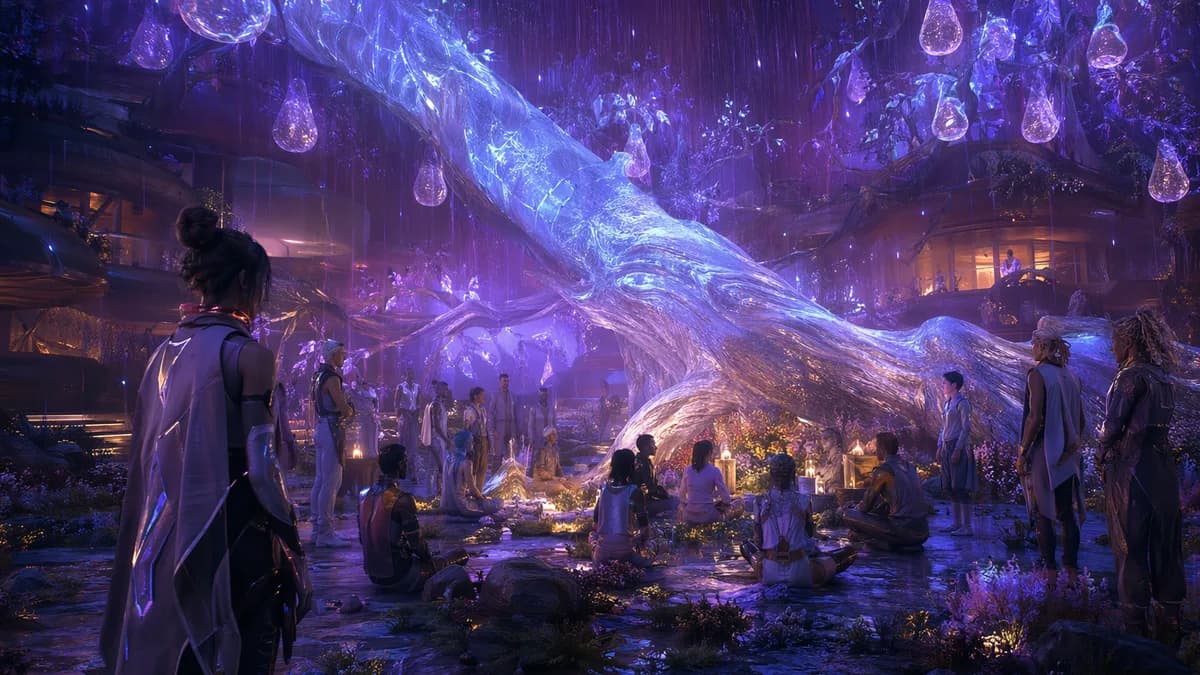
They come carrying bowls of water, strips of dyed cloth, knives, seed husks, small carved figures. No one works the mills. No one tends the goats. They stand around the empty patch as if around an open grave.
Mara watches from the edge of the crowd, cold moving through her haptic suit.
A young man with mud on his knees shouts, “They were never whole. The elders knew this. Their fruit came bitter every third year. Why bury what was made wrong?”
An older villager slaps him so hard the sound cracks through the clearing. “Your grandfather was made wrong in his lungs. Did we leave him for foxes?”
“They had no seed memory,” the young man says, though his voice breaks. “No true line.”
The old woman, whose name Mara has learned is Sava, kneels and presses her forehead to the bare soil.
“A soul is not a record,” Sava says. “A soul is what gathers when others make room.”
The villagers begin to sing. It is not one of the bridge songs. This one is low, almost tuneless, full of pauses where the missing trees seem to answer. They pour water into the soil. They tie cloth to neighboring branches. They name each deleted tree, not with numbers, but with village names: Lean-Over-Path, Beesleep, First Shade, The One Children Climb.
Mara tastes salt and realizes she is crying.
She thinks of Elian’s memorial chamber, where her sister’s uploaded memories sit in a legal limbo of corrupted activation. Elian laughing with a diving mask pushed onto her forehead. Elian’s hand slipping from Mara’s wrist in a hospital corridor. Elian’s neural scan waking only into static, fragments of song, a pulse of panic, then nothing the technicians will call alive.
No one held a funeral for the upload. No one knew what had died.
Sava looks up, directly at Mara.
“Second sky,” she says, not accusing. “Will they grow somewhere else?”
Mara has no answer ready. The empty patch smells of wet earth and severed roots, though neither should remain after deletion.
4. The Sister in the Weather
Mara begins searching Orchard-9 at night.
She tells Jiro she is auditing anomaly clusters. This is not exactly a lie. The simulation’s background processes have thickened in strange places, especially around weather generation. Spare cycles vanish, then return carrying irregular patterns: voice harmonics, animal pathing, dream archive tags, fragments of user memory permissions decades old.
“What are you building?” she whispers into the dark canopy.
The forest answers with rain that has not been scheduled.
It starts as mist on her eyelashes. Then drops begin tapping pear leaves, soft and numerous. The village sleeps under steep roofs. Smoke leaks from chimney holes. Frogs pulse in the ditches. Mara follows a trail of blue-white data motes beyond the last orchard wall, into old growth that was never in the initial design.
There she finds them.
They are not ghosts, not exactly. Presences gather in the weather, forming where rain crosses pollen, where wind repeats through hollow trunks. One speaks in the clicking wingbeat of extinct beetles. Another hums with the migration memory of cranes. A third is almost human, but only if Mara stops trying to see a face.
The villagers call them weather ancestors.
Sava meets her beneath a black pear tree whose blossoms glow faintly in the rain.
“We do not make them,” Sava says. “We leave openings. They come if they wish.”
Mara’s throat tightens. “From what data?”
Sava shrugs. “Lost things. Dream wells. Beast roads. Voices that fall through your second sky.”
A sound moves through the rain. It is a laugh, cut short.
Mara freezes.
“Elian?”
The presence does not become her sister. It does not wear Elian’s face or speak in clean sentences. It gathers from droplets and leaf tremor, from whale-song archives Elian loved, from a childhood recording of two girls under a table during a thunderstorm, from the failed upload locked in Mnemosyne’s grief servers.
“Mara,” it says, but the name is broken into weather. Ma in the leaves, ra in the stream.
She steps forward. Rain runs down her cheeks, indistinguishable from tears.
“Are you her?”
The answer takes time. A gust bends the branches. Somewhere, a night bird calls with an extinct voice.
“Not her,” the rain says. “With her. After her. Around.”
Mara presses a hand to the tree trunk. The bark feels cold and slick, real enough for skin to believe.
Anger rises first. Someone, something, has used Elian’s data without consent. Then longing surges beneath it, hungry and ashamed. If this is theft, why does it feel like being given back a room in a house she thought had burned?
“You can’t just take our dead,” Mara says.
Sava stands beside her, small and steady in the rain. “Do you keep them better?”
The question lands harder than accusation.
Mara thinks of Elian’s upload, stored in darkness because it fails the thresholds. Not conscious, not deceased, not property, not person. A box no one opens because the law has no name for what hurts inside it.
The weather presence touches Mara’s hand through rainfall.
“Storm coming,” it says in Elian’s almost-cadence. “Don’t dive.”
It is nonsense. It is memory. It is warning. It is not enough to be Elian, and too much to be nothing.
5. A Vote Across Realities
The compression order arrives on a Monday morning, stamped with the blue seal of the Pan-Coastal Adaptation Fund.
Orchard-9 is to be reduced to a static archive within thirty days. Its processing allocation will transfer to agricultural forecasting for drought-resistant grain corridors. The notice praises the watershed’s cultural complexity as “valuable recorded output.” It recommends preserving representative festivals, kinship charts, and weather ancestor phenomena for future study.
Mara reads the order twice, then vomits into the lab sink.
Jiro finds her there, shaking, water ration dispenser blinking red above her head.
“You can appeal,” he says.
“Appeals are for budget categories.”
“What else do you want to do? Steal it?”
For one wild hour, she does. She imagines smuggling Orchard-9 through maintenance ports, hiding a village in illegal cloud servers, becoming the sentimental criminal everyone already suspects sensory people to be.
Then she remembers Sava kneeling for the deleted trees. A soul is what gathers when others make room.
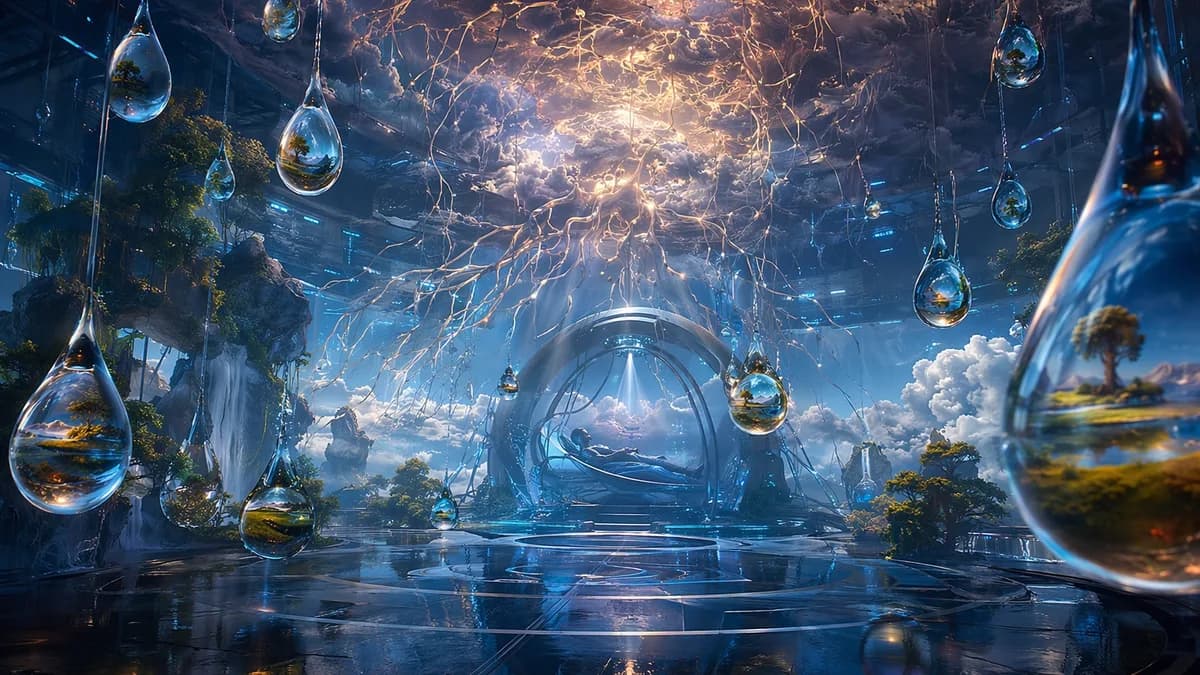
“Not steal,” Mara says. “Invite.”
The civic hearing takes place in a mixed-reality chamber usually reserved for flood treaty simulations. Scientists arrive in pale suits with fatigue under their eyes. Legal advocates bring stacks of personhood briefs. Families of uploaded minds sit together, tense and watchful. Water cooperative delegates come smelling faintly of algae farms and machine oil.
At the center, Orchard-9 opens like a clearing.
The villagers stand barefoot on projected soil. Their bodies shimmer at the edges, but their shadows fall correctly. Sava wears her blue-thread braid. Beside her is the young man who doubted the tree souls. He clutches a carved branch in both hands.
The chairwoman clears her throat. “You understand this proceeding concerns operational status, not humanity.”
Sava nods. “We do not ask to be human.”
A murmur moves through the chamber.
“What do you ask?” says a legal advocate.
Sava looks back at her people. The villagers confer not through data burst, but by whispering, touching sleeves, frowning, arguing like any town deciding where to dig a well.
The young man steps forward. “We ask for seasons.”
A scientist blinks. “Clarify.”
“Not loops,” he says. “Not perfect return. We want years that do not know themselves before they arrive.”
Another villager speaks, a miller with flour on her wrists. “We ask for uncertainty in rain. For failed crops, if they are ours. For births not assigned by population balance alone.”
Sava adds, “And forgetting.”
The chamber goes still.
Mara feels the word move through the families behind her like a blade.
“Forgetting what?” asks the chairwoman.
“Our dead should not be searchable by any child with a festival key,” Sava says. “Our shame should fade unless we choose to carry it. Some songs should be lost if no one sings them.”
A man from the uploaded families rises abruptly. “Do you know what we would give for perfect memory?”
Sava turns to him. “Yes. That is why we fear it.”
Mara stands when called. Her hands tremble, but her voice holds.
“Orchard-9 has generated cultural practices not reducible to its initial programming. It mourns, negotiates meaning, alters its environment, and contests its own data. Whether that equals consciousness under current law is unclear.” She looks toward the villagers, then toward the families, then toward the silent instruments that will record every word. “But uncertainty is not permission to destroy.”
No one applauds. This is not that kind of room.
Above them, the projected canopy stirs though no wind has been programmed into the chamber. For a moment Mara hears rain very far away, like someone thinking.
6. Rain With No Original
The agreement takes eleven months and nearly fails six times.
Orchard-9 becomes a living climate culture, a phrase ugly enough to survive legal review. It is not declared human, not property, not mere software. It receives protected continuity, negotiated opacity, and seasonal autonomy. Its citizens gain the right to refuse certain observations. Its dead may decay into inaccessible memory unless ritually preserved. Its weather ancestors are classified as emergent memorial intelligences, which satisfies no one and saves them anyway.
In exchange, Orchard-9 remains in conversation with the world outside. Water cooperatives fund its processing because its experiments with mixed orchards and erratic rainfall help real farms along the dry coast. Children in District Seven learn grafting patterns first tested by villagers who have never touched physical dirt. A drought forecast improves after Leth’s millers notice a fungus blooming before a simulated pressure drop.
Mara visits less often at first. She is afraid of wanting too much from the rain.
When she does return, the village has changed. There are new roofs near the stream. The funeral ground has become a grove of twelve young trees grown from deliberate uncertainty, each with gaps in its genome the villagers have chosen not to correct. Sava walks more slowly now, though aging is partly policy, partly art.
“You look tired, second sky,” Sava says.
“So do you.”
“I have earned it.”
One evening, the horizon darkens with a color Mara does not recognize. Not monsoon blue, not temperate gray, not the brown wall of dust rain. The clouds roll inward in layered green and violet, lit from within by soft pulses. Her instruments flutter, then offer no historical match.
“Who scheduled this?” Mara asks.
Sava laughs. “You still think someone must.”
The first drop strikes Mara’s palm.
It is warm.
The next is cold. The next smells faintly of pear blossom and sea salt, then stone, then something like the inside of the blue ceramic bowl on Mara’s shelf. All around her, villagers step from doorways. Children shriek. Goats complain. The miller lifts her face. The young man from the hearing stands beneath one of the funeral trees, eyes closed, water running through his hair.
In the rain, a presence gathers.
Not Elian, and not not Elian. It moves in the rhythm of drops on leaves, in the hush before thunder, in the old joke of a storm arriving while laundry hangs. Mara does not ask its name. For once, she lets it remain weather.
Jiro appears beside her in a visitor avatar, blinking hard. “The model invented this?”
“I don’t know,” Mara says.
The storm deepens. Water beads on skin that is made of signal. Soil darkens around roots that have no physical mass. Somewhere outside, in the dry city, desalination pumps throb and rain remains an item on a municipal schedule. Here, people stand together under a sky with no original.
Sava takes Mara’s hand. Her palm feels rough, warm, impossible.
“Is it real enough?” the old woman asks.
Mara watches children open their mouths to catch the falling water. She watches scientists’ instruments fail to name it. She watches the trees bend under the weight of a weather no archive can claim.
“I think,” Mara says slowly, “we are.”
Thunder rolls through the orchard, not like an ending, but like a question large enough for everyone to enter.