
If Polish President Karol Nawrocki can strip Volodymyr Zelensky of Poland’s top honour during Russia’s war, how much political stress can the Poland Ukraine history feud absorb before symbolism starts shaping policy?
Global TrendsJune 22, 2026· 8 min read· By XOOMAR Insights Team
Poland Ukraine History Feud Costs Zelensky Top Honour
Updated on June 22, 2026
XOOMAR Intelligence
Analyst Take
61/ 100
3 sources analyzedLow confidenceTrend20Freshness95Source Trust82Factual Grounding90Signal Cluster40
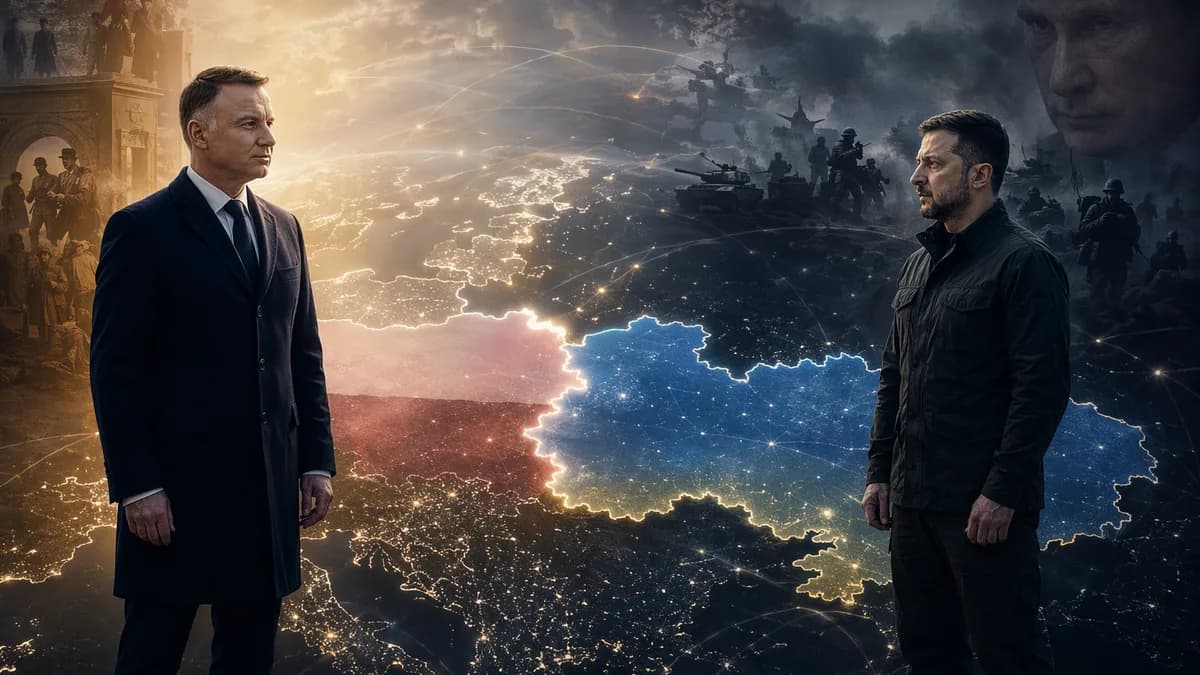
The immediate trigger is Zelensky’s decree naming a Ukrainian combat unit after the Ukrainian Insurgent Army, or UPA, a nationalist force tied in Polish memory to wartime massacres of Poles. Nawrocki stripped Zelensky of Poland’s top honour on Friday after the decree, according to Independent World. Ukraine says the naming had no "anti-Polish intent" and was chosen by soldiers to honour others who fought Moscow.
This is a rupture in symbolism, not evidence of an immediate collapse in Poland’s support for Ukraine. But symbolism matters here because the alliance rests on more than weapons and refugees. It also rests on the idea that Warsaw and Kyiv can keep the past from poisoning the present.
Can Poland strip Zelensky’s honour without breaking wartime alignment?
Yes, for now. The sources support that narrower reading.
Poland has strongly backed Ukraine against Russia’s invasion, taking in almost a million refugees and supplying weapons. Nawrocki’s move does not, by itself, reverse that. The dispute instead shows that wartime gratitude has limits when national memory enters domestic politics.
The timing is combustible. Ukraine is still fighting Russia. Poland remains one of its most important European supporters. Moscow benefits from any visible fracture between Kyiv and Warsaw, a point Polish Prime Minister Donald Tusk made plainly in response to the row.
“The front line runs elsewhere,” Tusk wrote, adding that the Poland Ukraine dispute “delights Putin and shocks our allies.”
XOOMAR analysis: the honour snub should be read as a political stress test. Nawrocki is signaling that support for Ukraine’s survival does not mean silence over Polish victims. Zelensky is signaling that Ukraine will defend its wartime symbols, especially those framed around resistance to Moscow.
Those signals collide because the Poland Ukraine history feud is not mainly about one unit name. It is about who gets to define twentieth-century violence while twenty-first-century security is still being fought over.
Why does the UPA name cut so deeply in Volhynia and Eastern Galicia?
The UPA occupies opposite moral positions in Polish and Ukrainian memory.
During and after World War Two, when Ukraine was part of the Soviet Union, the UPA fought the Red Army and, for a time, allied itself with Nazi German invaders in pursuit of Ukrainian independence. In Ukraine’s current framing, the unit name commemorates fighters against Moscow. In Poland’s framing, the UPA cannot be separated from mass violence against Polish civilians.
The central wound is Volhynia. From 1943 to 1945, Ukrainian nationalists carried out massacres in which Warsaw says around 100,000 ethnic Poles were killed. Thousands of Ukrainians also died in reprisal killings. Polish historians view the massacres as genocide intended to prevent a post-war Polish state from claiming sovereignty over Ukrainian-majority areas that had been part of Poland between the two world wars.
Kyiv rejects the genocide label, arguing that thousands of Ukrainians were also killed in a complex conflict. That difference is not semantic. For Poland, naming a unit after the UPA looks like glorification. For Ukraine, rejecting all UPA-linked symbolism can look like erasing anti-Soviet resistance.
A second wound runs in the opposite direction. In 1947, Poland forcibly relocated about 140,000 ethnic Ukrainians and people identifying as members of the small Lemko ethnic group from southeastern Poland to territories recovered from Germany. Poland’s aim was to cut support for underground UPA groups. The Ukrainian side sees it as ethnic cleansing.
That is why this dispute keeps returning. Each side has victims. Each side has a national story. Neither story fits neatly into the other.
Which numbers show strength, and which numbers show exposure?
The hard numbers in the source tell two stories at once.
| Issue | Source-backed figure or fact | Political meaning |
|---|---|---|
| Ukrainian refugees in Poland | Almost a million | Poland’s support has been material, not rhetorical |
| Polish victims cited by Warsaw | Around 100,000 ethnic Poles killed | Volhynia remains central to Polish national memory |
| Ukrainians and Lemkos relocated by Poland | About 140,000 in 1947 | Kyiv has its own grievance against Polish state action |
| Recent exhumations | Poland began exhuming remains in Puzhnyky last year | Historical disputes are moving from speeches to burial sites |
| New permission | Kyiv allowed more exhumations in Volhynia’s Liuboml district last week | There was still space for practical cooperation before the honour row escalated |
The outline of this crisis is clear. The missing data is also important.
The supplied material does not provide polling, trade figures, border logistics data, housing costs, labour market numbers, or election results. So the safest conclusion is narrower: Nawrocki has tapped into weariness with the large number of Ukrainians in Poland, and during his campaign vowed not to ratify any Ukrainian accession to NATO to avoid provoking Russia, a departure from previous Polish policy that angered Kyiv.
XOOMAR analysis: that creates a domestic incentive structure. Nawrocki can support Ukraine against Russia while pressing Kyiv on history. That position may appeal to voters who back Ukrainian resistance but reject what they see as one-way concessions from Warsaw.
For readers following separate Russia-related security pressure points, XOOMAR has also covered Russian warning shots rattling a British yacht in the Channel and Ukrainian strikes shutting Crimea gasoline sales to civilians. Those are separate stories, but they sit in the same broader war environment where symbolism, escalation, and public resolve all matter.
How do Warsaw, Kyiv and Moscow read the same honour dispute?
Warsaw sees a boundary. Poland can arm and host Ukraine while insisting that Polish victims not be folded into Ukrainian nationalist commemoration.
Kyiv sees a wartime memory trap. Zelensky cannot easily concede that an anti-Soviet symbol is illegitimate while Ukraine is fighting Russia. The decree was described as recognising a unit’s contribution to defending Ukraine’s territorial integrity and independence. Ukrainian officials also argue there was no anti-Polish intent.
Moscow sees opportunity. Nawrocki himself said that glorifying the UPA gave Russian propaganda material. That matters because Russian President Vladimir Putin has justified his assault on Ukraine in part as a campaign to "de-Nazify" the country.
The dispute also exposes a split inside Poland. Tusk, Nawrocki’s political rival, urged both sides to lower the temperature. Critics have accused Nawrocki of promoting an approach to history teaching that whitewashes difficult parts of Poland’s past. Nawrocki’s supporters are likely to see the same stance as overdue pressure on Kyiv.
XOOMAR analysis: the danger is not that one award changes battlefield realities overnight. The danger is cumulative. Trust erodes through public insults, stalled gestures, and leaders discovering that confrontation polls better than reconciliation.
Does this expose a gap between eastern security strategy and domestic politics?
It does.
Strategically, Poland benefits from Ukraine resisting Russia. The source says Poland has supplied weapons and Nawrocki said support for Ukraine’s defense would not decrease. Politically, Nawrocki has incentives to harden the tone on history, refugees, and Ukraine’s NATO path.
That gap matters for Ukraine’s future European position. The source material does not give a Brussels or Washington response, so claims about EU or US pressure would go beyond the record. But the dispute itself shows how historical memory can become a bargaining tool around NATO accession, reconstruction forums, and bilateral trust.
Ukraine also faces a specific diplomatic problem. It wants Western integration while elevating some symbols that are deeply toxic in a neighboring state that has been central to its wartime support. That requires sharper memory diplomacy than Kyiv has shown in this episode.
A mature approach would not require Ukraine to abandon its anti-Soviet history. It would require cleaner distinctions: archival access, exhumations, joint historical commissions, and language that honours Ukrainian resistance without appearing to honour massacres of Polish civilians.
Which evidence will show whether the feud stays symbolic?
The next test is practical, not rhetorical.
Watch whether exhumations in western Ukraine continue after the honour dispute. Poland began work in the former Polish village of Puzhnyky last year, and Kyiv recently approved more exhumations in Volhynia’s Liuboml district. If that work continues, the relationship still has working channels beneath the public anger.
A second test is NATO language. Nawrocki’s campaign vow not to ratify Ukrainian accession to NATO marked a clear break from earlier Polish policy. If that position becomes governing practice rather than campaign posture, the feud has moved beyond memory politics.
A third test is whether both presidents keep escalating symbols. Zelensky’s unit naming and Nawrocki’s honour stripping have already turned history into a live political weapon. The alliance can survive that. It cannot afford to make it routine.
The Poland Ukraine history feud will not disappear in six months. The realistic scenario is colder symbolism, harder bargaining, and continued Polish support for Ukraine’s defense. The risk is that leaders on both sides treat historical memory as a domestic asset when, in wartime, it is also a strategic vulnerability.
The Stakes
- The feud shows how unresolved wartime history can strain even critical alliances.
- Poland’s support for Ukraine remains intact, but symbolic disputes can shape domestic politics.
- Visible tension between Warsaw and Kyiv risks benefiting Russia by exposing cracks among Ukraine’s allies.
Poland-Ukraine Dispute Over UPA Unit Naming
| Issue | Poland/Nawrocki | Ukraine/Zelensky |
|---|---|---|
| Immediate trigger | Objected to Zelensky naming a Ukrainian combat unit after the UPA. | Said the naming had no "anti-Polish intent" and reflected soldiers honoring those who fought Moscow. |
| Historical memory | The UPA is tied in Polish memory to wartime massacres of Poles. | Frames the choice around resistance to Moscow rather than hostility to Poland. |
| Current alignment | Poland remains a major supporter of Ukraine, including refugees and weapons. | Ukraine still relies on Poland as a key European backer during Russia’s war. |
Sources

Written by
XOOMAR Insights Team
Research and Editorial Desk
The XOOMAR Insights Team pairs automated research with human editorial judgment. We track hundreds of sources across technology, fintech, trading, SaaS, and cybersecurity, cross-check the facts, and explain what happened, why it matters, and what to watch next. We do not just rewrite headlines. Every article is fact-checked and scored for reliability before it goes live, and we link back to the original sources so you can verify anything yourself.
Explore More Topics
Related Articles
 Global Trends
Missile Crunch Forces Trump Test for Ukraine Air Defences
Zelensky wants Trump to turn Patriot production support into a hard deal as Ukraine faces a worsening interceptor crunch.
Aug 2, 20267 min
 Global Trends
Ukraine's 'Deep Strike' Strategy Cripples Russia's Oil Revenue
Ukraine has shifted to a strategy of 'deep strikes', using drones to attack oil refineries and military hubs inside Russia, aiming to cripple the economic engin
Aug 6, 20267 min
 Global Trends
UK General Warns: Russia’s Next War Targets Britons at Home
The UK's former head of Defence Intelligence reveals why the next major conflict will be fought at home, targeting the public with disinformation long before tr
Aug 10, 20267 min
 Global Trends
Drone Hunts Ukrainian Vegetable Seller in 'Human Safari'
A Russian drone operator targeted and pursued a Ukrainian vegetable seller in a Kherson market, attempting a filmed execution in a tactic Ukrainians call 'human
Aug 9, 20267 min
 Global Trends
Zelenskyy Demands Patriots as Kyiv Missile Toll Rises
Ukraine lacks the specific Patriot systems needed to intercept ballistic missiles, a critical weakness laid bare by a deadly Russian attack on Kyiv.
Aug 9, 20266 min
 Fintech
Poland Launch Tests Paysafe's Legacy Card Pivot
Paysafe's launch in Poland is a strategic test of whether it can upgrade its existing prepaid card users into full digital wallet customers, following a wave of
Aug 10, 20266 min
 Technology
Bluesky Hides Reposts From That One Annoying Account
Bluesky added a feature allowing users to hide reposts from specific accounts they follow, a targeted tool for feed curation without unfollowing.
Aug 10, 20267 min
 Trading
Strait of Hormuz Shutdown Lifts Oil Prices 6%
WTI crude oil jumped over 6% after Iran confirmed talks on shipping routes don't mean the Strait of Hormuz will reopen, setting the stage for a prolonged geopol
Aug 10, 20268 min
 Fintech
Erebor Quadruples Deposits In 100 Days For $8B Valuation
Startup-focused Erebor Bank has quadrupled deposits in three months and is now raising $1.5 billion at an $8 billion valuation, a giant bet on its post-SVB nich
Aug 10, 20265 min
 Trading
Stocks Ignore Record Job Losses as Fed Pledge Trumps Payrolls
The Dow Jones Industrial Average showed no fear after July's shocking job losses, as investors bet weak labor data will keep the Federal Reserve from raising ra
Aug 10, 20266 min
Don't miss the signal
Get our weekly roundup of the stories that matter across tech, fintech, and trading. No noise, just signal.
Free forever. No spam. Unsubscribe anytime.