Alan Greenspan's death reopens the fight over the Fed's most powerful modern chairman
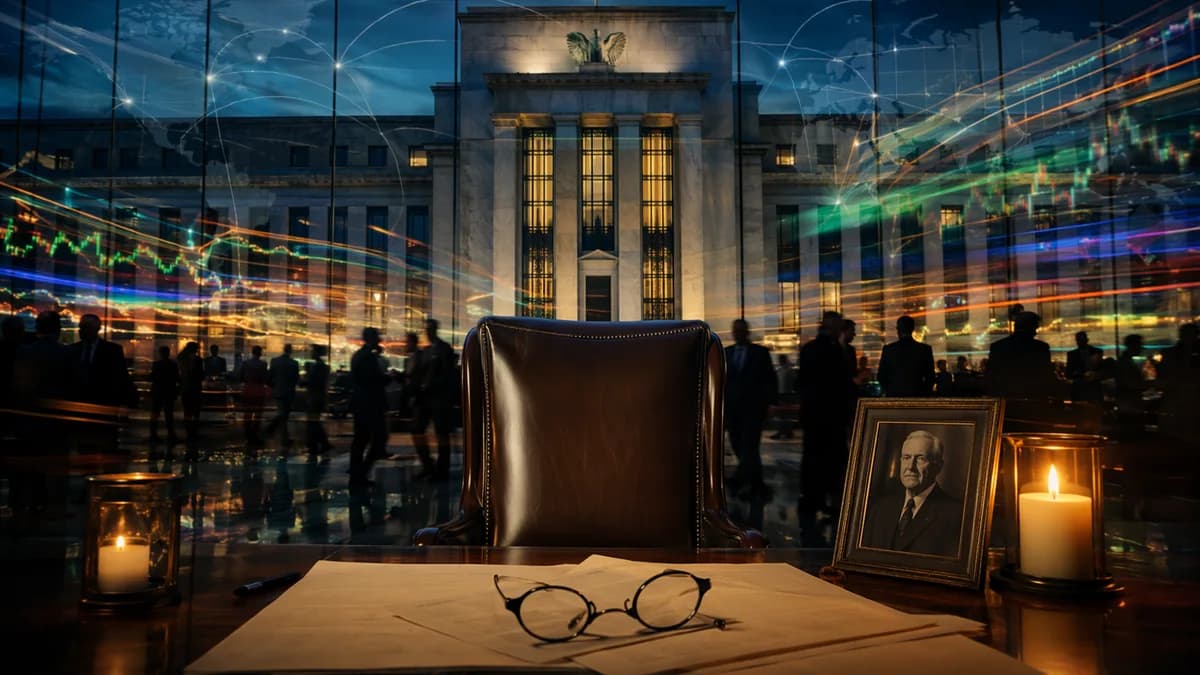
Alan Greenspan held the Federal Reserve chairmanship for five terms, served under four presidents, and died Monday at 100, a record that makes his death more than an obituary for a former central banker.
XOOMAR Intelligence
Analyst Take
Greenspan died from complications of Parkinson’s disease, his wife, Andrea Mitchell, said in a statement shared with NBC News, Guardian World reported. He chaired the Fed from 1987 to 2006, spanning the presidencies of Ronald Reagan, George HW Bush, Bill Clinton, and George W Bush.
“He will be remembered for his brilliance and his kindness,” Mitchell’s statement to NBC said. “Being his life partner was the joy of my life.”
The fight over Greenspan’s legacy will not be sentimental. XOOMAR analysis: his career sits at the hinge point of modern central banking. He was praised for keeping markets liquid during shocks and for presiding over a long expansion. He was also faulted by critics for choices they say helped set up the 2007-08 global financial crisis, including support for financial deregulation and a misplaced confidence in market discipline.
That tension is the story. The same Alan Greenspan who reassured markets after crashes became a symbol of the risk that markets would expect rescue when bets went wrong.
Five Fed terms gave Alan Greenspan an unusually long grip on monetary policy
Greenspan’s chairmanship began fast. Ronald Reagan appointed him to fill Paul Volcker’s term, and the Senate confirmed him on Aug. 11, 1987, according to the supplied NBC account. Two months later, on Oct. 19, 1987, Black Monday hit, and the Dow Jones Industrial Average fell by more than 22%, its largest one-day percentage fall ever.
Greenspan moved to keep markets liquid. That first crisis helped create the label that followed him for decades: the Greenspan put, shorthand for the belief that the Fed would step in during severe financial stress.
His long run mattered because it crossed party lines and economic cycles. He was reappointed under George HW Bush, Bill Clinton, and George W Bush, then retired on Jan. 31, 2006. NBC’s account says he had the second-longest tenure as Fed chair, behind William McChesney Martin, who served from 1951 to 1970.
The reputation of “the maestro” came from that continuity. Greenspan navigated the 1987 stock-market crash, the expansion from 1991 to 2001, the dotcom boom and bust, and the aftermath of the Sept. 11, 2001, attacks. His public language was famously hard to parse, yet investors, lawmakers, and economists treated it as market-moving text.
That mix gave him power. Not formal power beyond the Fed’s mandate, but practical power: the power to calm, confuse, and condition markets.
The Greenspan economy in numbers: crashes, inflation, expansions, and risk
The source record gives a few hard markers, and they explain why Alan Greenspan’s legacy split so sharply.
| Marker | Source-supported detail | Why it matters |
|---|---|---|
| Fed tenure | 1987 to 2006 | Nearly two decades across four presidents |
| Black Monday | Dow fell more than 22% on Oct. 19, 1987 | First major test of Greenspan’s crisis response |
| Expansion | Boom from 1991 to 2001 | Helped build his “maestro” reputation |
| Inflation context before the Fed | Policies during his Ford-era service, alongside tighter Volcker Fed policy, helped reduce inflation from 11% to 6.5% | Shows his pre-chair role in anti-inflation policy debates |
| Retirement | Jan. 31, 2006 | He left before the full financial collapse, but critics link earlier policy choices to it |
CBS described Greenspan’s tenure as coinciding with the Great Moderation, a period from the mid-1980s until 2007 marked by low inflation, stock market gains, and strong economic growth. But that same framing carries the core warning. Stability can hide fragility.
The phrase “irrational exuberance,” which Greenspan used in 1996, became the cleanest expression of his dilemma. He saw signs of speculative heat, but critics later faulted him for not doing enough to restrain bubbles in stocks and housing. NBC’s account says he was criticized for missing the early-2000s housing bubble. CBS says critics pointed to his “loose money” policies as contributing to the subprime housing crisis.
XOOMAR analysis: the Greenspan lesson is not that low inflation is meaningless. It’s that low inflation and rising asset prices can coexist with financial risk that central-bank models, regulators, and investors underestimate.
Wall Street, Washington, borrowers, and critics saw different Greenspans
Wall Street saw Greenspan as a stabilizer. After Black Monday, he acted to keep markets liquid. Later Fed support during instability became known as the Greenspan put, a phrase that matters because it turned crisis management into market psychology.
Washington saw something else: durability. Presidents from both parties kept him in place. That did not make him nonpolitical, but it made him institutionally rare. Few economic officials keep power across Reagan, Bush, Clinton, and Bush.
Borrowers experienced his Fed less directly, through credit conditions. The supplied sources connect his later criticism to easy credit, subprime mortgages, and the housing bubble. That is enough to say his decisions reached far beyond trading desks, but not enough to assign one clean household-level verdict. The credit cycle created winners and losers at different points, and the sources do not quantify them.
Critics focus on his faith in markets. CBS cites a 2017 Economist essay saying the main post-crisis criticism was that Greenspan was “a naive believer in market efficiency,” failed to pop bubbles, and failed to regulate the financial sector properly. Greenspan defended himself, telling Fortune Magazine in 2007 that he was the victim of “revisionist history” and had warned about subprime mortgages and other red flags.
For XOOMAR readers tracking finance at the firm level rather than the central-bank level, our separate fintech coverage of PayPal Ventures Freezes Deals as Lores Cuts Deeper and JPMorgan Wallet Hands BILL Holdings a Reconciliation Edge sits in a different lane: company decisions inside the financial system, not the policy architecture Greenspan helped define.
From Volcker’s inflation fight to Greenspan’s market-calming Fed
Greenspan followed Volcker, whose Fed is associated in the supplied NBC account with tighter monetary policy that helped bring inflation down from 11% to 6.5% while Greenspan chaired the Council of Economic Advisers under Gerald Ford.
That contrast matters. Volcker’s story is usually framed around breaking inflation. Greenspan’s is framed around managing confidence: liquidity after crashes, opaque public signaling, and a Fed that markets watched line by line.
Yet Greenspan was not simply anti-transparency. CBS reports that he supported a move away from less informative Fed statements before the 1980s. In a 2009 Federal Reserve oral history, he said:
“You don’t want to surprise the markets unless there is a purpose to it.”
That sentence captures the Greenspan model. Surprise had to be controlled. Markets had to be read carefully. But the more the Fed reduced surprise, the more investors could start treating central-bank support as part of the risk calculation.
XOOMAR analysis: that is the unresolved inheritance. The Fed gained credibility by calming markets, but credibility can become a subsidy for risk if investors assume losses will be cushioned.
Greenspan’s legacy now rests on the risks his era made easier to ignore
Alan Greenspan’s record still matters because it shows how a central banker can be judged twice. First in real time, when markets are falling and liquidity is scarce. Then years later, when the hidden costs of prior calm become visible.
His admirers can point to 1987, the 1991 to 2001 expansion, and his ability to retain trust across four administrations. His critics can point to deregulation, the housing bubble, and the crisis that erupted after he left the Fed.
The strongest reading is also the least comfortable: Greenspan was effective at managing visible shocks, but his era exposed how hard it is for central banks to confront risks that build during good times.
The next test for his legacy will be historical, not ceremonial. Evidence that strengthens the pro-Greenspan case will emphasize his crisis responses and long expansion. Evidence that weakens it will keep tying his policy philosophy to excessive faith in financial self-policing. Future Fed chairs will be measured against that split record: not only whether they calm the panic, but whether they spot the conditions that make the panic possible.
Impact Analysis
- Greenspan’s death renews debate over how much power central bankers should wield in modern markets.
- His 1987-2006 Fed tenure shaped how investors expect policymakers to respond to financial crises.
- The controversy over his legacy remains central to arguments about deregulation, bubbles, and crisis prevention.
Alan Greenspan's contested legacy
| Supporters emphasize | Critics emphasize |
|---|---|
| Kept markets liquid during major shocks, including Black Monday in 1987. | Helped create expectations that markets would be rescued when bets went wrong. |
| Presided over a long economic expansion during his Fed tenure. | Backed financial deregulation and trusted market discipline too much. |
| Became one of the most influential modern Federal Reserve chairs. | Is linked by critics to conditions that preceded the 2007-08 global financial crisis. |
Primary Sources & Disclosures

Written by
XOOMAR
Data desk
XOOMAR is a capital markets software and data company. Every brief on this site starts from a dataset the company collects itself from primary sources (CFTC, SEC EDGAR, FINRA, the Federal Reserve, exchange APIs) and names the numbers it is built on, with a link to the data page so you can check them. Briefs are reviewed before they go out and corrected in place when the data is revised.