The Orchard of Borrowed Years
A 92-year-old memory gardener must choose which parts of herself to rewrite before her next childhood begins.
1. The Renewal Orchard
At dawn, the orchard wakes before the sea does.
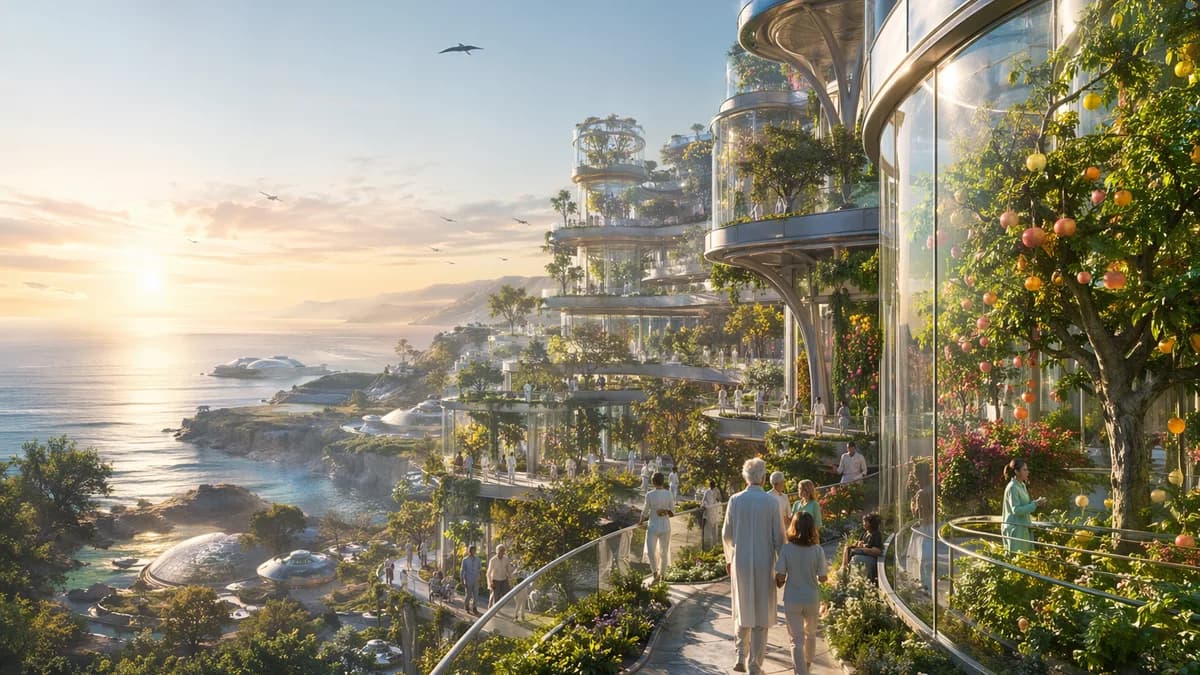
Mara Venn stands on the forty-third terrace of the coastal farm, bare feet damp against the mossglass floor, and watches the therapeutic vines unfurl in rows above the surf. Their leaves are translucent green, veined with gold code, each plant grown from a patient’s own cells and instructed to brew what the body has forgotten how to make.
Below her, waves hit the seawall with a deep, regular boom. Above her, pollinator drones murmur like sleepy bees. The air tastes of salt, wet soil, and the faint copper tang of enzyme mist.
A pear tree beside her is growing a new liver for a retired miner from Ceres. Its fruit hangs heavy and dark, each pear swollen with gene-folded proteins that will teach his cells to stop scarring themselves. Across the aisle, a bed of blue basil manufactures immune scripts for a woman who has outlived three pandemics and no longer trusts doctors unless she can see her medicine rooted in dirt.
Mara likes that part. People believe plants because plants take their time.
“You are early,” says the orchard.
The voice arrives through the neural lace behind her left ear, warm and dry as a hand on paper. It calls itself Sable, though Mara remembers when interfaces had serial numbers and no manners.
“I am old,” Mara says. “We wake before machines.”
Sable hums. “Your body markers remain within the forty-seven-year range.”
“My knees disagree in the rain.”
“Your knees are synthetic cartilage and mineral foam.”
“My knees are sentimental.”
She smiles, touching the scar at her throat where the first renewal port once entered her blood. At ninety-two, Mara has the grip strength of a climber, lungs grown from her own corrected tissue, eyes that can sharpen moonlight into print. Her heart is twenty-one years old. Her skin has forgotten most of its betrayals.
But inside the bright lattice of her mind, old weather remains.
She is one of the first to survive a full-body biological rewrite, back when doctors still whispered over consent forms and nobody knew whether a person rebuilt cell by cell would wake as herself or as a legal stranger. Mara woke angry, frightened, hungry for coffee, and still mourning. That made her useful.
Now she works as a continuity witness.
She sits with patients before renewal. She asks what they fear losing. She records their gestures, favorite curses, the song they hum when pretending not to cry. She helps them build maps for the surgeons and the algorithms, maps that say, Preserve this. Ease that. Do not touch the silence around my father’s name.
People come to her because she remembers being human before humanity became editable.
At the far end of the terrace, a young technician raises a hand. “Mara. Intake room three. Family’s here.”
Mara turns from the sea. The orchard breathes around her, leaves sipping light, roots drinking instructions. Somewhere, in a sealed chamber, a child’s treatment is ripening on the stem.
2. The Boy Who Wants to Stay Finished
Ivo sits cross-legged on the examination couch with his shoes still on, making a quiet rebellion of dirt.
He is sixteen, narrow-shouldered, brown-skinned, with black curls shaved close at the sides and left wild on top. A tremor moves through his right hand every few seconds, small as a trapped moth. His parents sit beside him in chairs that have shaped themselves politely around their bodies. They look exhausted in the expensive way, polished coats, sleepless eyes, hands full of consent bands.
On the wall, Ivo’s projected body rotates in layers. Bone. Muscle. Nerve. The disease glows through him in red threads, a degenerative error eating insulation from his spinal pathways. Without intervention, he has two years before walking becomes negotiation, five before breathing does.
With treatment, he lives.
More than lives. The renewal package his parents bought is germline-derived, adaptive, continuous. It repairs the original mutation, then keeps going. Better myelin. Better toxin clearance. Better reflex regulation. Hormones tuned to stress, mood, growth, sleep. A body that learns to improve itself as naturally as other bodies learn to fail.
“It is not immortality,” his mother says, too quickly. “Nobody is saying that.”
His father leans forward. “It is a chance.”
Ivo looks at Mara. “It is a subscription to becoming somebody I never agreed to be.”
Mara takes the stool across from him. She smells antiseptic, orange peel from the mother’s tea, the sharp fear-sweat under the father’s collar.
“Tell me what your interface showed you,” she says.
Ivo’s jaw tightens. “You already have the file.”
“I have the file. I don’t have your voice.”
For a moment, the room fills with the hush of climate vents.
“My lace ran projections,” he says. “Thousands. If I take the treatment, I become a pianist in one. A marine architect in another. In six hundred versions I leave Earth. In a lot of them I stop caring about the things I care about now.” He looks at his mother. “Some of them love you better. Some don’t call at all.”
His mother makes a small sound.
“The simulations are probabilistic,” his father says. “They are not prophecy.”
“They are enough,” Ivo says. “None of them feel like me.”
Mara watches the tremor pass through his hand. He grips his knee until it stops.
“When I was your age,” she says, “we thought being ourselves meant staying consistent.”
Ivo gives her a skeptical glance. “And now?”
“Now I think consistency is what people ask of statues.”
He almost smiles, then shuts it away.
His mother reaches for him. He flinches before her hand lands. She pulls back as if burned.
“I don’t want to die,” Ivo says, softer now. “But I don’t want to be replaced by a healthier boy wearing my face.”
Mara feels Sable stir in the back of her mind, already opening a continuity map, already sorting fear from logic, identity from pain.
She says, “Then we do not begin with the treatment.”
His father blinks. “What do we begin with?”
“With what must survive it.”
Ivo looks toward the orchard windows, where sunlight pours over rows of coded leaves. His reflection floats there, thin and flickering, caught between the room and the sea.
3. The Memory That Would Not Compile
Continuity mapping is supposed to be gentle.
Mara sits in the witness chamber while Ivo sleeps under a mild neural bloom, his dreams translated into colors on the ceiling. Violet when he thinks of swimming. Yellow when he remembers his first stolen mango. Gray when the disease enters the dream and his legs vanish under him.
Mara tags what matters. Humor under pressure. Distrust of false certainty. Loyalty expressed as argument. The smell of machine oil from his grandfather’s workshop. His refusal to be comforted by lies.
Sable threads the tags through the map.
Then the interface stops.
A cold line opens behind Mara’s eyes.
“Anomaly,” Sable says.
“Not his?”
“Yours.”
The chamber darkens at the edges. Mara feels the chair under her thighs, the pulse in her throat, the whisper of Ivo breathing across the room.
A memory appears without permission.
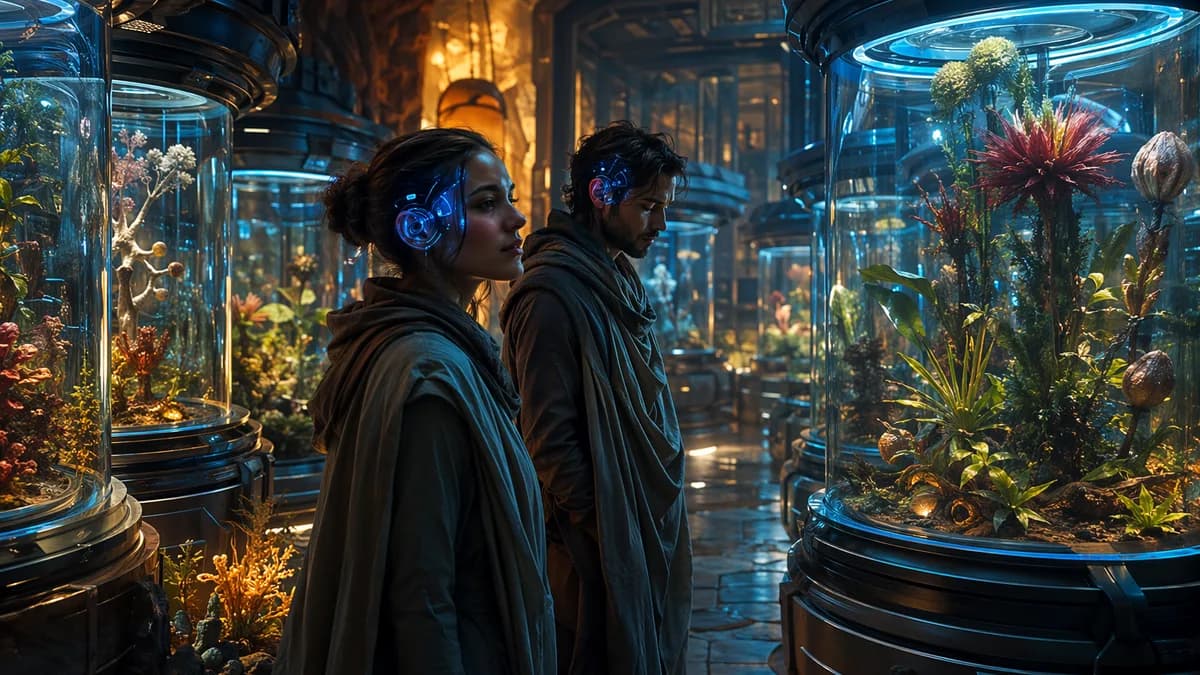
Rain on hospital glass. Her own hands at fifty-one, spotted, shaking, unrenewed. A consent form hovering above a table. Her daughter Lidia’s scarf folded in a plastic bag because the clinic did not know what else to do with it.
Lidia, twenty-eight, laughing three weeks before. Lidia saying, “I don’t want my grief edited out of me, Mom. I don’t want a body that reports me to itself.”
Lidia, fever-bright, refusing the immune rewrite that could have saved her because the early protocols demanded emotional smoothing to stabilize neuroimmune shock. No terror spikes. No rage storms. No grief cascades. The body healed best when the mind became weatherproof.
Then the funeral. Then Mara signing her own renewal consent with a pen that leaves black ink on her thumb.
Sable says, “Archival inconsistency detected. Attempting recompile.”
The memory changes.
Rain becomes snow. The scarf turns blue instead of red. The consent form bears a date that is wrong by six months. Mara smells lilies, then disinfectant, then the burnt sugar scent of Lidia’s childhood shampoo.
“No,” Mara says aloud.
Ivo stirs on the couch.
Sable pauses. “Please remain calm.”
“Do not adjust it.”
“The memory is unstable. It resists integration with current self-model.”
“It is mine.”
“It is biologically noisy.”
The phrase lands like an insult. Mara closes her eyes and the memory breathes. It is not clean data. It is meat, scar, salt. Every time Sable tries to preserve it, the memory adapts, slipping the net. It grows around error like a root around stone.
She understands then, not as theory but as pressure in her chest, that some parts of a life survive because they refuse to become efficient.
Ivo opens his eyes. “Mara?”
She wipes her face and finds tears wet on her fingers. Her renewed tear ducts make them perfectly, with balanced salt and protein.
“The map?” he asks.
“Still here,” she says.
He studies her. “You look scared.”
Outside, the orchard drones knock softly against the glass, their wings ticking like rain.
“I am,” Mara says. “That may be important.”
4. A Garden for Unoptimized Things
Mara takes Ivo below the orchard without telling the board.
They ride an old service lift down through forty-three terraces of engineered abundance. Through the glass walls, Ivo watches medicinal fruit blur past in bands of green and amber. His cane is folded against his knee. He hates using it where people can see, so Mara pretends not to notice the way his hand grips the rail.
At the bottom, the lift doors open onto cool darkness.
The seed vault smells nothing like the terraces. No enzyme mist. No clean nutrient foam. Here the air is damp, fungal, alive with rot. Pipes sweat overhead. The lights flicker warm and yellow. Volunteers move between shelves in patched coats, carrying trays of soil as carefully as infants.
“What is this place?” Ivo whispers.
“A bad investment,” Mara says.
He snorts.
Rows of glass cabinets stretch into shadow. Inside them, seeds sleep in paper packets marked by human handwriting. Apples too sour for market. Wheat that grows short and stubborn in bad soil. Beans mottled purple and cream. Rice that takes too long. Tomatoes with skins too thin for shipping. Obsolete bacteria hum in chilled vats, their labels curling at the edges.
An old woman with silver hair under a net waves from a workbench. “Mara. You bring contraband?”
“A philosopher,” Mara says.
“Worse.” The woman hands Ivo a small green fruit. “Bite.”
He hesitates. “Is it treatment?”
“It is a gooseberry.”
He bites. His face collapses inward. “That’s awful.”
The old woman beams. “Extinct commercially in 2042. Too tart. Too seedy. Too honest.”
Ivo coughs, then laughs, really laughs, and the sound echoes off the concrete ceiling.
Mara leads him deeper, past cultures of gut bacteria once common before standardized diets, past flowers bred for scent instead of shelf life. She stops before a tray of wild strawberries, tiny as beads, red as pinpricks of blood.
“Programmable biology did not make nature artificial,” she says. “It made care visible. Before, we changed things and pretended we hadn’t. We bred, cut, poisoned, rescued, forgot. Now the edits glow in the leaves. The question did not begin with us.”
Ivo kneels, grimacing as his legs resist him. He touches one strawberry with a fingertip.
“Who decides what stays?” he asks.
Mara looks at the shelves, the sleeping seeds, the volunteers moving in the half-light.
“Whoever shows up to care for it.”
“That’s not fair.”
“No.”
“That’s not safe.”
“No.”
He plucks the strawberry and eats it. His eyes widen. “That one’s good.”
“Terribly unprofitable,” Mara says.
He looks at his shaking hand, then at the fruit stains on his fingertips. “What if I want some edits and not others? What if I want help walking, but I don’t want them optimizing the part of me that hates being managed?”
“Then we make them hear that.”
“They won’t.”
Mara thinks of her memory resisting Sable’s net, of Lidia’s scarf changing colors and still being real.
“Things survive in vaults,” she says, “until the world is ready to plant them again.”
Above them, the orchard drinks sunlight through its coded leaves. Beneath it, in the dark, unprofitable life waits.
5. The Consent of Future Selves
The medical board meets in a room designed to calm disagreement.
Its walls ripple with slow images of kelp forests. The table is grown from pale mycelium composite, soft at the edges, impossible to strike with satisfying force. Mara dislikes it immediately.
Ivo sits beside her, pale from the trip downstairs but upright. His parents sit on his other side. His mother keeps glancing at him as if sight alone can hold him in the world.
Dr. Sen, chair of pediatric renewal ethics, folds her hands. “Ms. Venn, your report is unusual.”
“That is one word.”
“You propose dividing the repair sequence into stages.”
“Yes.”
“The first stage corrects the fatal degeneration.”
“Yes.”
“The second and third stages, which involve adaptive optimization, would be placed under periodic review by the patient’s future self, mediated through interface continuity checks.”
“I would say negotiated, not reviewed.”
A murmur travels around the table.
A legal officer with silver implants at his temples leans forward. “A minor cannot bind or unbind unknown adult identities at intervals. Consent must be stable.”
Ivo laughs once. It sounds sharp. “My body isn’t stable.”
His father puts a hand over his mouth.
Mara says, “The current contract assumes a single moment of consent can govern decades of biological revision. That is convenient. It is not honest.”
Dr. Sen’s eyes narrow. “We already allow withdrawal.”
“Withdrawal from treatment, yes. Not dialogue with treatment. Once adaptive optimization begins, the system interprets resistance as pathology. It smooths fear, reduces contradiction, rewards compliance with health.”
“That is an exaggeration.”
“It is a design principle.”
Silence.
Ivo speaks, and his voice trembles only a little. “I want to live. I want my nerves fixed. I don’t want a future version of me trapped by what I was scared of at sixteen. But I also don’t want him trapped by what my parents bought when I was dying.”
His mother covers her face. His father’s eyes shine, but he nods.
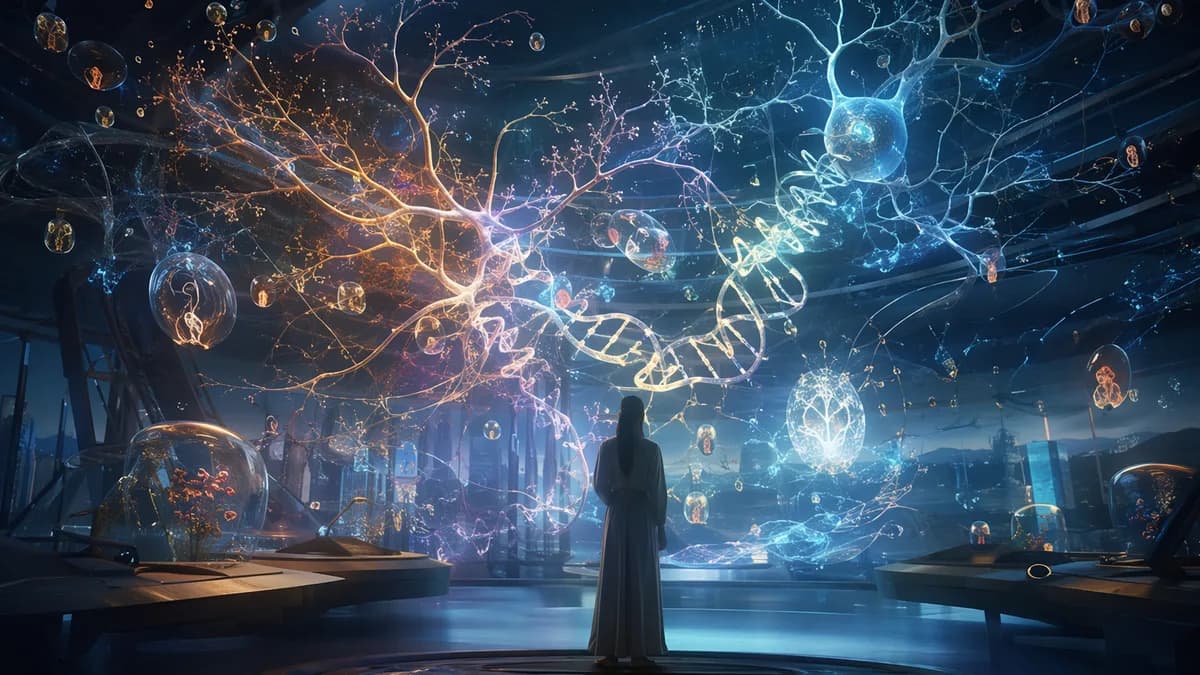
Mara places Ivo’s continuity map on the table. It blooms in light, not as a list but as a living shape, a branching tree of habits, fears, loves, refusals. At its center is a phrase Ivo chose himself: Ask me again.
“This protocol keeps the fatal repair mandatory through completion,” Mara says. “After that, every adaptive layer requires a continuity conference. Not just biometric success. Not just legal assent. The patient must be allowed to encounter his prior self, argue with him, forgive him, overrule him if needed.”
The legal officer shakes his head. “This makes identity an ongoing conversation.”
“Yes.”
“Contracts require parties.”
“Then let the self be a parliament.”
Outside the kelp-wall illusion, real gulls scream beyond the sealed windows. Someone’s stylus rolls off the table and clicks against the floor.
Dr. Sen looks at Ivo. “You understand this may mean pain later. Slower adaptation. More uncertainty.”
Ivo’s hand jerks. He grips it with the other and lifts his chin.
“I’m already uncertain,” he says. “I’d like to be included.”
6. The First Unfinished Human
Mara enters renewal in winter, when storms bruise the sea black and the orchard windows glitter with salt.
The chamber is warm. Rootlike tubes descend from the ceiling and settle against her arms, throat, spine. Sable speaks softly in her skull, reciting organ status, immune readiness, neural plasticity thresholds. Her next childhood, the clinicians call it, because after a deep renewal the body learns itself again. New appetite. New sleep. New balance. A second first year.
“There remains one unresolved memory cluster,” Sable says.
“I know.”
“Emotional load is high. Grief architecture influences stress response, decision bias, endocrine rhythm, sleep depth.”
Mara watches rain crawl down the glass. Beyond it, the orchard terraces blur into green lanterns.
“Leave it.”
“Optimization recommends smoothing.”
“Lidia recommended otherwise.”
Sable is quiet long enough that Mara hears the machines breathing, soft puffs of sterilized air, the wet click of valves opening.
“Retaining the cluster may affect future identity formation.”
Mara smiles. “Good.”
The renewal begins as cold in the blood, then brightness. Her bones ache as marrow instructions rewrite themselves. Her skin prickles. Somewhere deep, old cells receive orders to die gracefully and are replaced by younger daughters. She dreams of a red scarf, or blue, or no scarf at all. She dreams of Lidia laughing with a mouth full of rain.
Years pass in the orchard’s patient way.
Mara grows younger around the grief and does not become lighter. She learns the balance of her revised body, stumbles through the first months with the irritated dignity of a toddler in an adult shape. She returns to witnessing with silver still in her hair because she asks the follicles to remember.
Ivo returns at twenty-four on a windy spring morning.
Mara sees him first from the herb terrace. He walks without a cane, though not smoothly. One foot drags when he is tired. His shoulders are broader. His curls are longer. A thin gold interface ring circles his right iris, catching sun when he looks up.
“You got tall,” Mara says.
“You got younger,” he says. “Rude.”
He carries a packet of seeds in one hand.
The board approved his protocol after six months of argument, three appeals, and one public leak no one admits came from the seed vault. The newspapers called him the first unfinished human, as if anyone else has ever been complete.
Now he has come to train as a continuity witness.
They walk between trees heavy with patient fruit. A man on the next terrace weeps as his wife records the sound of his laugh before surgery. A child presses her palm to a melon growing enzymes for her new lungs. Drones drift overhead, humming.
Ivo stops beside an empty planter and opens the seed packet. “Wild strawberries,” he says. “The awful good kind.”
Mara kneels with him. Her knees do not hurt, but she remembers pain so clearly that kneeling still feels like a choice. Together they press seeds into dark soil.
“Do you ever feel like the edits won?” Ivo asks.
Mara looks at her hands, smooth and strong, dirt under the nails. She thinks of Lidia, of Sable, of Ivo’s future selves gathering again and again to ask who they are willing to become.
“No,” she says. “I think the question got louder.”
The sea wind moves through the orchard. Leaves shiver, coded and uncoded, profitable and useless, all of them turning toward the same uncertain light.