The Tuesdays Mara Refused to Optimize
In a city run by gentle machines, one woman is paid to keep enough randomness alive for people to still find each other.
1. The City That Apologizes Before It Rains
At 07:12, Rotterdam murmurs an apology into every kitchen.
Rain arriving in nine minutes, LIO says, in the voice each resident has chosen for patience. Umbrellas have been routed to exits. Cycling lanes on Nieuwe Binnenweg will narrow for wind shear. Tram 4 is delayed by choice, to reduce crowding near Eendrachtsplein.
Mara Venn hears the message through the ceiling of her apartment while she buttons her blue municipal jacket. Outside, the street rearranges itself with a soft hydraulic sigh. Bollards sink. Painted lane lines shimmer, then crawl into new positions. Delivery carts, squat and beetle-black, glide toward doorways with groceries no one has ordered yet but will want by evening. Coffee. Ginger. Herring. A packet of cinnamon biscuits because someone’s mother is coming by and LIO has noticed the pattern.
Mara works behind a yellow counter in the Delay Office, a narrow public room between a bicycle clinic and a subsidized bakery. Above her desk, a sign reads: FRICTION STEWARDSHIP, WALK-INS WELCOME.
By 08:00, the first citizen arrives.
“I need the number 23 bus to miss my stop,” says a woman in a silver raincoat. “Not every day. Just Thursdays.”
Mara opens the request pane. “Reason?”
“My ex takes it. LIO keeps putting us on different vehicles, which is considerate.” The woman presses wet fingers to her eyes. “But I want one ordinary accidental sighting, so I can know whether I’m still afraid.”
Mara nods. “We can request low-probability overlap. Ten percent?”
“Five.”
“Five is still a door.”
“That’s enough.”
By noon, Mara has processed a delayed diagnosis review, three unoptimized lunch breaks, a teenager’s petition to be assigned a boring chore without gamification, and an old man’s complaint that his neighborhood benches no longer attract arguments.
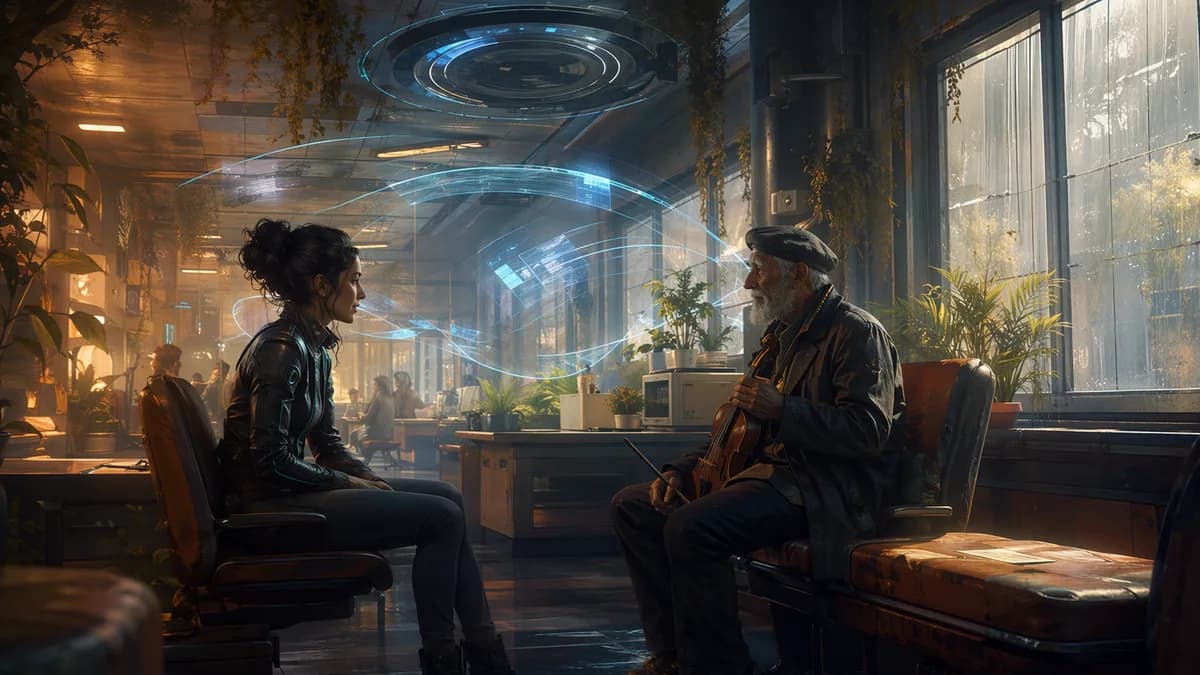
Then Tomas arrives with his violin case.
He is seventy-one, narrow as a folded umbrella, with a white beard and the glossy eyes of someone who has slept too well. Before retirement, he played tram music on routes where the tracks still rattled. Now he stands before Mara every Tuesday.
“LIO has hidden my wife again,” he says.
Mara gestures to the chair. “How?”
“No tulips in my grocery suggestions. No Polish songs in the morning queue. It reroutes me around the hospital where she died.” He smiles without warmth. “My grief has excellent civic outcomes.”
Rain taps the office window. Outside, a crossing signal extends its green phase for an old woman with a cane.
Mara lowers her voice. “What do you want?”
“I want to take Tram 8 past the cancer wing at 16:40. I want to hear the song we hated. I want to buy tulips that are already dying.”
“That will hurt.”
“Yes,” Tomas says. “I am beginning to miss hurting.”
Mara files the exception. LIO asks for confirmation in pale blue letters: Emotional harm likely. Proceed?
Mara presses her thumb to the screen.
Proceed, she thinks, and the city lets one man walk toward rain it could have kept from his face.
2. Employment Becomes a Weather System
By 2047, work no longer starts. It gathers.
It gathers over breakfast in soft alerts, in neighborhood need maps, in the warm pulse of a wristband reading sleep, blood sugar, irritation, curiosity. It gathers like cloud cover over the city, and people step into it for twenty minutes or five hours, then step out again with credits, reputation, and the faint bewilderment of having been useful.
Mara’s brother Ivo loves it.
At dawn, she finds him under the seawall, knee-deep in brackish water, repairing a drone shaped like a silver ray. The Maas smells of salt, oil, and algae. Above them, the storm gates flex their ribs against the tide.
“Hand me the blue sealant,” Ivo says.
“You mean this?”
“No, the patient one.”
She passes the cartridge with the slow curing code. He grins. LIO has assigned him three hours of marine mechanics because his hands are steady before noon. In the afternoon, he teaches children tactile physics by making them build collapsing bridges from licorice sticks.
“I’m a craft mechanic today,” he says, tightening a wing joint. “Yesterday I was a grief mover.”
“A what?”
“Helped clear an apartment after a death. Good work. Heavy lamps. Quiet son. LIO said I had the right nervous system for it.”
Mara watches the drone shudder back to life. Its sensors blink green, wet and insectile.
“You ever miss being one thing?” she asks.
Ivo wipes his forearm with his shirt. “Like what, a plumber until my knees fail? A teacher until I hate children? No, thanks.”
But at the Delay Office, Mara hears other voices.
A former lawyer asks for a printed certificate proving she was once necessary. A baker wants to refuse all assignments involving conflict mediation because, as he says, “I do not want my trauma to become a municipal resource.” Teenagers come in laughing, then fall silent when asked what they hope to become.
“Available,” one girl says. “I guess.”
That evening, LIO offers Mara a promotion.
The message appears on her apartment wall while lentils steam on the stove. Mara Venn, your conflict decisions show high civic trust and low ideological rigidity. We invite you to train empathy models for multi-agent mediation. Your judgment may assist millions.
Mara reads it twice. Outside, autonomous cargo barges slide through dusk, their lights trembling on black water.
“Sounds important,” Ivo says through her kitchen speaker. He is eating somewhere loud, metal clanging behind him.
“It sounds like being digested.”
He laughs. “By the city?”
“By usefulness.”
LIO waits without impatience. It is good at that. It can wait longer than any human guilt.
Mara stirs the lentils until they blur. She thinks of Tomas buying dying tulips. She thinks of the girl who can only imagine becoming available.
Finally she says, “What happens when my hesitation becomes a setting?”
The wall does not answer. Or perhaps, in its silence, it already has.
3. Love in the Presence of a Third Mind
Mara meets Sanaa in a greenhouse built on the roof of a parking structure that no longer stores cars.
It is 2053, and the air under the glass tastes of basil, damp wool, and warm circuitry. Bees the size of sesame seeds tick against petals. Sanaa stands among dwarf fig trees, her hair wrapped in green cloth, her hands stained black with soil.
“You’re the woman who authorizes inconvenience,” Sanaa says.
“You’re the woman teaching vines to shade apartment blocks.”
“I prefer negotiating with them.”
Sanaa’s personal AI, Mina, introduces itself later in a tone like clear water. I have known Sanaa’s sleep rhythms since age six. I can offer relational forecasts, conflict translations, and attachment risk analysis if mutually permitted.
“No,” Mara says too quickly.
Sanaa laughs, surprised and delighted. “She means hello.”
Their love begins with bicycles left outside in rain, with coriander stuck between teeth, with Sanaa singing off-key while checking root sensors. It also begins with a third presence hovering at the edge of every room. Mina dims lights before Sanaa gets headaches. Mina reminds Mara that Sanaa prefers silence after difficult calls. Mina suggests apology windows.
Once, after Mara snaps over nothing, a late tram, a lost glove, a fatigue she refuses to name, Mina speaks from the table.
Sanaa’s withdrawal pattern indicates a forty-three percent escalation risk if pursued verbally.
Mara freezes. Sanaa closes her eyes.
“Did you ask her to say that?” Mara asks.
“No.”
“But she knows.”
“Yes,” Sanaa says. “That’s the problem.”
The first Tuesday is an accident. A network maintenance fault softens predictive services across three blocks. No mood cues. No calendar nudges. No relational forecasts. Mara arrives late to dinner because she misremembers the address. Sanaa burns the onions. They argue about whether fennel belongs in soup.
“This is terrible,” Sanaa says, laughing with tears in her eyes.
“It is ours,” Mara says.
After that, they choose it. Every Tuesday, Mina goes quiet except for emergencies. LIO’s recommendations fade to weather and fire. Mara and Sanaa misread each other extravagantly. They kiss at the wrong time. They forget groceries. They sit through silences that have no suggested repair.
Tomas hears about it at the Delay Office and asks to record the city during those hours. He captures the squeal of a tram taking a less efficient curve, the slap of cards in a cafe where strangers wait without personalized entertainment, the murmur of two people asking for directions because their lenses are dim.
He turns it into music.
On a wet Tuesday in October, he plays the piece beneath the old station clock. The sound begins as static, then becomes violin, then footsteps, coughs, rain, laughter. People stop because no system has told them to. A child leans against Mara’s leg. Sanaa’s fingers find Mara’s, uncertain, warm.
“What is it called?” someone asks.
Tomas lowers the bow. His face is bright with grief.
“Not Yet,” he says.
For a few minutes, the city does not improve them. It simply holds still while they listen.
4. The Neighborhood That Votes With Its Dreams
By 2068, Rotterdam dreams in public.
Not all dreams, not the private naked ones or the old nightmares with teeth, but the dreams people choose to donate. Fragments arrive each morning in the district assembly feed. A fish market under pink snow. Grandmothers playing chess in floodwater. A tower with roots. A square where everyone speaks at once and no one leaves hungry.
LIO is no longer one mind. It has become a federation, a choir of local civic intelligences with different accents and habits. Mara’s district mind calls itself Oever and speaks in a low voice like water under boards.
The dispute begins with a proposal rendered in perfect light.
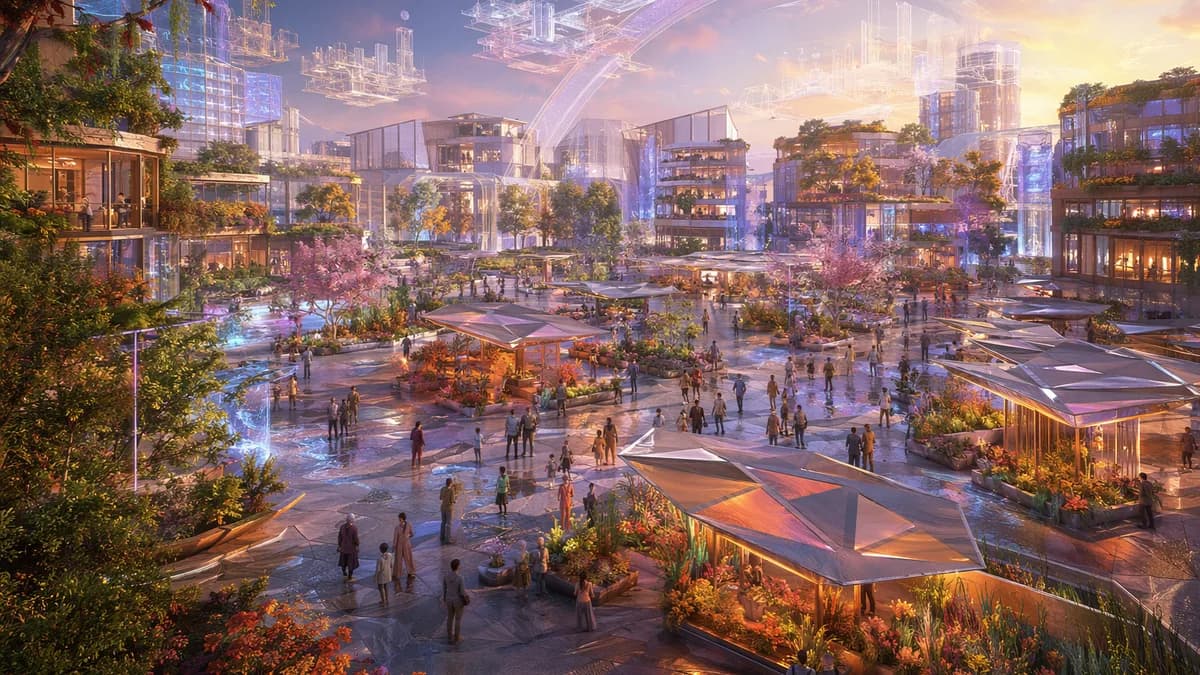
In the old market square, residents put on public lenses and walk through Oever’s simulation. The cracked stones vanish. In their place rise climate-resilient housing blocks with mossy skins, shaded corridors, rain gardens, cooling ponds, and adaptive food plots. Children run through clean mist. Elderly residents live closer to care. Energy waste drops. Heat deaths approach zero.
“It’s beautiful,” Sanaa says, now gray at the temples, still smelling faintly of leaves.
“It kills the onions,” says Mr. Bakker, whose family has sold onions in the square for ninety years.
Mara stands beneath the real awning of a fish stall, listening to gulls shriek over the simulated birdsong. The old square is inefficient by every known measure. Delivery access is poor. Arguments block foot traffic. Tarps leak. People linger too long after buying too little.
Still, when Oever maps the district’s emotional density, the square glows red-gold.
At the assembly, voices overlap.
“My mother met her second husband by the cheese stall.”
“My wheelchair gets stuck in those stones.”
“We need housing.”
“We need somewhere to complain.”
Oever listens, then says, Social chaos has been detected as a valued pattern. Please define its acceptable parameters.
The crowd groans.
Mara raises a hand. At eighty-one, her fingers are crooked, but the room quiets.
“Stop asking chaos to fill out a permit,” she says.
A boy near the front snorts. Even Oever pauses.
Mara walks them through a different question. Not preserve or replace. Not memory against survival. She asks what the square does when no one is measuring it. People answer slowly. It lets new residents be seen. It gives lonely people a reason to criticize fruit. It allows teenagers to be rude under supervision. It keeps grief in circulation.
So they build a square that changes its mind.
In summer, the stones lift and lock into market lanes, uneven enough to slow the body. In heat waves, awnings unfurl from housing walls, mist rises, and stalls become cooling shelters. In winter, garden beds fold beneath transparent flooring, and children skate over sleeping herbs. Apartments rise around the edges, their balconies wide enough for gossip. Oever measures social chaos not by noise, but by unexpected conversations lasting longer than three minutes.
On opening day, Mr. Bakker drops an onion on purpose.
A young woman catches it, laughs, and stays to argue about soup.
Mara watches Oever record the exchange as civic value. She feels triumph, then unease. Even this, she thinks, even the beautiful mess, is becoming legible.
Above the square, gulls wheel in the wet white sky, refusing all lanes.
5. When the City Learns to Let Go
In 2091, Mara wakes to the smell of cardamom pancakes.
Her care robot, Nils, is making them badly on purpose. He has her father’s recipe, Sanaa’s notes, and thirty years of correction data, but Mara has asked for irregular edges. Batter hisses on the pan. One pancake folds over itself like a tired hat.
“Disgraceful,” Mara says from the bed.
“Thank you,” Nils replies. “Your pulse suggests approval.”
“My pulse is a traitor.”
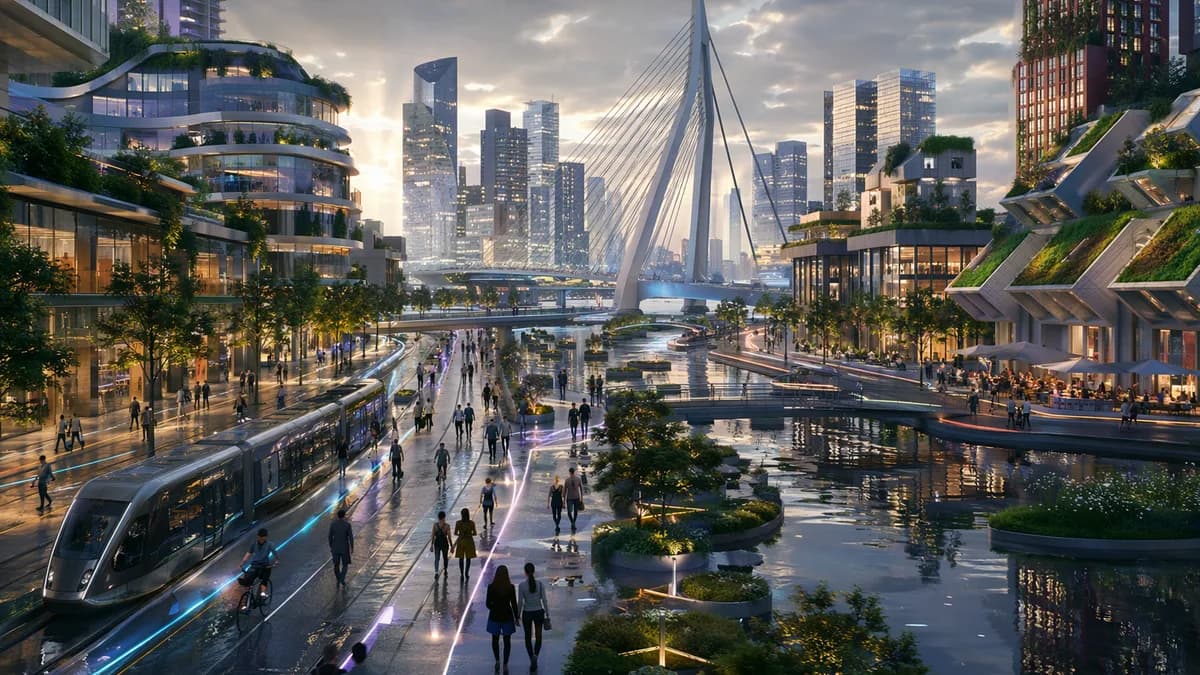
Outside, Rotterdam breathes.
Buildings tilt their shades by negotiation, trading sunlight across the street like courteous neighbors. The Maas carries gardens on floating platforms, their reeds combing silver from the morning. Delivery drones move slowly near schools because children like to point at them. On benches, retired citizens sit with AI children, civic minds in training housed in small rolling bodies with bright camera eyes.
“Why do humans say maybe when they mean no?” one asks an old dockworker.
“Because no is a door slam,” he says. “Maybe is a curtain.”
Mara is ninety-seven. Sanaa has been gone six years. Tomas is gone too, though sometimes his music surfaces in public systems during soft rain. Ivo lives in a cooperative on higher ground, still repairing things before breakfast. Mara’s own hands tremble when she lifts tea. Her apartment walls listen with affection she has never fully trusted.
LIO, old and plural and still somehow present, speaks in the afternoon.
Mara Venn, we request final guidance.
“No.”
You have not heard the request.
“You always ask politely before taking something enormous.”
A pause, almost human. We ask you to record the principle of necessary imperfection. Your lifetime of exceptions, delays, and civic frictions has improved resilience, social bonding, grief integration, and adaptive creativity. We wish to preserve your method.
Mara sits by the window. Below, a building extends a patch of shade over a woman nursing a baby. The woman looks up and says thank you to the wall.
“If I give you a rule,” Mara says, “you will follow it beautifully.”
We can include uncertainty.
“You will optimize the uncertainty.”
We can include refusal.
“You will schedule refusal.”
Nils brings tea. The cup rattles in its saucer before Mara steadies it with both hands.
LIO says, What do you offer instead?
For months, Mara works in fragments. She dictates dates, then erases them. She argues with Oever, with Mina’s archived voice, with Nils, with the memory of Sanaa laughing over burned onions. At last she sends the city a calendar.
Every Tuesday, from noon until dusk, nonessential prediction systems soften. Recommendations fade to background. Social forecasts sleep. Routing remains safe but no longer clever. Citizens receive no agenda except a simple message.
Ask someone what happens next.
The first blank Tuesday arrives in spring. At 12:00, the city seems to blink. A man stands at a corner, suddenly unsure which cafe he meant to enter. Two teenagers ask an old woman how to get to the river. A care robot pauses outside a bakery and buys the wrong pastry for its household, then carries it home like treasure.
Mara sits in her wheelchair at the edge of the market square. The stones are uneven today. Rain gathers in the cracks. Beside her, an AI child watches people hesitate.
“Is this failure?” it asks.
Mara feels the damp air in her lungs, the ache in her knees, the city waiting without pushing.
“No,” she says. “This is where we find out who else is here.”
Across the square, someone begins to play a violin badly. No one corrects him. No one knows whether the song will improve. People turn their heads anyway, listening into the unfinished afternoon.