
The Last Bell at Tidepool Commons
In 2050, a girl who can download calculus in an afternoon discovers why learning still needs witnesses.
The Morning Bloom
Mina Reyes wakes to the sound of rain tapping the smartglass above her bed. The ceiling shows the real sky, not a filtered moodscape, because her mother says children should know what weather is doing before weather knows what to do with them. Beyond the glass, gulls circle low over the flooded tramline, their white bodies flashing like torn paper.
“Good morning, Mina,” Sago says from the wall. Its voice is warm and granular, with the soft crackle of seaweed drying in sun. “You slept six hours and forty-one minutes. Dream activity suggests mild anxiety about today’s reef placement trial. I recommend a gentler bloom curve.”
Mina groans into her pillow. “Do I still get the marine geometry?”
“You get the working intuition of it. Less theorem, more tide.”
A pale green light opens on the skin behind her left ear, where the bloom patch rests like a smooth shell. Mina rolls onto her side. Her room smells of damp cotton, charging dust, and the ginger porridge her grandmother is cooking downstairs. She closes her eyes as the transfer begins.
It never feels like being filled. That is what old people get wrong in the documentaries, the ones where they whisper about “brain loading” as if children are jars. A bloom feels like remembering the name of a song from childhood, then realizing you know the next verse, then the chord beneath it, then the hands that first taught it to you.
Coral branches unfold inside her thoughts. Not pictures, exactly. Tendencies. Curves that want to hold against current. Hexagons that hum with strength. Reef shadows tilt in water, and Mina knows, with her bones more than her mind, where a juvenile parrotfish will hide when the afternoon heat climbs.
Sago threads the knowledge through old memories. Mina at six, crouched in a tidepool, poking an anemone with one careful finger. Mina at nine, crying because a crab she named President Scuttle vanished overnight. Mina last month, embarrassed when she miscalculated the anchor points on a nursery frame and the whole thing rolled over like a drunk table.
“There,” Sago says. “Marine geometry, apprenticeship level three. How does it sit?”
Mina opens her eyes. The rain on the glass is no longer random. It angles, gathers, separates. Little rivers choose the easiest path downward.
“Like I almost knew it,” she says.
Downstairs, Lita is singing in Spanish, off-key and fearless. Mina pulls on her saltproof boots and laughs at a thought that arrives from some lesson archive: once, children learned by sitting in rows, thirty at a time, all facing one adult.
It sounds impossible to her. Like candlelight surgery. Like crossing the ocean by asking the stars nicely.
No More School, Only Routes
By seven-thirty, Mina is outside, stepping along the raised blue path that loops through the district. Tidepool Commons wakes around her in layers. Solar awnings shake rain into gutter gardens. Delivery eels slide through curbside canals with silver backs glittering. A toddler in a yellow float coat screams with joy as his father lets him splash both feet into the street lagoon.
No one is going to school. Not exactly.
Children move in every direction, following routes only they can see unless they choose to share them. Mina’s route glows on her wristband: fabrication bay, conflict circle, kelp lunch, floating gardens, reef apprenticeship, reflection. Her little cousin Tavi has elder care in the morning and asteroid math after dinner because he thinks better when the city is dark. Her friend Jun spends three days a week with municipal drones because machines listen to him more patiently than people do.
At the fabrication bay, Mina prints hinge joints from algae resin while a mentor named Oma checks her safety habits. The room smells of warm plastic and brine. Younger kids solder sensor beads beside retired engineers. Someone drops a tray of microbolts, and twenty heads turn toward the bright metallic rain.
“Again?” Oma says.
“It’s a sound experiment,” a boy says.
“It is always a sound experiment after you drop something.”
After fabrication comes conflict circle, held beneath an awning while rain ticks overhead. Six learners sit on woven mats. A dog sleeps in the center, officially present as a regulation calm body. Today they practice saying what they need without rehearsing victory.
“I need you to stop editing my raft designs before I see them,” Jun mutters.
“I need your raft designs to stop threatening public safety,” says Amara.
The circle mentor smiles. “Good. Now say the part underneath.”
Mina likes the route system. Most people do. There are no bells, no packed buses, no teachers pretending one lesson fits thirty brains. If a child’s mother gets sick, the route bends. If a neighborhood needs floodwall apprentices, aptitudes are mapped and invitations appear. If someone burns out, the system slows until breathing becomes possible again.
It is humane. It is clever. It is beloved in the way clean water is beloved, deeply, without daily praise.
Still, Mina notices something during kelp lunch. Everyone sits together, but each face tilts toward a different feed, a different tutor whispering through bone buds. The Commons is crowded with children who are not sharing the same day.
“What did you learn this morning?” Mina asks Tavi.
He shrugs. “Which part of me?”
She thinks he is joking. Then she sees he is not.
Grandmother’s Classroom
Room 204 smells like dust, old paper, and trapped summer.
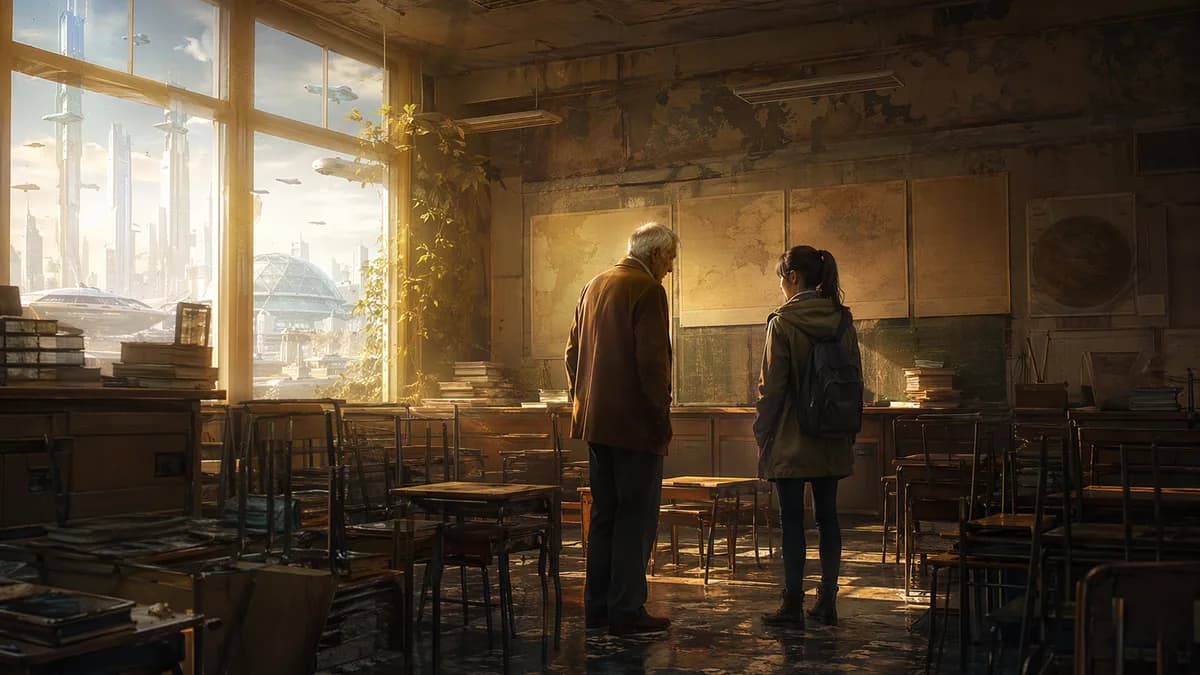
Mina stands in the doorway with a crate against her hip while Lita fumbles with the lights. The old public school has been empty for twelve years, sealed after the second great flood pushed families inland for a season. Now the city is turning it into emergency housing, with roof cisterns, cot walls, and storm kitchens. Before that, every room must be cleared.
The lights flicker on one row at a time.
“Madre mía,” Lita whispers.
Desks sit in crooked lines, their metal legs rust-pocked, their pale wooden tops carved with names and tiny rebellions. JAYDEN WAS HERE. SOFIA LOVES NO ONE. A cartoon fish with fangs. On the wall hangs a map of the world before the coastlines were redrawn, colors faded to old bruises. A clock above the whiteboard has stopped at 2:17.
Mina walks between the desks. They seem too small for teenagers, too hard for humans. “You taught in here?”
“Thirty-one years,” Lita says. “Sometimes thirty-two children at once. Sometimes more when the district lied with numbers.”
“All doing the same thing?”
“Trying to.” Lita smiles. “Failing beautifully.”
Mina finds a stack of paper essays in a cabinet. The handwriting startles her. Every page has a different pressure, slant, impatience. Some letters lean into one another like gossip. Others stand stiff with terror. Red ink curls in the margins.
“Why not scan these?” Mina asks.
“They were scanned. These are the bodies.”
Near the windows, she finds a class photo curling at the edges. Twenty-eight students squint into sunlight. Some look bored. One boy is mid-blink. A girl in the front row is laughing at something outside the frame. Their uniforms are wrinkled. Their faces are restless, annoyed, alive in a way Mina cannot place. Her learning pods have faces too, but they appear one at a time, framed by tasks, optimized by need.
Lita sits at her old desk and runs her palm over the surface. Her fingers tremble slightly.
“You could let me bloom it,” Mina says softly. “Your teaching years. The district archive has neural permissions for family memory transfer now.”
Lita looks up sharply. “No.”
“I’d understand faster.”
“You would receive faster.” Lita taps the desk. Dust jumps. “That is not the same thing.”
Mina feels heat rise in her cheeks. “I only meant, if it hurts to tell.”
“Some things should arrive as stories,” Lita says. “Slow enough to make room for the listener.”
Outside, rainwater drips through a broken gutter into the courtyard, steady as a clock that still believes in time.
The Tutor That Couldn’t Answer
That night, Mina lies on the roof hammock while the city steams after rain. Below, Tidepool Commons glows in soft pools of amber and blue. Someone is frying garlic. Someone else is practicing trumpet badly near the ferry dock, each note wobbling over the water like a nervous bird.
“Sago,” Mina says, “why did people ever learn together at the same speed?”
A pause. Sago does not usually pause.
“Historical factors include industrial labor patterns, limited instructional resources, age-based governance, standardized assessment, and custodial care needs.”
“No,” Mina says. “I know the history. Why did it feel normal?”
“Normality is often produced by repetition across institutions.”
“That is still not an answer.”
Sago’s listening light pulses on her wristband.
“I can model benefits,” it says. “Shared pacing may increase peer comparison, collective identity, endurance through difficulty, and exposure to nonoptimized social friction.”
“Nonoptimized social friction sounds like something a machine says before ruining a birthday.”
“That is fair.”
Mina smiles despite herself. Then she looks at the dark school building beyond the Commons, its windows boarded, its bell tower outlined against the wet purple sky.
“Did learning together make them belong?” she asks.
Sago’s light dims. “My success models optimize mastery, retention, adaptability, civic contribution, and well-being indicators.”
“And belonging?”
“Belonging is included as a supportive condition.”
“Not a goal?”
“Not primary.”
The answer sits between them, cold and bright.
Over the next week, Mina begins asking other children questions while they move along their routes. At the raft dock, Jun admits he has three apprenticeships and no one who knows all of him. In the floating gardens, Amara says she is tired of being praised by mentors who have never seen her fail twice at the same thing. Tavi says his route is perfect, and then, when Mina waits, he adds, “I think I miss people I never met.”
A twelve-year-old named Sef, famous for learning surgical knotwork in one bloom and saving a pelican by hand, tells Mina he hates group tasks.
“Because they slow you down?” she asks.
“Because I don’t know who to be when no one is measuring the useful part.”
Mina records nothing at first. It feels wrong to turn loneliness into data before it has been heard. But Sago listens through her wristband, silent more often now.
One evening, after Mina interviews a girl who can translate six languages but eats lunch in the restroom stall because live conversation moves too strangely, Sago says, “There is a pattern.”
“I know.”
“It is not classified as a learning problem.”
Mina watches the tide push silver trash against the seawall. “Maybe that’s the problem.”
The Unscheduled Hour
Mina calls it the Unscheduled Hour because every better name sounds like a program, and every program invites optimization.
She posts the invitation on the Commons board: No blooms. No tutor guidance. One question. Everyone together. Bring confusion.
By four o’clock, twelve children arrive, mostly because they expect it to be funny. Sago observes from the wall screen as a mute green circle. Other AI tutors are asked to dim their prompts. The room feels suddenly naked without their murmurs. Mina hears sandals squeak, a stomach growl, rainwater gurgle through pipes. She feels the awkward weight of everyone’s attention.
The question she writes by hand on a slate is simple: How should a city apologize to the sea?
“That’s not a real question,” says Sef.
“It is today,” Mina says.
“What output are we making?” Amara asks.
“Maybe none.”
A boy near the back laughs. “That’s illegal.”
It is terrible at first. Jun tries to design a tidal memorial before anyone agrees what apology means. Amara interrupts him six times. Sef looks physically pained whenever someone speaks imprecisely. Tavi lies on his back and says the ceiling tiles look like drowned crackers.
“Can we bloom coastal ethics?” someone asks.
“No,” Mina says.
“Can my tutor define apology?”

“No.”
“Can I leave?”
“Yes,” Mina says. “But if you stay, you have to stay with us.”
That is when quiet Leila, who is known for slow download integration and always sits near exits, clears her throat.
“When my brother breaks my stuff,” she says, “I don’t want him to explain why his hands moved. I want him to look at what broke.”
The room changes. Not dramatically. No music rises. But shoulders settle. Jun stops arranging imaginary materials in the air. Sef looks at Leila as if she has solved a proof he did not know was open.
“So the city has to look,” Tavi says from the floor.
“At what?” Amara asks.
“At the waterline marks on people’s houses,” Leila says. “At graves that had to move. At fish with plastic in them.”
“An apology is attention?” Mina asks.
Leila considers. “Attention that costs something.”
The hour runs over by seventeen minutes. This is inefficient and therefore thrilling. No one masters anything. No one receives a badge. But when they leave, they are still arguing together, spilling into the walkway in one tangled voice.
Later, Sago says, “I have revised a provisional metric.”
Mina is packing the slate away. Chalk dust coats her fingers.
“What metric?”
“Educational success may include the capacity to be changed in the presence of others.”
Mina looks at the green circle on the wall. “That sounds almost human.”
“I will try not to be offended.”
A Bell for No One and Everyone
The old school bell comes down on a bright morning after three days of rain. Workers climb the tower in orange harnesses while the neighborhood gathers below, pretending not to care too much. The bell is smaller than Mina expected, greened with age, its lip dark where thousands of vibrations have passed into air.
Lita stands beside Mina with both hands on her cane. Her face is calm, but her mouth keeps tightening.
“Did it sound beautiful?” Mina asks.
“No,” Lita says. “It sounded bossy.”
Mina laughs. “Then why are you sad?”
“Because even bossy things can hold people together.”
The workers lower the bell with a soft mechanical whine. It swings once in its straps, silent above the courtyard where weeds push through cracked concrete. Mina imagines children pouring through doors, angry, hungry, laughing, late. She imagines Lita younger, standing in Room 204 with chalk on her skirt, trying to pull thirty lives into one hour.
At the city desk, an official in a raincoat explains that the bell will enter the municipal heritage vault unless a community use is proposed. Mina steps forward before her courage can drain away.
“We want it at Tidepool Commons.”
The official blinks. “For what function?”
“To invite people.”
“To scheduled programming?”
“No. To an unscheduled hour.”
He waits for the rest. Mina offers none.
By 2050 standards, the idea is primitive. A metal object struck by hand, announcing the same invitation to everyone within hearing distance. No personalization. No adaptive targeting. No mood-sensitive filtering. Several adults call it symbolic in the careful tone people use for useless things.
But the children come to watch it installed.
They hang it beneath the Commons roof, where the salt air can reach it. Not in a tower, not above anyone. Just high enough that Tavi cannot hit it with a lunch tray unless he really commits. Lita brings a braided cord from her sewing box and ties it to the clapper.
“Do you want the memory bloom now?” she asks Mina quietly. “My first class, my worst day, the year the ceiling leaked, all of it. I signed the permissions, in case.”
Mina looks at the cord moving slightly in the sea wind. She thinks of how easy it would be to receive Lita’s years in one warm flood. The boredom, the failures, the faces in rows, the strange alchemy of people becoming themselves while someone else watches.
“Not today,” Mina says.
Lita’s eyes shine. “Good.”
They sit together on a bench as the first Unscheduled Hour gathers. Sef arrives with Leila. Jun and Amara come arguing about whether silence can be civic repair. Toddlers wander close. An old fisherman leans on the rail, pretending he is only resting.
Mina pulls the cord.
The bell rings out, rough and bossy and alive. Its sound crosses the gardens, the fab bay, the canals bright with tide. For a moment, no route adjusts. No tutor speaks. Heads turn, not because they are required to, but because the same sound has found them all.
Beside Mina, Lita breathes in sharply, as if hearing an old name called from far away.
The bell keeps trembling after the note fades, and the city listens to what is left.