The Woman Who Bought the Last Diesel Generator
In 2049, a Lagos market electrician becomes the unlikely broker of peace after wireless fusion power makes energy borders obsolete.
1. The Last Day of Noise
On the morning Nigeria joins the Sunthread, Amina Bello buys one hundred and forty-three diesel generators.
They arrive in coughing convoys at her warehouse behind Balogun Market, yellow, red, and rust-brown machines strapped to flatbeds like defeated animals. Their tanks smell of old fuel and wet metal. Their handles are slick with the grease of churches, salons, pharmacies, betting shops, and two wedding halls that once paid her extra to come running on Saturdays.
“Madam Amina, you sure?” Tunde asks, watching another crane lift a twenty-kilowatt monster from a truck.
“I am buying the copper, not the ghosts,” she says.
But when the last generator settles on the concrete floor, the warehouse seems to breathe out. For twenty-three years, Amina has known Lagos by its engines. The dawn cough of small tiger gens. The afternoon roar of market units behind plywood walls. The midnight sputter from apartment balconies. Noise is how the city says it is still alive.
Now the noise drains away.
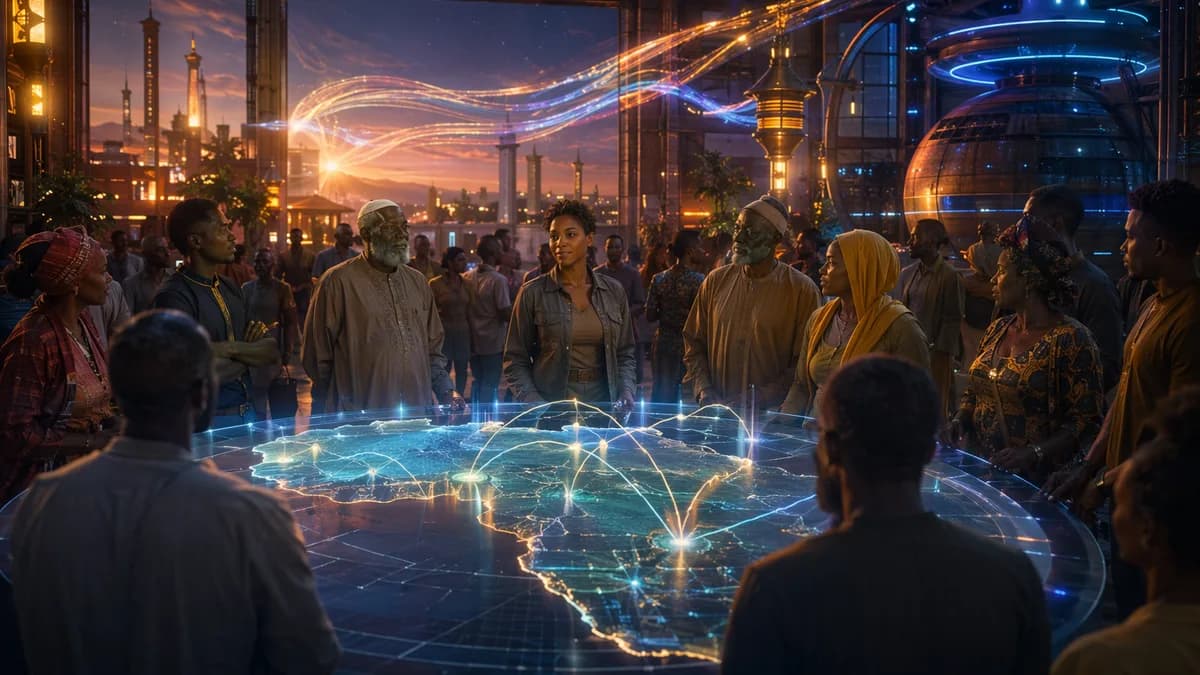
At noon, the president’s face appears on every wall screen and phone glass. Behind him, a map of Africa glows with pale gold threads stretching from the Sahara fusion fields southward. The Sunthread, fed by tokamaks buried beyond old oil roads and salt flats, begins its official transmission into Nigeria’s receiving mesh.
In Balogun Market, the lights do not flicker. They simply hold.
A woman selling lace wrappers looks up at her ceiling fan as if it has insulted her.
“That is all?” she says.
“That is all,” Amina answers.
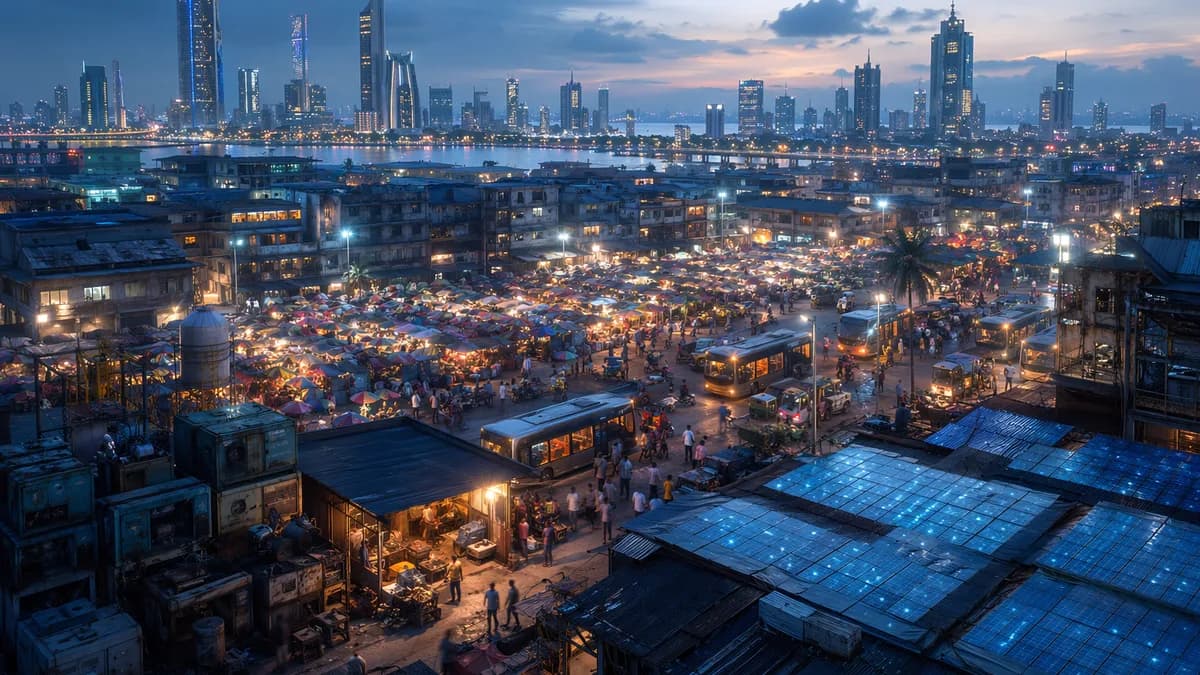
Outside, battery buses whisper down Broad Street, their tires hissing over rain-dark asphalt. No fuel queues curl around stations. No boys carry jerry cans through traffic. At the clinic on Martins Street, vaccines sit in humming cabinets, cold without interruption. Rooftop desalination tanks pulse softly under the sun, filling blue drums with clean water. By evening, the night market opens bright as noon, fish silvering on crushed ice, plantain oil snapping, children reading under white lamps instead of phone torches.
Still, Amina feels unsettled.
She stands in her warehouse among obsolete engines and hears the city’s new sound, not silence exactly, but a low, orderly hum. It comes from buses, tiles, relay receivers, cooling systems, thousands of devices no longer fighting to survive.
Tunde leans against a generator and folds his arms.
“So what are we now?”
Amina looks at her blackened fingernails, at the machines that made her important.
“Scrap dealers,” she says.
Then the lights above them brighten by one careful degree, and she knows the answer is not enough.
2. Abundance Has a Signal Strength
Six months later, Amina carries a ladder, a handheld spectrum reader, and a bag of ceramic spacers through Ajegunle rain. Her old generator van now has a green sticker on the door: NEIGHBORHOOD ENERGY MEDIATION, TUNING, AUDIT, DISPUTE.
The job smells cleaner than diesel, but it is not easier.
On rooftops and balconies, wall-sized rectenna tiles drink power from the air. They are dull gray panels, thin as cupboard doors, angled toward stratospheric relay kites too high to see except at sunset, when their skins catch fire-orange light. The beams are safe, low-density, and spread wide enough that birds cross them without noticing. Still, people argue with the invisible.
“My freezer drops at two every afternoon,” says a fish seller named Ibidun, pointing at a wall tile beside her sink. “But his television never blinks.”
Her neighbor, a retired customs officer, snorts. “Because I paid for premium stability.”
Amina raises her spectrum reader. It chirps in three tones. Rain taps the zinc roof, and below, children splash through gutters that no longer smell of petrol runoff.
“You both receive from the same kite,” she says. “Your tile is shadowed by his new water tank.”
The man looks offended. “Water is life.”
“So is fish that does not rot.”
They stare at each other, then at her.
This is what energy mediation becomes, not wires and fuses, but manners, angles, promises. She helps families place tiles where they catch clean signal. She explains household load curves in Yoruba, Hausa, Pidgin, and diagrams scratched onto cardboard. She teaches landlords that abundance still needs fairness, that a strong signal on one wall can make another home weak.
At Makoko lagoon, fishermen show her ice boats that glide out before dawn with silent motors and return with catch still stiff and bright. No middleman with a diesel freezer can bully them at the dock.
“Before, we sold fast or lost everything,” one man says, opening a cold hold that exhales white mist. “Now we wait for price.”
At midnight, she passes a courtyard where teenagers sit around glowing tables, solving equations, laughing over noodles, arguing about Mars agriculture and old Nollywood.
“Aunty Amina,” one girl calls, “come and see. Darkness has resigned.”
Amina laughs, but the words follow her home.
People think electricity is light. They are wrong. Electricity is time. It is bargaining power. It is a girl studying when her brothers sleep, a clinic keeping blood cold, a widow charging a sewing cooperative’s tools before sunrise.
Abundance has a signal strength, yes. But it also has witnesses.
3. The Borderless Commodity
The first panic begins in places with polished floors.
Currency traders in London blink at Sahara energy futures and curse at screens. Shipping insurers in Athens recalculate tanker risk and discover that the sea has become too quiet. Former petroleum ministers, now consultants with careful teeth, appear on global feeds and warn of “unregulated atmospheric extraction,” as if sunlight and fusion beams are thieves.
Then the Sahel Accord proposes its impossible sentence: transmitted fusion power shall be treated like a shared atmosphere during emergencies, not like exported fuel.
In Lagos, people read the line on cracked phones and wall displays while buying tomatoes.
“What does that mean?” Tunde asks in Amina’s shop.
“It means energy crosses borders like weather,” Amina says, soldering a contact pad. “And weather does not show passport.”
He whistles. “Governments will hate that.”
They do.
The crisis comes in September, when heat settles over Tripoli like a lid. Night temperatures stay above forty degrees. Hospitals fill with old men and infants whose skin is hot to the touch. The Mediterranean relay array, governed by emergency protocol, diverts capacity south and east to Libya. For eleven minutes, Lagos receives a lower band.
In most homes, nothing happens. Fans slow slightly. Wall screens dim.
But at Mainland Children’s Hospital, a cooling bank already under maintenance hiccups. Nurses run with portable cells. A dialysis clinic in Surulere loses pressure for ninety seconds. In Balogun Market, cold-chain pharmacy alarms shriek so loudly that traders spill into the aisles.
By evening, the feeds are full of anger.
“They took our light for Europe’s favorite desert city,” says one commentator.
“New colonial pipeline,” says another. “Only now the pipe is invisible.”
North African officials answer with images of Tripoli wards, mothers pressing wet cloths to babies’ heads. The Sahara Fusion Authority insists the algorithm followed treaty rules. Nigerian legislators demand compensation. Ghana asks whether Accra is next. Niger asks why its land hosts relay farms but its villages still vote on allocation after export contracts are satisfied.
Amina watches the arguments from her shop, where old generator parts hang on hooks like bones.
Her mother calls from Abeokuta.
“Do we need to buy candles?”
“No, Mama.”
“Your father says I should ask about one small generator.”
Amina looks at the warehouse across the lane, stacked with dead machines. Outside, Balogun glows, but the light feels different now. Fragile, because people no longer know who is touching the switch.
“The problem is not power,” she says slowly.
“What is it, then?”
Amina hears, beneath the market voices, the old memory of engines starting one after another in the dark. Each compound once controlled its own thunder, if it could afford fuel.
“Trust,” she says. “The problem is trust.”
4. Amina's Blackout Ledger
Amina does not mean to become famous. She only keeps notebooks.
They are black-covered school ledgers bought in bulk from a stationery trader whose son once failed exams during a week of outages. In them she records every complaint she hears, every dip, every brownout, every quiet injustice hiding inside the clean language of system optimization.
Wedding hall, Oyingbo, 18:42, music cut during bride’s entrance, no medical risk, high social damage.
Dialysis clinic, Surulere, 19:03, pressure loss, backup cell activated late, four patients frightened.
Cold-chain pharmacy, Balogun, 19:07, insulin temperature spike, stock saved by neighboring vendor’s battery.
Mosque, Idumota, Friday prayers, fans down, elderly worshippers moved outside.
Data farm, Lekki, no interruption, premium resilience contract.
Street food row, Marina, oil coolers off, eighty trays spoiled, no contract category.
When the Assembly committee summons her, she wears a blue boubou and carries six ledgers in a market bag. The hearing room smells of chilled air and new carpet. Men in tailored suits murmur over tablets. A Sahara Fusion engineer sits with her back straight, silver hair braided tight. A senator taps his microphone as if it is guilty.
“Madam Bello,” he says, “are you here to tell us the algorithm discriminates against Nigeria?”
Amina adjusts the microphone. Her palms are damp, but her voice comes steady.
“I am here to tell you the algorithm does not know what Nigeria is.”
A murmur rolls through the room.
The engineer leans forward. “The system prioritizes contracted critical loads, verified emergency demand, and grid stability.”
“Yes,” Amina says. “That is the problem.”
She opens a ledger. Paper rustles. Cameras blink red.
“A wedding hall is not critical until the groom’s mother collapses in heat because the hall was built without windows. A street vendor is not critical until one hundred families lose the only hot food they can afford that night. A mosque is not critical until old men faint. A data farm is always critical because its lawyers wrote better contracts.”
The senator stops tapping.
Amina places photographs on the table. A pharmacist standing beside saved insulin. A fisherman’s daughter holding a melted crate of vaccine ice packs during a local dip. Teenagers studying by shared battery lantern after their salon voted to lend power.
“I am not saying Tripoli should go dark,” she says. “No mother should watch a child burn with fever because Lagos wants cold beer. But communities understand consequences better than contracts. Your grid optimizes for agreements. We live with outcomes.”
The room becomes quiet enough for her to hear the air vents.
The Sahara engineer looks at the ledgers, then at Amina.
“What would you replace it with?”
Amina thinks of market women settling disputes over inches of stall space, of fishermen dividing ice, of landlords arguing under rain.
“Not replace,” she says. “Expose. Let people see the choices. Then let them help make them.”
5. The Market Becomes a Parliament
The trial begins on a Monday morning with no flags, no anthem, and no minister cutting ribbon. Just a public dashboard projected onto the side of Amina’s old warehouse, bright enough to see through the harmattan haze.
BALOGUN LOCAL ENERGY COMMONS, THREE-DAY RATIONING SIMULATION.
People gather with plastic stools, trays of puff-puff, bolts of fabric, phone chargers, babies tied to backs. Above them, rectenna tiles gleam from rooftops like patient gray leaves. Inside the warehouse, the dead generators are gone except for oil stains on the floor. In their place stand screens, voting kiosks, chalkboards, and a large map showing power flow in soft blue lines.
Tunde walks in, eyes wide. “You turned scrap into government.”
“No,” Amina says. “Government is too slow. This is market.”

The rules are simple. For three days, Balogun voluntarily accepts reduced allocation as if another regional emergency is underway. Every hour, traders and residents vote on priority categories. Clinics, refrigeration, water pumps, cooking, worship, study spaces, entertainment, advertising screens, luxury cooling, data services. The system shows consequences before each vote.
If cold-chain pharmacies receive full power, fashion display walls dim.
If night study salons stay open, decorative lighting on Broad Street waits.
If water pumps run at midday, private laundry drones charge after midnight.
At first people shout.
“My customers need to see the lace sparkle,” says a fabric trader.
“My mother’s insulin needs to not become water,” says the pharmacist beside her.
A young man who runs a gaming lounge raises both hands. “If we always cut entertainment, what kind of life are we saving?”
An old imam nods. “Joy is also a public service, but perhaps not every hour.”
By the second day, arguments sharpen into something like craft. People form blocs, then break them. Fishermen offer ice storage space to street vendors in exchange for evening cooking priority. A wedding hall agrees to pre-cool before guest arrival and reduce decorative screens. Teenagers volunteer to run study salons during low-demand hours and share recorded lessons with homes that vote to dim.
On the third night, rain falls hard on the warehouse roof. The market glows unevenly, not dark, not blazing, but alive with intention. Blue dashboard lines thicken and thin as votes move power through the neighborhood.
Amina stands near the entrance, smelling wet concrete and roasted corn, listening to hundreds of voices make the invisible visible.
The Sahara engineer from the hearing appears beside her, hair damp from rain.
“It is messy,” she says.
Amina smiles. “So is life.”
“The central ministries say this cannot scale.”
“Markets scaled before ministries learned to count them.”
The engineer watches a group of women argue down a proposal to keep luxury cooling in jewelry shops while a maternity clinic requests reserve capacity.
“And if people choose wrongly?”
Amina looks at the crowd. “Then at least they know who paid the price.”
6. What the Light Is For
By December, the Sahel Accord changes one word, then another, then whole paragraphs.
Emergency allocation is no longer determined only by contracts, ministries, and distant control rooms. Local energy juries form in Lagos, Kano, Niamey, Accra, Bamako, Tripoli, Agadez, and fishing towns whose names once appeared nowhere on transmission maps. Each jury has traders, nurses, teachers, engineers, imams, pastors, mechanics, farmers, and teenagers who understand dashboards faster than everyone else.
Their decisions link across borders. When heat rises in Libya, Lagos sees the wards before voting. When floods threaten Niger relay farms, coastal cities see the men sandbagging towers in brown water. When a cold-storage failure in Accra risks vaccines, Tripoli dims ornamental waterfront lights for two hours and sends a message in Arabic, English, and Hausa: We remember September.
Not everyone is pleased.
There are still politicians who call it mob electricity. Corporations complain that public votes make profit forecasts nervous. Old oil families fund documentaries about the dignity of national fuel. A few men insist that no country is sovereign if its power can be negotiated by market women with plastic stools.
Amina hears all of it from her shop, where children now come on school trips.
She keeps one diesel generator near the entrance. It is small, red, and scratched, with a pull cord stiff from age. She has cleaned it until its metal shines, but she leaves one patch of soot around the exhaust. Beside it, a placard reads: BEFORE THE SUNTHREAD, PEOPLE BURNED FUEL IN MACHINES LIKE THIS TO MAKE LIGHT.
The children stare.
“It made electricity?” a boy asks.
“Yes.”
“Inside the house?”
“Sometimes on the balcony.”
“Was it safe?”
Amina laughs. “Not especially.”
A girl with beaded braids leans close and sniffs. “It smells angry.”
“That smell was everywhere,” Amina says.
Their teacher asks, “And countries fought over the fuel?”
Amina looks past them to the open shopfront. Balogun Market shines in the evening, not with the old careless glare, but with layered decisions. The clinic sign is bright. The gaming lounge waits its turn. A mosque courtyard glows softly. Above, unseen relay kites hold their stations in the high dark, catching fusion-born power and laying it gently over borders drawn by older hungers.
“Yes,” Amina says. “They fought over what burned beneath the ground.”
The children look at the generator again, trying to imagine a world loud enough to need it.
Outside, the public dashboard updates. A heat alert in Agadez. A water pump request in Makoko. A school server in Tamale asking for night study capacity. Tiny lights pulse on the map, each one a need, each one a voice.
One child raises his hand.
“Aunty Amina, if there is enough power now, why do people still argue?”
Amina rests her hand on the cold metal of the generator.
“Because enough is not the same as fair,” she says.
The boy considers this. The market hums around them, full of light nobody owns completely, and for a moment the future sounds less like silence than listening.