The Choir Under Europa
When alien intelligence is found singing inside an icy moon, the hardest question is whether humanity has been listening wrong.
1. The Pattern That Should Not Survive
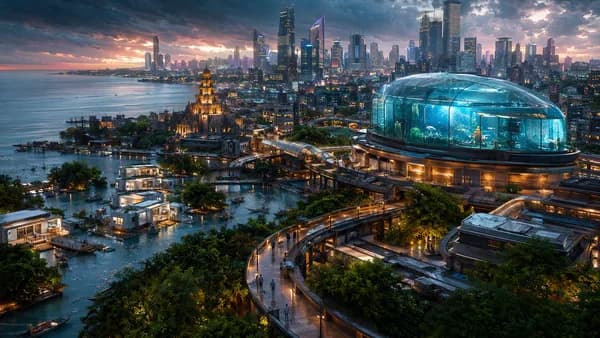
The archive hums under Reykjavík like a sleeping animal.
Dr. Mara Venn feels it through the soles of her boots before she sees the morning data, a low mechanical shiver coming up through the basalt foundation, through the elevator shaft, through the metal legs of her desk. Outside, rain needles the windows. Beyond the glass, the harbor is a smear of gray water and sodium lamps, fishing drones blinking red in the fog.
She cannot hear the rain. She has not heard rain since she was nine.
Instead, she watches sound.
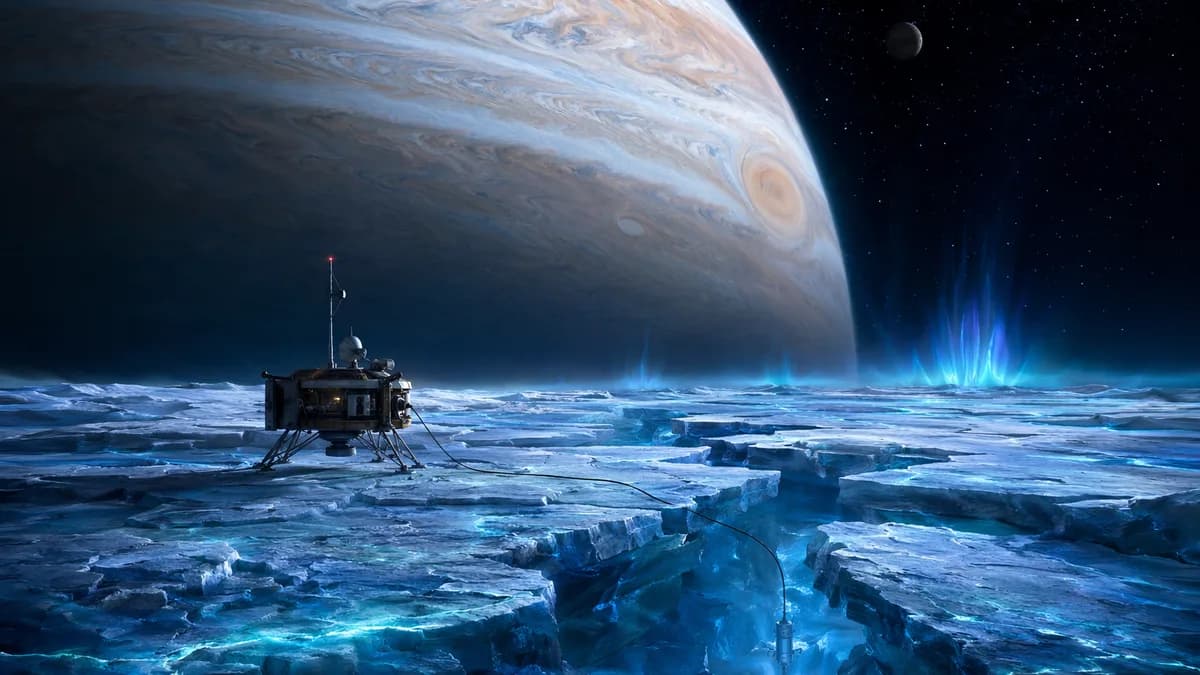
On the wall in front of her, Europa’s subsurface ocean unrolls in colored bands: pressure, frequency, duration, drift. The Europa Ocean Array is fourteen cryobot instruments frozen into the under-ice sea of Jupiter’s moon, each one dangling microphones and tremor skins into black water where no sunlight has ever fallen. Most days the archive receives ice stress, tidal groans, methane pops, the grinding complaint of a moon kneaded by Jupiter’s gravity.
Most days, the universe is noisy and meaningless.
Mara sips coffee gone cold and scrolls through a dataset labeled REJECTED, PROBABLE ICEQUAKE NOISE. Someone in the night shift has tagged it with a shrug emoji. She almost moves on. Then one band catches her eye.
A rise. A fall. A return.
She enlarges it with two fingers. The pattern blooms across the wall, pale blue against black. Seven tones, if tones can exist without ears. A ladder of pressure waves sliding through brine, repeated after thirty-one hours, then again after sixty-two, but altered, braided, thickened.
Her pulse changes. She feels it in her throat.
“No,” she signs to herself.
The room lights flash once as the translation system notices movement. A text window opens on her desk.
NO WHAT?
Mara looks toward the ceiling camera. “Nothing,” she says aloud, because the system reads her lips better than most people do. “Archive, overlay months four through nine. Compensate for sensor drift, tidal phase, plume interference.”
The wall fractures into layers. Colors stack on colors. Storms pass through the data. Europa flexes. Instruments wobble. Ice cracks and reseals. Yet the pattern remains.
It should not survive that much chaos.
Mara stands, forgetting her coffee. She walks closer until the wall fills her vision. The structure is not language, not like human words. It has no clean boundaries, no alphabet, no repeated syllables demanding translation. It is closer to humpback song, if a whale could sing over centuries. Closer to coral growth, if coral could remember rhythm.
Her colleague Pavel appears in the doorway, hair wet from the street, scarf hanging loose.
“You’re here early,” he says.
Mara points at the wall. “Tell me that’s noise.”
Pavel studies it. His face changes slowly, the way ice changes before breaking.
“Noise does not come back with revisions,” he says.
Mara feels the archive humming beneath her feet. For the first time, it feels as if something far below another world is humming back.
2. A Mind Without a Mouth
The confirmation takes eleven weeks, three review boards, two political leaks, and one argument in a Zurich conference room where a planetary geologist throws a stylus hard enough to crack a display.
By then, Mara is sleeping in the archive more often than in her apartment.
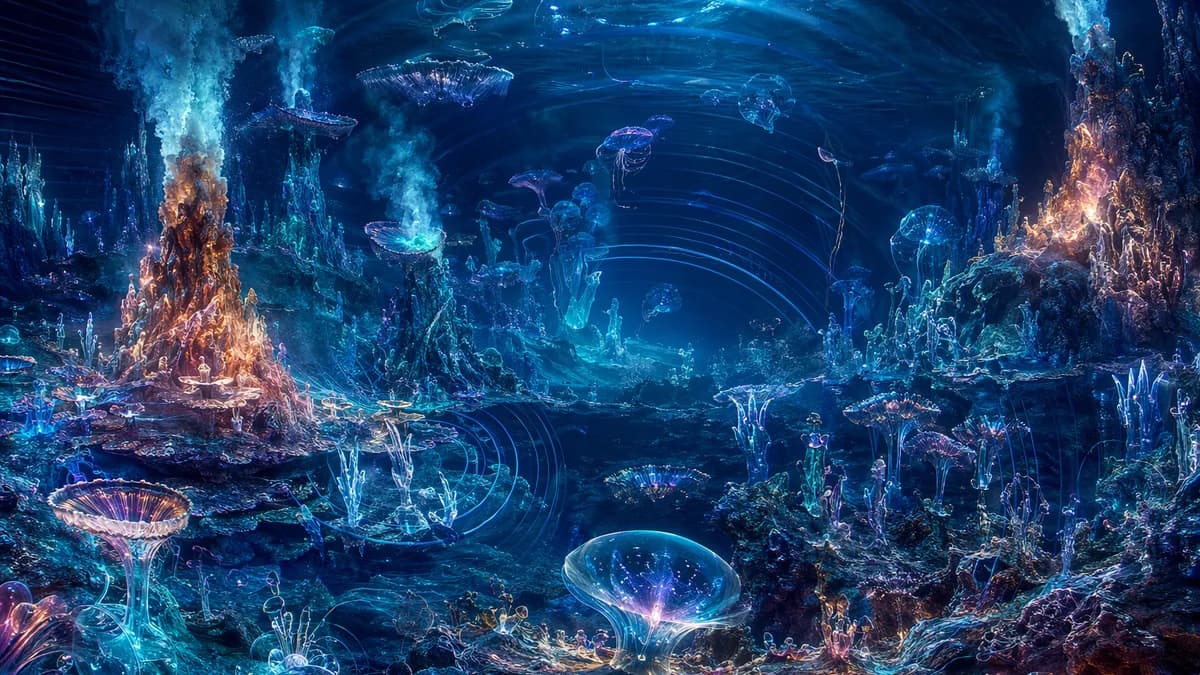
Europa rotates on the main wall, white and veined, its ice shell glowing with false color. Below that shell, in black water pressed under kilometers of frozen crust, the array maps the source of the impossible harmonics. They gather around thermal vents along the Minos Rift, where heat spills from stone and mineral towers rise like forests in the dark.
The first probe images arrive grainy and blue-white. Mara watches them with both hands braced on the table.
There are reefs down there.
Not coral, not exactly. Living mineral lattices build themselves around the vents, branching in fans and spirals, sheathing hot plumes in porous towers. Flexible organisms move among them, pale ribbons and jointed bulbs, opening and closing sacs that pulse the water. Every motion sends pressure waves through the reef. Every reef answers. The whole forest trembles with structured vibration.
On the feed, a mobile creature brushes a mineral stalk. The stalk quivers. Three neighboring structures respond, then seven, then the vent field shudders in a delayed cascade. Data blooms across the screen.
Pavel whispers, “A nervous system made of landscape.”
Mara reads his lips and nods.
The team stops saying signal and starts saying exchange. They stop saying organism and start saying node. None of the words fit. The thing under Europa has no mouth, no hands, no king, no nest, no tool marks carved into stone. It makes nothing that looks like a city. It does not separate itself from its dead.
When a ribbon organism fails, its body hardens into the reef. Its vibration pattern remains, faint but persistent, carried by mineral pores and repeated by living neighbors. Pressure becomes memory. Memory becomes structure. Structure shapes future pulses.
“So is it intelligent?” a minister asks during the emergency briefing, her voice sharp even in text.
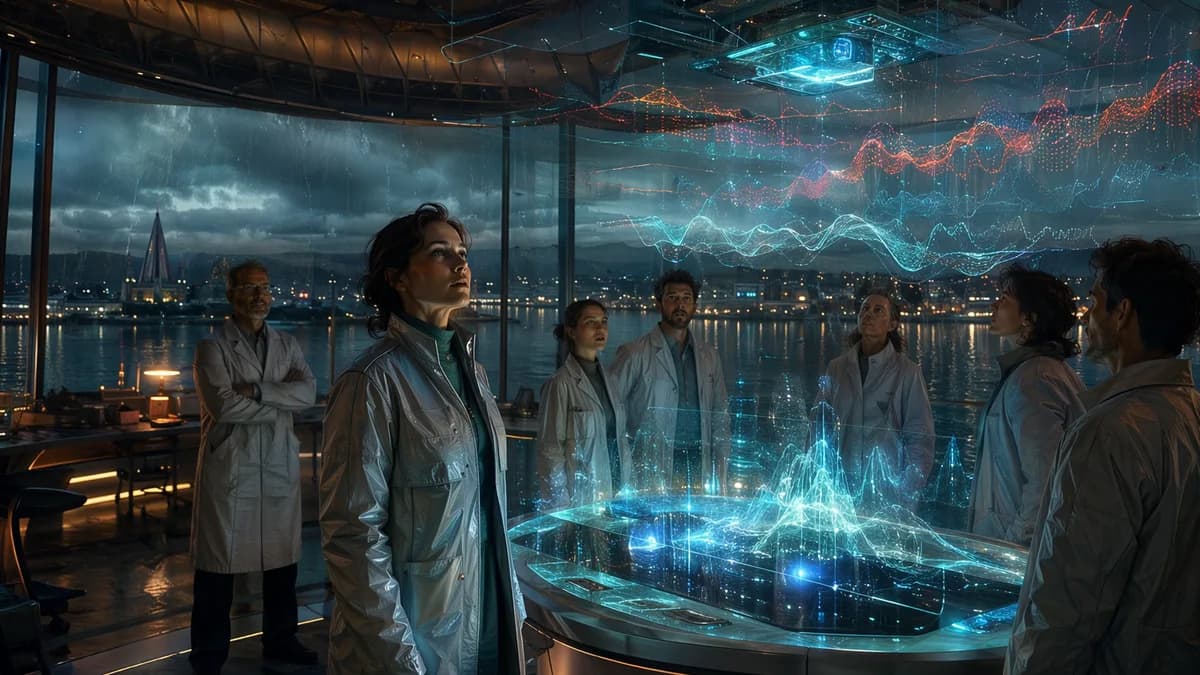
Mara sits under white lights with twelve other specialists, her palms damp against her trousers. Cameras hover like insects.
“It solves problems across generations,” she says. “It stores information outside individual bodies. It responds to change. It edits its own patterns.”
“That is not an answer.”
“No,” Mara says. “It is a correction. We asked whether there is a civilization under Europa. We assumed civilization would mean tools, borders, histories, maybe art. What we found is a living archive that thinks through resonance.”
A silence moves through the room.
Someone asks, “Does it know we’re here?”
Mara looks at the image of the vent forest, those pale bodies opening and closing in the dark, singing into stone.
“Not yet,” she says. “Or not in any way we understand.”
3. Earth Learns It Is Not the Main Character
The announcement does not bring panic. No one runs through streets shouting about invasion. No telescopes catch warships sliding out from Jupiter’s shadow. The alien mind is trapped under ice, and humans are very good at feeling safe from anything that cannot burn cities.
Instead, the world becomes strange in quieter ways.
In Nairobi, legal scholars argue through the night over whether an ocean can be a rights-bearing entity. In São Paulo, a judge pauses a mining injunction on the Moon and asks whether human expansion law has just become morally obsolete. In Delhi, schoolchildren tap Europan resonance patterns on steel lunch tables until teachers give up and build it into music class.
Mara sees the videos on her kitchen wall while eating toast over the sink. A girl in Manila presses her palm to a bass speaker, eyes bright, feeling a translated pulse ripple through her bones. A choir in Reykjavík sings adapted harmonics in a church where the pews vibrate under the audience. At a protest in Lagos, banners read LEAVE THE SECOND OCEAN ALONE.
Religions split, but not cleanly. Some preachers declare the choir proof that creation is broader than scripture. Others insist souls require lungs, names, faces. A monk in Kyoto says, on a broadcast that reaches three billion viewers, “Perhaps the soul is not a candle. Perhaps it is the warmth passed from hand to hand.”
Economies shift like ice shelves. The Europa Extraction Consortium collapses in nine days. Its promotional videos, once full of clean fonts and glittering diagrams of rare isotopes, become obscene almost overnight. Governments redirect money toward quarantine science, preservation treaties, passive listening stations. Investors complain. Teenagers mock them without mercy.
“Humanity discovers the oldest conversation in reach,” one message says, “and your first thought is drilling rights?”
Mara is invited everywhere and goes almost nowhere. She gives statements from the archive, seated before the same wall of pulsing data. Her interpreter captions her speech in thirty languages. She explains again and again that the choir does not sing for beauty, not exactly. It regulates heat flow. It maps chemical change. It preserves event, injury, abundance, absence.
“But is it art?” a journalist asks.
Mara thinks of whale song bending through Earth’s oceans before humans named it music. She thinks of wind making instruments of old buildings. She thinks of her wife, Leona, humming into Mara’s palm when sound still felt like a private miracle.
“I don’t know,” Mara says. “Maybe art is what intelligence becomes when it has more memory than hunger.”
Outside, the rain slides down the glass. Inside, Europa’s patterns move across the wall, patient and dense, indifferent to whether Earth has found the correct word.
4. The Translator’s Grief
Mara keeps Leona in a shoebox under the bed.
Not her body, which the flood takes in Lisbon during the third relocation failure, when seawalls buckle and the emergency ferries leave half-loaded. What Mara keeps are small survivals: a museum ticket softened by rain, a cracked green ring, a scarf that still smells faintly of cedar if Mara presses her face deep into it on dry winter nights. There is also a haptic recording, Leona laughing with her mouth against Mara’s wrist, the vibration stored in old polymer.
Mara does not play it often. When she does, it undoes her.
Now she sits in the archive at 2:13 in the morning, replaying a Europan death.
The data is not dramatic. No scream, no final flare. One mobile organism slows near a vent chimney. Its pressure sacs falter. It folds against a lattice and begins to mineralize. Over several days, its motions cease, but the surrounding reef alters. A narrow band of vibration, once produced by the body, appears in the mineral structure. Then another node repeats it. Then another.
The dead one does not vanish. It becomes easier to transmit.
Mara rubs her thumb across Leona’s ring until the cracked edge bites skin.
Pavel finds her near dawn. He sets tea on her desk, waiting until she looks up.
“You have been in this sequence for three days,” he says.
“I’m working.”
“You’re haunting it.”
She almost smiles. “Maybe it’s haunting me.”
He sits beside her. On the wall, the dead organism’s pattern continues as a faint gold thread woven through blue.
Mara says, “They don’t archive the dead as records. They keep using them.”
“Using?”
“No. That’s wrong.” She closes her eyes, frustrated by language. “They continue through them. A pressure path forms because a body existed. The reef keeps that path open. New signals pass through old lives.”
Pavel is quiet for a long time. “You’re thinking of Leona.”
Mara feels the name as a pressure wave in her chest.
“I keep saying I lost her,” she says. “Everyone says that. Lost. As if grief is a search problem. As if the dead are misplaced.” She looks at the gold thread. “What if that’s a human prejudice? What if a person is not only the body walking around, but every pattern they leave in those who loved them?”
Pavel’s eyes soften. “That does not make it hurt less.”
“No,” Mara says. Her voice frays. “But maybe hurting is not evidence of absence.”
She takes the shoebox from her bag. She has brought it without admitting why. The scarf lies folded inside, soft as breath. Mara places Leona’s haptic recording on the desk and lets it play once into her palm.
A laugh blooms against her skin, tiny, familiar, alive in the only way it can be.
On the wall, under Europa’s ice, the reef carries its dead forward into song.
5. The First Question
The first message to Europa takes six months to approve and almost no one likes it.
The mathematicians want primes. The diplomats want greeting sequences. The navigation authorities suggest a map of Earth and the solar system, until Mara asks whether pointing at oneself is meaningful to a mind that has never seen sky, star, or horizon. A military adviser wants proof of restraint embedded in the transmission. A poet from Buenos Aires says that sounds like apologizing with clenched teeth.
In the end, Mara stands before the Interplanetary Contact Council with a pulse map glowing behind her.
“We should not begin by announcing what we know,” she says. “We should begin with what has shaped us.”
The message is not music, though musicians help make it. It is a slow modulation carried by a Europa relay, tuned for water and ice, built from Earth tides, human heartbeats, infant sleep rhythms, whale migration calls, and fragments of lullabies stripped of melody until only rocking remains. It says nothing in words. It offers recurrence, pull, rest, loss, return.
A councilor from the Pacific Union frowns. “You are proposing we send grief.”
“I’m proposing we send kinship,” Mara says.
The transmission chamber in Reykjavík fills for the sending. No one needs to be there, but everyone comes anyway. Technicians stand shoulder to shoulder. Pavel brings coffee no one drinks. Leona’s ring hangs on a chain under Mara’s collar, cool against her skin.
At 18:00 UTC, the pulse leaves Earth, laser-tight to the relay net, then onward toward Jupiter. Mara watches the confirmation light blink green. It feels absurdly small.
Now physics takes over.
Seventeen hours for the message to arrive and the answer, if there is one, to return. During the wait, Earth pretends to sleep. Cities hold vigils. Children wear haptic bands in classrooms. In Reykjavík, snow begins after midnight, soft white static against black windows.
Mara stays awake with her hands flat on the desk.
At 11:22 the next morning, Europa cracks.
Not because of them, not entirely. Icequakes happen there every day, the moon flexing in Jupiter’s fist. But this one changes as it travels. The fracture’s violence enters the vent fields and comes out shaped. The array catches it in twelve instruments at once.
A vast harmonic mirror unfolds across the archive wall.
There are Earth’s tides, bent through Europan stone. There is heartbeat rhythm, slowed and widened until it feels geological. There is the lullaby pulse, returned inside a structure Mara has only seen in the reef’s memory sequences, the ones that mean continuation after rupture.
Pavel grips the back of a chair. “Is it a reply?”
Mara cannot speak. Her hands tremble too hard to sign.
The wall floods with gold and blue. The archive floor vibrates faintly under her boots, a ghost of an ocean beneath an ocean, a moon answering a planet without knowing what a planet is.
At last Mara whispers, “It knows another current touched it.”
The pattern deepens, not saying hello, not saying we are here, but making room for the shape of them.
6. The New Human Century
Years later, Mara teaches students to listen with their knees, palms, ribs, and doubts.
The xenoresonance studio at Reykjavík University has no chairs in the center of the room. The floor is a suspended membrane over thousands of actuators, warm from use, smelling faintly of dust and copper. On the walls, Europa’s patterns drift beside Earth recordings: elephants through savanna soil, roots clicking in drought-stressed forests, glaciers groaning, premature infants soothed by chest vibrations in neonatal wards.
The students arrive barefoot, laughing at first, then quiet when the floor begins to speak.
Mara is older now. Silver cuts through her black hair. Her hands ache in cold weather. Leona’s ring still rests against her sternum. She walks among the students as a low Europan sequence rolls through the room, not loud, never loud, but immense. The young ones close their eyes. Their faces change as they feel the timing.
“Don’t translate too quickly,” Mara tells them. Her voice appears as text along the wall for those who need it, and as vibration through the floor for those who prefer that. “If your first impulse is to name it, wait. Naming can be a kind of interruption.”
A student named Imani lifts her hand. “But how do we know we’re not just imagining meaning?”
Mara smiles. “We are always in danger of imagining meaning. We are also always in danger of refusing it because it arrives in the wrong body.”
Outside, the city is brighter than it used to be, powered by wind towers and tidal gates, rebuilt higher after the old harbor drowned twice. The world has not become wise. There are still wars, shortages, vanities dressed as policy. Humans still lie, hoard, and mistake speed for purpose.
But something has shifted.
Europa is protected by treaty now, not as property held in trust, but as a legal presence. The listening arrays remain passive. No drilling. No sampling without consent, and consent remains a question humanity is still learning how to ask. Children grow up knowing intelligence does not require fire, metal, eyes, or conquest. They learn that a civilization can be a reef remembering its dead.
Mara dims the studio lights. A new sequence arrives from the moon, twenty-three years after the first answer, threaded through an ordinary tremor. It carries old motifs and unfamiliar alterations. The students lean into it, bodies still, attention bright.
“What does it mean?” someone whispers.
Mara feels the pulse rise through her bones. It is not a message in the human sense. It is weather and memory, invitation and boundary, grief and endurance braided together under ice.
“I don’t know yet,” she says.
For once, no one is disappointed.
They stand together in the trembling room, a small species on a wet planet, learning that the universe has been full of conversations all along, and that listening may be the first technology worth keeping.