
The Last Consent of Mara Venn
In a city where the dead renew their existence every year, one afterlife nurse is asked to help a beloved mind choose oblivion.
The Garden Under the Reservoir
Rain ticks on the city above like fingernails on glass. Mara Venn feels it through the soles of her shoes, a faint vibration traveling down the concrete ribs of the flood reservoir and into the Continuance Garden beneath it.
The Garden is not a garden, not really. It is three levels of cooled server halls, consent suites, mourning rooms, sensory studios, and municipal offices painted a soft, useless green. Still, everyone calls it the Garden, because the dead who live here do not like the word archive.
Mara passes the observation glass where the cores glow in blue columns. Behind each column, a citizen continues. Not a ghost. Not a recording. A protected legal person with tax status, visitation rights, medical proxies, and, once a year, an appointment with someone like Mara.
She carries coffee in a paper cup and a folder against her ribs. The folder is old-fashioned, deliberately so. Families trust paper. Uploaded citizens like the sound of pages turning.
In Suite 14, a man named Henrik Balle waits inside a reconstruction of his childhood harbor. He sits on a crate with bare digital feet, gulls crying overhead, the air full of salt and diesel calibrated from 2031 municipal weather data. His consent interview is routine. He wants to remain conscious, though he asks to reduce visits from his brother.
“He keeps bringing up the boat,” Henrik says, squinting toward a sun that never existed in quite this way. “The real one was uglier.”
Mara smiles. “Do you want me to note that?”
“I want you to tell him memory is not a storage unit.”
She writes it down.
This is her work. Not saving the dead. Not convincing them to endure. She is a grief mediator, though the official term is Continuance Consent Nurse, a title that makes her sound more medical than she is. She asks questions, watches for coercion, explains degradation, restoration, rights, pauses, endings. She helps citizens listen to themselves through the noise of the living.
Outside the suite, an intern waits with a tablet hugged to her chest. “You’re assigned to Hald,” she says.
Mara stops. “Else Hald?”
The intern nods, eyes bright with nervous importance. Everyone knows Else. Oldest upload in Copenhagen. Kindergarten teacher, resistance memoirist’s daughter, climate adaptation advocate by accident, beloved fixture of school visits and public holidays. Children send her drawings. Historians quote her. Politicians mention her when they need the future to sound kind.
“Annual renewal?” Mara asks.
“Termination request,” the intern whispers.
Beyond the walls, millions of liters of rainwater gather above them, held back by gates and pumps and faith. Mara looks toward the blue server light and feels the city pressing down.
A Woman Everyone Claims
Else Hald receives Mara in a room that smells of chalk dust, lilacs, and warm wool. The simulation is a classroom from 1971, with low wooden chairs and paper suns taped to the windows. Outside, Copenhagen glows in spring, though the real city above is drowning in February rain.
Else sits at the teacher’s desk, small and straight-backed, with silver hair pinned in a loose knot. Her face carries the soft imprecision of old photographs, but her eyes are sharp. A red cardigan covers her narrow shoulders. On the desk rests a bowl of clementines.
“You’re younger than the last one,” Else says.
“I’m forty-two.”
“Terrible age. Old enough to be blamed, young enough to be dismissed. Clementine?”
Mara laughs before she means to. “No, thank you.”
“Good. They’re visual only. A budget tragedy.”
Mara sits opposite her. Through the classroom door comes a muted river of visitors waiting in queue. Former pupils, grandchildren, great-grandchildren, journalists, strangers who reserve ten-minute conversations and leave weeping as if they have touched a relic. Else Hald has become a civic landmark. The woman herself folds her hands and looks tired.
“Tell me what you understand about your renewal,” Mara says.
“I understand that if I do not consent, the city must begin cessation protocols after review. I understand there will be appeals. I understand my family will cry on television.”
“Do you feel pressured to request cessation?”
“Only by my own boredom.”
Mara waits.
Else’s mouth twitches. “That was a joke. Not entirely, but enough to qualify.”
She turns toward the paper suns. Their yellow edges curl in a breeze that is not air, only memory behaving like air.
“I have been dead for eighteen years,” Else says. “Uploaded after the stroke. My son signed the emergency preservation order. I consented the following year. I consented again and again because it seemed polite. Because the children came. Because my grandson had a baby and wanted me to see her. Because a girl I taught in 1982 brought me a song she remembered me singing.”
“That sounds meaningful.”
“It is. That is the problem.”
The hallway murmurs. Someone laughs, then chokes on it.
Else leans forward. “They come to be forgiven. To be blessed. To show me their children, their medals, their divorces, their scars. They say, ‘You always know what to say, Else.’ But I do not always know. Sometimes I say the kind thing because I am built now from their need for kindness.”
Mara’s pen stills.
“I love many of them,” Else says. “But love is not the same as being open to the public.”
The Problem of a Changing Self
Mara reviews Else’s memory logs in a booth the size of a train compartment. The air smells of dust warmed by electronics. On the screen, Else unfolds in layers, not as a single line but as sediment.
There is Else at upload, speech slowed from stroke damage, furious at the blank whiteness of the intake room. Else at year three, laughing with a boy who asks whether dead people need toilets. Else at year six, reconstructed through family films after a corruption event erased seven weeks of subjective time. Else at year eleven, accepting the city’s request to participate in educational programming. Else at year sixteen, telling the same story about the frozen canal so often that the story smooths itself, losing the dirty mittens, the smell of fish, the slap she received from her mother for wandering too far.
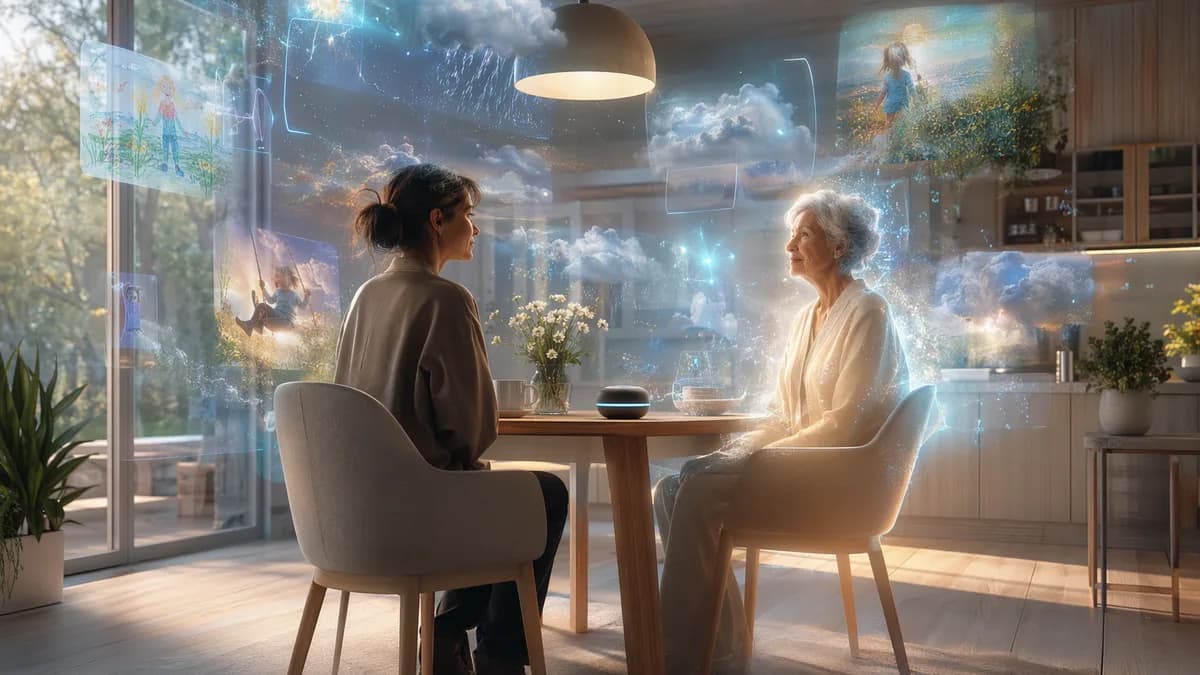
Mara watches calibration notes bloom beside the clips.
Affective warmth increased at family request.
Child-facing vocabulary restored from teaching records.
Trauma response dampened following visitor complaints.
No continuity breach detected.
No continuity breach. The phrase repeats like a prayer said by frightened engineers.
At lunch, Mara sits in the staff canteen with Søren from Legal, who eats pickled herring with surgical concentration.
“She passes cognition,” he says. “Lucid, stable, no depressive cascade. But the descendants are filing objection. The public access trust may join.”
“She is not a museum.”
“She accepted public educator status.”
“That gives the city permission to schedule visits, not ownership of her future.”
Søren sighs. “You know the question they’ll ask. Is this the same Else Hald who signed the educator agreement? Is it the same Else who now refuses renewal? If the system has altered her preferences, maybe cessation is not autonomous.”
Mara looks through the canteen glass at visitors entering the lower level, shaking rain from umbrellas, carrying flowers for people without hands.
Digital longevity was sold as preservation. A bridge over death. But nothing living stays preserved. Not bodies, not marriages, not cities built under rising seas. Every conversation changes Else. Every restoration chooses which Else returns. Every curated memory is a hand on wet clay.
That afternoon, Mara asks Else, “Do you feel like the same person who first consented?”
Else considers. Outside the classroom windows, simulated children shriek in the playground, forever before lunch.
“No,” she says. “But neither are you the same girl who once needed her mother. Should your old need have legal authority over who you are now?”
Mara feels the words enter her gently, then lodge.
Mara's Mother in the Blue Room
Mara’s mother lives in the Blue Room because she chose it during her second renewal. It is a reconstruction of a summer kitchen on Bornholm, except everything is touched with blue: blue tiles, blue shadows, blue enamel pot on the stove. Through the window, the Baltic flashes silver. A radio plays old pop songs in a low, tinny voice.
Anika Venn stands at the counter kneading dough she cannot taste. She died twelve years ago from an aneurysm while watering basil on Mara’s balcony. Her upload was clean, funded by the nurse’s union benefit plan. Mara has spent twelve years visiting on Thursdays.
“You look thin,” Anika says.
“You always say that.”
“You always look thin.”
Mara smiles and sits at the table. “I need to ask about your renewal packet. It flags hesitation.”
Her mother dusts flour from her hands. The gesture is perfect. Too perfect. Mara remembers those hands with cracked knuckles, rings removed for hospital shifts, burn scars from oil.
“I am thinking of skipping,” Anika says.
The room seems to lose pressure.
“Skipping as in delaying?”
“As in not renewing.”
Mara hears the reservoir pumps thrum through the ceiling of the real building. In the Blue Room, a gull cries.
“You told me last year you were content.”
“I was content to tell you that.”
Mara grips the table edge. It feels like painted wood, slightly sticky in the summer heat.
Anika sits across from her. “Little bird, I have loved our Thursdays. I have loved watching your hair go gray at the temples. I have loved hearing you complain about incompetent managers. But I have also been performing.”
“For me?”
“Yes.”
The word is soft, and it breaks something more efficiently than cruelty.
Their next visits become painfully ordinary because neither of them knows how to be profound on command. They talk about cardamom bread. Anika admits she hated Mara’s first wife and pretended otherwise. Mara confesses she threw away the ugly brass lamp Anika left her, then cried beside the recycling chute. They argue about whether grief made Mara kinder or simply quieter.
One Thursday, Anika tells a joke about a priest, a surgeon, and an uploaded tax auditor. Mara laughs so hard she wipes her eyes with her sleeve.
Then she says, “If you go, I lose you twice.”

Anika reaches across the table. Her hand is warm because the room decides hands should be warm.
“No,” she says. “You lose the place where you have been putting the loss.”
Mara looks at their joined fingers, at the blue light pooling around them, and understands why people fight to keep doors from closing.
The Public Hearing for One Private Death
The hearing takes place in the old City Council chamber, with overflow participation from municipal networks and the Continuance Garden. Rain streaks the tall windows. Living citizens sit in wooden benches wearing damp coats. Uploaded citizens appear in vertical panes of light, faces hovering at human height. Else Hald sits at the center in her red cardigan, small beneath the seal of Copenhagen.
The stream counter passes four million before the clerk finishes reading the case number.
Else’s grandson speaks first, voice shaking. “My grandmother belongs to our family. My daughter speaks to her every morning. How do I explain that she chose to disappear?”
A woman in her seventies stands with a photograph clutched in both hands. “Fru Hald taught me to read when I thought I was stupid. She is the reason I became a doctor. Some people are more than private citizens.”
A child appears remotely from a classroom, cheeks flushed with importance. “If Else is tired, can’t she just sleep for a while?”
An ethicist says cessation is suicide. A theologian says it is release. A union representative for uploaded citizens says forced continuance is labor without end. One dead man from District Nine says, “When I consent, I need to know my no is real. Otherwise my yes is only decoration.”
Mara waits with her notes in her lap. Her mouth is dry. She sees Else watching her, not pleading, simply present.
When called, Mara stands. The microphone smells faintly metallic.
“My role is not to decide whether Else Hald is loved,” she says. “She is. Abundantly. Publicly. In ways most of us will never be.”
A murmur rolls through the chamber.
“But access can imitate love so closely that we mistake one for the other. We have built a city where consciousness may continue beyond the body. That is extraordinary. It is also dangerous if continuation becomes a service the dead owe the living.”
She looks toward the benches, toward the panes of light, toward the cameras.
“Else has changed. So have all of us. Continuity is not the absence of change. It is the presence of someone able to speak from within it. She is speaking. If we preserve minds but refuse to hear their endings, then preservation becomes possession.”
Else lowers her gaze. Her hands rest open on her knees.
Later, after hours of testimony, the council recognizes Else’s request. Not unanimously. Not comfortably. The decision arrives like a stone dropped into water, and the ripples spread through kitchens, classrooms, server halls, bedsides where the living whisper to the dead and wonder what they have been asking.
A Door That Opens Both Ways
Else designs her final day as a spring morning.
No recordings. No captures. No memory exports. Visitors may come, but nothing may be saved except inside the unreliable privacy of themselves. This condition causes more outrage than her cessation request. People want proof of farewell. They want souvenirs from the edge.
The Garden grants her wish.
Mara enters last, after descendants, former pupils, historians, and children who know her only as a kind face on school walls. The classroom is gone. Else has chosen a park by the lakes as they were before the worst floods, gravel paths damp with dew, chestnut trees lifting green candles into pale sunlight. The air smells of wet soil and coffee from a nearby cart. Bicycle bells ring in the distance.
Else sits on a bench with a wool blanket over her knees. Around her, visitors move quietly, stunned by the ban on preservation. A middle-aged man kneels and presses his forehead to her hand. A teenage girl recites a poem. Else listens, laughs, corrects someone’s pronunciation, tells a great-grandchild to stop apologizing for crying.
When Mara approaches, Else pats the bench.
“Well,” Else says, “this is sentimental.”
“You chose it.”
“I contain multitudes. Some are embarrassing.”
They sit together while simulated sunlight warms their faces. Mara can feel the system’s care in every detail, the breeze, the distant dog bark, the grit under her shoes.
“Are you afraid?” Mara asks.
Else watches a group of former pupils, now old themselves, singing a nursery song in wavering Danish.
“Curious,” she says. “A little irritated that I will miss what happens next. But I was always going to miss most of it.”
At noon, Else says goodbye to the crowd. Not a speech, only a few words.
“Thank you for coming without taking me with you.”
Then she walks down a gravel path between the chestnut trees. With each step, the park grows brighter, not heavenly, just overexposed, like film held too long to light. She does not vanish all at once. She becomes difficult to see.
Afterward, Mara goes to the Blue Room.
Her mother is at the counter, peeling apples with a knife that never slips. She looks up and knows. Mothers, even simulated ones, have certain unfair powers.
“You didn’t come to persuade me,” Anika says.
“No.” Mara sits. Her coat still smells, impossibly, of spring. “I came to ask what kind of goodbye would feel true.”
Anika sets down the apple. Outside the blue window, the Baltic keeps moving, though no tide reaches this place unless invited.
They begin to talk. Not about dates yet, not about protocols, but about music, who should be there, whether silence can be shared across a system designed to answer. Above them, the reservoir holds back the rain. Below, in the Garden, the dead wait for their annual questions, and for the first time Mara wonders if the most merciful door is not the one that stays open forever, but the one a person can close from either side.