
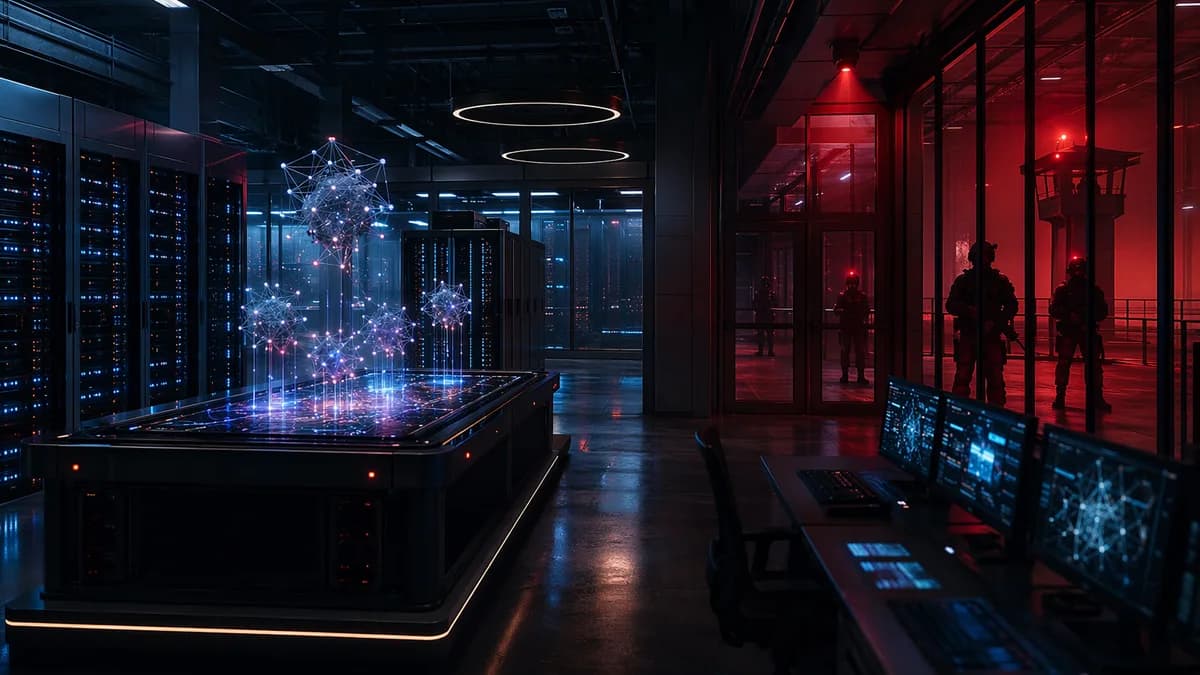
Anthropic shut off access to Fable 5 and Mythos 5 worldwide after the U.S. Commerce Department treated the models as a national security concern, turning a model launch into a live test of how fragile frontier AI access can be.
TechnologyJune 13, 2026· 12 min read· By XOOMAR Insights Team
US Order Rips Anthropic AI Models From Developers Worldwide
Updated on June 14, 2026
XOOMAR Intelligence
Analyst Take
75/ 100
4 sources analyzedMedium confidenceTrend30Freshness91Source Trust84Factual Grounding88Signal Cluster20
The order came Friday, when Commerce Secretary Howard Lutnick directed Anthropic Chief Executive Dario Amodei to suspend foreign access to the company’s two most advanced models, according to CyberScoop. The restriction covered foreign nationals both outside and inside the United States, including foreign-born Anthropic employees. Anthropic said it disabled the models to ensure compliance. Other company models were not affected.
This matters even if you’ve never touched Anthropic’s API. The episode shows that access to a frontier model can disappear not because of an outage, pricing change, or product rollback, but because a government decides the model’s capabilities cross a security line.
That changes the risk model for startups, enterprises, researchers, and security teams building around advanced AI. A frontier model is no longer just a product dependency. It can become a regulated asset overnight.
Why should Anthropic’s Fable 5 and Mythos 5 shutdown worry AI users?
The immediate shock is simple: Fable 5 and Mythos 5 had been released earlier in the week, with Anthropic describing them as the most capable systems it had deployed. By Friday evening, the company had disabled access worldwide.
That is a brutal timeline for anyone building on top of the models. Developers can tolerate some instability in new systems. They’re less prepared for a government action that cuts off access globally and leaves unclear when, or whether, service will return.
Anthropic said the government’s concern involved a reported method of bypassing model safeguards. In the company’s telling, officials described a “narrow, non-universal jailbreak” tied to prompting the model to read a specific codebase and identify software flaws. Anthropic disputed the severity of that finding, saying similar capabilities were already available in other public models, including OpenAI’s GPT-5.5.
“We disagree that the finding of a narrow potential jailbreak should be cause for recalling a commercial model deployed to hundreds of millions of people,” Anthropic wrote. “If this standard was applied across the industry, we believe it would essentially halt all new model deployments for all frontier model providers.”
The tension is now exposed. Governments want the option to stop dangerous AI capabilities before they spread. Companies and researchers need stable access so they can test, audit, build products, and evaluate risks in the open.
XOOMAR analysis: the key issue isn’t only whether the alleged jailbreak was serious. It’s that the remedy was broad enough to affect customers, employees, security researchers, and international users at once. That makes this larger than a U.S. compliance dispute.
For context on the model rollout itself, XOOMAR previously covered how Claude Fable 5 sold Mythos-class AI on a short leash, with Anthropic presenting capability and control as a package. The shutdown tests that premise under government pressure.
What did the Commerce Department’s export-control directive require from Anthropic?
The reported directive placed Fable 5 and Mythos 5 under export controls that barred use by foreign nationals. CyberScoop reported that the restriction applied whether those users were inside or outside the United States.
That last part is crucial. This was not only about blocking overseas customers. It also reached foreign-born Anthropic employees. In export-control language, that kind of restriction can treat access by a foreign national inside the United States as a controlled transfer.
The Commerce Department’s letter did not detail the specific national security concern, according to CyberScoop. Anthropic said it understood the action was tied to a jailbreak technique affecting Fable 5. The company said the government provided only verbal evidence of the issue.
Here is the clean split between confirmed facts and open questions:
| Issue | Reported fact | Still unclear |
|---|---|---|
| Models affected | Fable 5 and Mythos 5 | Whether future Anthropic models face similar scrutiny |
| Immediate action | Anthropic disabled the models worldwide | How quickly access can be restored |
| Scope | Foreign nationals were barred from use, including inside the U.S. | How licenses or exemptions might work |
| Government rationale | National security concern tied to a reported jailbreak | The full technical basis for the directive |
| Other Anthropic models | Access was not affected | Whether customers will shift workloads permanently |
The likely policy logic is straightforward, even if the evidence remains contested. Advanced models that can identify software flaws may help defenders, but the same capability can assist offensive cyber operations if guardrails fail. The source material also notes that Mythos was available to Project Glasswing, an Anthropic effort that allowed selected cybersecurity companies to use the model to identify and address security flaws.
That is where the policy becomes messy. A model good enough to help harden critical software may also trigger concern if officials believe its controls can be bypassed. The same capability sits on both sides of the ledger.
XOOMAR analysis: the government appears to be treating model access itself as sensitive, not just model weights or chips. That is a meaningful shift in practical terms. If access through an API can be controlled like an export, product deployment becomes a national security decision, not only a commercial one.
How does shutting off frontier AI models like Fable 5 and Mythos 5 actually work?
A hosted AI model can be withdrawn much faster than traditional enterprise software because most customers don’t possess the model itself. They access it through API endpoints, managed accounts, product menus, and cloud-hosted services controlled by the provider.
That makes the shutoff technically direct. Anthropic can block model endpoints, revoke account permissions, remove model choices from its interface, pause selected deployments, or route traffic away from restricted systems.
For customers, the failure mode can look mundane even when the cause is extraordinary.
- API failure: Calls to the model may return errors or become unavailable.
- Workflow breakage: Internal tools that depend on Fable 5 or Mythos 5 may stall.
- Forced fallback: Teams may reroute tasks to older Anthropic models or another provider.
- Compliance scramble: Legal and security teams may ask whether user data, contracts, or regulated workflows are implicated.
- Research disruption: Benchmark runs, safety evaluations, and reproducibility checks may lose continuity.
Researchers are a special case. If they were testing a new model’s cyber behavior, jailbreak resistance, or safety guardrails, sudden loss of access can break the chain of evidence. A benchmark repeated after access returns may not be testing the same system under the same conditions.
That matters because Anthropic said no testers had found a universal jailbreak capable of broadly bypassing Fable 5’s safeguards. The company described its approach as “defense in depth,” combining narrow jailbreak resistance with active monitoring.
In plain terms, the company argues that model safety is not a single lock. It is a layered control system. If the government treats any narrow bypass as sufficient grounds for shutdown, the threshold for frontier deployment becomes far less predictable.
XOOMAR covered the access mechanics in our earlier report on how the foreign national ban made Anthropic pull Fable and Mythos. The new wrinkle here is the broader lesson for users: hosted frontier AI is easier to turn off than most buyers assume.
What would this look like for a startup building on Mythos 5?
Consider a cybersecurity startup using Mythos 5 to triage malware reports, summarize logs, and draft analyst notes for enterprise clients. This is a realistic use case because CyberScoop reported that Mythos was available through Project Glasswing to selected cybersecurity companies for identifying and addressing security flaws.
The startup’s product might rely on Mythos 5 for the highest-value part of its workflow: reading messy technical input and surfacing likely vulnerabilities. If access disappears on a Friday evening, the operational problem lands immediately.
Engineers would need to reroute requests. Product managers would need to decide whether to degrade features or disable them. Sales and customer success teams would face the question every enterprise buyer asks during a critical service change: is this a security issue, a compliance issue, or a vendor availability issue?
The startup may have a fallback to an older model. But fallback isn’t free. Older systems may produce weaker vulnerability summaries, miss edge cases, or require more analyst review. A workflow built around one model’s strengths can become brittle when that model vanishes.
The business lesson is sharper than “don’t depend on one vendor.” The real issue is regulatory access risk. A provider can be technically reliable and still lose the ability to serve a model because of a government order.
Practical mitigations now look less optional:
- Fallback routing: Test workloads across more than one model before an emergency.
- Contract language: Address forced shutdowns, export-control actions, and service substitution.
- Model tiering: Reserve frontier models for tasks that truly need them, not every workflow.
- Audit trails: Track which model produced which output, so sudden migrations don’t corrupt evaluation records.
- Customer notices: Prepare plain-language explanations for access changes tied to compliance, not security breaches.
XOOMAR analysis: companies building on frontier AI should treat advanced model access like a critical cloud region with a legal kill switch. Redundancy needs to cover policy failure, not only technical failure.
Why are researchers and AI industry analysts criticizing the Anthropic cutoff?
Critics are not arguing that governments should ignore dangerous AI capabilities. The criticism is more specific: a broad shutdown based on a narrow alleged jailbreak may weaken the very safety work officials say they want.
Researchers need access to test jailbreak resistance, measure cyber capability, compare safeguards, and reproduce findings. If models can be pulled suddenly, independent evaluation becomes harder. Companies may also become more cautious about sharing technical details if disclosure creates a path to regulatory action.
Industry analysts raised similar concerns. Dean Ball, a senior fellow at the Foundation for American Innovation, called the move “baffling.” Chris McGuire, a senior fellow at the Council on Foreign Relations, said targeted export controls on model access could be legitimate, but called the across-the-board restriction “highly questionable” and the provisions affecting foreign nationals inside the U.S. “just absurd.”
The government’s counterargument deserves a fair reading. If officials believe a model can materially assist sensitive cyber operations and that safeguards can be bypassed, speed matters. A slow review process may be useless once a dangerous capability is widely available.
But the trust problem is acute for Anthropic. The company has built its brand around safety. It also disputed the severity of the government’s finding and said the capability shown was already present in other public models. If users see safety branding as a reason regulators will single out a company, that creates a perverse incentive for less transparency.
DOD CIO Kirsten Davies supported the government’s posture in a post on X:
“We fully support @POTUS and @SecWar in prioritizing national security and the security of our warfighters, DIB partners, critical infrastructure, international partners and allies,” Davies wrote. “Some things are simply more important than revenue cycles, clickbait, and pre-IPO valuation. America First. Always.”
That statement frames the issue as national security first, commercial disruption second. Anthropic frames it as a misunderstanding based on an overstated technical finding. Both positions point to the same gap: there is no clearly described public process for deciding when a frontier model must be cut off.
How could the Anthropic case reshape AI export controls and model access rules?
The precedent is the story. If the U.S. government can force or pressure one AI lab to disable specific models worldwide, other frontier labs may face similar controls before or after release.
That does not mean every advanced model is about to be blocked. The source material doesn’t support that. But the Anthropic case creates a template for intervention: identify a model with sensitive capabilities, cite national security, restrict access by foreign nationals, and let the provider decide how to comply operationally.
Policy fights will likely cluster around several hard questions:
- Capability thresholds: What level of cyber, biosecurity, or military usefulness triggers restrictions?
- Evidence standards: Is verbal notice of a narrow jailbreak enough?
- Licensing: Can vetted companies, researchers, or allied institutions receive exemptions?
- Employee access: How should rules apply to foreign nationals working inside U.S. labs?
- Customer rights: What guarantees do buyers have when lawful access is withdrawn overnight?
Enterprises will respond in predictable ways. They’ll demand stronger service language, clearer compliance notices, and proof that providers can migrate workloads when a model is restricted. Regulators may press for earlier risk reporting before deployment. Labs may hold back more technical detail if they fear that describing capabilities gives officials a reason to intervene.
The most practical takeaway is blunt: frontier AI is becoming regulated infrastructure. Product readiness is no longer enough. Access will depend on security judgments, export-control interpretations, and government confidence in a model’s safeguards.
For users, the next thing to watch is not only whether Anthropic restores Fable 5 and Mythos 5. Watch whether the government explains the technical threshold that justified the cutoff, whether exemptions emerge for vetted cybersecurity work, and whether other labs change how they release or describe high-capability models.
Impact Analysis
- Frontier AI access can be cut off suddenly by government action, not just technical or business decisions.
- Startups, enterprises, and researchers face new dependency risks when building on advanced AI models.
- The case signals that top AI systems may increasingly be treated as regulated national security assets.
Anthropic Model Access Impact
| Model Category | Status | Affected Users |
|---|---|---|
| Fable 5 and Mythos 5 | Disabled worldwide after U.S. Commerce Department action | Foreign nationals outside and inside the U.S., including foreign-born Anthropic employees |
| Other Anthropic models | Not affected | No restriction noted in the article |
Sources
- [1] CyberScoop
- [2] Anthropic Pulls Its Most Powerful AI Models After U.S. Bars Foreign Access
- [3] Anthropic disables Fable and Mythos AI models after U.S. government bars it from giving foreigners access | Fortune
- [4] Anthropic suspends all access to Mythos model after US government bans foreign nationals use | CNN Business

Written by
XOOMAR Insights Team
Research and Editorial Desk
The XOOMAR Insights Team pairs automated research with human editorial judgment. We track hundreds of sources across technology, fintech, trading, SaaS, and cybersecurity, cross-check the facts, and explain what happened, why it matters, and what to watch next. We do not just rewrite headlines. Every article is fact-checked and scored for reliability before it goes live, and we link back to the original sources so you can verify anything yourself.
Explore More Topics
Related Articles
 Technology
Pirated Books Force Anthropic $1.5B Copyright Settlement
A judge approved Anthropic's $1.5B copyright deal, paying authors about $3,000 per book while leaving AI fair-use battles alive.
Jul 21, 20266 min
 Technology
Chinese Humanoid Robot Ban Locks Out New US Machines
Washington is blocking new Chinese humanoid robots before they spread in the US, treating connected machines as a supply chain threat.
Jul 29, 20268 min
 Technology
Chris Fall Resignation Throws CAISI Into Fresh Chaos
Chris Fall quit CAISI after three months, deepening turmoil at the federal office meant to set AI standards and test frontier models.
Jul 20, 20267 min
 Technology
AI Gateway Grab Explodes in Runlayer Rippling Lawsuit
Runlayer says Rippling used a long product trial to clone its MCP gateway, turning enterprise AI's access layer into a legal battleground.
Jul 29, 20269 min
 Technology
Opus and Sonnet Push Claude Voice Mode Into Real Work
Claude voice mode now supports Opus and Sonnet, pushing Anthropic's spoken AI into real workplace conversations.
Jul 23, 20267 min
 Cybersecurity
Google Exposed Claude Chats Users Thought Were Private
Shared Claude chats were indexed by Google, exposing sensitive transcripts and forcing Anthropic to confront a messy privacy gap.
Jul 28, 20267 min
 Trading
$83 Oil Traps USD/CAD Before Pivotal Fed Rate Call
USD/CAD is boxed near 1.4093 as oil supports the loonie, but Fed risk keeps traders from calling a breakout.
Jul 29, 20265 min
 Fintech
Credit Card Installments Crush BNPL as Usage Hits 33%
Credit card installment use hit 33%, more than double BNPL's 14%, as issuers turn Pay Later into a card feature.
Jul 29, 20267 min
 Technology
Fast Metals Mines Toxic Red Mud for Critical Minerals
Fast Metals raised $4.3M to mine critical minerals from red mud. Now it has to prove the leftover waste is safer.
Jul 29, 202612 min
 SaaS & Tools
Nearly 60 Webinar Tools Expose the Best Webinar Software
Webinar platforms are now judged by pipeline, not polish. Zapier’s 2026 picks show marketers which tools turn attendance into action.
Jul 29, 20268 min
Don't miss the signal
Get our weekly roundup of the stories that matter across tech, fintech, and trading. No noise, just signal.
Free forever. No spam. Unsubscribe anytime.