
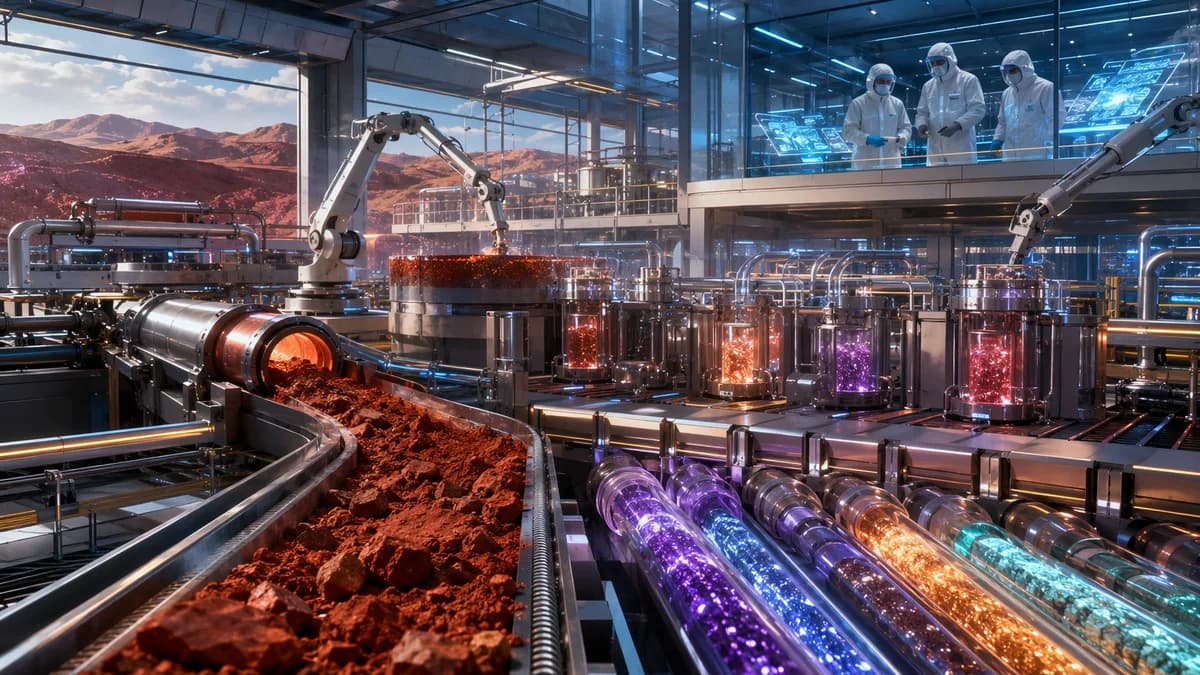
Fast Metals red mud processing is a bet that aluminum’s dirtiest leftover can become a critical minerals feedstock instead of a permanent balance-sheet liability. The scale is ugly enough to matter: aluminum refining has left more than 3 billion tons of red mud stored in open-air ponds or mounds, according to TechCrunch.
TechnologyJuly 29, 2026· 12 min read· By XOOMAR Insights Team
Fast Metals Mines Toxic Red Mud for Critical Minerals
Updated on July 29, 2026
XOOMAR Intelligence
Analyst Take
58/ 100
4 sources analyzedLow confidenceTrend10Freshness100Source Trust90Factual Grounding90Signal Cluster20
Fast Metals, a startup led by co-founder and CEO Sumedh Gostu, says that same caustic waste contains metals worth recovering, including iron, titanium, aluminum, and rare earth elements. The company recently raised a $4.3 million pre-seed round led by New Climate Ventures, with participation from Azolla Ventures, Astor Swiss, and Rio Tinto’s accelerator, Founders Factory. The company has also announced a commercial customer, Metalox Mineral Corporation, through a strategic partnership described in its company announcement.
The claim is simple. The proof won’t be. Fast Metals must show that its chemistry works outside the lab, that the recovered products meet buyer specifications, and that the leftover material is safer than the red mud it started with. If any one of those pieces fails, the business shrinks from climate-mining breakthrough to expensive waste handling.
Fast Metals red mud matters because the waste pile may also be a mineral inventory
The thesis: red mud is not just an environmental problem. It is a giant, already-mined mineral stockpile with bad chemistry.
Red mud, also called bauxite residue, is created during alumina refining, the step that turns bauxite into alumina before aluminum metal is made. The residue is caustic, iron-rich, and difficult to store. TechCrunch reports that more than 3 billion tons are now sitting in open-air ponds or mounds. Fast Metals’ own release puts the figure even higher, saying global alumina production has left more than four billion tons in stockpiles.
That gap matters less than the direction of the story. Both figures point to an enormous accumulation of waste. The company also claims those stockpiles contain an estimated $3 trillion to $4 trillion of metals crucial for defense, manufacturing, and clean energy. That is a company estimate, not an independently verified market audit, but it explains why investors are paying attention.
“It is a very rich resource,” Gostu told TechCrunch. “If you attack with the right chemistry, it can be very profitable.”
The strongest counterpoint is that red mud has looked tempting for decades. A material can contain valuable elements and still be uneconomic if recovery is too expensive, too inconsistent, or too dirty. Gostu’s pitch is that Fast Metals has found a route around the main cost barrier: separating valuable minerals from iron oxide, the dominant compound that gives red mud its color.
XOOMAR analysis: The key phrase is not “critical minerals.” It is “right chemistry.” Fast Metals red mud extraction only becomes a serious business if the company’s process changes the cost curve, not just the narrative.
Red mud is abundant, caustic, and chemically annoying
The thesis: red mud is hard to monetize because it combines low-grade mineral value with high handling risk.
The residue’s red color comes largely from rusted iron. That iron is useful, but it is also the mass that gets in the way. TechCrunch reports that red mud contains critical minerals, including titanium, aluminum, and rare earth elements, but Gostu said it has largely been ignored because separating those minerals from iron oxide has been too expensive.
“We are removing that impediment,” Gostu told TechCrunch.
Storage is the other half of the problem. The source material describes red mud as caustic, toxic, hazardous, and stored in ponds or mounds. That means the cost of doing nothing is not zero. Companies managing these sites face long-term obligations around containment, monitoring, land use, and regulatory exposure. The supplied sources do not document specific spill events or groundwater cases tied to Fast Metals’ targets, so the right framing is risk management, not incident reporting.
Abundance cuts both ways. Red mud has already been mined in one sense because the bauxite has been extracted and processed. That should help. Yet the metals are not sitting in clean, high-grade ore bodies. They are mixed into a chemically difficult residue, often in forms that require selective processing.
Here is the commercial tension in plain terms:
| Red mud as waste | Red mud as feedstock |
|---|---|
| Cost center: storage, monitoring, containment | Revenue source: iron, titanium, aluminum, rare earth elements |
| Chemistry problem: caustic, iron-rich residue | Processing opportunity: selective separation of target metals |
| Liability: long-term site burden | Asset: already-mined material near refineries |
| Hard question: can it be made safer? | Hard question: can recovery pay for the work? |
That last line is the whole business. If Fast Metals can lower both cleanup cost and extraction cost, it has room to build. If it solves one while worsening the other, buyers and regulators will hesitate.
Fast Metals red mud chemistry uses refinery waste as part of the reagent stack
The thesis: Fast Metals’ distinctive idea is to treat one waste stream with another waste stream, then sell the metals that fall out along the way.
Gostu developed much of the process during his doctoral studies at the Colorado School of Mines, according to TechCrunch. The missing piece came later in a conversation with co-founder Anthony Staley, when they recognized that another waste stream from alumina refineries could help the economics.
“We were like, ‘oh wait, theres’s a waste stream which can make the whole process very economical, and it’s lying right there,’” Gostu told TechCrunch.
Fast Metals applies that waste stream, along with other chemicals, to red mud through six different steps. TechCrunch reports that different minerals separate at different points in the process, allowing each output to be sold.
“Iron pays for the opex, and the other stuff is profit,” Gostu said.
That is a sharp commercial claim. It means Fast Metals is not counting only on rare elements to carry the project. The company’s model appears to depend on recovering enough iron to cover operating expense, while higher-value materials such as titanium dioxide and scandium oxide drive margin. TechCrunch gives the price contrast: titanium dioxide sells for around $2.50 to $3 per kilogram, while scandium oxide sells for about $750 per kilogram.
One useful way to read the process is as a staged filter, though the chemistry is more complex than a household filter. Each stage changes conditions so a different material becomes easier to separate. The attractive part is that a waste byproduct may replace some conventional chemical input. If that input is cheap, nearby, and compatible with the process, it can improve the economics.
The counterpoint is obvious. Using waste as a reagent does not automatically make a process clean or cheap. Fast Metals still has to prove feedstock variability does not wreck recovery rates, that water handling is manageable, and that the final residue does not become a new disposal problem under a different name.
XOOMAR analysis: This is where the story separates from many circular materials pitches. The company is not just saying “we can recover rare earths.” It is saying the mundane material, iron, can pay the bills. That claim is testable, and it should be one of the first numbers buyers ask to see.
The first real-world test is one ton per week with Metalox
The thesis: Fast Metals’ most important near-term proof point is not the funding round. It is whether the Metalox project can run repeatedly on real feedstock.
With the new capital, Fast Metals plans to scale its process. TechCrunch reports that the startup has a commercial contract with Metalox, a mineral processor, to treat one ton of red mud and refinery waste per week later this year. The company announcement says the work will take place at Metalox’s Florida facility and is intended to confirm commercial viability.
That tonnage is small, but it is meaningful for an early technical company. A weekly run creates data that lab batches cannot fully provide: feedstock variation, material handling problems, separation consistency, residue characteristics, and product quality. It also forces the process to meet a customer’s operating environment rather than a researcher’s ideal conditions.
A practical Fast Metals red mud project would likely depend on several site conditions, all suggested by the economics of moving low-value industrial material:
- Feedstock: a red mud stockpile or ongoing alumina residue stream close enough to process without costly transport.
- Reagent source: the complementary refinery waste stream or industrial byproduct nearby.
- Utilities: access to power, water treatment, and materials handling.
- Product path: buyers or processors for iron, titanium, aluminum, scandium, and rare earth outputs.
- Residue plan: evidence that treated material is safer, smaller in volume, or easier to manage.
Revenue could come from several places. The sources support recovered metals as the core revenue stream. The company also frames red mud as a financial and environmental liability, which implies potential value in reducing storage burden, though no specific cleanup fees, disposal savings, or tipping fees are disclosed in the supplied material.
The numbers currently available show why the mix matters:
| Product or claim | Source-backed detail |
|---|---|
| Titanium dioxide | Around $2.50 to $3 per kilogram, per TechCrunch |
| Scandium oxide | About $750 per kilogram, per TechCrunch |
| Metalox project | One ton of red mud and refinery waste per week later this year |
| Funding | $4.3 million pre-seed round led by New Climate Ventures |
| Waste stockpile | More than 3 billion tons per TechCrunch, more than four billion tons per Fast Metals release |
The biggest missing numbers are recovery rates, processing cost per ton, energy use, water balance, impurity levels, and end-product specifications. Without those, no buyer can fully judge whether the Metalox pilot is a stepping stone or a science project with a customer logo.
For XOOMAR readers who track how tech claims survive real markets, this is the same proof problem that appears far outside mining. Public pushback against vague technology promises is visible in stories like Avoiding AI Workshops Turn Libraries Into Big Tech Revolt, while digital monetization fights show up in Platforms Hijack the World Cup Digital Economy Boom. Fast Metals sits in a heavier, dirtier category, but the rule is the same: deployment data beats pitch language.
The winners would be refiners, mineral buyers, and nearby communities, if the residue is safer
The thesis: the upside is broad, but only if Fast Metals reduces the liability rather than shifting it.
Alumina refiners are the most direct beneficiaries. If red mud can be processed into saleable products while reducing the amount or hazard of stored waste, refiners get a possible path to lower long-term burden. The company release says its technology can “drastically” reduce the volume of red mud waste and the associated environmental and regulatory burden. That is a company claim, and it needs pilot data behind it.
Governments may also care because the recovered products include materials tied to defense, manufacturing, clean energy, and industrial supply chains. The company announcement explicitly frames Fast Metals as an alternative strategy as the U.S. and the global West look to compete with China’s mine-to-manufacturing supply chain. It also names Australia, the European Union, the Middle East, India, and broader North America as strategic markets.
Manufacturers could gain if recovered materials meet quality standards and arrive from more traceable sources. Communities near waste storage sites could gain if the process reduces causticity, volume, or long-term containment risk. Those are the strong-form benefits.
The weak version is less attractive. A process that extracts a few valuable products while leaving behind a troublesome residue would not solve the core problem. It might still have a niche as mineral recovery, but it would not justify the cleanup story.
XOOMAR analysis: The circular economy language only holds if the loop closes. For Fast Metals red mud processing, that means salable outputs plus a safer residual stream. One without the other is a partial win.
The proof points that decide whether Fast Metals red mud recycling survives scale-up
The thesis: Fast Metals has a compelling two-problem pitch, but the business will be decided by operating data, not scarcity headlines.
The company has credible ingredients for an early-stage industrial startup: technical roots in extractive metallurgy, a $4.3 million pre-seed round, mining-linked investors, and a first commercial customer. Gostu previously worked in mining industry roles, and the company says it was founded in 2025 by Dr. Sumedh Gostu and Dr. Anthony Staley.
Now the questions get harder. Investors and customers should press for:
- Assays: what is actually in each red mud feedstock, and how much does it vary?
- Recovery rates: how much iron, titanium, aluminum, scandium, and rare earth material is recovered per ton?
- Operating cost: does iron really cover opex across different sites?
- Chemical use: how much outside chemical input is needed beyond the waste stream?
- Water balance: how is process water handled, treated, and reused or discharged?
- Residue safety: is the final material less alkaline, less mobile, and easier to store?
- Product quality: do outputs meet customer specifications without expensive upgrading?
- Permitting path: can the process be approved at refinery-adjacent sites without long delays?
What would prove the thesis wrong? A pilot that only works on carefully selected feedstock. Recovery rates that collapse at continuous operation. Residue that remains hazardous enough to erase the cleanup value. Product streams that require too much additional refining before customers will buy them.
What would prove the thesis right? Repeated Metalox runs showing consistent recovery, saleable products, manageable costs, and a demonstrably safer residue. That would not make Fast Metals instantly large, but it would move red mud from “interesting waste problem” to bankable industrial feedstock.
The practical watch item is narrow: follow the one-ton-per-week Metalox work, then look for disclosed recovery data, offtake agreements, and residue test results. Fast Metals is attacking two expensive problems at once. The next phase will show whether the cleanup value and the minerals value survive contact with real operations.
The Bottom Line
- Fast Metals is targeting more than 3 billion tons of red mud as a potential critical minerals source.
- The startup’s $4.3 million pre-seed round signals investor interest in waste-to-minerals technology.
- Its commercial prospects depend on proving the process works at scale and leaves safer residual material.
Global Red Mud Stored
Red mud stockpile
tons3,000,000,000
Sources

Written by
XOOMAR Insights Team
Research and Editorial Desk
The XOOMAR Insights Team pairs automated research with human editorial judgment. We track hundreds of sources across technology, fintech, trading, SaaS, and cybersecurity, cross-check the facts, and explain what happened, why it matters, and what to watch next. We do not just rewrite headlines. Every article is fact-checked and scored for reliability before it goes live, and we link back to the original sources so you can verify anything yourself.
Explore More Topics
Related Articles
 SaaS & Tools
Nearly 60 Webinar Tools Expose the Best Webinar Software
Webinar platforms are now judged by pipeline, not polish. Zapier’s 2026 picks show marketers which tools turn attendance into action.
Jul 29, 20268 min
 Trading
$83 Oil Traps USD/CAD Before Pivotal Fed Rate Call
USD/CAD is boxed near 1.4093 as oil supports the loonie, but Fed risk keeps traders from calling a breakout.
Jul 29, 20265 min
 Technology
DoorDash Drone Delivery Seizes FAA Clearance to Fly
DoorDash won FAA clearance for DoorDash Air, signaling a bigger bet on owning delivery from couriers to bots to drones.
Jul 29, 20269 min
 Trading
Swiss Franc Slips as Inflation Math Frees SNB's Hand
Moderate inflation pass-through gives the SNB room to tolerate a weaker franc, sharpening the bull case for EUR/CHF.
Jul 29, 20268 min
 Global Trends
100 Aftershocks Turn Japan Earthquake Into Rescue Race
More than 100 aftershocks hit Kyushu after a 6.8 quake killed 13, turning rescue work into a race against time.
Jul 29, 20265 min
 Technology
Kremlin Targets Telegram Founder Durov in Terror Case
Russia accused Telegram founder Pavel Durov of facilitating terrorism, turning a moderation fight into a Kremlin pressure campaign.
Jul 29, 20266 min
 Technology
AI-Generated Children's Books Ignite Privacy Fights
Personalized AI kids' books are becoming family flashpoints over sloppy stories, creepy images, and children's privacy.
Jul 29, 20268 min
 Global Trends
FIFA Stake Sale Ignites Fight for World Cup Control
FIFA’s stake sale plan has turned World Cup funding into a control fight, with the FA alarmed and UEFA rushing into emergency talks.
Jul 29, 20268 min
 Trading
GBP/USD Bears Threaten 1.3300 Before Fed BoE Showdown
GBP/USD’s bounce is still fragile below 1.3353, with Fed and BoE decisions set to test whether bears keep control near 1.3300.
Jul 29, 20267 min
 Future Fiction
The City That Asked Before Moving
In heat-struck Ahmedabad in 2039, Leela Vyas loses her bus route to an AI traffic system, then discovers a stranger job: representing her neighborhood in negotiations with the city’s adaptive intelligence. Across five decades, as AI reshapes work, family, streets, and memory itself, Leela learns that the future of daily life depends less on smarter machines than on better questions.
Jul 29, 202612 min
Don't miss the signal
Get our weekly roundup of the stories that matter across tech, fintech, and trading. No noise, just signal.
Free forever. No spam. Unsubscribe anytime.