
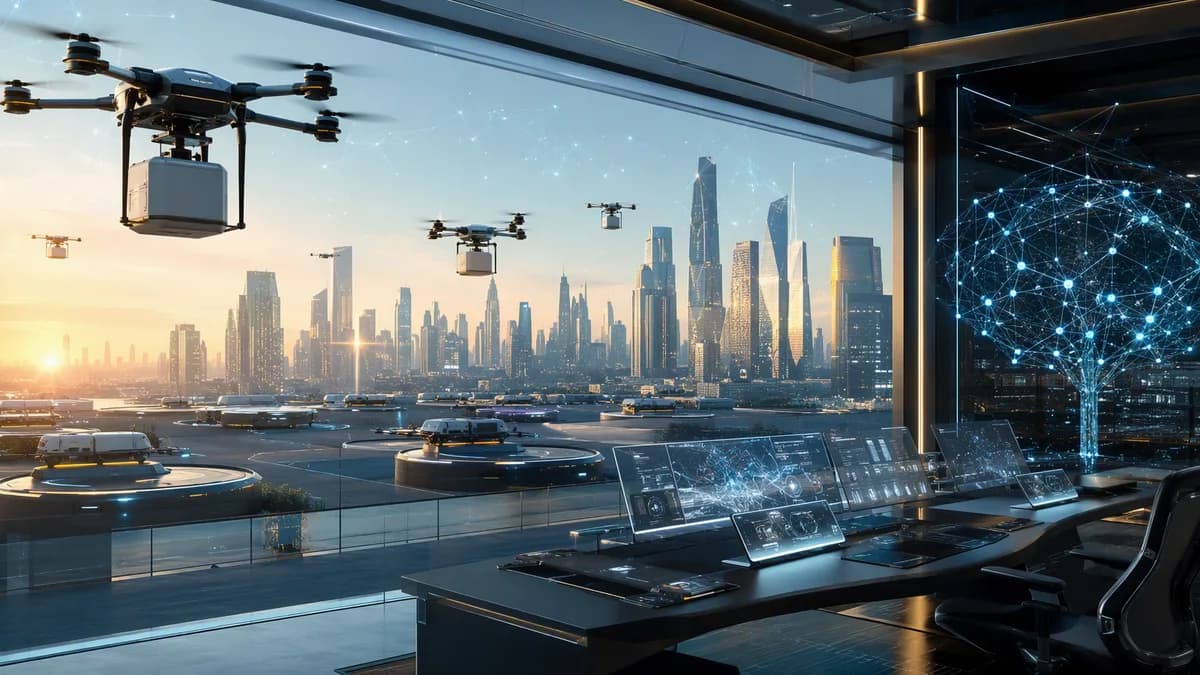
DoorDash drone delivery just shifted from partner experiment to owned infrastructure bet, after DoorDash won FAA clearance to operate a commercial drone delivery service in the United States.
TechnologyJuly 29, 2026· 9 min read· By XOOMAR Insights Team
DoorDash Drone Delivery Seizes FAA Clearance to Fly
Updated on July 29, 2026
XOOMAR Intelligence
Analyst Take
58/ 100
3 sources analyzedLow confidenceTrend10Freshness100Source Trust90Factual Grounding89Signal Cluster20
The company unveiled DoorDash Air after receiving a Part 135 air carrier certification from the U.S. Federal Aviation Administration, according to TechCrunch. That certificate lets DoorDash legally run commercial drone delivery in the U.S. It does not mean its own aircraft are about to start dropping burritos across suburbia.
DoorDash is trying to control a new delivery layer: human couriers, sidewalk bots, partner drones, and now its own aircraft. The thesis is clear. If delivery keeps fragmenting by distance, package type, merchant setup, and neighborhood layout, the winning platform won’t just match orders to drivers. It will decide which machine or person should move each order.
DoorDash wants the sky, not just the sidewalk
DoorDash Air is being built inside DoorDash Labs, the same R&D group behind Dot, the autonomous sidewalk delivery bot introduced in September 2025. Dot is now operating in the Phoenix suburbs of Tempe, Mesa, Gilbert, and Chandler, as well as in Fremont, California.
That matters because DoorDash is no longer presenting autonomy as a side project. It is framing drones and sidewalk bots as parts of one delivery network, coordinated by software.
“We didn’t start with the question, “What’s the coolest autonomous tech we could make?” We started from first principles: What’s the actual customer problem that needs to be solved?” DoorDash co-founder and chief product officer Stanley Tang wrote in a blog post announcing DoorDash Air.
XOOMAR analysis: the customer problem DoorDash is pointing at is not simply speed. It is dispatch precision. A restaurant order three blocks away, a grocery top-up five miles away, and a small retail item from a merchant back door are not the same logistics problem. DoorDash wants the app to route each one through the cheapest, fastest, least fragile channel available.
That is a serious infrastructure bet. It is also early. DoorDash did not provide a detailed timeline for when its custom-built drones will be used in operations.
FAA approval gives DoorDash permission, not a national drone network
The Part 135 air carrier certification is a legal milestone, not a scaled delivery system. TechCrunch reports that DoorDash will likely begin with limited pilot programs where unmanned aircraft travel short distances while staying within the operator’s line of sight.
For longer autonomous routes, DoorDash would need approval for Beyond Visual Line of Sight technology. TechCrunch notes that companies including Amazon, Wing, and Zipline have received that certification in recent years.
That gap is the key constraint. DoorDash Air can exist as a certified commercial operation before it becomes a broad consumer product. The regulatory door is open, but the operating model still has to be proven.
The Verge reported that DoorDash plans to design and assemble its own drones inside DoorDash Labs, while also building ground-level infrastructure for merchant handoffs, flight planning, airspace management, and drop-off logistics.
“The aircraft is what everyone sees,” DoorDash said, according to The Verge. “The harder problem is the infrastructure and integration on the ground, and that’s our advantage.”
That statement is the most revealing part of the announcement. DoorDash knows the drone is only the visible layer. The harder task is making a restaurant, grocer, or retailer hand an order to a drone without slowing down the store, confusing the customer, or breaking the app’s delivery promise.
Regulatory approval gates matter across technology markets. XOOMAR has tracked that dynamic in very different settings, from PRIMA Retinal Implant Wins EU Approval, Tests $100M Bet to $20M Crowdfunding Cap Grips SEC Small Business Forum. DoorDash’s FAA clearance fits the same broad pattern: permission starts the commercial test. It does not finish it.
Mid-range orders are the first economic target
DoorDash gave one concrete reason for building drones: mid-range deliveries. The Verge reports that more than 20 percent of DoorDash orders involve distances of three to five miles, and that those orders take on average nearly 25 percent longer than shorter deliveries, largely because finding a courier takes longer for those trips.
That is where DoorDash drone delivery has a plausible first use case.
| Delivery mode | Best fit from the DoorDash Air logic | Main constraint shown by the sources |
|---|---|---|
| Human Dashers | Flexible pickup and drop-off across varied orders | DoorDash says mid-range courier matching can slow trips |
| Dot sidewalk bot | Local sidewalk delivery in selected markets | Currently limited to named suburbs and Fremont |
| DoorDash Air drones | Small-package mid-range delivery under approved conditions | No detailed launch timeline, broader autonomy needs BVLOS approval |
| Partner drones | Existing drone programs with Wing and Flytrex | DoorDash is now adding its own aircraft, not abandoning partners |
XOOMAR analysis: the economics will hinge less on the aircraft and more on utilization. A drone that runs a few promotional flights is marketing. A drone that moves repeat orders through predictable corridors can become infrastructure.
DoorDash’s challenge is that food delivery is messy. The source material does not specify payload limits, packaging rules, or merchant eligibility. That absence matters. Early DoorDash Air service will likely need selected merchants, repeatable handoff setups, and order types that can survive a different delivery flow.
Wing, Zipline, and Amazon already mark the certification race
DoorDash is not entering an empty field. TechCrunch says DoorDash is maintaining partnerships with Wing and Flytrex. DoorDash first partnered with Alphabet’s Wing in 2022 for a drone delivery program in Australia, then expanded that partnership to a couple of U.S. cities, including Dallas-Fort Worth, in 2024.
The new move is not a breakup with partners. It is a hedge against dependence.
DoorDash has watched Wing, Zipline, and Amazon clear key regulatory steps. Now it wants its own aircraft, its own operating system, and its own merchant integration layer.
Tang described the software layer as the Autonomous Delivery Platform, built to coordinate Dot, human delivery drivers, and soon drones. He said DoorDash is working across hardware, embedded systems, routing algorithms, and real-time decisions about whether a human driver, drone, or sidewalk bot should handle an order.
“Most autonomy companies work on one layer. At DoorDash, you’re working on all of them simultaneously; nobody else is running all these systems on one network,” Tang wrote. “DoorDash is where the most interesting problems in autonomy are being solved today.”
XOOMAR analysis: that is also the risk. DoorDash is not solving one hard problem. It is stacking several: aircraft design, merchant workflow, routing, customer expectations, and regulatory approval for broader flight modes.
Restaurants, Dashers, customers, and cities get different versions of this story
For restaurants and retailers, DoorDash Air promises another path to faster local commerce. But the source material makes clear that ground handoff is central. DoorDash referenced systems for drive-throughs, rooftops, and merchant back doors, which means stores may need operational changes before drone delivery is practical.
For Dashers, DoorDash is positioning drones as complementary. The Verge quotes the company saying that routing mid-range deliveries to drones could let Dashers focus on shorter deliveries they often favor, staying near dense merchant areas and getting to the next order faster.
That framing matters. DoorDash is not saying drones will replace most human delivery. It is saying drones could remove a category of trips that slows the network.
For customers, the promise is narrower than the headline. DoorDash has not announced launch markets, timing, menu availability, or how drone drop-offs will work. A customer might eventually see DoorDash Air as one option inside the app, not as a replacement for standard courier delivery.
Cities and regulators will shape that rollout. This is commercial low-altitude delivery, not the security-driven airspace problem XOOMAR covered in 3 Romania Drone Shootdowns Drag NATO Into Airspace Fight, but both stories point to the same practical reality: drones become political and operationally sensitive once they move from demos into shared airspace.
DoorDash drones may reshape local commerce before dinner delivery
The first meaningful impact of DoorDash drone delivery may not be full restaurant meals. Based on DoorDash’s own emphasis on mid-range routes and local commerce gaps, the stronger near-term fit looks like small, repeatable orders from selected merchants.
DoorDash already operates across restaurants, grocery, convenience, and retail. Its Google Play listing describes more than 310,000 menus and 55,000+ grocery, convenience, and retail stores across 4,000+ cities in the U.S., Canada, Australia, and New Zealand. That breadth gives DoorDash demand density, but it also creates package complexity.
XOOMAR analysis: drones make the most sense where DoorDash can narrow that complexity. A limited set of merchants, limited item types, and repeat delivery corridors would let the company test whether drones improve reliability without making the app harder to use.
The watch item is not whether DoorDash can fly a drone. The FAA approval says it can operate commercially under the relevant certification. The real test is whether DoorDash can make drones disappear into the app experience, so customers see a faster delivery option without caring which machine handled the trip.
A 2030 test: premium lane or default network?
By the end of this decade, the strongest DoorDash Air scenario is not drones replacing Dashers. It is drones becoming a premium or specialized lane inside a broader delivery system.
That would fit DoorDash’s stated direction: one network, multiple delivery modes, software choosing the right option in real time. Human couriers would still handle flexible, irregular, bulky, or complex orders. Sidewalk bots could serve selected short routes. Drones could target approved corridors where distance and courier matching create friction.
The evidence to watch is concrete: first launch markets, whether pilots stay line-of-sight or move toward broader autonomy, how many merchants participate, what order categories qualify, and whether DoorDash keeps expanding its Wing and Flytrex relationships while building its own fleet.
If DoorDash succeeds, the win won’t be flying burgers across America. It will be turning local delivery into a tiered logistics system where the app, not the customer, decides whether the next order moves by person, bot, or aircraft.
The Bottom Line
- FAA clearance gives DoorDash legal footing to build its own U.S. drone delivery operation.
- DoorDash is moving from delivery marketplace to operator of a multi-layer logistics network.
- The strategy could change how orders are routed across couriers, sidewalk robots, and drones.
DoorDash Delivery Network Layers
| Layer | Status | Role |
|---|---|---|
| Human couriers | Existing DoorDash network | Handle flexible, traditional deliveries |
| Sidewalk bots | Dot operating in Tempe, Mesa, Gilbert, Chandler, and Fremont | Serve short-distance autonomous delivery |
| Partner drones | Previously part of DoorDash experiments | Support drone delivery without DoorDash owning the full system |
| DoorDash Air drones | FAA Part 135 certification received | Enable DoorDash to operate its own commercial drone delivery service |
Sources

Written by
XOOMAR Insights Team
Research and Editorial Desk
The XOOMAR Insights Team pairs automated research with human editorial judgment. We track hundreds of sources across technology, fintech, trading, SaaS, and cybersecurity, cross-check the facts, and explain what happened, why it matters, and what to watch next. We do not just rewrite headlines. Every article is fact-checked and scored for reliability before it goes live, and we link back to the original sources so you can verify anything yourself.
Explore More Topics
Related Articles
 Technology
Physical AI Delivery Robots Hit the Costly Last 50 Feet
The hard part of delivery automation is the porch, where $90 billion in costs and messy doorsteps could decide physical AI's future.
Jul 21, 20268 min
 Technology
Chinese Humanoid Robot Ban Locks Out New US Machines
Washington is blocking new Chinese humanoid robots before they spread in the US, treating connected machines as a supply chain threat.
Jul 29, 20268 min
 Technology
Apple Upgrade Hides iPhone Sticker Shock in Monthly Fees
Apple's lease plan turns rising device prices into smaller monthly payments, making premium hardware feel cheaper without cutting the real cost.
Jul 28, 20268 min
 Technology
AI Boom Hits the Wall as PJM Data Center Power Cuts Loom
PJM plans to cut power to 50MW-plus data centers from 2027, forcing AI infrastructure to bend during grid emergencies.
Jul 28, 20268 min
 Technology
HBO Max Shorts Swipes at Viewers Lost in the Menu Grid
HBO Max is testing Shorts, a vertical feed meant to turn clips and trailers into a retention tool before viewers leave.
Jul 28, 20268 min
 Trading
$83 Oil Traps USD/CAD Before Pivotal Fed Rate Call
USD/CAD is boxed near 1.4093 as oil supports the loonie, but Fed risk keeps traders from calling a breakout.
Jul 29, 20265 min
 Fintech
Credit Card Installments Crush BNPL as Usage Hits 33%
Credit card installment use hit 33%, more than double BNPL's 14%, as issuers turn Pay Later into a card feature.
Jul 29, 20267 min
 Fintech
Rules Gap Stalls Coinbase Canada Everything Exchange
Coinbase Canada wants a one-app finance hub, but says permanent crypto rules must come before derivatives, DeFi and tokenized assets.
Jul 29, 20269 min
 Trading
Swiss Franc Slips as Inflation Math Frees SNB's Hand
Moderate inflation pass-through gives the SNB room to tolerate a weaker franc, sharpening the bull case for EUR/CHF.
Jul 29, 20268 min
 Global Trends
100 Aftershocks Turn Japan Earthquake Into Rescue Race
More than 100 aftershocks hit Kyushu after a 6.8 quake killed 13, turning rescue work into a race against time.
Jul 29, 20265 min
Don't miss the signal
Get our weekly roundup of the stories that matter across tech, fintech, and trading. No noise, just signal.
Free forever. No spam. Unsubscribe anytime.