
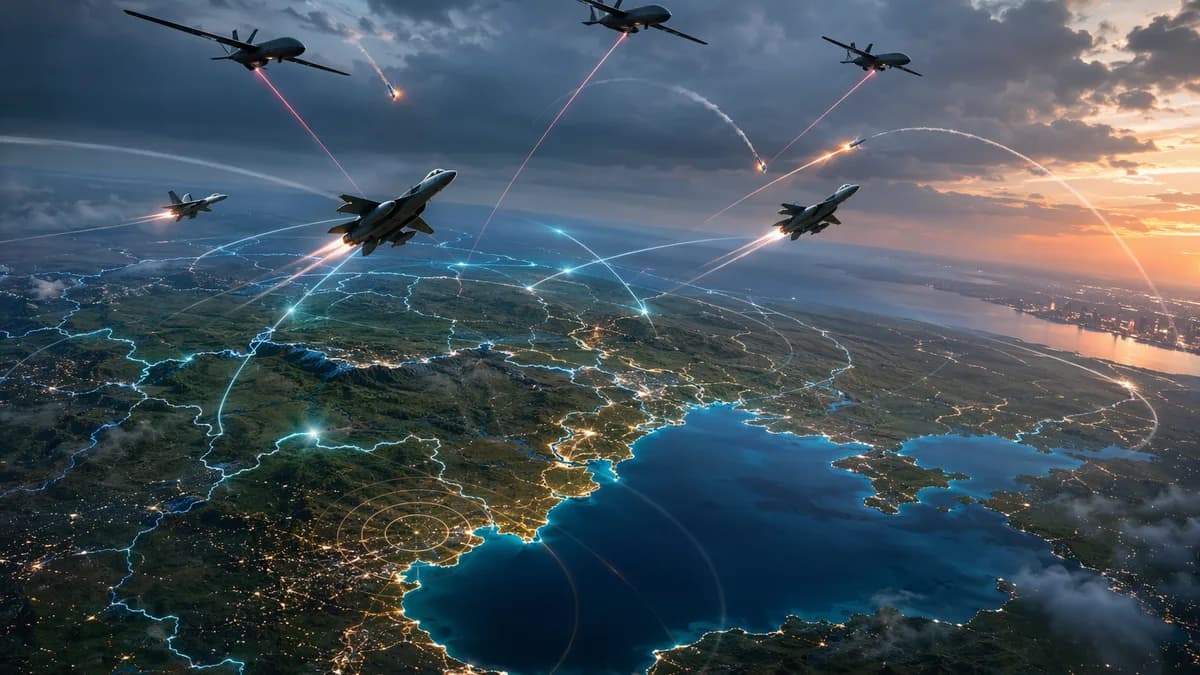
Three Romania drone shootdowns in three days have turned a recurring border hazard into a sharper test of NATO airspace control over the Black Sea.
Global TrendsJuly 26, 2026· 8 min read· By XOOMAR Insights Team
3 Romania Drone Shootdowns Drag NATO Into Airspace Fight
Updated on July 26, 2026
XOOMAR Intelligence
Analyst Take
66/ 100
1 source analyzedMedium confidenceTrend10Freshness95Source Trust90Factual Grounding93Signal Cluster20
Romania said it is summoning Russia’s ambassador after its military downed a third drone since Friday, according to Guardian World.
The shift matters because Romania has reported repeated drone incursions since Russia launched its invasion of Ukraine, but the latest incidents move the issue from border anxiety into active airspace defense. Romania drone shootdowns are no longer a hypothetical escalation scenario. They are now part of the week’s military record.
Three Romania drone shootdowns in three days raise the stakes over the Black Sea
The headline fact is simple: Romania, a NATO and EU member, says it has shot down three drones since Friday and is calling in Russia’s ambassador over repeated violations of its airspace.
The political message is sharper than a standard protest note. Bucharest is signaling that incursions into Romanian airspace will not be absorbed as routine spillover from the war next door. That is the core change. For years, according to the source material, Romania experienced frequent drone incursions after Russia’s invasion of Ukraine. Now the response includes interception.
The available public record does not support stronger claims about the exact model, origin, command chain, or technical systems involved in each incident. Investigations and official statements may add detail later, but the safe reading from the supplied source is narrower: Romania says drones entered its airspace, its military shot them down, and the government is escalating the matter diplomatically with Moscow.
That line of response is doing two jobs at once. It asserts Romanian sovereignty, and it reminds Moscow that Romania’s airspace sits inside two larger security structures. The phrasing stops short of declaring a wider crisis, but it refuses to treat the incidents as local noise.
The available numbers show a fast escalation from incursions to interceptions
The source record gives a tight but important sequence.
| Date or period | Reported fact | Status |
|---|---|---|
| Since Russia’s invasion of Ukraine | Romania has reported repeated drone incursions | Context for the latest response |
| Since Friday | Romania says three drones have been shot down | Central fact in the current report |
| Latest diplomatic step | Romania is summoning Russia’s ambassador | Formal protest over repeated violations |
| Attribution | The supplied record does not establish detailed public attribution for every drone | Further investigation may clarify |
| Military response | Romania’s military has moved from monitoring incursions to shooting drones down | Operational shift now visible |
The latest interceptions are the clearest operational marker. Tracking a drone is one decision. Destroying it inside national airspace is another. It requires the military chain of command to decide that letting the object continue is riskier than engaging it.
The Black Sea setting compresses that decision window. Even without relying on unsupported timing claims, the geography creates pressure: small drones can move quickly, cross borders, and force officials to balance identification, escalation management, and public accountability.
That is why the shift from repeated incursions to repeated shootdowns matters. It suggests Romania is no longer treating each breach as only a matter for later protest. It is now pairing diplomatic action with immediate airspace defense.
Romania’s response appears to have hardened after repeated drone incursions
Romania’s response now sits in a more forceful phase. The supplied record does not establish the details of a specific drone law, counter-drone system, or technical upgrade, so those claims should not be treated as confirmed here. What is clear is the practical result: drones that enter Romanian airspace are now being met with direct military action.
That distinction matters because it turns airspace defense from a warning-and-monitoring problem into an active state response. Whether that posture is driven mainly by military assessment, domestic pressure, alliance coordination, legal authority, or a mix of all of them is not established by the supplied source.
XOOMAR analysis: Romania appears to be lowering its tolerance for drone breaches, but the source does not prove the exact institutional reason for that shift. The safest reading is narrower: Bucharest has demonstrated willingness to shoot down drones that enter its airspace and then raise the issue directly with Russia.
That distinction matters. A NATO state defending its own airspace is not the same as entering the war. But every armed interception near Ukraine carries political weight because it can be read in Moscow, Brussels, Kyiv, and Romanian border communities at the same time.
For wider XOOMAR coverage of pressure points around Russia’s war, the same broader conflict file remains relevant. These are separate stories, but they sit inside the same pattern of military pressure, border risk, and alliance signaling.
NATO’s public line is firm, but the hard part is calibration
NATO’s role in the source material is carefully framed by Romania’s membership in the alliance and by the fact that Romanian airspace is also part of NATO’s eastern edge. The supplied record does not support detailed claims about specific NATO spokesperson comments, particular weapons systems, or an announced wider NATO response.
That restraint is not weakness. It is calibration.
Romania needs to defend its airspace. NATO needs to avoid turning every drone fragment or incursion into an automatic alliance-wide confrontation. Those goals can coexist, but only if air defense decisions, political messaging, and investigations move quickly enough to keep the facts ahead of speculation.
The Romanian position pushes the issue into alliance terms by treating violations of national airspace as more than a local border problem. That is true as a political and institutional matter. Still, the evidence released so far should be separated into careful categories:
- Confirmed in the current report: Romania says it has shot down three drones since Friday.
- Diplomatic response: Romania is summoning Russia’s ambassador over repeated airspace violations.
- Context: Romania has faced repeated drone incursions since Russia’s war against Ukraine began.
- Not established in the supplied record: detailed public attribution, specific drone models, named technical systems, or precise engagement timing.
That sequencing is crucial. Romania is acting militarily in real time, then building public and diplomatic response after the fact. That is the reality of drone defense near an active war zone.
Civilians near the border now have proof the risk is physical, not abstract
The latest shootdowns give Romania’s border communities a civilian frame even without relying on unsupported claims about specific casualties or property damage. The source does not establish intent, and that distinction should be preserved. But for residents, the practical concern is simpler: drones can cross into Romania and trigger a military response overhead or nearby.
XOOMAR analysis: the more visible Romania’s interceptions become, the more pressure Bucharest will face to show that military action is paired with clear public communication. Local warnings, shelter advice, and rapid explanations after interceptions may matter almost as much as fighter jets or other defenses for maintaining confidence in border regions.
The source does not provide evidence of effects on shipping, energy assets, insurance, or broader markets. Those may become relevant if incidents spread or disrupt infrastructure, but they are not established in the supplied record. For now, the concrete stakes are national airspace, alliance signaling, and civilian safety near the border.
This is why the language around each incident matters. If officials move too slowly, speculation fills the gap. If they move too quickly with unsupported attribution, they risk overstating the public record. Romania’s challenge is to defend its airspace while keeping its explanations precise enough to be credible.
The next signal is whether three shootdowns become a standing pattern
The immediate watch item is not whether Romania can shoot down drones. It just did, three times since Friday. The larger test is whether these interceptions become routine and whether investigations provide clearer public evidence about the drones involved.
Evidence that would strengthen the thesis of a hardened Romanian posture would include more rapid interceptions, further public attribution from Bucharest, and continued diplomatic protests over airspace breaches.
Evidence that would weaken it would be a pause in incursions, investigations finding other causes for later drones, or Romanian officials narrowing the events to an isolated cluster.
For now, the core risk is the normalization of armed incidents inside NATO airspace. One drone can be treated as a dangerous episode. Three Romania drone shootdowns in three days look like a new operating problem on the Black Sea frontier.
The Stakes
- Romania is treating repeated drone incursions as active airspace violations rather than routine spillover from the war in Ukraine.
- Because Romania is a NATO member, each incident raises the sensitivity of military activity around the Black Sea.
- Summoning Russia’s ambassador signals Bucharest is escalating the issue diplomatically as well as militarily.
Romanian Drone Shootdowns Since Friday
Drones downed
drones3
Sources

Written by
XOOMAR Insights Team
Research and Editorial Desk
The XOOMAR Insights Team pairs automated research with human editorial judgment. We track hundreds of sources across technology, fintech, trading, SaaS, and cybersecurity, cross-check the facts, and explain what happened, why it matters, and what to watch next. We do not just rewrite headlines. Every article is fact-checked and scored for reliability before it goes live, and we link back to the original sources so you can verify anything yourself.
Explore More Topics
Related Articles
 Global Trends
600 Attacks Turn Ukraine Military Recruiters Into Targets
More than 600 attacks on Ukraine's recruiters reveal a manpower crisis turning violent as conscription collides with public fear.
Jul 20, 20268 min
 Global Trends
Arkady Dvorkovich Sanctions Drag FIDE Into Governance Crisis
EU sanctions sidelined Arkady Dvorkovich but didn't force him out, leaving FIDE trapped in a governance crisis over Russia and Ukraine.
Jul 25, 20267 min
 Global Trends
Ukraine Installs Mykhailo Drapatyi to Shake Up War Command
Mykhailo Drapatyi takes Ukraine's top command with reform hype and a brutal winter test ahead.
Jul 22, 20268 min
 Global Trends
Wildberries Drone Strikes Expose Russia's Soft Underbelly
Four strikes on Wildberries sites turn Russia's e-commerce backbone into a wartime liability and shake sellers who rely on it.
Jul 22, 202612 min
 Global Trends
Zelensky Ousts Ukraine Commander After Street Fury
Zelensky fired Oleksandr Syrskyi after protests, putting Mykhailo Drapatyi atop Ukraine's army while doubts over command deepen.
Jul 21, 20267 min
 Technology
PRIMA Retinal Implant Wins EU Approval, Tests $100M Bet
PRIMA can now be sold in Europe. Science Corp.'s next fight is proving restored vision can become a real medical business.
Jul 26, 20267 min
 Technology
$1B Google Search Fine Threatens Its Ranking Machine
The EU's $1B Google fine goes after search placement and Play Store control, not just a one-off antitrust penalty.
Jul 26, 20267 min
 Trading
Trump Tariffs Hit 80 Nations After Supreme Court Rebuke
Trump's new tariff round hits 80-plus countries, recasting a court defeat as a fresh trade weapon.
Jul 25, 20268 min
 Technology
$400 Dyson V10 Konical Puts Flagship Vacuums on Notice
The Dyson V10 Konical delivers core Dyson cleaning for $400, making pricier cordless models harder to justify.
Jul 26, 20269 min
 Trading
Gold Price Breakout Exposes the Dollar Trade Behind Rally
Gold broke higher as the dollar softened, making DXY follow-through the key test for bulls, not just US-Iran tension.
Jul 26, 20267 min
Don't miss the signal
Get our weekly roundup of the stories that matter across tech, fintech, and trading. No noise, just signal.
Free forever. No spam. Unsubscribe anytime.