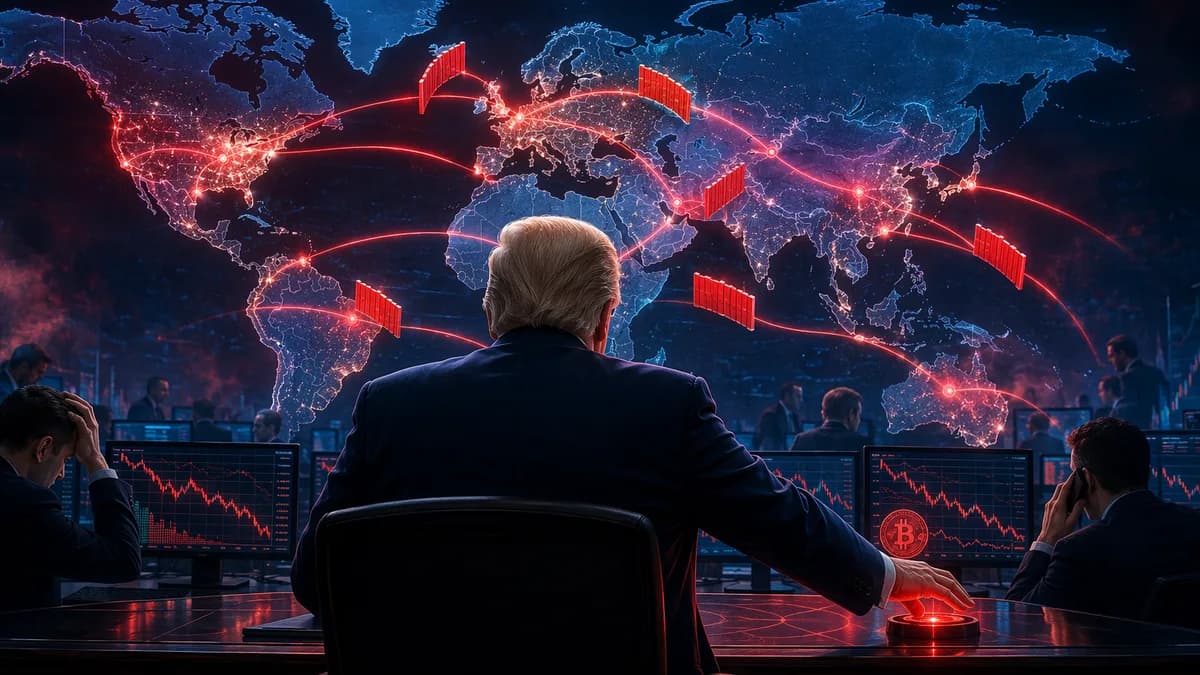
Can Trump tariffs keep reshaping global trade after the Supreme Court tariff ruling?
XOOMAR Intelligence
Analyst Take
That is the question hanging over Donald Trump’s fresh tariff round, which hits more than 80 countries and replaces a 10% global duty that was due to expire, according to Guardian World. The new measures impose tariffs of 10% to 12.5% on dozens of trading partners, including the UK, Mexico, Canada, Australia, India, China and the 27 EU member states.
The connecting thread is clear: the White House is trying to preserve an aggressive trade agenda after a legal defeat. The method has changed. The pressure has not.
Which legal defeat is Trump trying to outrun with new Trump tariffs?
The new Trump tariffs replace the blanket 10% tariff imposed in February, after the Supreme Court declared many earlier tariffs illegal. That ruling forced the administration to find a different legal basis for a policy that Trump has made central to his economic program.
The latest version is narrower on paper. It is not a single global duty. It is a set of country-specific tariffs, with rates between 10% and 12.5%.
But to trading partners, the practical effect still feels sweeping. The list covers major US allies and rivals alike. The UK and EU are grouped with China, India, Mexico, Canada and Australia, which guarantees diplomatic friction.
XOOMAR analysis: this is not a retreat from tariffs. It is a legal redesign. The administration is trying to turn a court-imposed constraint into a new trade weapon.
Why is Section 301 now the White House’s route?
The White House is now relying on section 301 of the Trade Act of 1974, a statute aimed at responding to unfair foreign trade practices. The stated justification is forced labor.
The newest tariffs were announced by US trade representative Jamieson Greer. Trump had said after the February Supreme Court decision that his administration would investigate unfair trading practices in order to impose permanent tariffs.
That matters because the administration needs more than political will. It needs a legal framework that can survive the next challenge.
| Tariff approach | Legal posture | Practical effect |
|---|---|---|
| Earlier broad tariffs | Weakened after Supreme Court ruling | Many measures declared illegal |
| 10% global duty | Temporary replacement | Due to expire |
| Section 301 tariffs | Tied to alleged unfair practices | New 10% to 12.5% country-specific duties |
A senior White House official told reporters, according to related reporting from CNN Business, that the president would not let his trade agenda be undercut by a court limiting one tool.
“The president is not going to allow his trade policy and overall objectives to be undermined simply because one tool may be limited by a court or something else.”
Why are US allies calling the forced labor argument bewildering?
The forced labor rationale has landed badly with affected countries. The Guardian described the reaction as “bewilderment,” with some countries saying their labor laws are stronger than those in the US.
The European Union questioned the tariff logic. CNN reported that Kaja Kallas, the EU’s foreign policy chief, called the move a “negative surprise” and rejected the forced labor claims as unfounded. Australia, subject to a 12.5% tariff, also objected, with trade minister Don Farrell calling the move “completely unjustified.”
The diplomatic tension comes from the framing. Tariffs are one thing. Being placed inside a forced labor-related action is another.
That is why this dispute is harder to defuse than a standard fight over rates. The legal label carries reputational weight.
This follows our broader coverage of Trump Tariffs Drag 80 Countries Into Legal Showdown, where the fight had already moved from trade policy into legal authority.
Do importers get certainty or just a new pricing spreadsheet?
For importers, replacing one broad duty with multiple country-specific tariffs does not automatically simplify planning. It means recalculating costs by supplier, country, contract and product category.
The administration argues the rollout avoids the complexity of stacking the new levies on top of the expiring 10% duty. CNN reported officials said business leaders wanted more continuity and predictability around tariff rates.
That may be true at the headline level. A fixed tariff is easier to model than a tariff threat.
But the new structure still leaves companies watching exemptions, country lists and enforcement details. CNN reported that oil and gas, along with products that cannot be sourced domestically, received exemptions, according to administration officials.
For consumers, the immediate effect may be muted because many importers were already paying duties. CNN reported the change is unlikely to translate immediately into higher prices for most Americans. The risk sits further out, if retailers and manufacturers decide they cannot keep absorbing tariff costs.
XOOMAR analysis: the near-term issue is less a sudden price spike and more a planning freeze. Companies hate not knowing whether today’s landed cost is tomorrow’s baseline.
Can the courts choke off the tariff reboot again?
The courts remain the hardest obstacle for the Trump tariff agenda. The February Supreme Court decision set the stage by declaring many earlier tariffs illegal, forcing the administration to rebuild its policy through other statutes.
That is why Section 301 now matters so much. It gives the White House a more specific route than the earlier broad approach. It also invites a more specific fight: whether the forced labor findings support tariffs on such a wide set of countries.
Yahoo’s related tariff coverage said the Liberty Justice Center filed a lawsuit against the administration on behalf of two small businesses in the US. That shows the legal fight is not only diplomatic. Domestic importers and companies have their own reasons to challenge the policy.
Congress sits in the background because the dispute ultimately turns on delegated trade power. The question is how far a president can stretch older trade statutes without fresh congressional authorization.
For companies, that means tariff exposure is no longer just a procurement issue. It is a litigation variable.
Can a forced labor label carry a tariff action this broad?
The forced labor justification gives the policy a moral frame. It also creates a credibility test.
The administration says the tariffs target countries that engage in forced labor or fail to address it. Affected countries dispute that framing, especially allies that argue their labor protections are stronger than those in the US.
The wider the list gets, the harder the White House must work to make the label look evidentiary rather than political. That is the core risk.
If the forced labor rationale is viewed as a trade pretext, allies will treat the tariffs as coercive bargaining. If the administration can substantiate the claims in a way that survives scrutiny, the policy becomes harder to attack.
That answer will not come from speeches. It will come from documents, enforcement details and court records.
Why does secondhand fashion belong in the same cost story?
The Guardian’s secondhand fashion thread shows how affordability pressure is spreading beyond new goods. Depop and other resale platforms have helped turn thrifting into a $350bn industry, according to the Guardian.
The cultural shift is stark. Janelle Best, owner of a vintage boutique, has been shopping thrift bins since the 1990s, when secondhand clothing carried a stigma. Now, the category has professionalized through platforms and resellers.
The connection to tariffs should be handled carefully. The Guardian did not say new tariffs caused resale prices to rise. But if imported apparel becomes more expensive, shoppers looking for cheaper alternatives may put more demand on secondhand clothing.
That is the broader consumer signal. The “cheap alternative” is not insulated from cost pressure once everyone starts chasing it.
The bigger picture: how far does Trump’s tariff reboot reach?
The new Trump tariffs tie together four fights: legal authority, labor rights language, allied pushback and consumer costs.
The immediate fight is over whether Section 301 can do the work the earlier tariff structure could not. The diplomatic fight is over whether close US partners should accept being swept into a forced labor-related action. The business fight is over whether companies can plan around tariff rules that keep changing form.
The household effect will take longer to read. CNN reported most Americans may not see an immediate price jump because the new duties largely preserve charges importers were already paying. That does not remove the risk. It shifts the timing.
The practical watch item is simple: if courts allow the new structure to stand, tariffs move from temporary disruption to operating assumption. At that point, trade policy stops being a distant diplomatic dispute and becomes part of every sourcing plan, retail margin and consumer budget.
Disclaimer: This XOOMAR analysis is for informational and educational purposes only. It is not financial, investment, legal, tax, or professional advice. It does not provide buy, sell, hold, price-target, portfolio, or personalized recommendations. Verify information independently and consult qualified professionals before making decisions.
Impact Analysis
- The new tariffs show the White House is continuing its trade agenda despite a Supreme Court setback.
- Major US allies and rivals are affected, raising the risk of diplomatic and economic retaliation.
- Businesses and consumers could face renewed uncertainty as tariffs reshape import costs and supply chains.
Old vs New Trump Tariff Approach
| Policy | Scope | Rate | Legal/Policy Basis |
|---|---|---|---|
| February blanket tariff | Global duty | 10% | Later affected by Supreme Court ruling |
| New tariff round | More than 80 countries, including UK, EU, China, India, Mexico, Canada and Australia | 10% to 12.5% | Section 301 of the Trade Act of 1974 |
Trump Tariff Rates
Primary Sources & Disclosures
Disclaimer: Content on XOOMAR is produced using AI-assisted research, drafting, and verification workflows and is intended for informational and educational purposes only. It does not constitute financial, investment, legal, tax, medical, or professional advice of any kind. All analysis reflects available information at the time of publication and may not be current. Verify information independently and consult qualified professionals before making decisions. Editorial policy

Written by
XOOMAR Insights Team
Research and Editorial Desk
The XOOMAR Insights Team pairs automated research with human editorial judgment. We track hundreds of sources across technology, fintech, trading, SaaS, and cybersecurity, cross-check the facts, and explain what happened, why it matters, and what to watch next. We do not just rewrite headlines. Every article is fact-checked and scored for reliability before it goes live, and we link back to the original sources so you can verify anything yourself.