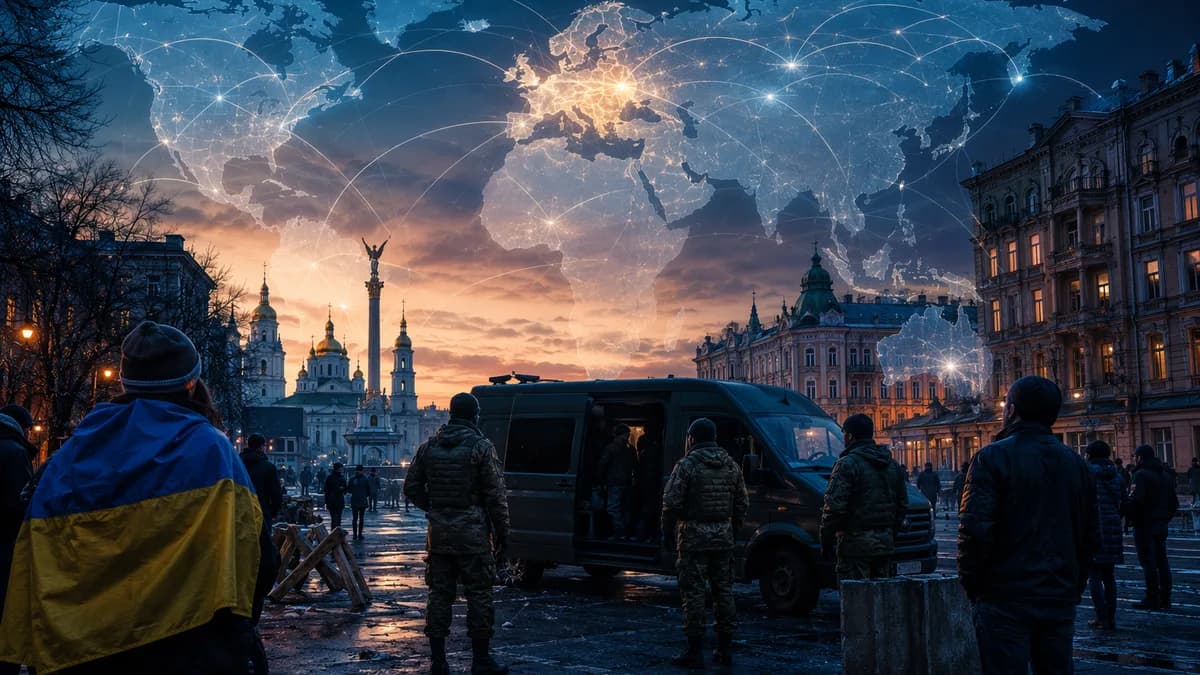
Ukraine military recruiters are being attacked inside the country they are trying to defend, a sign that Ukraine’s manpower crisis has moved from administrative strain into open confrontation. The latest National Police Service report recorded more than 600 assaults on recruitment officers to date and warned that the aggression has become “increasingly threatening”, according to BBC World.
XOOMAR Intelligence
Analyst Take
The contradiction is brutal. Ukraine needs troops as the war against Russia enters its fifth year. Yet some of the state agents tasked with finding those troops are now being treated by angry citizens as threats. That doesn’t prove broad pro-Russian sentiment. XOOMAR analysis: it points more directly to fear of the front line, anger over forced conscription tactics, and a widening gap between military necessity and civilian endurance.
The National Police Service report warned that aggression against recruitment officers has become “increasingly threatening”.
Ukraine military recruiters have become targets in the war behind the front
The front line is not the only place where Ukraine’s war effort is under pressure. The mobilisation system itself is now a flashpoint.
BBC World reports that many Ukrainians are hesitant to sign up for reasons ranging from plain fear of the front line to reluctance to fight in a war with no end in sight. That hesitation has collided with forced conscription efforts, producing violent attacks on recruitment officers.
The recent incidents are no longer low-level disputes. In April, several recruiters were stabbed, one fatally. In Lviv this month, about 200 protesters surrounded officers who were trying to detain a suspected draft dodger, then smashed and overturned their car. President Volodymyr Zelensky condemned violence against serving soldiers after the street fury made headlines.
The deeper signal is about trust. A state can legally compel service, but compulsion depends on legitimacy. Once citizens begin to see recruiters as predators rather than public officials, every street check risks becoming a confrontation.
That matters beyond Ukraine. As XOOMAR has covered in other global pressure points, state authority frays fastest when coercion meets public distrust, whether in protest crackdowns such as Police Seize Sonam Wangchuk After 20-Day Hunger Strike or security crises like Standoff Ends as Kidnapped US Forest Service Employees Freed. Ukraine’s case is sharper because the stakes are military survival.
More than 600 assaults show mobilisation has turned physical
The more than 600 assaults figure is the anchor. It turns scattered incidents into a national pattern.
France 24, citing Interfax-Ukraine, reported that police recorded just five cases of people attacking draft officers in 2022. By last year, that number had risen to 341. In the first four months of 2026 alone, there were just shy of 120 such clashes, including the fatal stabbing of a draft officer in April.
That escalation suggests the dispute over Ukraine military recruiters has moved through stages:
- Before: document checks, arguments, avoidance, complaints.
- Now: assaults, intimidation, crowd action, damage to military vehicles.
- Risk next: more organised resistance if enforcement grows harsher and trust keeps falling.
The Lviv riot shows how quickly a conscription encounter can spiral. France 24 reported that territorial recruitment officers stopped a man in the street, checked his registration documents, and held him at a local draft centre for a medical exam. Eyewitnesses said officers then tried to detain two more men. Prosecutors said a crowd of some 200 people gathered.
Footage shared on social media showed people rocking the officers’ army vehicle while chanting “Shame!” before tipping it over, France 24 reported. A police officer who tried to intervene was also injured.
The number still has gaps. Public reporting does not fully break down regional concentration, injuries, prosecutions, repeat offenders, or whether assaults spike after specific mobilisation measures. But the scale already shows this is not just a Lviv story.
From early invasion urgency to 2026 conscription fatigue
Ukraine’s mobilisation problem has hardened as the war has dragged on.
France 24 reported that Ukraine has become increasingly reliant on conscripted troops to replace those killed or wounded on the front line, especially as the number of people signing up fell dramatically after Kyiv’s last major counteroffensive in the spring of 2023. The same report cited the US-based Centre for Strategic and International Studies, which estimated this month that as many as 635,000 Ukrainian troops had been killed, wounded, or gone missing since February 2022. It also cited an estimated 1.4 million Russian casualties.
Those numbers explain the pressure. They do not excuse abuses. They show why the mobilisation machine keeps pushing.
Under current mobilisation laws, men aged 25 to 60 are subject to mandatory military service, France 24 reported. RFE/RL separately reported that Kyiv lowered the draft age from 27 to 25 last year, while resisting pressure to lower it to 18.
The public anger often lands on recruiters because they are visible. They stop men in the street. They check documents. They escort people to draft centres. They do not decide the war’s strategic demands, but they embody them.
That is why “busification” has become such a toxic term. RFE/RL describes it as the practice in which men stopped by conscription officers or soldiers from units seeking recruits, and unable to prove exemption, are sometimes bundled into buses and taken for induction.
Recruiters, families, soldiers and police are trapped in the same manpower crisis
Different groups are living different versions of the same breakdown.
| Stakeholder | Pressure they face | Why the conflict hardens |
|---|---|---|
| Recruitment officers | Enforcing mobilisation under public hostility | They become the face of unpopular decisions made above them |
| Civilians and families | Fear of indefinite service, medical reviews, and aggressive tactics | Street detentions turn legal duty into personal terror |
| Front-line soldiers | Need replacements and rotations | Draft resistance can look unfair to those already serving |
| Police and government | Protect state authority during war | Public violence gives Russia a propaganda opening |
The legitimacy problem is not abstract. France 24 cited a March analysis for the Carnegie Endowment for International Peace warning that mobilisation has lost trust.
“Highly visible cases of abusive practices, legal overreach, and selective enforcement of mobilisation have undermined Ukrainians’ perception of the process’s legitimacy, increased public anxiety, and provided fertile ground for Russian information operations,” it read.
RFE/RL’s reporting on Roman Sopin sharpened that concern. Sopin, 43, died on October 23 after being taken to a Kyiv recruitment centre. The military said he passed out, collapsed, and hit his head. His family and lawyer dispute that account. His lawyer, Oleksandr Protas, told RFE/RL: “People don’t fall like that naturally. This was a powerful, professional blow.”
Authorities deny wrongdoing in that case, according to RFE/RL. The point for mobilisation politics is narrower but serious: disputed deaths and alleged beatings can poison the entire system, even if officials say most cases pass without incident.
Attacks on recruiters threaten Ukraine’s manpower pipeline
If Ukraine military recruiters cannot operate safely, the consequences reach the front.
Recruiters are the administrative link between law and force generation. If they are blocked, attacked, or forced to retreat from public spaces, Ukraine’s ability to replace casualties, rotate exhausted units, and staff formations weakens. That does not mean every assault immediately shifts battlefield outcomes. It means the manpower pipeline becomes less reliable at the worst possible time.
There is also a coercion trap:
- Harsher enforcement: The state reacts to draft evasion and attacks by tightening policing.
- More resentment: Citizens see enforcement as arbitrary or brutal.
- Greater resistance: Confrontations become more common and more violent.
- New coercion: The state doubles down because the army still needs troops.
That cycle benefits Russia indirectly. France 24 reported that videos of “busification” incidents spread quickly on social media and are picked up by Russian media. The propaganda value is obvious: show Ukraine’s war effort as internally divided, abusive, and exhausted.
XOOMAR analysis: the danger is not that Ukraine’s mobilisation system collapses overnight. The danger is cumulative degradation. Each violent incident makes the next document check more volatile. Each allegation of abuse makes lawful mobilisation harder to defend. Each viral video turns a manpower problem into a political problem.
Ukraine’s next mobilisation choices will decide whether the violence spreads
Ukraine has three broad paths, and none is clean.
The first is tougher policing and prosecutions. That could deter attacks on recruitment officers, especially after incidents like the Lviv riot. But if citizens see enforcement as collective punishment or protection for abusive recruiters, it could deepen anger.
The second is a legitimacy repair strategy: clearer mobilisation rules, more transparent medical reviews, better handling of abuse complaints, and stronger support for soldiers’ families. The supplied reporting does not show whether such measures are being expanded at scale. But the logic is direct. If people trust the process more, they are less likely to fight it in the street.
The third path is drift. Battlefield pressure worsens, reforms lag, recruiters keep using aggressive tactics, and attacks become more organised or more political. That would give Russian media more material and force Kyiv to spend more energy policing its own mobilisation system.
The next evidence to watch is concrete: whether assaults on Ukraine military recruiters keep rising, whether prosecutions follow the Lviv riot, whether complaints about draft officers fall, and whether the government can separate lawful mobilisation from abusive enforcement. If those indicators improve, the violence may recede. If they worsen together, Ukraine’s manpower crisis will no longer be just a military problem. It will be a test of state legitimacy under fire.
Impact Analysis
- Violence against recruiters shows Ukraine’s mobilisation crisis is becoming a domestic security problem.
- Public anger over forced conscription could weaken trust between civilians, the military and the state.
- Ukraine’s ability to sustain the war effort depends not only on battlefield performance but also on civilian endurance.
Reported Violence Around Ukraine Recruitment Efforts
Primary Sources & Disclosures

Written by
XOOMAR Insights Team
Research and Editorial Desk
The XOOMAR Insights Team pairs automated research with human editorial judgment. We track hundreds of sources across technology, fintech, trading, SaaS, and cybersecurity, cross-check the facts, and explain what happened, why it matters, and what to watch next. We do not just rewrite headlines. Every article is fact-checked and scored for reliability before it goes live, and we link back to the original sources so you can verify anything yourself.