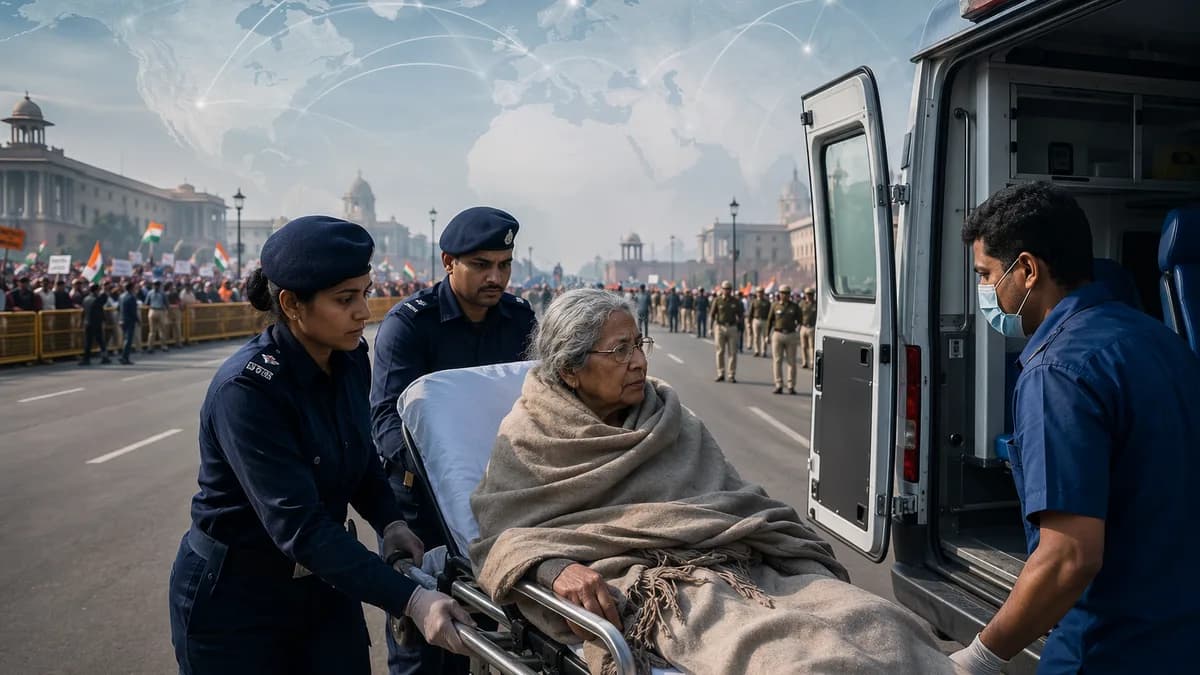
20 days into the Sonam Wangchuk hunger strike, Delhi police and paramilitary personnel forcibly removed the Indian activist from his protest stage at Jantar Mantar and took him to hospital, cutting into a planned march to India’s parliament on 20 July.
XOOMAR Intelligence
Analyst Take
The 59-year-old educationist had been fasting in Delhi in support of the Cockroach Janta Party, an online satirical protest movement demanding education reforms, according to BBC World. Wangchuk had urged supporters to join a peaceful march to parliament on Monday, despite his weakening condition.
20 days into Sonam Wangchuk hunger strike, police move him from Jantar Mantar
Videos from the protest site showed chaos breaking out just before 07:30 local time on Saturday, as dozens of police and paramilitary personnel moved onto the stage where Sonam Wangchuk was lying down. Protesters who tried to block them were pushed aside.
Wangchuk had been sitting on hunger strike in Delhi’s scorching summer, consuming only salt and water. The BBC reported that he had lost more than 9kg and was in significant pain.
Officers covered him with curtains of bedsheets before removing him from the stage. Minutes later, an ambulance was seen leaving the site.
Abhijeet Dipke, founder of the Cockroach Janta Party, told the BBC he had gone to a friend’s home in the morning to freshen up when police arrived and refused to let him leave. Dipke, who had stayed by Wangchuk’s side during the protest, said he had not been told where the activist was taken.
Police said the move followed a court-backed health intervention.
"Sonam Wangchuk has been moved to a government hospital for much-needed medical intervention and is currently under medical supervision," said Sachin Sharma, Deputy Commissioner of Police.
Sharma said Wangchuk had been moved "in compliance with [a court] order, and based on health conditions and medical advice". The reference was to a Delhi High Court order from Thursday directing the federal government to monitor Wangchuk’s health regularly and provide treatment if needed.
The Sonam Wangchuk hunger strike had become the center of a broader exam-reform protest. The CJP began in May as an online satirical movement against paper leaks and alleged irregularities in top Indian exams. Its supporters call themselves cockroaches, a deliberately abrasive label that turned into the movement’s organizing identity.
Forced hospitalisation raises stakes before 20 July parliament march
The timing is the pressure point. Wangchuk was removed two days before protesters planned to march to India’s parliament on 20 July, a date he had continued to promote even as his health deteriorated.
A couple of days before his hospitalisation, Wangchuk told supporters at Jantar Mantar:
"I've grown weak from the outside but I'm strong from within."
He then told the crowd:
"Together, we will march peacefully to the parliament and put forward our petitions at the altar of democracy."
He also joked that if he died before the march, his "ghost would join the march".
That rhetoric matters because the protest was no longer just a sit-in. It had a set date, a symbolic destination and a fasting figurehead. Removing Wangchuk may reduce the chance he physically joins the march, but it also gives supporters a sharper grievance.
| Point of tension | Official position | Protest-side facts from source material |
|---|---|---|
| Hospitalisation | Police said it followed court orders and medical advice | Wangchuk was removed by police and paramilitary personnel from the protest stage |
| Health risk | Officials cited "much-needed medical intervention" | He had consumed only salt and water and lost more than 9kg |
| 20 July march | No confirmed official permission details in the source | Wangchuk had insisted he would join the march despite frail health |
| Communication | Police said he was under medical supervision | Dipke said he had not been told where Wangchuk was taken |
XOOMAR analysis: The central conflict is now brutally simple. Authorities can argue they intervened to prevent a medical crisis after a court order. Supporters can argue the state removed the movement’s most visible face before a politically sensitive march.
Both claims can coexist. That’s why the hospitalisation is likely to harden positions rather than cool the protest.
The CJP is demanding the resignation of Education Minister Dharmendra Pradhan after a key entrance exam for aspiring doctors was cancelled in early May following a paper leak. Protesters say Pradhan should take moral responsibility and quit.
Pradhan has dismissed the CJP and its supporters as "the B-team of disruptive elements". Prime Minister Narendra Modi’s government has not engaged with the protesters yet, according to the BBC.
Former Delhi chief minister and Aam Aadmi Party leader Arvind Kejriwal visited Wangchuk on Thursday. In a video shared by CJP, Kejriwal greeted him with folded hands and shook his hand.
"Every year, exam papers get leaked and youth pay the price," Kejriwal said. "I appeal to the government to listen to students and Wangchuk."
He also said "Pradhan should be removed from his post and replaced by Wangchuk".
For readers tracking how fast state action can turn a planned demonstration into a wider political flashpoint, XOOMAR’s coverage of the US Tanker Strike Turns Hormuz Blockade Into a Flashpoint shows the same basic dynamic in a very different arena: timing can matter as much as the initial act.
Campaign now turns on hospital updates, court orders and turnout
The next confirmed milestone is the 20 July march to parliament. The BBC reported it is not clear whether the CJP will still attempt to march, though Wangchuk is unlikely to participate.
That uncertainty now defines the protest’s next phase.
Practical questions facing the campaign:
- Hospital status: Whether Wangchuk remains under medical supervision, is released, or resumes the indefinite fast.
- Legal position: Whether authorities invoke the Delhi High Court health order for further restrictions.
- Crowd turnout: Whether the forced hospitalisation expands mobilisation or weakens it by removing the movement’s main public figure.
- Police posture: Whether the march is allowed, restricted, dispersed, or met with arrests.
- Political response: Whether opposition parties, civil society figures and student groups intensify pressure on the government.
The Sonam Wangchuk hunger strike has already shifted from a health crisis to a political test. A protest movement that began online now has a hospitalised figurehead, a parliament march on the calendar and no confirmed engagement from the central government.
XOOMAR analysis: If organisers proceed on 20 July, turnout will show whether the movement depends on Wangchuk’s physical presence or has grown beyond him. If they pull back, the focus shifts to his medical condition and the legal limits of the state’s intervention.
Either way, the watch item is no longer only Wangchuk’s health. It’s whether his removal turns a planned march into a larger confrontation over education accountability and the right to protest.
Impact Analysis
- The forced hospitalization raises questions about the balance between public safety, health concerns and the right to protest.
- Wangchuk’s hunger strike had become a visible pressure point for education reform demands linked to the Cockroach Janta Party movement.
- The police action disrupted a planned march to parliament, potentially escalating tensions between protesters and authorities.
Primary Sources & Disclosures

Written by
XOOMAR Insights Team
Research and Editorial Desk
The XOOMAR Insights Team pairs automated research with human editorial judgment. We track hundreds of sources across technology, fintech, trading, SaaS, and cybersecurity, cross-check the facts, and explain what happened, why it matters, and what to watch next. We do not just rewrite headlines. Every article is fact-checked and scored for reliability before it goes live, and we link back to the original sources so you can verify anything yourself.