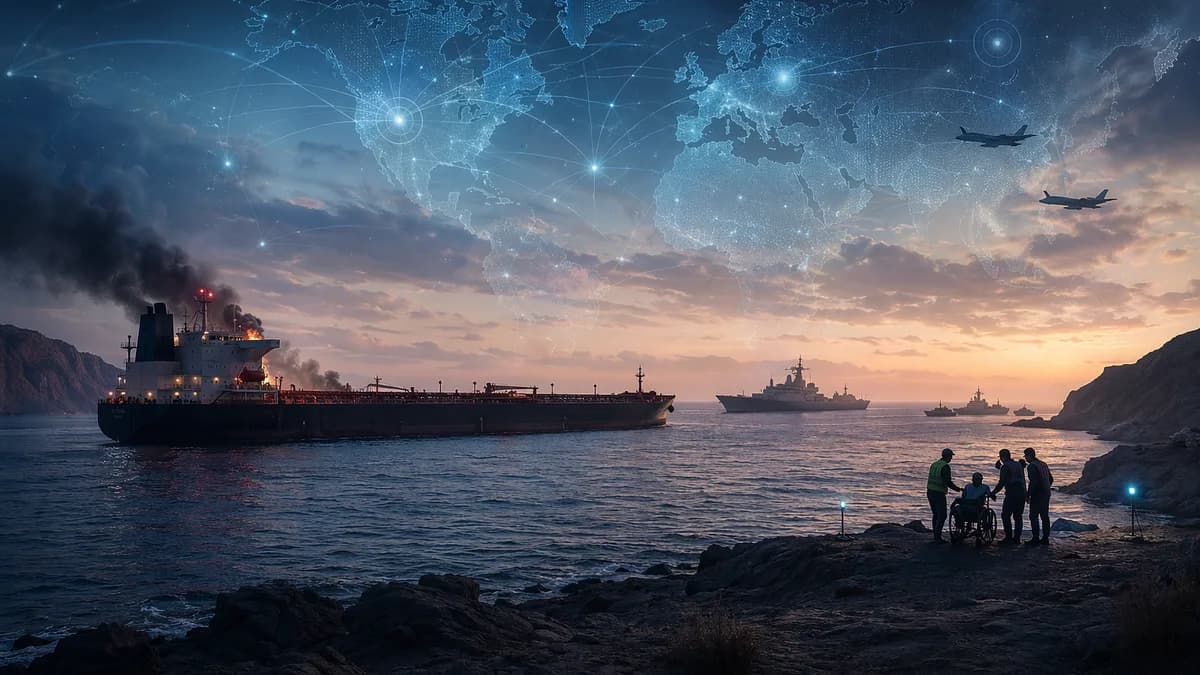
The Strait of Hormuz blockade is now the center of a wider test of US coercive power: Washington is striking Iranian targets and disabling shipping, while Tehran is releasing a US citizen and widening the conflict’s regional footprint. The tension is sharp. Military pressure is rising, yet diplomatic signals have not vanished.
XOOMAR Intelligence
Analyst Take
The latest moves, reported by Guardian World, connect three fronts that usually get treated separately: Gulf security, detainee diplomacy, and US immigration enforcement. The common thread is state power under stress. Abroad, that means blockades, missiles, and bases. At home, it means deaths tied to immigration enforcement and foreign governments demanding criminal scrutiny.
US blockade targets an oil tanker headed for Iran's Kharg Island
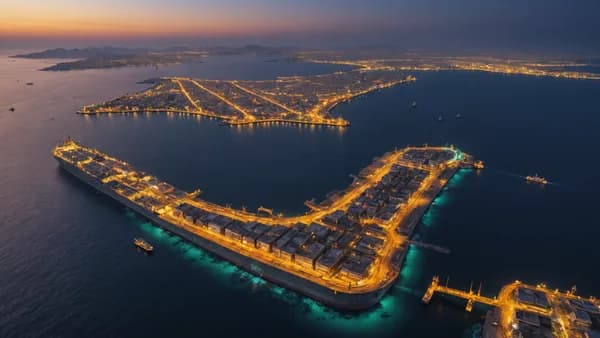
The US attack on an oil tanker marks a harder phase of the Strait of Hormuz blockade, because Washington is no longer only striking military sites. It is physically stopping commercial movement tied to Iranian ports. According to the Guardian, the US fired on an unladen oil tanker attempting to reach Kharg Island in the Strait of Hormuz after the vessel ignored multiple warnings.
US officials said they disabled the tanker by firing Hellfire missiles into its smokestack. ABC News, citing US Central Command, identified the vessel as the Curacao-flagged M/T Belma and reported that it had been traveling in international waters toward Kharg Island when it was hit.
“A U.S. aircraft disabled the vessel after firing hellfire missiles into the ship’s smokestack. The ship is no longer transiting to Iran,” CENTCOM said, according to ABC News.
The strongest counterpoint is that Washington framed the strike as blockade enforcement, not an attack on cargo or crew. CENTCOM also said it had redirected two compliant commercial vessels and disabled one non-compliant vessel during the first 24 hours of enforcement. That matters because the US is presenting this as controlled pressure.
The problem is that control is exactly what a blockade tests. The Strait of Hormuz blockade sits inside a crowded commercial corridor already linked in the sources to tanker attacks, military strikes, and energy market sensitivity. The BBC reported earlier that Brent crude rose by more than 3% to $76 after renewed strikes. That does not prove a sustained oil shock, but it shows how quickly the market reads military action in the strait.
For readers tracking how this pressure point became central to Washington’s Iran strategy, XOOMAR has related context in Trump Turns Iran Strikes Into Strait of Hormuz Blockade and Strait of Hormuz Erupts as Trump’s New Iran War Lever.
US strikes reach Tehran as Iran attacks sites in Bahrain and Kuwait
The conflict is no longer confined to Iran’s coast. The US has pushed strikes farther north, while Iran says it is targeting US military assets in neighboring Gulf states. The Guardian reported that the US hit coastal defences, missile sites, and targets farther north, while Iranian state media reported strikes on Tehran.
Al Jazeera reported that CENTCOM said US strikes targeted Iranian command centers, air defense sites, missile and drone capabilities, and coastal surveillance facilities. It also reported that Iranian media listed attacks in locations including Bandar Abbas, Qeshm Island, Sirik, Chabahar, Konarak, Rask, Khondab, Khorramabad, and Semnan.
Iran’s response widened the map. The Guardian said Iran attacked sites in Bahrain and Kuwait. Al Jazeera reported that Iran’s army claimed attacks on US military assets at Ali Al Salem airbase in Kuwait and Sheikh Isa airbase in Bahrain. Jordan, meanwhile, said it intercepted eight Iranian missiles, according to Al Jazeera and ABC News.
| Front | Reported action | Source-backed significance |
|---|---|---|
| Strait of Hormuz | US disabled tanker headed toward Kharg Island | Blockade enforcement now includes direct action against shipping |
| Iran | US strikes hit coastal and inland targets, with state media reporting Tehran strikes | The latest round has reached the capital for the first time |
| Gulf states | Iran claimed attacks on US assets in Bahrain and Kuwait | The conflict is spilling into countries hosting US-linked military infrastructure |
| Jordan | Eight Iranian missiles intercepted | Regional airspace and defenses are now part of the crisis |
The counterpoint is that not every reported strike has the same evidentiary footing. Some details come from US military statements. Others come from Iranian state media or Iranian military claims. Still, the pattern is clear enough: both sides are extending the battlefield.
XOOMAR’s Iran-US Strikes Pull Gulf Bases Into a Wider Crisis is the relevant companion read here, because the pressure is shifting from maritime disruption to the exposure of regional bases and air defenses.
Dena Karari's release gives Washington and Tehran a narrow diplomatic channel
Dena Karari’s release is the clearest sign that bargaining has not fully collapsed, even as the military track accelerates. Donald Trump said Iran released Dena Karari, identified by the Guardian as a dual US-Iranian citizen detained since 2024.
ABC News reported that Trump said Karari had been “wrongfully detained” and was “safely outside of Iran, and in good condition.” ABC also cited her lawyer, who said Karari had been trapped in Iran on “bogus charges of collaboration with a hostile state and espionage,” subject to a coercive exit ban, and interrogated repeatedly by Iran’s Ministry of Intelligence and Security.
This is not proof of de-escalation. The release happened while the US and Iran continued strikes. That timing cuts both ways. It may be humanitarian relief and political signaling at once, but it also shows that limited channels can remain open even when the battlefield expands.
The strongest test is whether this release is followed by more detainee moves, formal talks, or military restraint. None of that is confirmed in the supplied sources. For now, it is a narrow diplomatic opening inside a widening military crisis.
Israel says its forces will stay in security zones across Lebanon, Syria, and Gaza
Israel’s position adds another layer of pressure for Washington, because the Iran conflict is unfolding alongside Israel’s own regional security posture. The Guardian reported that Israeli defence minister Israel Katz told US defence secretary Pete Hegseth that Israel was determined to keep its forces in “security zones” in Lebanon, Syria, and Gaza.
That statement matters because it narrows the room for a clean diplomatic reset. A US-Iran escalation in the Gulf is already pulling in Bahrain, Kuwait, Jordan, and Iraq through reported strikes, interceptions, and drone incidents. Israel’s insistence on maintaining forces across three other fronts keeps the regional map crowded.
The counterpoint is that Katz’s statement is not the same thing as a new military operation. The source gives a position, not a fresh battlefield claim. Even so, posture shapes diplomacy. If Washington is trying to manage Iran while allies hold firm elsewhere, the number of moving parts rises fast.
Mexico demands criminal investigations after 17 immigrant deaths tied to US enforcement
The same hard-power posture is under scrutiny inside the US, where Mexico is demanding criminal investigations into deaths tied to immigration enforcement. The Guardian reported that Mexico formally requested US state attorneys general investigate cases of immigrants who died in ICE custody or during raids.
The numbers are specific. Since the beginning of Donald Trump’s second term, 17 Mexican immigrants have died during immigration enforcement, according to the Mexican government. Of those, 14 died in ICE custody and three died during agency operations.
The Guardian also reported allegations from Arenas-Silva’s sister and immigrants’ rights groups in Georgia that ICE did not provide necessary medications during detention for an unnamed condition, despite family pleas during his arrest last week. Those are allegations, not adjudicated findings. The point is that Mexico is now pressing for criminal review, which turns immigration enforcement from a domestic policy fight into a bilateral legal dispute.
The counterpoint is that the supplied material does not establish causation in each death. It reports Mexico’s request, the death count, and the family allegations. Still, the political effect is real: US enforcement actions are drawing formal pressure from another government.
The bigger picture
Washington is trying to project control across several fronts at once: a Strait of Hormuz blockade, strikes inside Iran, alliance management with Israel, detainee diplomacy, and immigration enforcement at home. Each tool carries a cost. A blockade can deter vessels or trigger wider disruption. Strikes can degrade military assets or pull more bases into range. Enforcement can signal toughness or invite legal blowback.
The practical watch item is whether US pressure remains bounded. The evidence to watch is concrete: more disabled vessels, confirmed attacks on Gulf bases, follow-on detainee releases, renewed talks, or state-level criminal investigations tied to ICE deaths. If those indicators move in different directions at once, the central risk is not weakness. It is overload.
The Stakes
- The US strike on a tanker signals a sharper phase in efforts to pressure Iran through maritime enforcement.
- Disruption around the Strait of Hormuz raises risks for global oil shipping and regional security.
- Iran’s release of a US citizen suggests diplomacy remains possible even as military escalation continues.
US and Iran Moves in the Escalating Conflict
| Actor | Key Action | Signal |
|---|---|---|
| United States | Disabled the Curacao-flagged M/T Belma with Hellfire missiles near the Strait of Hormuz | Escalating blockade enforcement beyond military targets to commercial shipping |
| Iran | Released a US citizen while widening the conflict’s regional footprint | Keeping diplomatic channels visible amid rising military pressure |
Primary Sources & Disclosures

Written by
XOOMAR Insights Team
Research and Editorial Desk
The XOOMAR Insights Team pairs automated research with human editorial judgment. We track hundreds of sources across technology, fintech, trading, SaaS, and cybersecurity, cross-check the facts, and explain what happened, why it matters, and what to watch next. We do not just rewrite headlines. Every article is fact-checked and scored for reliability before it goes live, and we link back to the original sources so you can verify anything yourself.