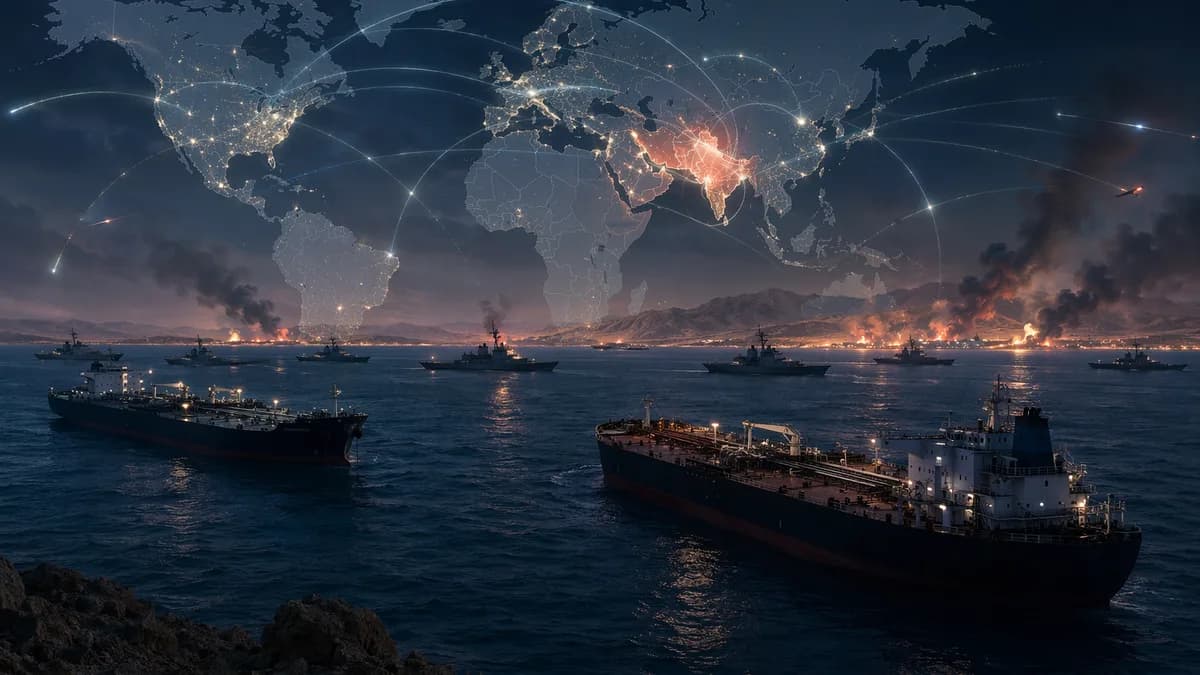
On Monday evening, the US launched a third consecutive night of strikes on Iran just hours after Donald Trump said Washington would reinstate a Strait of Hormuz blockade and charge ships for safe passage.
XOOMAR Intelligence
Analyst Take
The escalation ties fresh military action to an apparent reversal in US maritime policy, according to Guardian World. Until now, Washington had said the Strait of Hormuz should remain open to all traffic without tolls.
Monday night: US strikes Iran for third straight day as Trump revives Hormuz blockade
US Central Command said the latest strikes were aimed at reducing Iran’s capacity to threaten civilians and shipping in the strait.
“These strikes will continue imposing a heavy cost on Iranian forces and degrade their ability to attack innocent civilians and commercial shipping in the strait of Hormuz,” the US military’s Central Command said.
Trump had previewed the attacks in an interview with conservative radio host Hugh Hewitt.
“We’re going to hit them very hard tonight and we’re going to hit them hard tomorrow – and there’s not a damn thing they can do about it.”
He added: “They have nothing. They have nothing going, other than they have big mouths.”
The strikes came after Trump said the US would demand a 20% tariff on all cargoes shipped through the key passage. In a Truth Social post, he suggested the US should be known as the “guardian of the strait of Hormuz”.
That phrase matters. Washington’s previous position was that no state should charge for passage through an international waterway. The new proposal puts the US in tension with its own stated line.
The latest action follows the Strait escalation XOOMAR covered in US Strikes Iran as Strait of Hormuz Crisis Threatens Oil, where the military confrontation had already moved from isolated strikes into a broader shipping-security crisis.
Tuesday enforcement order puts the Hormuz fee plan against US policy
On Monday evening, the US Navy-led Joint Maritime Information Center said the US would begin enforcing the blockade on Iran, covering ports, oil terminals and coastal areas, on Tuesday night.
Its warning was direct.
“Any vessel suspected of entering or departing the blockaded area without authorisation is subject to interception, diversion and capture. Noncompliant vessels may be legally compelled with force.”
The center said neutral transit through the Strait of Hormuz to or from non-Iranian destinations would not be impeded.
That leaves a major operational question unanswered: how the US Navy would identify, stop, divert or capture vessels linked to Iranian ports without turning the Strait of Hormuz blockade into repeated naval confrontations.
The policy shift is also legally explosive because Trump’s own administration recently argued the opposite. Last month, US secretary of state Marco Rubio said:
“No country is allowed to charge tolls or fees on an international waterway. That’s existing international law.”
The International Maritime Organization, the UN agency responsible for safety and security in international shipping, said it was waiting for more details on Trump’s proposal. But it also rejected the core principle behind mandatory passage fees.
“We have always been consistent on our stance on fees – IMO stands firmly against charging fees for passage through straits used for international navigation. There is no legal basis through which to introduce mandatory tolls simply to transit through a strait.”
| Issue | Previous US position | Trump’s Monday position | Immediate problem |
|---|---|---|---|
| Transit fees | No tolls or fees on international waterways | 20% tariff on cargoes through the strait | Conflicts with Rubio’s stated legal view |
| Control of the strait | Open passage for all | US as “guardian of the strait of Hormuz” | No clear enforcement mechanism disclosed |
| Blockade scope | Strait should remain open | Blockade on Iranian ports, terminals and coastal areas | Risk of interception and capture at sea |
XOOMAR analysis: The sharpest contradiction is not rhetorical. It’s practical. A Strait of Hormuz blockade aimed at Iran but paired with a cargo fee for safe passage blurs the line between a military exclusion policy and a toll regime on a global shipping artery.
Oil jumps as the Strait of Hormuz blockade hits energy risk
The market reaction was immediate. Brent crude oil rose 7.8% to $81.92 a barrel on Monday, according to the Guardian’s cited market data, while still trading below the $120 (£90) reached at the height of the war.
The source material does not provide tanker-rate, insurance or freight-cost data. But it does show why traders reacted: Washington is now linking strikes on Iran, naval enforcement, and fees for passage through one of the world’s most sensitive energy routes.
Iran’s Islamic Revolutionary Guard Corps accused the US of putting global oil and gas supplies at risk by interfering in the strait.
Hossein Mohebi, an IRGC spokesperson, said Washington had “seriously endangered the security of the world’s oil and gas supply and must be held accountable.” He also said Tehran would “continue to exercise sovereignty over and management of the strait of Hormuz.”
Trump, meanwhile, argued that the US should be reimbursed if it controls the waterway.
“We’re going to keep the strait, and we’ll probably run it,” Trump said in a phone interview on Fox News. “We’ll become the guardian of the strait. Maybe we’ll call it the guardian angel of the strait. And we should be reimbursed for that.”
The regional spread has already widened beyond the waterway. The Guardian reports that Iran has attacked US bases in multiple countries, that Iran’s strikes on Sunday extended to Qatar, and that the United Arab Emirates said its air defences engaged missiles and drones from Iran. XOOMAR has also tracked the broader regional spillover in Four Iranian Missiles Pull Jordan Into a Wider War.
The next decision point is Tuesday night enforcement
The next test is not another Trump statement. It is enforcement.
If US forces begin stopping vessels tied to Iranian ports, oil terminals or coastal areas on Tuesday night, the Strait of Hormuz blockade moves from policy announcement to naval operation. The Joint Maritime Information Center says neutral transit to or from non-Iranian destinations will not be blocked, but the criteria for suspicion and authorisation remain unclear from the supplied statements.
CBS News reported that Trump formally notified Congress last week that US-Iran hostilities had resumed, with “military action” commencing on July 7, in a letter dated July 10 and obtained by the network. That adds a domestic political track to the military one.
Trump’s risk is clear from the source record. The blockade projects force, but it also collides with Washington’s own legal argument on waterway fees, invites Iranian contestation, and has already coincided with a sharp oil move.
The practical watch item now is whether Tuesday night enforcement stays limited to Iranian-linked shipping, as US officials describe, or whether Iran treats the operation as control of the strait itself. That distinction will shape whether this remains a blockade dispute or becomes the next phase of the war.
Impact Analysis
- The US shift from free passage to a proposed tariff could upend long-standing maritime policy in a critical global shipping lane.
- Repeated US strikes on Iran raise the risk of a broader regional military escalation.
- Any disruption or added cost in the Strait of Hormuz could affect global energy markets and commercial shipping.
US Strait of Hormuz Policy Shift
| Issue | Previous US Position | New Trump Proposal |
|---|---|---|
| Access to Strait of Hormuz | Open to all traffic without tolls | US would act as “guardian of the strait of Hormuz” |
| Charges on shipping | No state should charge for passage through an international waterway | 20% tariff on all cargoes shipped through the passage |
| Military posture | Framed around protecting free navigation | Strikes tied to degrading Iran’s ability to threaten civilians and shipping |
Primary Sources & Disclosures

Written by
XOOMAR Insights Team
Research and Editorial Desk
The XOOMAR Insights Team pairs automated research with human editorial judgment. We track hundreds of sources across technology, fintech, trading, SaaS, and cybersecurity, cross-check the facts, and explain what happened, why it matters, and what to watch next. We do not just rewrite headlines. Every article is fact-checked and scored for reliability before it goes live, and we link back to the original sources so you can verify anything yourself.