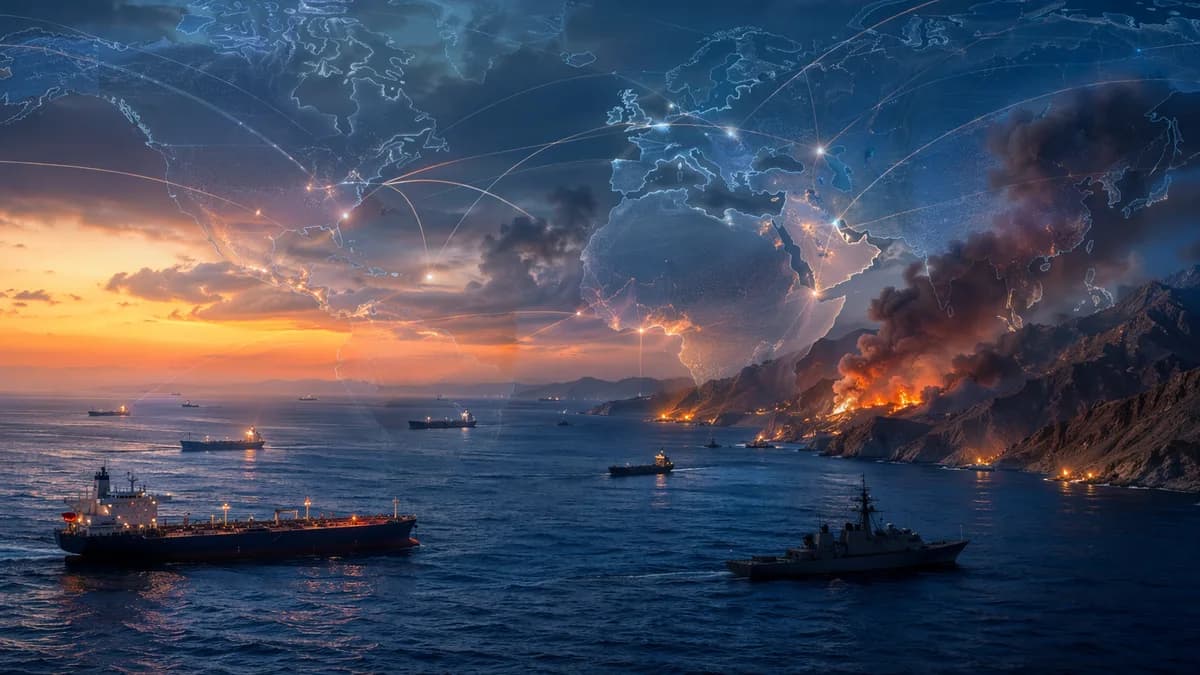
Two Iranian port cities on the Strait of Hormuz are among areas where state media reported explosions after the US launched new strikes against Iran, escalating a confrontation that President Donald Trump had just warned would intensify.
XOOMAR Intelligence
Analyst Take
The latest US strikes against Iran followed Trump’s statement that Washington would “hit them hard again tonight” after an overnight exchange of attacks, according to BBC World. Iranian state media reported explosions in Sirik and Bandar Abbas, both southern port cities near one of the world’s most sensitive shipping corridors.
Two southern port cities report explosions after new US strikes against Iran
US Central Command said the strikes were intended to “further degrade Tehran's ability to threaten freedom of navigation” in the Strait of Hormuz. Centcom framed the operation as a response to recent attacks on shipping, not as a broader campaign against Iran’s government.
“The United States is holding Iran accountable for recent unjustified aggression against commercial shipping and civilian crews freely navigating a vital international waterway.”
Iran has not yet publicly commented on the new strikes, according to the BBC report. Senior Iranian officials had warned earlier that any US attack would draw an “immediate response”.
The confirmed public picture remains narrow. The US has acknowledged strikes. Iranian state media has reported explosions. There is no confirmed casualty count, no verified damage assessment, and no official Iranian account of what was hit.
That matters because the locations named by Iranian state media sit close to the Strait of Hormuz, where shipping, military positioning, and energy market risk overlap. XOOMAR analysis: the escalation risk is not just the number of targets hit, it’s the geography. A strike cycle around Hormuz can quickly become a shipping crisis even before either side declares one.
The latest action follows the US military’s statement on Tuesday that it had launched “powerful” strikes in response to attacks on three tankers in the strait. That earlier exchange had already marked the worst US-Iran strike cycle since a memorandum of understanding, or MoU, was signed on 17 June.
| Flashpoint | What the source says | Current status |
|---|---|---|
| Tuesday strikes | US military said it launched “powerful” strikes after attacks on three tankers | Confirmed by US military |
| New strike wave | Centcom says the US struck to degrade Iran’s ability to threaten navigation | Confirmed by Centcom |
| Explosions in Iran | Iranian state media reported explosions in Sirik and Bandar Abbas | Reported, not independently detailed |
| Iran response | Officials warned of an “immediate response” to any US attack | No new official comment reported yet |
This is the same pressure point XOOMAR has tracked in US Strikes Iran After Hormuz Tanker Attacks Shatter Truce, where tanker attacks pushed the US response from deterrence language into active military action.
A 14-point MoU is cracking before its 60-day window expires
The June 17 MoU included 14 points, according to the BBC source. Those included a 60-day ceasefire period during which negotiations were supposed to continue, safe passage for vessels through the Strait of Hormuz, and US sanctions relief for Iran.
That negotiation window has not expired. Trump, however, said on Wednesday that the ceasefire agreement signed last month with Iran is “over”. He also said the US “hit them very hard last night” and would “probably hit them hard again tonight”.
Iran’s Foreign Minister Abbas Araghchi answered on X with a line aimed squarely at Washington’s threat posture:
“We do not answer vulgarity with vulgarity, but with action: fearlessly and with great valour.”
Trump has also said he views further talks as “a waste of time”. That statement raises the stakes around the MoU because it suggests the US may no longer see the deal as the main channel for containing the conflict.
XOOMAR analysis: the legal and diplomatic language now trails the military tempo. The MoU still has time left on paper, but both sides are acting as if the enforcement mechanism has already failed.
This follows the pattern we covered in Hormuz Tensions Flare as Iran Accuses US of MoU Breach, where the truce was already under strain before the latest round of strikes. The new US action turns that strain into a direct test of whether any part of the agreement can still restrain escalation.
Shipping risk, Gulf pressure, and oil volatility now sit in the same corridor
The Strait of Hormuz is the center of this confrontation because Centcom itself tied the strikes to “freedom of navigation” and “commercial shipping”. The US justification is not abstract. It points directly to civilian crews, tanker traffic, and the security of a vital waterway.
For markets, the immediate issue is not a confirmed disruption number. The source does not provide oil prices, tanker counts, or insurance data. The issue is escalation risk near a route that traders already treat as a geopolitical tripwire.
Market read, based on verified facts only:
- Oil volatility: The risk rises if Iran targets shipping, US assets, or Gulf-linked infrastructure after warning of an “immediate response”.
- Risk-off pressure: A wider US-Iran exchange could push investors toward defensive positioning, but the source does not report actual market moves.
- Shipping exposure: Centcom’s language makes clear the US sees commercial navigation as a central reason for the strikes.
- Regional spillover: Retaliation could come outside Iranian territory, including against US personnel or assets, though no such response has been confirmed in this latest round.
Our earlier report, Iran Strait of Hormuz Attack Jolts Global Oil Shipping, laid out why attacks near the waterway can move quickly from military incident to market event. The current strike wave keeps that channel open.
Pentagon briefings and Tehran’s first move will set the next hours
The next verified details need to come from official channels. The key gaps are basic but consequential: which sites were hit, whether anyone was killed or wounded, whether the strikes are complete, and whether Washington plans another round.
Watch Pentagon and White House messaging first. Centcom has given the strategic rationale, but not a target list or damage assessment in the BBC report.
Tehran’s response is the larger variable. Iran has not yet commented on this new strike wave, but its earlier warning of an “immediate response” now becomes the live risk marker.
XOOMAR analysis: if Iran responds directly against US forces, the conflict likely moves into another strike cycle. If it responds through threats to shipping or pressure around Hormuz, markets may react before governments finish briefing.
This is a fast-moving story. The practical watch item now is whether the next confirmed action is diplomatic messaging, a military response, or a shipping incident near the Strait of Hormuz.
The Stakes
- The strikes raise the risk of a broader US-Iran military escalation near a critical global shipping route.
- Explosions near the Strait of Hormuz could threaten commercial shipping and increase energy market uncertainty.
- The lack of confirmed casualties or damage leaves markets and governments reacting to an incomplete picture.
Primary Sources & Disclosures

Written by
XOOMAR Insights Team
Research and Editorial Desk
The XOOMAR Insights Team pairs automated research with human editorial judgment. We track hundreds of sources across technology, fintech, trading, SaaS, and cybersecurity, cross-check the facts, and explain what happened, why it matters, and what to watch next. We do not just rewrite headlines. Every article is fact-checked and scored for reliability before it goes live, and we link back to the original sources so you can verify anything yourself.