The Strait of Hormuz tanker fire hit a corridor that carried a fifth of the world’s oil and natural gas before the latest phase of the US-Israel war on Iran.
XOOMAR Intelligence
Analyst Take
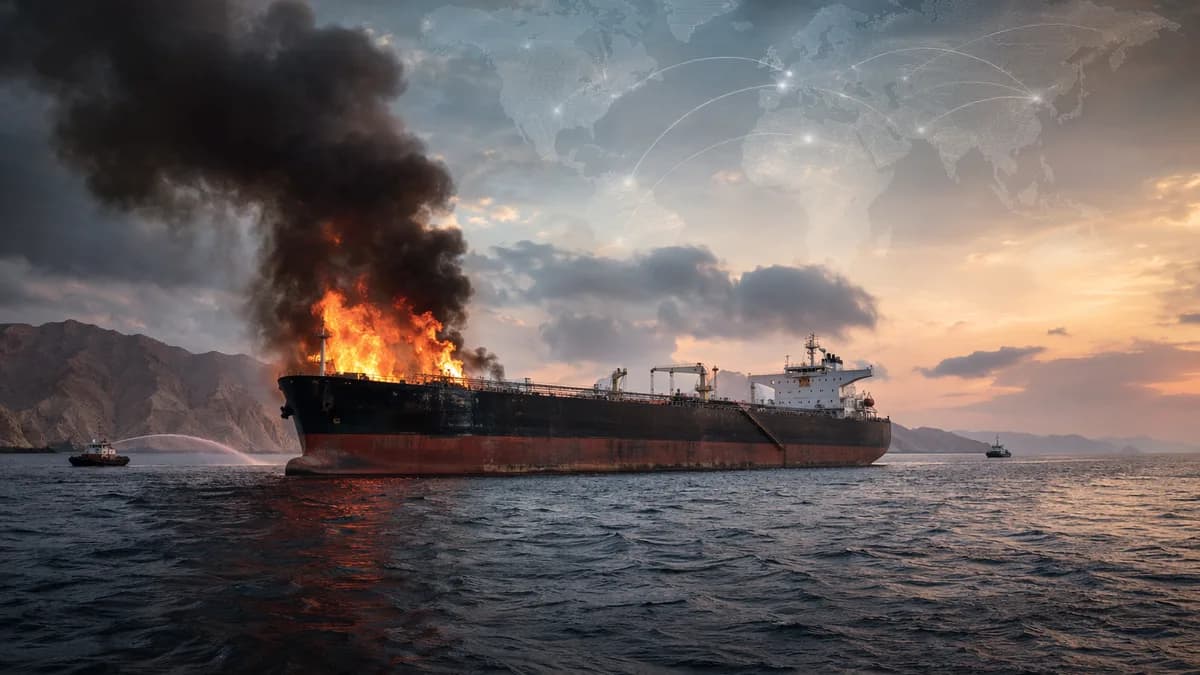
A tanker off Oman caught fire early Tuesday after being struck by an “unknown projectile” near Limah, Oman, according to Independent World, citing the United Kingdom Maritime Trade Operations centre. The vessel was traveling south out of the strait toward the Gulf of Oman when the projectile hit its port side, UKMTO said.
Strait of Hormuz tanker fire: projectile hit port side near Limah, Oman
The confirmed facts are narrow but serious. UKMTO said the tanker was struck near Limah in the Strait of Hormuz area, caught fire, and authorities are investigating. It also said there was no environmental impact from the strike.
No one immediately claimed responsibility. The tanker’s name, flag, owner, operator, cargo, crew condition, and exact damage level have not been confirmed in the supplied reporting.
That distinction matters. Early maritime incident reports often move faster than verified vessel data. A projectile strike is confirmed by UKMTO, but attribution is not.
| Confirmed by supplied reporting | Not yet confirmed |
|---|---|
| Projectile strike near Limah, Oman | Who fired the projectile |
| Port side of tanker was hit | Tanker name, flag, owner, operator |
| Vessel was heading south toward the Gulf of Oman | Cargo type in the main UKMTO account |
| Tanker caught fire | Crew injuries or casualties |
| No environmental impact reported by UKMTO | Whether the fire is fully controlled |
The attack comes after other reported vessel incidents in the same corridor. The Independent reported that Iran is suspected of attacking at least two other vessels traveling near Oman in recent days, though suspicion is not proof and Tehran has not been officially tied to Tuesday’s strike in the supplied reporting.
Axios, cited in the source material, reported that Iran's Revolutionary Guards fired at least two missiles at commercial ships transiting the Strait of Hormuz on Monday night. Axios said two commercial ships suffered significant damage and no casualties, citing a US official.
One-fifth energy route faces fresh disruption risk after tanker fire
The location is the story. The Strait of Hormuz control issue centers on a narrow exit point for Gulf energy exports, and the source material states that a fifth of the world’s oil and natural gas passed through it before the latest fighting.
A single Strait of Hormuz tanker fire does not confirm a broader shutdown. But it can still force shipowners, insurers, energy traders, and governments to reassess risk fast. The operational questions are immediate: which route is safe, whether escorts are needed, whether insurers reprice cover, and whether nearby ships alter course.
Analysis: The pressure point is not just the damaged tanker. It is the credibility of safe passage through the strait. If ships believe one route is exposed to attack and another is politically controlled, the cost of moving cargo can rise before any physical blockage occurs.
Some regional reporting has pointed to disputes over navigation instructions and military warnings in the strait. However, the precise language, authority, and scope of any such directives were not confirmed in the supplied primary excerpt or context.
That uncertainty matters for shippers. Without verified guidance, vessel operators are left weighing official maritime alerts, insurer instructions, naval activity, and the risk that political messaging may outpace confirmed operational facts.
For readers following the wider Hormuz file, XOOMAR’s related coverage includes Iran Strait of Hormuz Attack Jolts Global Oil Shipping and Hormuz Missile Shock Pins NZD/USD Near 0.5700 as Dollar Wins. Those links provide adjacent coverage, while Tuesday’s confirmed maritime facts remain limited to the UKMTO alert and the sourced reports cited here.
Ceasefire politics collide with maritime security
The tanker fire landed during a volatile diplomatic pause. Talks between Iran and the United States to end the war appear to be on hold while Tehran holds burial events for former Supreme Leader Ayatollah Ali Khamenei, who is described in the supplied reporting as slain.
Indirect US-Iran talks ended last week without any public sign of progress toward lasting peace. On Monday, US president Donald Trump renewed his threat of military action if no deal is reached.
“We can knock down their bridges in one hour, we can knock out their energy supply…. They don’t have any money now. We haven’t given them any money,” he told reporters at the Oval Office on Monday.
On Tuesday, Iranian foreign minister Abbas Araghchi said negotiations on a final deal “will not commence” if US threats continued. He wrote on X that “millions of proud Iranians” were gathering for the funerals of the slain supreme leader.
“Neither them nor our Brave Armed Forces are moved by any threats,” he wrote on X. “Honour your signature,” he added.
The source material indicates the rhetoric and actions in the strait have complicated fragile diplomacy around the conflict. It does not confirm the terms of any formal ceasefire, interim signing venue, or maritime-fee arrangement.
That uncertainty now faces a direct stress test. If the route dispute hardens while projectile strikes continue, commercial shipping will have to weigh legal passage, physical risk, and military signaling at the same time.
Crew safety, fire control and attribution now carry the market signal
The next phase depends on practical facts, not political noise.
Crew safety is the first missing variable. The supplied reporting does not confirm casualties, injuries, evacuation, or whether the crew remains aboard.
Fire status is the second. UKMTO reported the tanker caught fire, but the available material does not say whether the fire has been extinguished, contained, or is spreading.
Assistance is the third. No confirmed details have been provided on rescue vessels, naval support, tugs, or warnings to nearby ships.
Attribution is the most sensitive. No one immediately claimed responsibility, and early claims in a live maritime incident can be wrong or politically loaded. The cleanest line for now is this: UKMTO has reported a projectile strike, while responsibility remains unconfirmed.
The Strait of Hormuz tanker fire becomes more consequential if follow-up reports show repeated attacks, damage to a loaded crude or product tanker, blocked passage, or formal warnings that push ships away from normal routes. Until then, the signal is serious but incomplete: one tanker hit, one fire reported, no environmental impact reported, and a strategic waterway under fresh scrutiny.
The Stakes
- The Strait of Hormuz is a critical energy corridor carrying about a fifth of the world’s oil and natural gas.
- A projectile strike on a tanker raises the risk of wider disruption to shipping near Oman and the Gulf of Oman.
- Key facts such as responsibility, vessel identity, cargo, and crew condition remain unconfirmed.
What is confirmed vs. unknown
| Confirmed by supplied reporting | Not yet confirmed |
|---|---|
| Projectile strike near Limah, Oman | Who fired the projectile |
| Port side of tanker was hit | Tanker name, flag, owner, or operator |
| Vessel was heading south toward the Gulf of Oman | Cargo type |
| Tanker caught fire | Crew injuries or casualties |
| No environmental impact reported by UKMTO | Whether the fire is fully controlled |
Strait of Hormuz share of global oil and natural gas flows
Primary Sources & Disclosures

Written by
XOOMAR Insights Team
Research and Editorial Desk
The XOOMAR Insights Team pairs automated research with human editorial judgment. We track hundreds of sources across technology, fintech, trading, SaaS, and cybersecurity, cross-check the facts, and explain what happened, why it matters, and what to watch next. We do not just rewrite headlines. Every article is fact-checked and scored for reliability before it goes live, and we link back to the original sources so you can verify anything yourself.