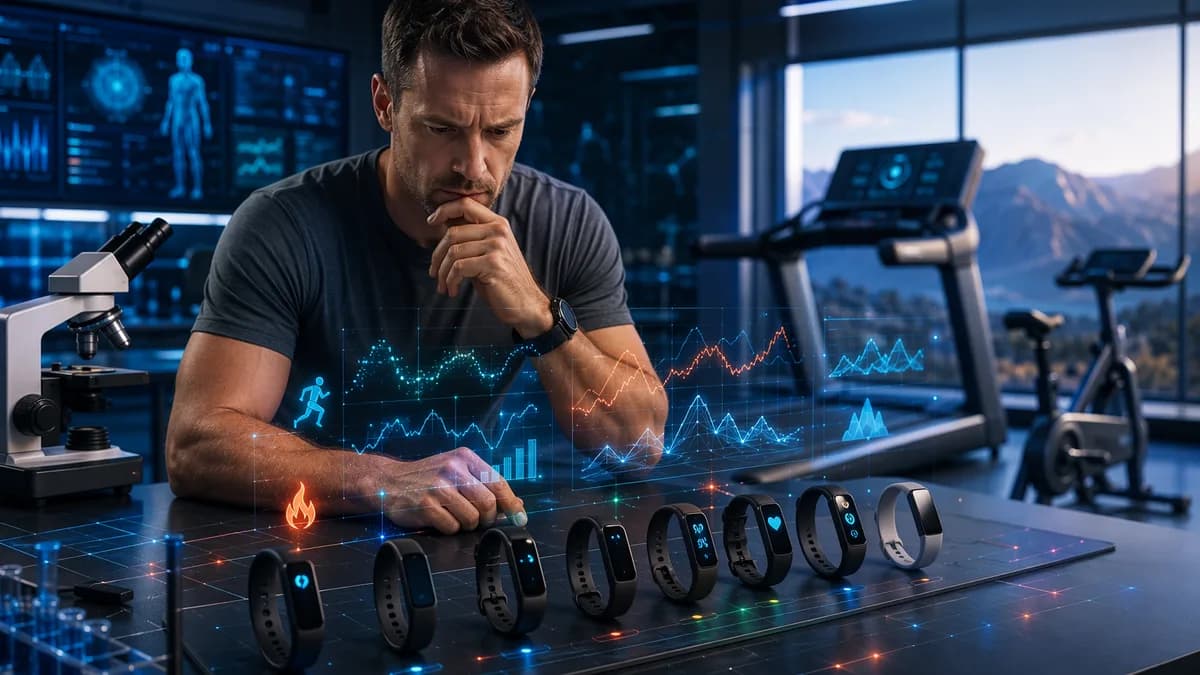
Fitness tracker accuracy is good enough to feel authoritative, but Tom’s Guide’s head-to-head testing shows some of the most actionable workout stats still wobble when users most want certainty.
XOOMAR Intelligence
Analyst Take
That’s the tension inside a blunt assessment from Tom’s Guide, where a reviewer who says he has tested many smartwatches and fitness trackers released over the past three years argues that modern wearables are broadly reliable on basics, yet inconsistent on elevation gain, pace, and calories burned, according to Tom's Guide.
The read-through is bigger than one buyer’s guide. The fitness tracker market has improved fast. Name-brand devices now often produce similar readings for step count, distance, and heart rate during walks. But the category still sells confidence more consistently than it delivers precision.
That matters because these numbers don’t sit quietly in an app. People use them to pace runs, judge training load, track recovery, manage weight goals, and decide whether they’re getting fitter. A polished chart can make an estimate feel like a measurement.
Your expensive fitness tracker may be guessing through the stats you trust most
Tom’s Guide’s testing points to a split reality: many wearables are impressive on repeatable, simple movement tracking, but shakier when the metric requires more interpretation.
The reviewer says he has performed dozens of walk tests, wearing devices on both wrists while manually counting steps. In those tests, most modern wearables came within a few hundred steps of his actual count during walks of 5,000 or more steps. Distance often landed within a few tenths of a mile, and heart rate readings were broadly similar, usually within a handful of beats per minute.
That’s not trivial. For consumer hardware worn loosely on skin, during real movement, across different bodies and workouts, that level of agreement is strong enough for everyday use.
The problem starts when users treat every stat with the same trust.
"That said, there are three workout stats that are consistently, well... inconsistent."
Those three stats, in Tom’s Guide’s account, are elevation gain, pace, and calories. They’re not cosmetic. Elevation affects how hard a walk, ride, or run really was. Pace changes how an athlete judges effort. Calories influence eating decisions, deficit targets, and motivation.
The harder truth: expensive devices don’t automatically escape the problem. Tom’s Guide says even some of the best smartwatches and best fitness trackers can stumble on these metrics. That undercuts the assumption that paying up always buys cleaner truth.
Elevation, pace, and calories expose the weakest parts of fitness tracker accuracy
Elevation gain is the most obvious failure point in the Tom’s Guide piece because it turns location and terrain into workload. The reviewer lives in Seattle, WA, and says a standard midday two-mile walk can include several hundred feet of climb. If a tracker misses that, it misses the character of the workout.
Some devices don’t show elevation gain at all in post-workout reports. Tom’s Guide names the Fitbit Inspire 3 as one example. Others show the metric but perform poorly in testing. The reviewer singles out the Fitbit Air, a device he otherwise likes, as weak on elevation measurement.
Apple is not exempt. Tom’s Guide says the Apple Watch Ultra 3 has been “rock-solid” in the reviewer’s experience, while the Apple Watch Series 11 and Apple Watch SE 3 have sometimes logged slightly inflated elevation stats.
Garmin gets the strongest nod here, but with a hardware caveat. Tom’s Guide says Garmin has been the most consistent brand for elevation tracking in the reviewer’s experience, assuming the watch includes an onboard barometric altimeter. The Garmin Forerunner 70 does not.
| Metric | Testing reality from Tom’s Guide | Why users should care |
|---|---|---|
| Elevation gain | Some devices omit it, while others inflate or undercount climb | It changes perceived effort, especially in hilly areas |
| Pace | Garmin reports moving pace and elapsed pace, while Apple and Google offer one unspecified pace metric | Pauses can make a workout look slower than the actual moving effort |
| Calories | One device can report one hundred or more calories more than another after the same workout | It can distort weight-loss planning and post-workout decisions |
Pace is a quieter issue, but it may be more damaging for runners. Tom’s Guide says Garmin provides both average moving pace and average elapsed pace for outdoor activities such as walks, hikes, runs, and bike rides. Moving pace ignores longer stops, including waiting at a traffic light or pausing for water. Elapsed pace includes them.
Apple and Google, according to Tom’s Guide, provide only one pace metric in workout reports and don’t specify which one it is. The reviewer says those readings are almost always slower than competitors’ moving pace stats, suggesting they are reporting elapsed pace.
That distinction matters. A runner doing a steady session with traffic-light pauses may think their actual pace was slower than it was. A cyclist stopping at intersections may see a weaker effort than their legs produced. The device hasn’t necessarily failed. It has chosen a definition, then hidden the definition from the user.
Calories are worse because the calculation is opaque. Tom’s Guide says post-workout calorie counts are the most inconsistent metric in testing, with one device sometimes logging one hundred or more calories burned than another after the exact same workout.
"Not only are most manufacturers opaque about how the calorie counts are even calculated in the first place, but key factors like a user's metabolism or muscle mass are rarely taken into account when generating them."
That’s the core indictment. Calories look precise because the app prints a number. The underlying estimate may be far less solid.
Small measurement errors can turn into bad training decisions
A tracker that is slightly wrong once is annoying. A tracker that is slightly wrong every day becomes a training model.
Tom’s Guide’s step-count testing gives a useful scale. If a device misses by a few hundred steps on a walk of 5,000 or more steps, that may be acceptable for motivation. It’s less acceptable if the user treats it as exact. A 200-step miss on 5,000 steps is 4%. A 300-step miss is 6%. That math is simple, but the behavior change can be real if someone is chasing streaks, calorie targets, or recovery scores built from activity volume.
Distance errors compound in the same way. Tom’s Guide says many devices report distance within a few tenths of a mile on walks. Fine for a casual loop. More troublesome if the user is using that pace readout to judge performance. A small distance mismatch can make pace look better or worse without the athlete changing anything.
Heart rate is where average agreement can hide moment-by-moment weakness. The source says name-brand wearables often report broadly similar heart rate data, give or take a handful of beats per minute, during walk testing. That supports confidence for steady, low-chaos activity. It does not prove the same accuracy for every workout type, especially when wrist movement and grip pressure change the signal.
XOOMAR analysis: this is the difference between consistency and accuracy. A device can be consistently biased and still help users track broad trends. If it always undercounts a hilly route in the same way, the trend line may still show whether the user is doing more or less work over time. But that same device should not be treated as an absolute measuring tool.
Head-to-head testing matters because it removes the usual excuse. Same person. Same workout. Same conditions. Different devices. When the numbers disagree under identical conditions, the disagreement belongs to the products and their algorithms, not the user.
That’s why this story is less about which brand “wins” than about how much uncertainty sits beneath a clean post-workout summary.
Wearables moved from step counters to health dashboards, then got overconfident
Older fitness trackers had a narrower bargain with the user. Count steps. Log workouts. Estimate distance. Maybe show heart rate. The claims were modest, and users understood the limits.
Modern devices do far more. The source material around current wearables describes products focused on Readiness, Stress Management, sleep tools, recovery insights, training load, and AI-powered coaching. That shift changes the product’s role. The watch no longer just records movement. It tells the user what the movement means.
That’s where the accuracy problem mutates. Sensor hardware can improve while interpretation becomes the weak link. A wrist device may collect decent signals, then convert them into a calorie estimate, recovery score, or workout recommendation that looks more certain than it is.
Here’s the before-and-after that matters:
- Before: Trackers counted movement and left interpretation mostly to the user.
- After: Trackers score effort, recovery, stress, and readiness in simplified dashboards.
- Before: A wrong step count was irritating.
- After: A wrong input can influence training load, calorie targets, or confidence in recovery.
- Before: The device felt like a logbook.
- After: The device behaves more like a coach.
This is a product design issue as much as a sensor issue. Clean interfaces reduce friction, but they also suppress uncertainty. XOOMAR readers have seen that pattern in other consumer tech categories too, where polished platforms shape user behavior before users interrogate the mechanics underneath. Our coverage of Apple Maps ads taking on Google in home services showed a similar trust problem: when a platform controls the interface, its outputs can feel more neutral than they are.
Fitness tracker accuracy now sits inside that same design tension. The more confident the app feels, the more responsibility the brand has to explain when the number is an estimate, a model output, or a direct measurement.
Runners, casual users, clinicians, and wearable brands need different kinds of accuracy
Not every user needs lab-grade precision. That’s the part critics often miss.
A casual user trying to walk more can live with a step count that lands within a few hundred steps on a 5,000-plus-step walk. The direction of travel matters more than the exact count. If the tracker keeps them moving, the product has done something useful.
A serious runner or cyclist has a different problem. Pace definitions matter. Moving pace and elapsed pace answer different questions. If Garmin shows both while Apple and Google show one unspecified pace, Garmin gives the athlete more context. The value is not just accuracy. It’s transparency.
Lifters and interval athletes face another challenge. The Tom’s Guide source does not provide strength-training or HIIT test data, so it would be wrong to claim specific failures from this article alone. But the broader inference is fair: metrics that depend on clean wrist signals and algorithmic interpretation deserve more skepticism when movement gets less steady.
Clinicians sit in a separate category. The Tom’s Guide article is not a medical validation study. It does not test diagnosis, treatment, or clinical monitoring. That boundary matters. Wearable trends may be useful context, but consumer workout stats should not be treated as definitive medical evidence without validation and professional interpretation.
Brands, meanwhile, are balancing trade-offs. A bigger sensor, tighter strap, stronger GPS behavior, or more complex reporting may improve one metric while hurting comfort, battery life, design, or simplicity. The market rewards devices people actually wear. That means perfect measurement is not the only engineering target.
Consumer psychology does the rest. A chart with rounded rings, colored zones, and a single recovery score makes uncertainty feel settled. That is part of the product’s appeal. It is also the risk.
Flawed fitness tracker stats should change how runners, lifters, and everyday users read the app
The practical answer is not to throw out the watch. It is to demote some numbers from “truth” to “signal.”
Trust duration first. If you started a workout at 7:00 and ended at 7:45, the device can handle that. Broad activity trends are also useful, especially when the same device tracks the same user over time. Step count, distance, and steady-state heart rate appear relatively consistent in Tom’s Guide’s walk testing across name-brand wearables.
Treat other numbers with more caution.
- Calories: Use them as a rough estimate, not a food budget. Tom’s Guide found device-to-device gaps of one hundred or more calories after the same workout.
- Elevation gain: Check whether the device has a barometric altimeter and whether the app even reports climb data.
- Pace: Find out whether the app shows moving pace, elapsed pace, or an unspecified blend.
- Recovery-style scores: Useful as prompts, but weak if built on shaky sleep, calorie, or workload estimates.
- Single-workout anomalies: Don’t rewrite your training plan because one chart looked weird.
Buying decisions should start with the workouts people actually do. A hilly walker should care about elevation. A runner should care about pace definitions and heart-rate behavior. A cyclist may care less about wrist metrics and more about external sensors. A casual user may be better served by comfort and consistency than by the longest feature list.
There’s a markets lesson here too. A single number can seduce people into overconfidence, whether it’s a wearable score or a price level. In our analysis of gold price bulls getting trapped at $4,100 as Fed bets bite, the useful question wasn’t just the number on screen. It was whether the forces behind it supported the conclusion. Fitness data deserves the same discipline.
The best use of a tracker is comparative and contextual: same route, same device, similar conditions, watched over time. The worst use is absolute: one calorie number, one recovery score, one pace reading, treated as a verdict.
The next fitness tracker fight will be over proof, not feature lists
The wearable race has spent years adding metrics. The next credibility fight should be about proof.
Brands that want serious users will need to explain how their numbers are produced, where they’re strongest, and where confidence drops. A workout summary that says “calories burned: 612” looks cleaner than one that admits uncertainty. But the honest version is more useful.
Premium devices are likely to push harder into multi-sensor interpretation, better GPS behavior, improved optical sensors, and coaching that adapts to uncertainty instead of hiding it. The source already hints at the split. Garmin’s advantage on elevation depends partly on hardware, specifically watches with an onboard barometric altimeter. Software can’t fully compensate for missing inputs.
XOOMAR analysis: the market will separate into two buyer groups. Casual users will keep choosing devices that motivate them, fit comfortably, and make activity visible. Serious athletes will keep pairing smartwatches with more specialized tools when precision matters. The watch remains the hub, but not always the final authority.
The evidence that would confirm this thesis is simple: more brands publishing validation data, clearer labels for moving versus elapsed pace, visible confidence ranges around calorie estimates, and stronger disclosure when a metric is modeled rather than directly measured.
The evidence that would weaken it would be just as clear: independent head-to-head tests showing tight agreement across brands on elevation, pace definitions, and calorie estimates under the same workout conditions.
Until then, the winning wearable won’t be the one with the most metrics. It’ll be the one honest enough to tell users when the numbers are weak.
Key Takeaways
- Fitness trackers are useful for trends, but some workout stats should not be treated as exact measurements.
- Users may make training, recovery, or weight-management decisions based on numbers that are partly estimated.
- The most dependable readings appear to be simple movement and heart-rate basics, not more interpretive metrics like calories or elevation.
Fitness tracker metrics: more reliable vs less certain
| More reliable basics | Less certain workout stats |
|---|---|
| Step count during walks often came within a few hundred steps on 5,000+ step tests | Elevation gain can vary because devices infer climbing from sensors and algorithms |
| Distance often landed within a few tenths of a mile | Pace can wobble, especially when GPS or movement data is imperfect |
| Heart rate readings were broadly similar, usually within a handful of beats per minute | Calories burned remain estimates shaped by formulas, not direct measurement |
Primary Sources & Disclosures

Written by
XOOMAR Insights Team
Research and Editorial Desk
The XOOMAR Insights Team pairs automated research with human editorial judgment. We track hundreds of sources across technology, fintech, trading, SaaS, and cybersecurity, cross-check the facts, and explain what happened, why it matters, and what to watch next. We do not just rewrite headlines. Every article is fact-checked and scored for reliability before it goes live, and we link back to the original sources so you can verify anything yourself.