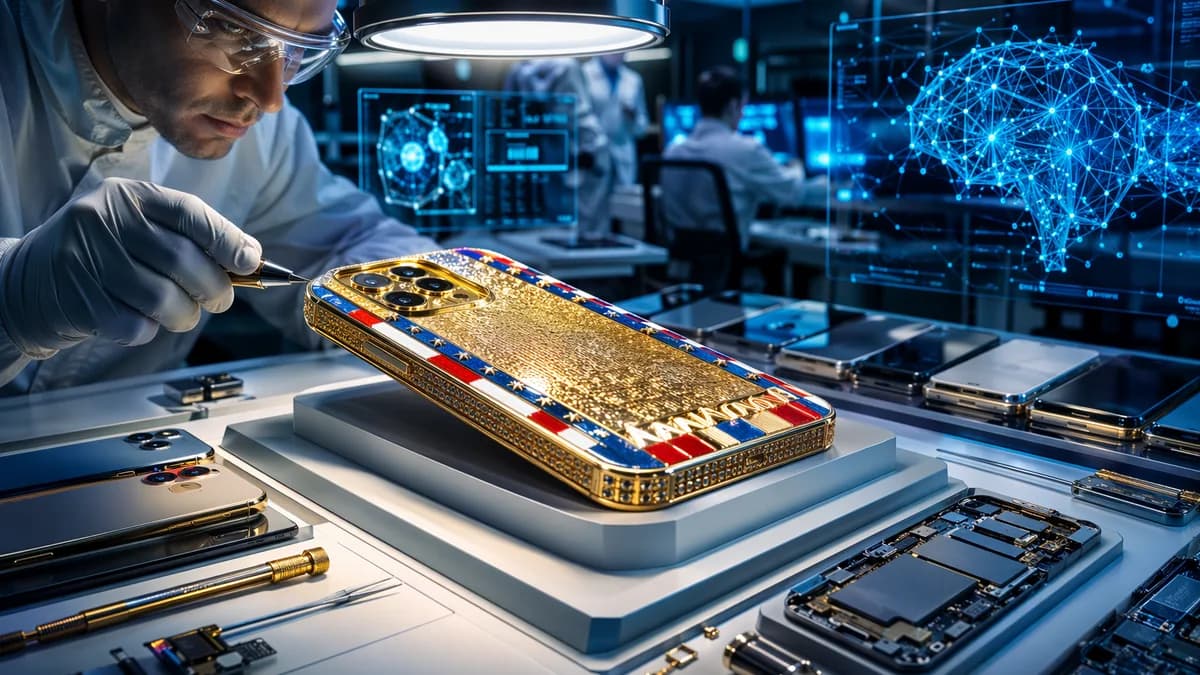
The Trump phone now exists, costs $499, and The Verge says the week-long reality check is brutal: the Trump Mobile T1 is branding dressed as hardware, and the people most exposed are buyers who need a phone, not a souvenir.
XOOMAR Intelligence
Analyst Take
Dominic Preston’s review gives the T1 a 3 Verge Score. The “Good” list is almost comic in its restraint: “It actually exists,” a 3.5mm headphone jack, a MicroSD card slot, and software that “basically runs stock Android.” The “Bad” list is shorter and more damning: “Almost everything else.”
That’s the thesis. The Trump phone is a political product first and a technology product second. Judging it like a serious Android handset almost gives it too much credit.
Buyers face a $499 phone that looks like the launch went wrong before shipping
The T1’s trust problem started long before anyone touched the finished device. According to The Verge, it was announced “last June” with “dodgy renders” and an “incoherent spec sheet.” Two weeks later, Trump Mobile admitted it wouldn’t be made in the US. The final phone was shown privately over a video call in February, then publicly in April through a short commercial The Verge described as having “the slick sheen of AI.”
So the first buyer question is simple: if the story kept shifting before launch, why assume it gets more stable after purchase?
A phone spec sheet can’t be vibes. Screen, battery, processor, bands, cameras, software support, manufacturing claims, these are not mood-board items. They decide whether a device survives daily use.
The T1 is now on sale for $499, after “tenuous, ever-shifting release dates.” The Verge says a few buyers have it, including The Verge, while “more still seem not to.” That gap matters. Hardware credibility doesn’t begin when a product page goes live. It begins when claims, timelines, and support promises line up.
Trump Mobile executives told The Verge customers won’t “be locked into what’s there today,” but the company has not announced how long it will support the phone with software updates.
That is not enough. Not for a device people carry every hour.
Product makers should study the T1 as a warning about minimum-effort hardware
The T1 proves one uncomfortable thing about modern phones: it’s hard to make a device that completely fails. It’s much easier to assemble acceptable parts, load Android, add branding, and ship something that technically works.
The Verge’s review says the phone has a 120Hz OLED screen, a 5,000mAh battery, a triple rear camera setup with 50-megapixel sensors, 512GB of storage, 12GB of RAM, wireless charging, and a Snapdragon 7 Gen 3 chipset. On paper, that sounds respectable. In use, The Verge found the phone “often sluggish,” with stutters while switching apps or triggering animations.
What does that tell builders? Parts are not product.
| T1 element | On paper | The Verge’s experience |
|---|---|---|
| Display | 120Hz OLED | Curved waterfall screen feels dated |
| Battery | 5,000mAh | Not the main issue in the review |
| Memory | 12GB RAM | Phone still stutters |
| Storage | 512GB | One of the few standout specs |
| Cameras | Triple rear setup, 50-megapixel sensors | Oversaturated daylight shots, noisy night shots, poor 8-megapixel ultrawide |
| Software | Android 15 | Nearly stock, but no clear update policy |
The useful lesson for founders and hardware teams is harsh: shipping late with commodity components doesn’t create trust. Execution does. That same discipline applies across tech launches, whether it’s a phone or the product readiness questions we track in Startup Battlefield Australia coverage.
End users get a few nostalgic Android perks wrapped in bad design
The T1 is not devoid of appealing details. The Verge liked the headphone jack, the microSD slot, the included case, charger, and braided USB cable. It even has a notification light, a feature many Android users still miss.
But nostalgia can’t carry a $499 phone. Would you buy a daily driver because it has a headphone jack if the rest of the experience feels unfinished?
The physical design sounds especially careless. The Verge describes a “curved slab of cheap gold plastic,” with a gold finish that can look more yellow, a sticky feel, and a unit that arrived with a tiny scratch. The American flag logo is missing a stripe. “Trump Mobile” appears twice on the back, in two orientations and two fonts. The rear camera lenses are spaced unevenly.
Those are not spec-sheet quibbles. They’re signs of taste, manufacturing care, and quality control.
Software is equally revealing. The T1 runs Android 15, which The Verge calls “nearly two-year-old” software, with a February 2026 security patch. The only unusual preinstalled apps are Truth Social and Doctegrity, the telehealth platform included with Trump Mobile’s $47.45 cell service. Truth Social can be removed.
For practical Android users, the best advice is boring: learn what your phone is telling you, watch for software support, and don’t ignore warning signs. Our guide to Android status bar icons and hidden phone trouble is more useful to buyers than any patriotic wallpaper.
Reviewers should not let the Trump phone hide behind spectacle
A supporter of the Trump phone can make a fair argument. The T1 exists. It has stock-ish Android. It includes a charger. It brings back a few hardware features many buyers still like. It is tied to a recognizable political brand and a phone service some customers may prefer.
That is the strongest counterargument. It’s also not strong enough.
Choice still needs quality. A politically aligned product does not get an exemption from ordinary consumer standards. If anything, it should clear a higher bar because buyers are being asked to trust a new phone brand with unclear long-term support.
The Verge found basic camera performance that sounds far below what serious buyers should accept at this price. Daylight photos are “vivid and oversaturated,” nighttime shots are noisy, and the telephoto shows no sign of electronic stabilization. Even worse, every shot is watermarked by default with a small T1 mark.
Why would a weak camera insist on signing its work?
That detail captures the whole device. The branding is louder than the product.
Established phone makers should see the T1 as noise, not competition
The T1 does not read like a serious threat to established phone makers. That is analysis, based on the review evidence. A real challenger needs polish, support commitments, carrier confidence, camera processing, update discipline, and industrial design that doesn’t make reviewers count missing flag stripes.
The network issue is also glaring. The Verge reviewer lives in the UK and found the T1 could not maintain anything stronger than 2G, allowing texts and calls but not data. Based on FCC certification documents, The Verge says the phone appears not to support network bands commonly used in Europe.
Yes, the T1 is not sold in Europe. But buyers travel. A serious phone does not become a paperweight when it crosses a border.
There is no need to inflate this into a grand market story. The source supports a narrower, sharper point: the T1’s weakness is execution. It shows what happens when a phone launch leans harder on identity than on the boring machinery that makes a handset dependable.
Trump Mobile’s real test starts after the first wave of bad reviews
Bad reviews fade. Ownership problems linger.
The biggest unanswered issue is support. The Verge says Trump Mobile has not announced how long the T1 will receive software updates. When asked in February how many Android version updates the phone would get, executives “seemed confused” by the question, while insisting customers wouldn’t “be locked into what’s there today.”
That should stop buyers cold.
Phones are not one-time purchases in any practical sense. They need security patches, repair paths, return handling, replacement accessories, network reliability, and customer service that can answer specific questions. The source does not establish whether Trump Mobile can provide all of that. That uncertainty is the problem.
So the practical call is simple: don’t reward the Trump phone until Trump Mobile behaves like a real tech company. Demand full specs. Demand written update commitments. Demand clear warranty terms. Compare the T1 against proven phones before spending $499.
A phone earns its place in your pocket every day. Waving a flag at checkout doesn’t count.
Key Takeaways
- The $499 T1 appears to prioritize political branding over dependable phone hardware.
- Shifting launch claims and delivery uncertainty raise trust concerns for buyers.
- Consumers who need a reliable daily phone may face more risk than value.
Trump Mobile T1: Good vs Bad
| Good | Bad |
|---|---|
| It actually exists | Almost everything else |
| 3.5mm headphone jack | Dodgy renders and an incoherent spec sheet before launch |
| MicroSD card slot | Trump Mobile admitted it would not be made in the US |
| Basically stock Android | Tenuous, ever-shifting release dates |
Trump Mobile T1 Price
Primary Sources & Disclosures

Written by
XOOMAR Insights Team
Research and Editorial Desk
The XOOMAR Insights Team pairs automated research with human editorial judgment. We track hundreds of sources across technology, fintech, trading, SaaS, and cybersecurity, cross-check the facts, and explain what happened, why it matters, and what to watch next. We do not just rewrite headlines. Every article is fact-checked and scored for reliability before it goes live, and we link back to the original sources so you can verify anything yourself.