
What if the most interesting EV launch of 2026 is not faster, smarter, or longer-range, but slower on purpose? The Amble One is a street-legal electric buggy from Lisbon startup Amble, and its real provocation is simple: many households may not need a second car that behaves like a smaller first car.
TechnologyJuly 8, 2026· 8 min read· By XOOMAR Insights Team
40 MPH Amble One Dares EV Buyers to Rethink Second Cars
Updated on July 8, 2026
XOOMAR Intelligence
Analyst Take
69/ 100
4 sources analyzedMedium confidenceTrend10Freshness98Source Trust88Factual Grounding92Signal Cluster20
The Amble One is being pitched first to hotels and resorts, but CEO Adrien Roose told The Verge that Amble wants to build a new category around short local trips rather than compete with conventional automobiles. That framing matters more than the vehicle’s spec sheet.
Can the Amble One make restraint feel premium?
The Amble One rejects the usual EV sales script. It has no self-driving features. It is not chasing a headline 0-60 time. Its top speed is 40 mph (65 km/h), and its claimed range is upwards of 62 miles (100 km) on a charge.
That sounds modest only if the benchmark is a highway-capable EV. Amble is using a different benchmark: the underused second vehicle sitting beside a household’s main car.
Roose put it bluntly:
“If we look at the stats, most European and American families have, like, two cars on average,” Roose said. “The reality is that there is one car that brings the emotional freedom or the actual freedom that you need to go on a highway and to go on vacation or to go on long weekends. But the reality is that the second vehicle is mostly used for, like, school runs and grocery shoppings and neighborhoods.”
That is the thesis. Not every trip needs a truck, SUV, or long-range crossover. Some trips need style, low speed, cargo space, and just enough battery.
XOOMAR analysis: the Amble One won’t solve the EV market’s bigger problems. It does expose a blind spot. Automakers often define progress as more range, more power, more software, and more screen. Amble is betting that premium can also mean less vehicle.
Do 40 mph and 62 miles of range solve the trip Amble is actually targeting?
The numbers are narrow, but coherent.
The Amble One uses a 15kW motor and an 11kWh battery. It charges from a standard wall outlet in five hours. It weighs under 450kg (992lbs). Customers can reserve one with a $100 deposit, deliveries are targeted for 2028, and Amble is aiming for a starting price of $25,000. Roose said the company already has over 1,000 reservations.
| Vehicle question | Amble One answer |
|---|---|
| Use case | Short trips, resorts, neighborhoods, local roads |
| Top speed | 40 mph (65 km/h) |
| Range | Upwards of 62 miles (100 km) |
| Battery | 11kWh |
| Motor | 15kW |
| Charging | Standard wall outlet in five hours |
| Weight target | Under 450kg (992lbs) |
| Target price | $25,000 |
| Delivery target | 2028 |
The weight target is not cosmetic. Roose said Amble is being homologated under Europe’s L7e quadricycle regulations, which require the complete vehicle, including the battery, to weigh less than 450 kilograms. That forced hard engineering tradeoffs.
This is where the Amble One becomes more interesting than a luxury cart. A larger battery would improve range, but it could break the regulatory target. More enclosure could improve comfort, but it could add weight. More capability could make the vehicle less focused.
XOOMAR analysis: on a traditional car spreadsheet, the Amble One looks expensive for its speed and range. On a second-vehicle spreadsheet, the question changes. If the daily mission is school runs, groceries, beach paths, resort transport, or neighborhood driving, then 40 mph and 62 miles are not defects. They are the design boundary.
Is this a new EV category or a dressed-up golf cart?
Amble knows the obvious jab. Roose addressed it directly.
“Some people could call it a glorified golf cart, but it’s really in between in terms of platform. If you look at the battery, it’s three to four times the range of a golf cart.”
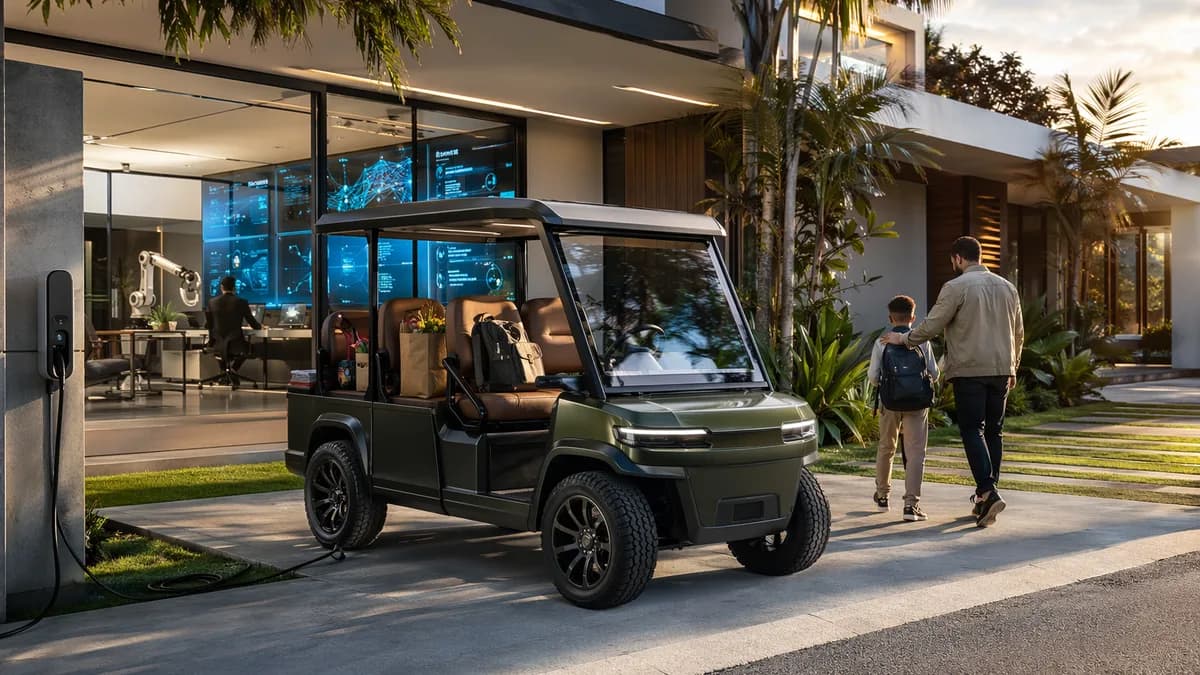
The design reinforces that “in between” position. The Amble One is open-air, has no doors, uses folding front seats, a digital display, and physical controls. Its materials include leather and cork, a nod to its Portuguese origins. There is a front cargo rack, rear seats that fold flat for surfboards or other gear, and built-in mounts for baskets, straps, mirrors, and accessories.
The company’s reference points are telling. Roose said the inspiration came from the Lunar Rover and older 4x4 vehicles, including the G-Wagen, known for flat surfaces. He also showed The Verge a rendering of a version with doors and windows that looked like a cross between a dune buggy and a Mini Moke.
Amble is entering a space that The Verge says already includes Microlino, Citroën Ami, Fiat Topolino, and an enthusiast subculture around Japanese kei cars. The difference is packaging. Amble is not trying to make small transport look merely cheap or utilitarian. It wants small transport to look intentional.
For XOOMAR readers tracking how product positioning can matter as much as raw specs, see our adjacent reads on Apple AirTags beating $2 Bluetooth trackers where it hurts and Bidbus saying dealers can beat Carvana by $3,000 a car. Different markets, same lesson: execution and framing can change how buyers read the spec sheet.
Who pays $25,000 for a street-legal buggy?
Amble is starting with fleets, not households. Roose said the company chose hospitality operators because it is a simpler launch path than diving directly into consumer sales. That fits the vehicle. Hotels and resorts can use a low-speed EV as transportation and as visual branding.
The leadership team also points toward that strategy. Roose previously led premium Belgian e-bike company Cowboy. Founder and chairman José António Uva is a Portuguese hotelier and entrepreneur behind São Lourenço do Barrocal. Design lead Julian Hoenig has worked on the R8, RSQ, A4, and Q3 at Audi, and the Apple Watch, Vision Pro, and Project Titan at Apple. Michael Tropper, founder of London-based creative studio forpeople, is cofounder and chief creative officer.
That is not a standard golf cart team. It is a design and hospitality team building a vehicle around place, mood, and repeated short trips.
Still, Amble may accelerate the US street-legal version because the response has been stronger than expected.
“I think we are just going to be forced to adapt our plans and accelerate the deployment of the street legal version in the US,” Roose said.
The production plan remains a major test. Amble will not manufacture the vehicles itself. It has partnered with an unnamed contract manufacturer that Roose described as a serious Tier 1 automotive supplier with roughly 1,100 people. Motors come from Germany, reducers from Italy, and batteries are currently sourced from China. Initial vehicles are planned for export to the United States from Europe, with possible US manufacturing later.
Does Amble expose the oversized EV problem without trying to fix all of it?
The Amble One’s sharpest critique is implicit. The Verge notes that Americans are drawn to larger vehicles, that trucks and SUVs sold today are bigger than they were 20 years ago, and that those vehicles make up about 80 percent of vehicles sold in the US. Experts have warned that larger vehicles raise the risk of injury or death for pedestrians and cyclists.
Amble is not presenting itself as a mass safety intervention. It is selling a premium buggy. But its design asks an uncomfortable question: why should the default second vehicle be nearly as large and capable as the first?
Roose pointed to a real behavioral pattern in parts of America:
“Many people have this huge pickup,” Roose said. “But next to it, they have these golf carts. And that’s perfectly normal in many places in America.”
That line explains the opportunity. Amble does not have to convince every driver to abandon large vehicles. It only has to prove that the second slot in the garage can be rethought.
XOOMAR analysis: the risk is that Amble becomes a beautiful object for resorts and wealthy households, not a broader transportation category. The opportunity is that design-led low-speed EVs make “smaller” aspirational rather than punitive.
Can Amble turn a beautiful buggy into a real EV business by 2028?
The next test is not whether people like the renderings. The Verge reports over 1,000 reservations, a $100 deposit, a $25,000 target price, and deliveries aimed at 2028. Those are early indicators, not proof of scale.
The evidence that would support Amble’s thesis is concrete: successful homologation under L7e, production-quality vehicles from its contract manufacturer, fleet deployments that work in resorts, and a US street-legal rollout that does not dilute the design.
The evidence that would weaken it is just as clear: missed delivery timing, weight creep, a price above the target, or a market that treats the Amble One as a novelty rather than a second-vehicle substitute.
Amble may stay niche. But the idea behind the Amble One is bigger than one buggy: the next useful EV category may not be the most impressive machine in the driveway. It may be the one that makes the shortest trips feel like they finally got the right tool.
The Bottom Line
- Amble is challenging the idea that every household vehicle needs highway-level speed and range.
- The Amble One highlights a potential market for stylish, low-speed EVs built around neighborhood trips.
- If successful, it could push automakers to rethink what a premium second vehicle should be.
Amble One vs. Conventional Second Car
| Category | Amble One | Conventional Second Car |
|---|---|---|
| Primary use | Short local trips, resorts, neighborhoods | Broader daily driving, including highways |
| Top speed | 40 mph | Typically highway-capable |
| Range focus | Upwards of 62 miles per charge | Longer-range capability prioritized |
| Product philosophy | Premium through restraint and simplicity | More range, power, software, and features |
Sources

Written by
XOOMAR Insights Team
Research and Editorial Desk
The XOOMAR Insights Team pairs automated research with human editorial judgment. We track hundreds of sources across technology, fintech, trading, SaaS, and cybersecurity, cross-check the facts, and explain what happened, why it matters, and what to watch next. We do not just rewrite headlines. Every article is fact-checked and scored for reliability before it goes live, and we link back to the original sources so you can verify anything yourself.
Explore More Topics
Related Articles
 Technology
Banks Hand Nscale $900M as AI Compute Race Turns Real
Nscale's $900M credit line shows banks are ready to finance the AI compute build-out, not just software bets.
Jul 7, 20267 min
 Technology
$1 Billion Liability Load Haunts Lime IPO After 9% Pop
Lime raised $167 million in its Nasdaq debut and shares popped 9%, but investors now see its $1 billion liability load.
Jul 1, 20267 min
 Technology
SK Hynix IPO Dares Wall Street to Reprice AI Memory
SK Hynix wants a $29 billion U.S. listing to make Wall Street price memory chips as AI infrastructure.
Jul 6, 20268 min
 Technology
Enterprise AI Leaders Widen the Gap With Content Plumbing
Box's survey says enterprise AI winners are pulling away through governance, permissions, and integration, not prompt tricks.
Jul 7, 20268 min
 Technology
100 Autonomous Ground Vehicles Roll Into Ukraine's War
Forterra has put 100-plus self-driving ATVs into Ukraine, turning the war into a brutal proving ground for US military robotics.
Jul 7, 20269 min
 Global Trends
Trump’s 1,400-Person NATO Summit Entourage Tests Allies
Trump’s giant delegation reassures NATO allies, but his spending fight and Zelenskyy’s air-defense push put Ankara on edge.
Jul 7, 20266 min
 Global Trends
ABC FCC Fight Drags The View’s News Shield Into 2026
ABC says the FCC is using a candidate interview to threaten The View’s news status, raising First Amendment stakes before 2026.
Jul 8, 20268 min
 Trading
Gold Price Fights for $4,100 as Fed Hawks Bite Hard
Gold reclaimed $4,100, but hawkish Fed bets, higher yields and US-Iran tension keep the rebound fragile.
Jul 8, 20266 min
 Trading
New Zealand Dollar Jumps as RBNZ Hike Stops Short of Shock
The New Zealand dollar jumped on the RBNZ's first hike since 2023, but MUFG sees restraint, not an aggressive tightening cycle.
Jul 8, 20265 min
 Fintech
FinCEN Stablecoin KYC Rules Force Issuers to Act like Banks
FinCEN wants stablecoin issuers to verify direct customers like banks, while secondary-market transfers stay outside the rule.
Jul 8, 20268 min
Don't miss the signal
Get our weekly roundup of the stories that matter across tech, fintech, and trading. No noise, just signal.
Free forever. No spam. Unsubscribe anytime.