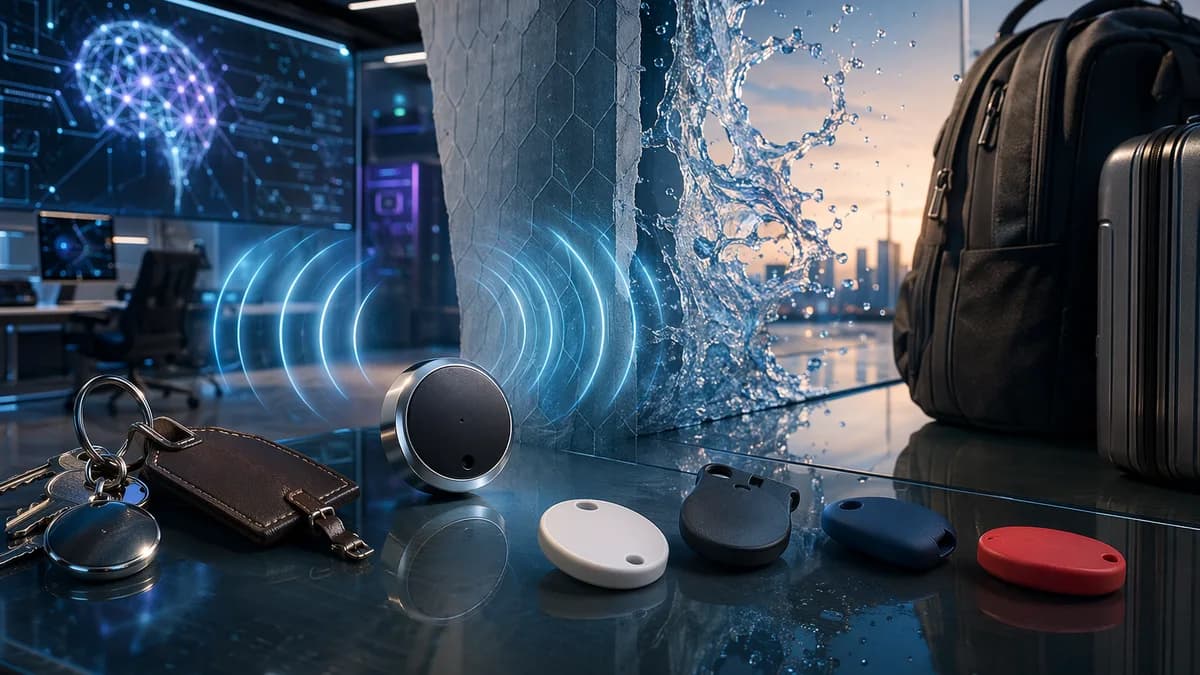
A $2.50 Bluetooth tracker can work, but ZDNet’s test shows why cheap tags can collapse exactly when distance, walls, water, and weak radio design start to matter.
XOOMAR Intelligence
Analyst Take
That’s the useful signal from Adrian Kingsley-Hughes’ comparison of Apple AirTags vs Bluetooth trackers, according to ZDNet. The no-name tag was not fake. It paired, transmitted, and could be found. The problem was narrower: it had less than half the useful range of stronger tags, and its claimed waterproofing failed under a tap.
“All the tags -- ranging in price from $40 to $2.50 -- worked.”
XOOMAR analysis: that line is the whole market in miniature. The cheap tracker clears the basic product-listing test. It fails the trust test.
The $2 Bluetooth tracker exposes the real weakness in AirTag alternatives
The core question in Apple AirTags vs Bluetooth trackers is not whether a tag can beep from a few feet away. It’s whether it gives you a real shot at finding keys, a wallet, a rucksack, luggage, or gear when the item is no longer sitting in plain sight.
ZDNet tested three devices:
| Tracker | Approximate price in source | Test setup | Main result |
|---|---|---|---|
| Apple AirTag | Around $29 | Paired with iPhone 17 Pro Max | Best Bluetooth range, plus precision finding |
| Nomad Tracker Card Pro | Around $39 | Paired with iPhone 17 Pro Max | Close to AirTag on Bluetooth range |
| No-name tracker tag | About $10 for four, or $2.50 each | Paired with iPhone 17 Pro Max | Worked, but range and build quality lagged badly |
All three tags were new, fully charged, and used Apple’s Find My environment. That matters because this was not a messy comparison across many phones and apps. ZDNet deliberately used one phone, Apple’s iPhone 17 Pro Max, because the AirTag only works on iOS and Android hardware differences would have turned the test into a phone comparison.
That restraint makes the result more useful. The cheap tag did not lose because it was tested unfairly. It lost because its hardware was weaker.
This follows a broader Apple pattern XOOMAR has tracked: the company’s products often look expensive until the surrounding hardware and service integration, from Find My to rearranging CarPlay apps, starts doing part of the work. We saw a different version of that dynamic in Leaked iPhone 18 Pro Max Battery Breaks Apple’s Pattern, where small component decisions, like Apple’s Broadcom chip deal, can shift the user experience more than spec sheets suggest. Apple’s services layer has also become a strategic anchor, as covered in Apple Account Card Payments End India's Four-Year Freeze.
Bluetooth tracker range tests show why specs don’t tell the whole story
Bluetooth Low Energy looks generous on paper. ZDNet notes that under ideal open and unobstructed conditions, BLE can reach 100 to 400 feet (30 to 120 meters). Real life is not ideal. Bags, pockets, wallets, luggage, walls, floors, cars, toolboxes, people, crowds, and radio-frequency interference all cut into range.
ZDNet’s practical estimate for real-world conditions was much lower: 30 to 100 feet (10 to 30 meters).
The test results show why the difference matters:
| Tracker | Clear line of sight | Indoors | Signal observations |
|---|---|---|---|
| Apple AirTag | 100 to 130 feet (30 to 40 meters) | 50 to 65 feet (15 to 20 meters) | RSSI as high as -35 dBm |
| Apple AirTag with precision finding | 180 to 200 feet (55 to 60 meters) | About 50 feet (15 meters) with two walls | Feature exclusive to Apple hardware |
| Nomad Tracker Card Pro | 85 to 100 feet (25 to 30 meters) | About 50 feet (15 meters) | RSSI as high as -35 dBm |
| No-name cheap tag | Struggled beyond 50 feet (15 meters) | About 30 feet (10 meters) | Never above -50 dBm, dropped to -70 dBm even next to the phone |
RSSI, or Received Signal Strength Indicator, is measured in dBm. ZDNet explains that the number is negative, with 0 dBm as the theoretical maximum and -100 dBm considered unusable or disconnected. Because dBm is logarithmic, a 20 dBm difference can represent a 100-fold difference in signal strength.
That makes the cheap tracker’s -50 dBm to -70 dBm behavior more than a nerdy measurement. It explains why a tag can seem fine in a room and become frustrating in a parking lot, office floor, airport baggage area, or cafe where a backpack is behind furniture and human bodies.
XOOMAR analysis: the no-name tag is good enough for “where did I put this?” It is much weaker for “where did this go?”
Find My compatibility didn’t save the weak radio
The tested tags were all compatible with Apple’s Find My setup, but ZDNet’s results show that software compatibility does not erase hardware limits.
That’s the mistake buyers make when comparing Apple AirTags vs Bluetooth trackers on marketplace listings. A cheap tag can advertise the same broad environment and still ship with a weaker antenna, weaker radio performance, weaker casing, or worse sealing.
The AirTag also has Ultra-WideBand support for precision finding, which ZDNet separated from the main Bluetooth comparison because the other tested tags did not have access to that capability. In practice, the precision finding result was strong: 180 to 200 feet with clear line of sight, and about 50 feet indoors with two walls between the phone and tag.
The Nomad Tracker Card Pro lacked precision finding, but its Bluetooth performance stayed respectable. It reached 85 to 100 feet in clear line of sight and about 50 feet indoors. That makes it a serious alternative in the test, not a bargain-bin compromise.
The cheap tracker’s weakness was different. It worked, then faded quickly.
The cheap tag’s waterproof claim failed the simplest reality check
Range was not the only gap. ZDNet reports that all the tags claimed some level of dust and water resistance. The AirTag and Nomad Tracker Card Pro passed the author’s tests “with flying colors.”
The cheap tag did not.
It claimed IP67, which ZDNet describes as fully dust-tight and capable of withstanding submergence in up to 1 meter of water for up to 30 minutes without damage. It failed after a simple run under a tap. When opened, the reason was visible: there was no gasket or seal, so water ingress was inevitable.
That is the clearest evidence in the whole test. The bargain tag was not just less polished. It made a durability claim its design did not support.
XOOMAR analysis: this is where the $2.50 price stops looking like a bargain and starts looking like risk transfer. The seller saves money on the build. The buyer absorbs the failure mode.
Buyers should match the tracker to the loss scenario
A cheap Bluetooth tracker can still make sense. ZDNet’s author says the cheaper options “still have their place” for situations where locating the item would be useful but failure would not be serious.
That is the right framework.
Budget tracker fit:
- Low-risk items: A spare wallet, remote, pouch, or item that usually stays indoors.
- Short-range recovery: Something lost around a room, desk, locker, or bag.
- Disposable use cases: Situations where the tracker itself is not expected to survive much abuse.
Premium tracker fit:
- Essential keys: Losing them costs time, money, and access.
- Wallets and rucksacks: The item may move through walls, crowds, transit, or public spaces.
- Luggage and work bags: Distance and obstruction matter.
- Bikes or gear: ZDNet’s author says he used AirTags on items including an electric bike, though this test does not make Bluetooth tags a substitute for dedicated GPS tracking.
The pet question needs care. The source did not test pets, children, stolen vehicles, or high-value recovery scenarios. Based on the measured Bluetooth limits alone, XOOMAR would not treat any of these tags as full GPS devices. They are proximity and item-finding tools. That distinction matters.
Bluetooth trackers are splitting into trusted tools and throwaway tags
The practical conclusion from Apple AirTags vs Bluetooth trackers is not that every buyer needs Apple’s tag. ZDNet’s own test shows the Nomad Tracker Card Pro performed well, especially for a wallet-style tracker.
The sharper conclusion is that the floor of the category is low. A $2.50 tag can pair and still have poor range. It can claim IP67 and still fail under a tap. It can appear to do the same job as an AirTag while giving you a much smaller margin when the item is obstructed, farther away, or exposed to water.
The next thing to watch is not another spec-sheet claim. It is evidence: independent range tests, teardown findings, water-resistance checks, and battery behavior over time. Stronger tags should keep proving themselves under ugly conditions, not just clean ones.
For now, the prescription is simple. Use cheap tags for items you can afford to lose. Use better-built tags when losing the item would actually hurt. In Bluetooth tracking, the lowest price often buys the weakest chance of getting your stuff back.
Key Takeaways
- Cheap Bluetooth trackers may work in basic tests but fail when range and durability matter.
- AirTag alternatives can vary sharply in reliability even inside Apple’s Find My environment.
- For important items like luggage, keys, or wallets, build quality and radio range may matter more than the lowest price.
Bluetooth tracker comparison
| Tracker | Approximate price | Test setup | Main result |
|---|---|---|---|
| Apple AirTag | Around $29 | Paired with iPhone 17 Pro Max | Best Bluetooth range, plus precision finding |
| Nomad Tracker Card Pro | Around $39 | Paired with iPhone 17 Pro Max | Close to AirTag on Bluetooth range |
| No-name tracker tag | About $10 for four, or $2.50 each | Paired with iPhone 17 Pro Max | Worked, but range and build quality lagged badly |
Approximate price per tracker
Primary Sources & Disclosures

Written by
XOOMAR Insights Team
Research and Editorial Desk
The XOOMAR Insights Team pairs automated research with human editorial judgment. We track hundreds of sources across technology, fintech, trading, SaaS, and cybersecurity, cross-check the facts, and explain what happened, why it matters, and what to watch next. We do not just rewrite headlines. Every article is fact-checked and scored for reliability before it goes live, and we link back to the original sources so you can verify anything yourself.