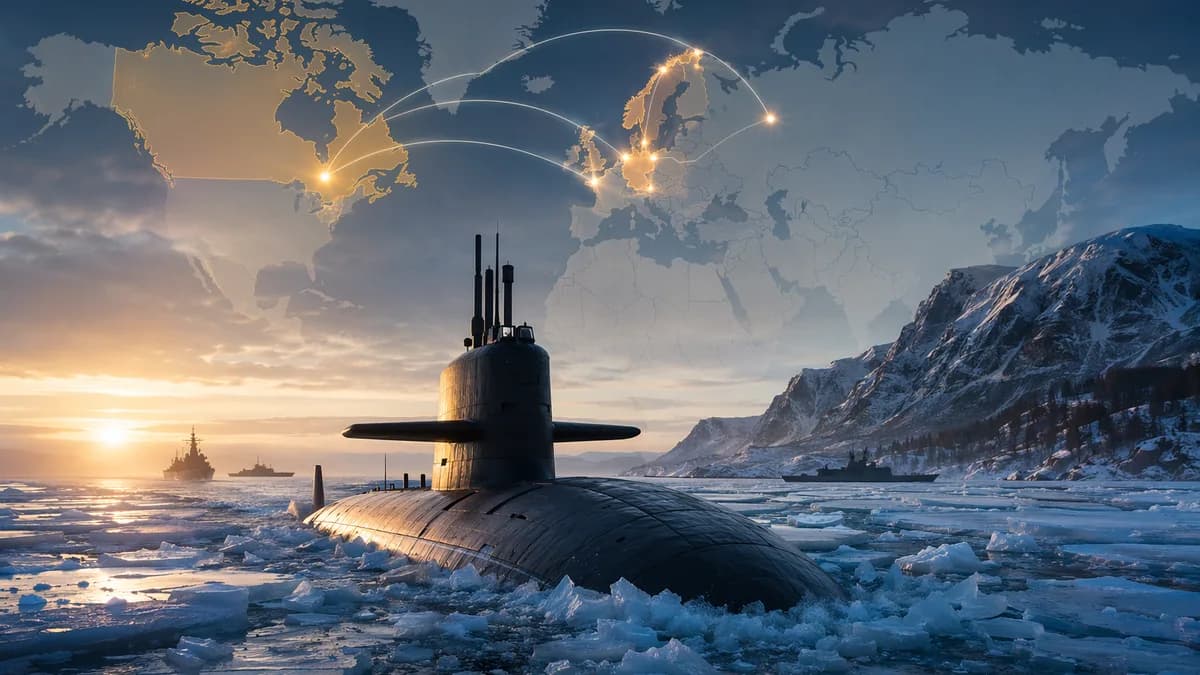
On Monday, Canada’s submarine deal shifted from procurement speculation to alliance signaling: Ottawa chose a German-Norwegian TKMS-led bid for 12 new submarines just as NATO allies prepare to judge whether Canada’s defence promises are turning into deployable capability.
XOOMAR Intelligence
Analyst Take
Prime minister Mark Carney announced the selection before a crucial NATO summit this week, with ThyssenKrupp Marine Systems beating South Korea’s Hanwha Ocean after months of lobbying, industrial promises, and competing claims about Arctic performance, according to Guardian World. The decision does more than replace worn-out boats. It ties Canada’s next undersea fleet to NATO’s northern defence architecture.
The sharper read: Canada is buying credibility in the Arctic, the North Atlantic, and the alliance politics around both. Submarines are not flashy campaign props. They are hard-to-see instruments of sovereignty, surveillance, and deterrence. That is exactly why this contract matters.
Monday’s Canada submarine deal turns Arctic defence into a NATO test
Canada has selected a German-Norwegian consortium led by TKMS to build 12 advanced diesel-electric submarines, a move that deepens Ottawa’s NATO ties before Carney heads into a summit where allies are expected to bring more than spending promises.
The timing is the tell. NATO secretary general Mark Rutte said Monday that alliance members were about to announce billions in new contracts, calling it the “crucial kit we need to deter and defend.” Canada now arrives with a procurement decision attached to one of its most exposed strategic problems: the ability to monitor its northern approaches and Arctic routes.
Submarines matter here because the mission is quiet by design. A surface ship can show presence. A submarine can watch without announcing itself. The Guardian reports that the TKMS vessels are designed with modern stealth technology for contested areas and can conduct lengthy surveillance missions in key Arctic routes, including the Northwest Passage.
That makes this less about naval prestige and more about operational credibility. Canada’s Arctic sovereignty claims need patrol capacity. NATO’s northern defence posture needs interoperable undersea assets. Ottawa’s own navy needs boats that are not trapped in maintenance cycles.
The connection to broader alliance pressure is hard to miss. As we reported in Zelensky’s NATO air defence fight, NATO summits increasingly force members to turn security rhetoric into procurement choices. Canada’s submarine decision fits that pattern.
The 12-boat TKMS choice starts negotiations, not delivery
The core decision is clear: TKMS won the bidding war against Hanwha Ocean, whose KSS-III Batch-II submarine had also been judged suitable for Canada’s military needs. Canada is now moving toward the 212CD model sub from TKMS.
But this is not a signed final contract. The Guardian reports that Canada’s federal government and TKMS still must negotiate the contract, a process that could take years. CBC News similarly described the decision as the selection of a preferred bidder, with negotiations still ahead.
That distinction matters. In major defence procurement, the political announcement is the opening gate, not the finish line. Cost discipline, delivery schedules, industrial offsets, Canadian modifications, training systems, sustainment terms, and parliamentary scrutiny can all reshape the final deal.
Canada’s current fleet explains the urgency. The Royal Canadian Navy has four Victoria-class submarines, bought secondhand from Britain in 1998. Of those four, three are undergoing maintenance, according to the Guardian. A navy cannot sustain meaningful undersea coverage when most of its submarine fleet is unavailable.
A 12-submarine fleet changes the math. It gives Canada a chance to rotate boats through patrols, training, repair, and modernization without reducing the operational fleet to a token presence. It also supports coverage across both the Atlantic and Pacific approaches, with the Arctic sitting above both as the strategic prize.
Still, hull count alone does not equal readiness. Canada has to crew, arm, maintain, base, and upgrade these vessels for decades. The Canada submarine deal will succeed only if Ottawa treats those less visible pieces as part of the acquisition, not as budget problems to solve later.
The numbers show why Canada’s submarine gap is a readiness problem
The headline figure is 12 submarines, but the more revealing comparison is between planned capacity and real availability.
| Measure | Current position | Planned direction |
|---|---|---|
| Submarine fleet size | 4 Victoria-class submarines | 12 new TKMS submarines |
| Availability snapshot | 3 of 4 undergoing maintenance | Intended to support rotation across patrol, training, and sustainment |
| Origin | Bought secondhand from Britain in 1998 | First brand-new submarines bought by Canada |
| Strategic focus | Limited by age and maintenance burden | Arctic routes, NATO interoperability, contested-area surveillance |
The contract scale is equally stark. The Guardian reports that the submarine order itself is estimated at more than US$12bn (£9bn), while the broader package, including roughly half a century of maintenance, could exceed US$70bn. CBC cites estimates that acquisition could run to $24 billion, with lifetime maintenance and support over three decades potentially reaching upward of $100 billion.
Those numbers are not automatically contradictory. Defence projects often produce different totals depending on whether they include acquisition only, long-term sustainment, infrastructure, weapons, training, and support. For taxpayers, the lifetime number is the one that matters.
Cost drivers are obvious from the mission. Arctic-capable submarines need advanced sensors, combat systems, stealth features, weapons integration, under-ice endurance, training infrastructure, maintenance facilities, and design adjustments for Canadian use. Every one of those layers adds money and schedule risk.
Canada is also under NATO spending pressure. The Guardian reports that Carney’s Liberal party has pledged to allocate 5% of gross domestic product by 2035, and that Canada recently announced it had hit 2% of GDP, the longstanding NATO target. The submarine purchase gives Ottawa a concrete capability to point to, rather than just a budget line.
Why TKMS beat Hanwha before the NATO summit
TKMS appears to have won on more than the boat. It won on alliance fit.
The Guardian identifies TKMS as the largest manufacturer of non-nuclear submarines and a key supplier of NATO’s fleet. German officials repeatedly emphasized broader compatibility with NATO. Related reporting also says the German-Norwegian arrangement could integrate Canada into a shared framework with Germany and Norway, including logistics, sustainment, training, and modernization pathways.
Hanwha’s case was serious. Its KSS-III Batch-II submarine is substantially larger than the German model, and the company and industry analysts said it would have given Canada more ability to deploy powerful weapons and conduct lengthy deep-ocean patrols. Hanwha also campaigned hard in Canada, including a wide-ranging ad campaign with a voiceover from Peter Mansbridge, and promised to use steel from Algoma’s plant in Sault Ste Marie, Ontario, to build armoured weaponized military vehicles in Canada.
The choice suggests Ottawa valued alliance architecture as much as raw platform ambition.
That is a rational call if Canada sees submarines as part of a broader NATO operating network in the North Atlantic and High North. Common training, parts, sustainment, and doctrine can matter as much as displacement or missile capacity. A submarine that fits into allied systems may offer more usable value than a larger platform that requires more bespoke support.
This is also consistent with Canada’s wider turn toward non-US defence suppliers. The Guardian notes that Ottawa has suggested it is open to larger purchases from European contractors as part of a push to lessen reliance on the US, even while Canada has already committed to buying 18 American-made Lockheed Martin F-35 Lightning II jets.
From 1998 secondhand British subs to a purpose-built Arctic fleet
Canada’s submarine history hangs over this decision. The country’s current undersea fleet was not purpose-built for Canada’s future Arctic problem. It was bought secondhand from Britain in 1998, then stretched through years of maintenance challenges and limited availability.
The new approach is different. Canada is not looking for bargain platforms near the end of their useful life. It is pursuing a purpose-built fleet tied to long-term requirements: Arctic access, stealth, surveillance, and alliance integration.
The Guardian reports that the new vessels will probably help give Canada a stronger foothold in the Arctic, with the ability to operate in contested areas with minimal detection and conduct lengthy surveillance missions in key Arctic routes. Related analysis from the NATO Association of Canada argues that the Type 212CD is suited for Arctic operations because of its air-independent propulsion and ability to operate under ice.
That does not erase execution risk. The political lesson from the Victoria-class experience is brutal: the purchase price is only the first test. Sustainment determines whether a fleet exists on paper or at sea.
Canada will need shipyard capacity, trained technicians, spare parts, weapons stocks, crew pipelines, and modernization budgets. It also needs an operating concept that explains where these submarines will patrol, how they integrate with surface ships and aircraft, and how they support NATO without leaving Canadian waters under-covered.
Canada’s security posture is also broader than ships. The same state-capacity question appears in cyber, as shown by CSE Cyber Operations Strike Fentanyl, Ransomware Targets. Hardware matters, but institutions decide whether capability becomes action.
Ottawa’s next test: sell the bill, build the fleet, train the crews
Ottawa will pitch this as sovereignty plus alliance credibility. That is the strongest political framing available. A 12-boat submarine fleet gives Carney something concrete to show NATO allies, especially after pledging major defence spending increases.
NATO allies will judge the deal by delivery, not announcement. If Canada signs a contract, funds sustainment, and brings submarines into service before the Victoria-class fleet fades out, the procurement will mark a real shift. If negotiations drag for years, the Monday announcement will look like another Canadian defence promise stuck between ambition and process.
TKMS and its Norwegian partners gain a major export win, but they also inherit a difficult client environment. Canadian defence procurement is politically exposed. Every schedule slip, cost increase, and industrial workshare dispute will become ammunition for critics.
Taxpayers and opposition parties will focus on the largest numbers: more than US$12bn (£9bn) for the order itself, and a possible total above US$70bn when maintenance is included, according to the Guardian. They will also ask whether submarines should outrank other needs inside the Canadian Armed Forces.
The navy’s concern is more practical. It needs more than hulls. It needs recruitment, retention, training capacity, dockyard infrastructure, weapons supply, and enough maintenance depth to avoid repeating the Victoria-class cycle.
Defence analyst Dave Perry, president of the Canadian Global Affairs Institute, framed the decision as a major capability step in comments reported by CBC News:
"The selection today of TKMS as the preferred bidder is a huge step forward to acquire Canadian naval capability," said Perry. "It will give Canada a right sized fleet of modern submarines for the first time in generations."
That is the optimistic case. The skeptical case is that Canada has bought into a generational project before proving it can manage the full lifecycle.
The 2030s deadline will decide whether this resets Canada’s undersea credibility
The Canada submarine deal now moves into its most dangerous phase: negotiations.
The near-term pressure points are clear. Ottawa must lock down price, delivery schedule, domestic industrial benefits, training terms, sustainment rights, and Canadian-specific modifications. It must also explain how the new fleet arrives before the existing Victoria-class submarines become strategically irrelevant.
CBC reported that the Germans said they can have four submarines to Canada by 2036, just as the Canadian navy plans to fully retire the Victoria-class submarines by the early 2030s. Another related source says Germany had proposed an accelerated delivery arrangement for four Type 212CD submarines, including temporary reallocation from German and Norwegian production sequences. Those details will matter once negotiations begin.
For industry, the message is blunt. Canada is likely to favor bids that combine capability with alliance integration, not just the lowest sticker price or fastest build claim. NATO compatibility, sustainment pathways, and political alignment now carry procurement weight.
For Arctic security, submarines are only one layer. To make the purchase operationally meaningful, Canada will likely need stronger Arctic basing, surveillance, undersea sensing, maintenance access, and NATO coordination. That is XOOMAR analysis, but it follows directly from the mission set described in the source material: long-duration surveillance, contested-area stealth, and patrols across key Arctic routes.
The deal can reset Canada’s undersea credibility. The evidence that would confirm that thesis is a signed contract, protected delivery schedule, funded sustainment plan, trained crews, and early infrastructure work on both coasts. The evidence that would weaken it is familiar: years of negotiation drift, shrinking scope, unclear workshare, and a widening gap between the old fleet’s retirement and the new fleet’s arrival.
Impact Analysis
- Canada’s selection signals to NATO allies that its defence pledges are moving toward deployable capability.
- The 12-submarine plan strengthens Canada’s ability to monitor Arctic routes and northern approaches.
- The deal ties Canada’s future undersea fleet more closely to NATO’s North Atlantic and Arctic defence architecture.
Canada Submarine Bid Outcome
| Bidder | Country/Partnership | Outcome | Key Context |
|---|---|---|---|
| TKMS-led consortium | German-Norwegian | Selected | Chosen to build 12 advanced diesel-electric submarines and deepen Canada’s NATO northern defence ties |
| Hanwha Ocean | South Korean | Not selected | Competed after months of lobbying, industrial promises, and claims about Arctic performance |
Primary Sources & Disclosures

Written by
XOOMAR Insights Team
Research and Editorial Desk
The XOOMAR Insights Team pairs automated research with human editorial judgment. We track hundreds of sources across technology, fintech, trading, SaaS, and cybersecurity, cross-check the facts, and explain what happened, why it matters, and what to watch next. We do not just rewrite headlines. Every article is fact-checked and scored for reliability before it goes live, and we link back to the original sources so you can verify anything yourself.