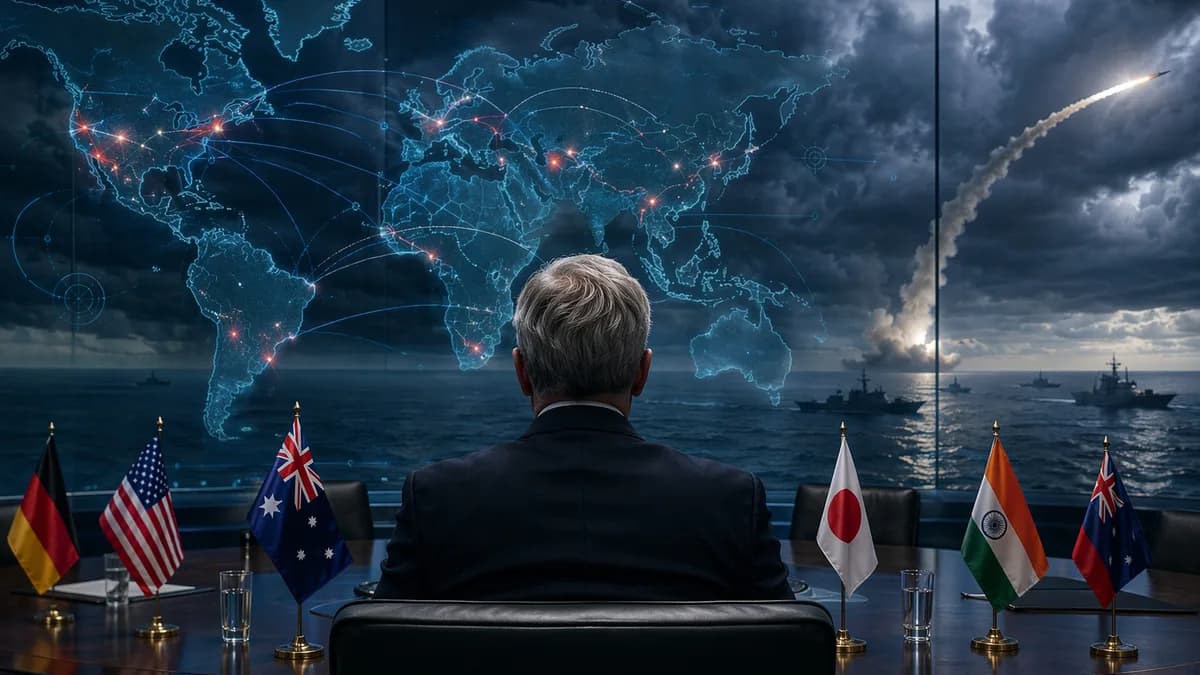
Penny Wong will personally raise the China Pacific missile test with Chinese counterparts after Australia told Beijing through diplomatic channels that the South Pacific launch was destabilising, according to Guardian World.
XOOMAR Intelligence
Analyst Take
The foreign affairs minister told the ABC on Monday evening that Australia had already made clear its displeasure over Monday’s long-range missile test and would keep doing so. Her warning was blunt: military signalling in a contested region can trigger mistakes.
“We have consistently made those representations and will continue to do so … because we do want the Pacific to be an ocean of peace. …
In an era where we see contest and competition, the destabilising acts can lead to miscalculation, can lead where we do not want these actions to lead.
You should anticipate that in my next engagements, those points will be something we will discuss.”
Why is Wong taking the China Pacific missile test directly to Beijing?
Wong’s comments move the dispute from diplomatic complaint to minister-level pressure. Australia has already used diplomatic channels, but Wong said the issue will also be raised personally in her next official engagements with Chinese counterparts.
That matters because the launch was not treated by Canberra as routine military activity, even though Beijing framed it that way. SBS reported that Chinese state media Xinhua described the test as part of China’s annual military exercise, said relevant countries had been alerted in advance, and said the launch was not aimed at any country or target.
China said the missile carried a dummy warhead and landed in a predetermined sea area. The sources do not identify the exact landing location.
Wong’s framing was narrower and sharper. She tied the test to what she called a “rapid military buildup” by China and said the region expects more transparency and reassurance about intent.
Analysis: The immediate dispute is not only about one missile. It is about whether prior notice is enough to make a strategic weapons test acceptable in the South Pacific. Australia’s answer, based on Wong’s comments, is no.
For XOOMAR’s earlier regional-security context on this same pressure point, read China Missile Test Rattles Australia's Pacific Shield.
Why does Canberra keep calling the Pacific an “ocean of peace”?
Wong repeatedly used the phrase “ocean of peace” to describe the standard Australia wants applied to the Pacific. The phrase also appears in regional reactions cited by SBS and other reporting, including New Zealand’s criticism of the launch.
The point is political as much as military. If China can describe a nuclear-capable missile test into the Pacific as routine, Australia and New Zealand are trying to stop that language from settling in uncontested.
New Zealand foreign minister Winston Peters said the launch was “unwelcome and concerning” and said New Zealand had no interest in China using the South Pacific as a testing site for missile capability. He also said the test appeared to have been carried out within hours of informing New Zealand.
Japan also objected after being notified. Tokyo said it had expressed “grave concern” over increased Chinese military activity and urged China to reconsider the launch.
| Government | Stated position from supplied reporting |
|---|---|
| Australia | Called the test destabilising and inconsistent with a peaceful Pacific |
| China | Called it routine annual military training, not aimed at any country or target |
| New Zealand | Called it unwelcome and concerning, and objected to the South Pacific being used for missile testing |
| Japan | Expressed grave concern and urged China to reconsider |
The launch also came on the same day Australia and Fiji signed a defence alliance. The supplied reporting says Defence Minister Richard Marles did not believe the test was designed as retaliation for that treaty.
That distinction matters. Australia is not publicly claiming the launch was a direct answer to the Fiji pact. It is saying the test raises broader regional security concerns on its own terms.
How much does Beijing’s “routine” defence answer?
China’s position is clear from the supplied reporting: the test complied with international law and international practice, relevant countries were notified, and the launch was not directed at any specific country or target.
Chinese foreign ministry spokeswoman Mao Ning urged “relevant countries” not to overinterpret the matter. That is the diplomatic shield Beijing is using.
Australia’s counterargument is also clear. Advance notice does not erase the destabilising effect of a long-range missile test in a region whose leaders have repeatedly invoked peace as a strategic goal.
Analysis: This is where the practical risk sits. If one side sees the launch as standard military training and the other sees it as destabilising strategic signalling, both can claim consistency while still moving further apart.
That is why Wong’s phrase “miscalculation” carries weight. She is not saying the test caused a crisis. She is saying this category of action can create the conditions for one.
For broader XOOMAR coverage of how Beijing presents state priorities, see China Ethnic Unity Law Turns Minority Identity into a Test.
What will Wong’s next talks with China actually test?
The next step is not mysterious. Wong said the missile test will be raised in her next engagements with Chinese officials.
The harder question is whether China gives Australia anything beyond the existing explanation: routine training, advance notification, no target. If Beijing repeats that line, Canberra will have to decide how often to escalate objections when similar activity occurs.
Pacific governments are the other audience to watch. New Zealand has already criticised the launch. Japan has objected. The supplied reporting does not establish how other Pacific governments will respond, and that gap matters because regional pressure will carry more weight if it is broad rather than bilateral.
Practical watch items:
- Chinese response: Whether Beijing sticks to “routine arrangement” language or offers more detail about notification and intent.
- Pacific reaction: Whether more governments publicly object to missile testing in the South Pacific.
- Australian messaging: Whether Wong’s next talks produce a public readout, or whether the dispute stays inside diplomatic channels.
- Defence context: Whether the Australia-Fiji alliance remains a separate track, as Marles suggested, or becomes part of the wider argument over Pacific security.
The question that won’t be answered quickly is whether Monday’s launch becomes an exception or a template. If China treats such tests as normal military practice and Australia treats them as destabilising, Wong’s next conversation with Beijing will be less about one missile than about who gets to set the rules for strategic signalling in the Pacific.
Impact Analysis
- Australia is escalating its response by taking the issue directly to Chinese counterparts.
- The missile test adds tension in a contested Pacific region where military signalling can increase risk.
- China’s explanation and Australia’s warning show a widening gap over what counts as destabilising activity.
Australia and China on the Pacific Missile Test
| Australia's Position | China's Position |
|---|---|
| Called the launch a destabilising act that could lead to miscalculation. | Described the test as part of an annual military exercise. |
| Raised objections through diplomatic channels and plans minister-level discussions. | Said relevant countries were alerted in advance. |
| Wants the Pacific to remain an “ocean of peace.” | Said the missile carried a dummy warhead and was not aimed at any country or target. |
Primary Sources & Disclosures

Written by
XOOMAR Insights Team
Research and Editorial Desk
The XOOMAR Insights Team pairs automated research with human editorial judgment. We track hundreds of sources across technology, fintech, trading, SaaS, and cybersecurity, cross-check the facts, and explain what happened, why it matters, and what to watch next. We do not just rewrite headlines. Every article is fact-checked and scored for reliability before it goes live, and we link back to the original sources so you can verify anything yourself.