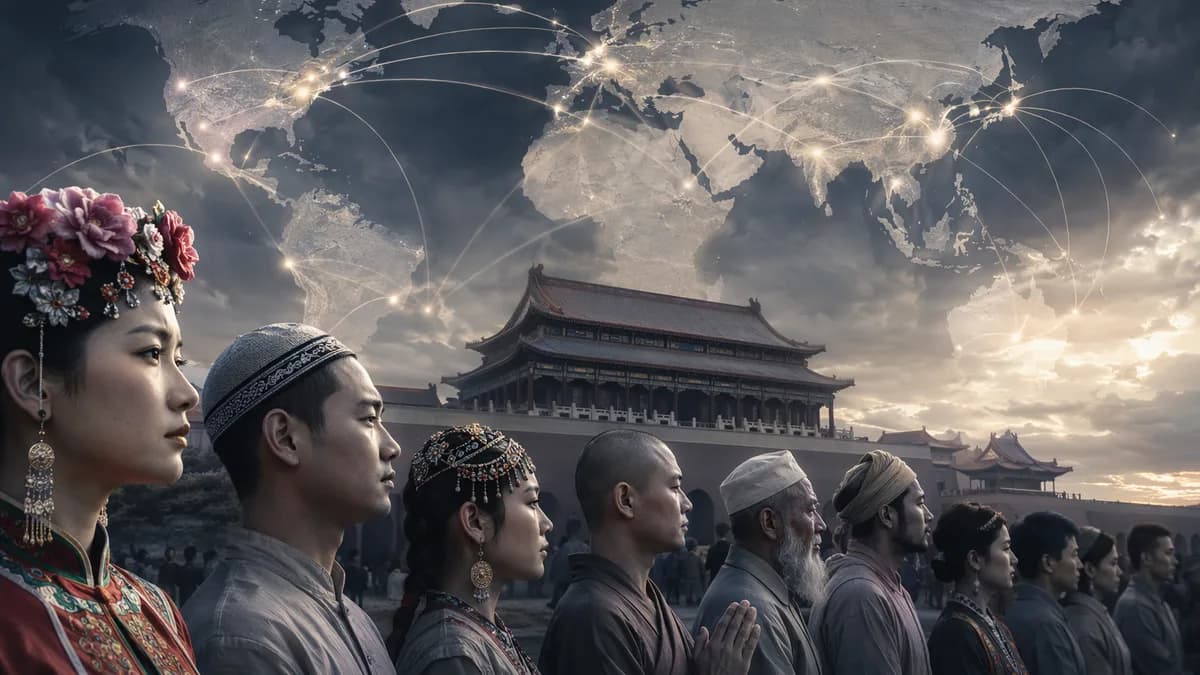
China’s ethnic unity law is now in force, and its sharpest edge falls on people whose language, religion, family history, or political speech can be judged against Beijing’s definition of national unity.
XOOMAR Intelligence
Analyst Take
The Law on Promoting Ethnic Unity and Progress took effect on 1 July 2026, despite warnings from Taiwan, the United Nations, and rights groups that it could further restrict minorities such as Uyghurs and Tibetans, according to Guardian World. This isn’t a trade dispute, and it sits apart from XOOMAR’s separate China-policy coverage of EU Steel Quota Slams China While UK Wins Softer Blow, €360B China Gap Forces EU Steel, E-Commerce Crackdown, and China’s Pacific missile test. The lever here is identity, language, and legal reach.
Why could China’s new ethnic unity law reshape daily life for Uyghurs, Tibetans, and other minorities?
The practical stakes are clear: the China ethnic unity law gives Beijing a wider legal framework to press a single national identity across schools, public spaces, local governance, religious life, media, and civic expression.
The law’s stated purpose is to build a “shared” national identity among ethnic groups. One major tool is strengthening Mandarin as the official language. Supporters describe that as social cohesion. Critics call it forced assimilation with a legal wrapper.
Rights groups see the measure as an escalation because China already faces sustained accusations over its treatment of minorities. In Xinjiang, human rights groups have documented mass detention of Uyghur Muslims in facilities Beijing calls “re-education” camps, while the UN has accused China of grave human rights violations, according to the BBC source material. Beijing denies abuses and says ethnic groups benefit from internal security and economic development policies.
The new concern is not only domestic. Critics point to a clause saying people can be held liable for violating the law even outside China. That matters to diaspora activists, academics, journalists, students, and relatives of detainees who speak publicly about Xinjiang or Tibet.
“Chinese authorities have human rights obligations requiring them to protect minority communities and their cultures, but this law does the opposite,” Amnesty International’s Sarah Brooks said.
What does China’s Law on Promoting Ethnic Unity and Progress require?
The law aims to promote unity among China’s 56 officially recognized ethnic groups, under the leadership and political framework of the Chinese Communist party. In official language, that means strengthening the “Chinese nation” and preventing ethnic division.
For critics, the danger sits in the breadth of the terms. Amnesty said the law prohibits acts that “undermine ethnic unity or create ethnic division,” but warned those phrases are broad and undefined. That gives authorities room to treat cultural, linguistic, religious, or political expression as disloyal.
The tools critics are watching
- Language: Mandarin gets stronger legal status in education, official business, and public spaces.
- Education: Schools are expected to reinforce national identity and patriotic messaging.
- Politics: The law demands alignment with the CCP’s concept of unity.
- Security: Provisions address terrorism, separatism, and social cohesion.
- Overseas reach: Officials have defended applying parts of the law beyond China’s borders.
Human Rights Watch said the draft version created a broad framework that could justify existing repression and force assimilation of minorities. Amnesty went further, saying the law puts a national framework behind policies that have “already devastated” the rights of Uyghurs, Tibetans, and other non-Han groups.
How could Mandarin language rules affect minority cultures in Xinjiang and Tibet?
Language is the pressure point because it shapes childhood before politics becomes visible.
Mandarin fluency can improve access to universities, state services, and jobs. Beijing uses that argument to defend Mandarin education. But in minority regions, the trade-off is sharper: when Mandarin becomes the default language of instruction, Uyghur, Tibetan, Mongolian, and other local languages can be pushed into secondary or symbolic roles.
The BBC source material says the law mandates that all children should be taught Mandarin before kindergarten and through high school. Previously, students could study much of the curriculum in native languages such as Tibetan, Uyghur, or Mongolian.
That matters because schools do more than teach vocabulary. They pass down local history, literature, religious memory, family identity, and community authority. If the language of public life changes, the culture carried by that language loses ground.
Not every minority group faces the same pressure. But Xinjiang and Tibet draw the sharpest scrutiny because they have long been governed through heavy state security campaigns. The China ethnic unity law adds a national statute to practices already visible in those regions.
How might the ethnic unity law expand Beijing’s power over dissent beyond China’s borders?
The law’s overseas clause is one of the most politically sensitive parts. Critics fear it gives Beijing another legal tool to pursue people who challenge its ethnic policy from abroad.
Taiwan’s foreign ministry said on the day the law took effect that it “expanded threats and intimidation against the people of our country and other nations.”
“In the future, individuals from any country whose words or actions are not acceptable to China may become targets of the law or be pursued under it,” Taiwan’s foreign ministry said.
Nine US lawmakers, including the top Republican and top Democrat on the Senate foreign relations committee, also objected. They said they were “deeply concerned” by language requiring ideological compliance with the CCP and allowing people outside China to be held legally responsible if Beijing deems them to be undermining ethnic unity and progress.
China’s official defense is narrower. Vice-minister of justice Hu Weilie said the law would target “illegal acts” that “undermine ethnic unity and progress or incite ethnic separatism.” He also called the overseas enforcement clause “legitimate, lawful [and] necessary.”
The gap between those views is the core issue. Beijing frames the law as a shield against separatism and instability. Critics see a sword aimed at speech, advocacy, and minority identity.
What does a Tibetan or Uyghur classroom reveal about the law’s real-world impact?
Consider a school in a minority region after the law takes effect. Mandarin becomes the main language of instruction. Patriotic education expands. Local history is taught through a national unity frame. A teacher may still mention local culture, but the safest version is one that supports the state’s definition of harmony.
That example is hypothetical, but the policy ingredients are not. The supplied source material says the law formalizes Mandarin promotion in education and public life. Human Rights Watch said the draft required preschool children to learn Mandarin and to “basically master” it by the end of compulsory education, typically around age 15.
For a parent, the trade-off is brutal. Mandarin can help a child move through exams, university, and employment. Yet the same policy can make the family’s home language feel less useful in public, less protected in school, and more vulnerable to suspicion if tied to religious or cultural identity.
Officials would defend the classroom as a path to opportunity, mobility, and integration across China. Rights groups would ask what happens when integration becomes mandatory conformity.
The answer won’t appear only in court rulings. It will show up in lesson plans, job requirements, public signage, religious practice, and what people decide not to say.
Why are Taiwan, UN experts, and rights groups warning about forced assimilation?
The strongest criticism is that the law places state-defined unity above rights to culture, language, religion, expression, and assembly.
UN rights chief Volker Turk called for the law to be repealed, warning that it risks “deepening restrictions on freedoms of language, education, practice of religion, culture, expression and assembly.”
Taiwan’s concern is sharpened by Beijing’s claim that Taiwan is part of its territory and its threat to use force to annex the self-ruled island. Taiwan’s Mainland Affairs Council said Taiwanese people already face high risks traveling to China and warned that Beijing now has “yet another law to fabricate charges.”
Amnesty’s Brooks put the critique bluntly:
“‘Unity’ in this context is not harmony between different communities — it is political and ideological alignment with the Chinese Communist Party.”
The forward watch is enforcement. If the China ethnic unity law is used narrowly against clearly defined violent acts, Beijing will claim vindication. If it is used against language advocacy, religious expression, overseas testimony, or criticism of Xinjiang and Tibet policy, the forced-assimilation charge will become harder for governments to treat as rhetorical.
Impact Analysis
- The law could expand Beijing’s legal authority over minority identity, language, religion, and political expression.
- Uyghurs, Tibetans, and other minorities may face stronger pressure to conform to a state-defined national identity.
- The measure adds to international concern over China’s human rights record, especially in Xinjiang.
China Ethnic Unity Law: Official Framing vs Rights Concerns
| Aspect | Beijing/Supporters | Critics/Rights Groups |
|---|---|---|
| Purpose | Build a shared national identity among ethnic groups | Create legal cover for forced assimilation |
| Language policy | Strengthen Mandarin as the official language for social cohesion | Undermine minority languages and cultural identity |
| Impact areas | Schools, public spaces, governance, media, and civic life | Greater control over religion, speech, family history, and minority expression |
Primary Sources & Disclosures

Written by
XOOMAR Insights Team
Research and Editorial Desk
The XOOMAR Insights Team pairs automated research with human editorial judgment. We track hundreds of sources across technology, fintech, trading, SaaS, and cybersecurity, cross-check the facts, and explain what happened, why it matters, and what to watch next. We do not just rewrite headlines. Every article is fact-checked and scored for reliability before it goes live, and we link back to the original sources so you can verify anything yourself.