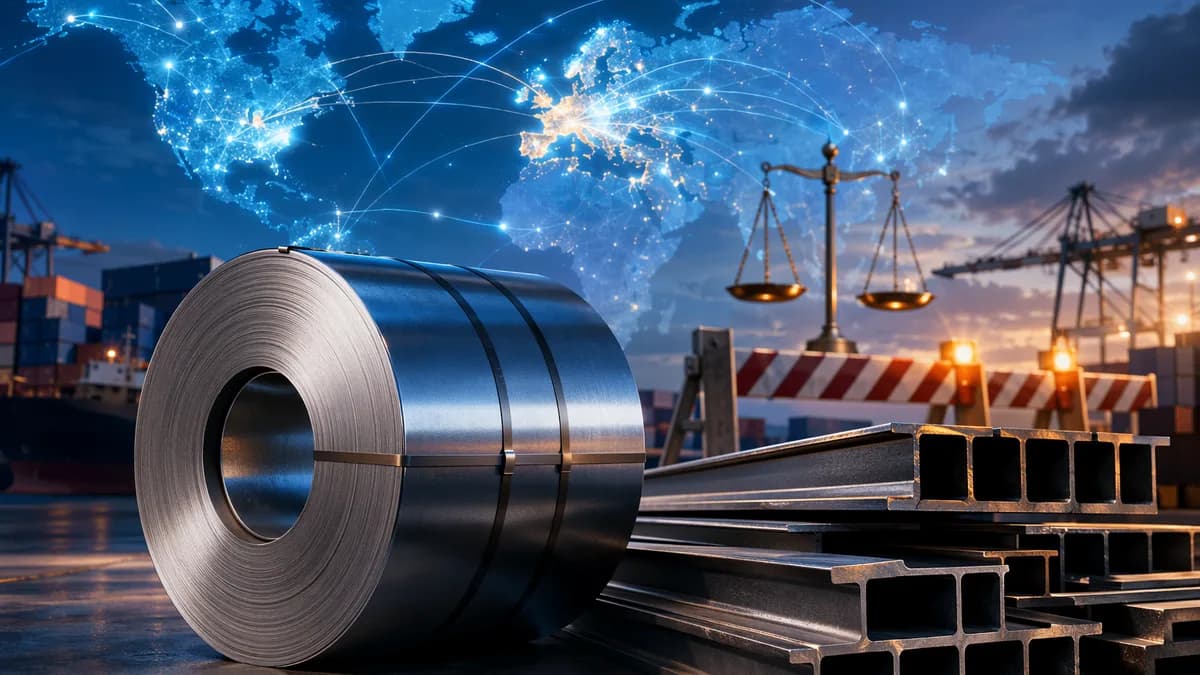
The EU steel quota cut is not a routine trade adjustment. Brussels is shrinking duty-free access by nearly half while giving 13 free trade agreement partners, including the UK, a softer landing than China and other non-preferred exporters.
XOOMAR Intelligence
Analyst Take
According to Guardian World, the EU has halved the amount of duty-free steel it will accept from abroad, but countries with free trade agreements with Brussels will see their quotas reduced by only about one-third. That split reveals the real policy: Europe is building a more selective steel market, one that punishes exposure to global overcapacity while rewarding trade partners it sees as more aligned.
This is defensive industrial policy with a diplomatic filter. The EU wants to slow cheap steel entering the bloc, especially metal linked to China’s global surplus, without detonating relations with countries whose supply chains remain tied to European manufacturers.
Brussels is using steel quotas to draw a new trade border around China
The European Union is trying to stop excess global steel from washing through its market after trade barriers elsewhere redirected metal toward Europe. The Guardian reports that the safeguards were designed to slow the use of Chinese products in European industries, particularly after trade was diverted from the US following Donald Trump’s “liberation day” tariffs launched in April 2025.
A senior EU official told the Guardian the bloc had been “forced” to act “not because we were copying the US but because overcapacity to our market”. The same official said that as the US “built the wall around their market”, steel was being diverted to the EU “in greater numbers”.
That is the core tension. Europe wants competitive steel inputs for manufacturers, construction firms and energy infrastructure. It also wants domestic mills to survive energy costs, decarbonisation pressure and weak demand.
Brussels has chosen managed access over open access.
“The commission is putting in place the practical arrangements needed to ensure that the EU’s steel measure operates effectively from day one,” said EU trade commissioner Maroš Šefčovič. “We are providing market participants with predictability through clear and transparent quota distribution rules.”
XOOMAR analysis: the quota design lets the EU send two messages at once. To steelmakers, it says protection is coming. To FTA partners, it says Brussels will preserve preferred access if they fit inside the EU’s trade architecture.
That is the same broad direction we flagged in €360B China Gap Forces EU Steel, E-Commerce Crackdown: Brussels is no longer treating China-linked industrial pressure as a narrow sector issue. It is turning trade access into an industrial filter.
The new EU steel quota numbers give FTA partners a clear advantage
The headline number is blunt: the EU announced plans to cut overall tariff-free steel imports from non-EU countries by 47% on 2024 levels from 1 July 2026 and double tariffs to 50% for imports outside those quotas.
The new EU steel quota system works through a tariff-rate quota. Steel inside the quota enters without the additional duty. Once the quota is used, extra volumes face the higher tariff. That changes pricing, shipment timing and bargaining power before a tonne even moves.
The Guardian reports that the UK government said it had secured a tariff-free quota of 2.14m tonnes out of the total 9.15m limit set under the new EU system. The rules cover 28 categories of product, from rolled steel used in automotive production to bars used in construction to reinforce concrete.
The preferred-country list matters because it creates a hierarchy.
| Supplier group | Quota treatment reported | Commercial effect |
|---|---|---|
| FTA partners including the UK | Historical trade cut by about one-third | Better relative access to EU buyers |
| Broader non-EU suppliers | Overall tariff-free access cut by 47% on 2024 levels | Tighter gate into the EU market |
| Out-of-quota exporters | Tariff doubled to 50% | Imports become materially harder to price |
The countries receiving better terms are the UK, Turkey, India, South Korea, Indonesia, Egypt, Brazil, Switzerland, North Macedonia, South Africa, Argentina, Ukraine and Singapore.
The quotas are linked to past trade, EU officials said. The reference period is 2022 to 2024. Allocations can be adjusted if shortages emerge in particular types of steel.
XOOMAR analysis: this is where the policy becomes more than protectionism. Brussels is not simply cutting imports. It is rationing access according to trade relationship quality, past flows and product category. That gives FTA partners a relative edge, even as they still lose volume.
Britain gets a steel trade reprieve, but it doesn’t remove post-Brexit friction
The UK is outside the EU single market, but it is not being treated like a generic third-country supplier. That distinction matters for British steel exporters because the EU remains central to the sector’s economics.
UK Steel director general Gareth Stace said the EU and UK were “interdependent”, with 70% of British steel ending up in the bloc. He said:
“Securing wider export access for certain high value steel products will be critical for the long-term viability and profitability of the UK steel sector.”
The better rate gives London something useful. It limits the damage relative to exporters without an FTA and preserves space for cross-Channel supply chains.
But it does not remove the friction. The Guardian reports that the new steel safeguards mark the biggest divergence in trade with the UK since Brexit in 2020. It also says they quash hopes that the EU and UK could forge a strategic “steel club” alliance under which they would give each other tariff-free trade and work together against China.
That is the uncomfortable part for Britain. It gets preferred treatment, but not equal treatment.
Tata Steel UK, Britain’s biggest producer, said its duty-free exports had been cut by 60%. Chief executive Rajesh Nair said the company needed time to analyse the impact.
“The overall reduction of 60% in guaranteed tariff-free EU quotas, combined with the recent UK steel import measures, is likely to have a significant impact on our UK business,” he said.
XOOMAR analysis: the UK outcome looks like a compromise, not a breakthrough. Brussels is willing to soften the blow for Britain as an FTA partner, but not enough to recreate single-market access through the back door.
That has implications beyond steel. Selective cooperation may still happen in strategic sectors, but only inside EU-designed rules. The UK can get a better lane. It cannot set the road.
Europe’s steel crackdown follows years of Chinese overcapacity and US tariff pressure
The EU’s move sits inside a wider steel glut. The added context supplied for this analysis cites OECD data, via EUROFER, putting global excess capacity at around 650 million tonnes, with China carrying an estimated surplus above 500 million tonnes. China’s steel exports hit a record 131 million tonnes in 2025, according to that same context.
Those numbers explain why Brussels sees the steel issue as structural rather than cyclical. Even when Chinese steel does not enter the EU directly, its exports can displace producers in other markets. Those producers then chase European buyers.
The Guardian’s source material makes the same point through the US channel. After US tariff barriers rose, steel that might have gone elsewhere was redirected toward the EU. Brussels saw itself becoming the pressure valve.
This is where the EU differs from the US. Washington’s approach, as described in the source, centered on building a wall around its market through tariffs. Brussels has leaned toward quotas and safeguards, partly because it still wants to manage imports rather than cut them off outright.
The result is a more bureaucratic form of protection. It is still protection.
This follows the pattern we described in Trump Turns USMCA Renewal Into a Trade Pressure Trap: major economies are using market access as bargaining power, not just as a neutral trade principle.
XOOMAR analysis: the old distinction between “free trade” and “protectionism” is becoming less useful. The EU steel quota is managed trade, with access calibrated by partner status, product category, history and strategic risk.
Steelmakers, carmakers and trading partners will read the quota cut very differently
European steel producers will see the new regime as overdue. Axel Eggert, director general of Eurofer, said the curbs paved the way “for restoring up to 15m tonnes of lost European steel production”.
That is the upstream case. If cheap imports are capped, domestic mills can run at higher volumes, defend margins and justify investment.
Steel buyers will see the same rules differently. The product categories include rolled steel for the automotive industry and construction bars used to reinforce concrete. If quotas fill quickly or certain grades become scarce, buyers face fewer low-cost options.
The source material does not provide price forecasts, so none should be assumed. But the mechanism is clear: when tariff-free access shrinks and out-of-quota duties rise to 50%, procurement teams have to think differently about timing, supplier location and contract exposure.
Stakeholder readout:
- EU mills: More protection against import pressure and a stronger case for restarting or preserving capacity.
- UK exporters: Better treatment than non-FTA suppliers, but still meaningful cuts for some producers.
- Downstream buyers: More risk around cost, availability and quota exhaustion.
- FTA partners: Relative advantage, paired with concern that Brussels is normalising tighter access.
- China and non-preferred exporters: A narrower route into Europe’s steel market.
The China angle is politically sensitive. A senior EU official told the Guardian the measure was not simply about copying the US. But the policy’s practical effect is to reduce the ability of excess global steel, heavily shaped by Chinese capacity, to enter the EU market.
That distinction may matter legally and diplomatically. It may matter less commercially.
Higher steel barriers could reshape prices, supply chains and green industry plans
Companies that buy steel now have a practical problem. The EU steel quota is not just a Brussels headline. It affects contract planning, shipment timing and supplier risk.
A firm sourcing from an FTA partner may still have access, but less than before. A firm sourcing from a non-preferred exporter faces a tighter cap. A firm importing above quota faces a 50% duty.
That creates an incentive to move early, lock in allocation and diversify supply. It may also push more buyers toward EU mills where available.
The green transition complicates the trade-off. European steelmakers are under pressure to decarbonise, and lower-carbon production often needs large upfront investment. Protection from cheaper imports can help defend the cash flows and utilisation rates needed to finance that shift.
But shielding upstream producers has a cost. Steel is a core input for cars, construction, machinery and energy infrastructure. If protection raises input costs or narrows supply too much, downstream manufacturers absorb the pressure.
XOOMAR analysis: Brussels is betting that preserving steelmaking capacity is worth the risk of tighter input markets. That bet only works if domestic supply can meet enough demand, in the right grades, without pushing steel-using industries into a weaker competitive position.
The safeguard contains some flexibility. The Guardian reports that allocations can be adjusted if shortages emerge in particular types of steel. That clause may become critical if buyers start warning of supply gaps.
The next fight will be over whether EU steel protection becomes permanent
The next battle will not be over whether Brussels has turned more defensive on steel. It has. The fight will be over how far the system hardens.
European steel producers are likely to keep pressing for stronger and longer-lasting protection if Chinese exports stay high or demand remains weak. Buyers will push the other way if quotas fill quickly or specific product categories tighten.
Affected exporters have their own incentives. They can seek better country allocations, lobby through trade talks or test the rules through diplomatic channels. The Guardian reports that EU officials still hope to set up a steel club with the US and UK to ringfence domestic markets from rivals who do not play by the rules.
That ambition sits awkwardly beside the latest decision. The new rules reduce hopes of a near-term EU-UK tariff-free steel alliance, but they also show the shape of a possible future club: aligned partners get better access, outsiders face harder limits.
The evidence to watch is concrete.
- Quota usage: Do preferred-country quotas fill early?
- Shortages: Do particular steel categories require adjustment?
- UK talks: Does Britain win wider access in later negotiations?
- Downstream pressure: Do carmakers, builders and machinery firms push back?
- China exposure: Does redirected steel keep targeting Europe despite the cap?
XOOMAR view: Brussels is unlikely to reverse course soon. The EU is building a steel trade system that rewards aligned partners and makes market access harder for rivals it sees as distorting global industry. The policy will be judged by whether it revives European steel production without making the rest of European industry pay too much for the shield.
Impact Analysis
- The EU is reshaping steel access to protect domestic producers from global overcapacity.
- The UK and other FTA partners get preferential treatment, reducing the trade shock.
- The move signals a more selective European trade policy aimed partly at limiting China-linked steel flows.
EU Steel Quota Treatment
| Exporter group | Quota impact | Policy signal |
|---|---|---|
| 13 free trade agreement partners, including the UK | Quotas reduced by about one-third | Softer treatment for aligned trade partners |
| China and other non-preferred exporters | Duty-free access cut by nearly half | Tougher stance on global steel overcapacity |
EU Duty-Free Steel Quota Reductions
Primary Sources & Disclosures

Written by
XOOMAR Insights Team
Research and Editorial Desk
The XOOMAR Insights Team pairs automated research with human editorial judgment. We track hundreds of sources across technology, fintech, trading, SaaS, and cybersecurity, cross-check the facts, and explain what happened, why it matters, and what to watch next. We do not just rewrite headlines. Every article is fact-checked and scored for reliability before it goes live, and we link back to the original sources so you can verify anything yourself.