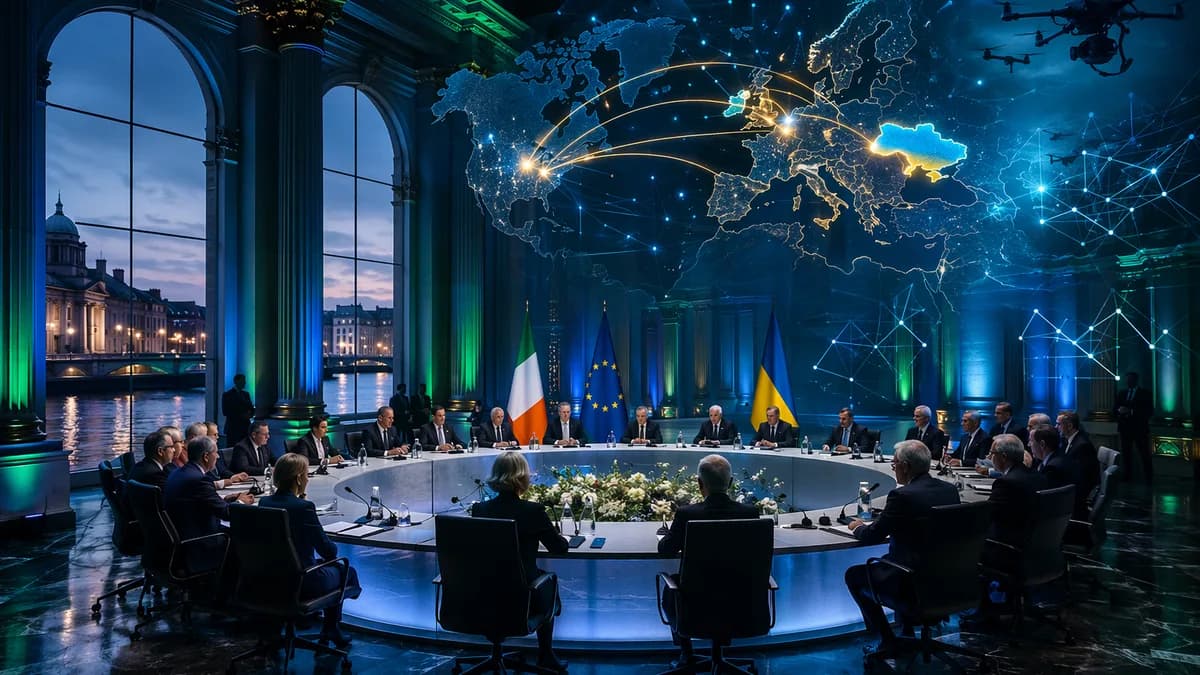
Ireland’s EU presidency began with Volodymyr Zelenskyy in Dublin, which turns a rotating Council role into an immediate test of whether a small member state can keep Europe aligned on Ukraine, Russia sanctions, enlargement and money.
XOOMAR Intelligence
Analyst Take
Ireland took over the six-month presidency from Cyprus at a formal ceremony in Dublin Castle, with Zelenskyy using the moment to press for tougher pressure on Moscow and faster movement on Ukraine’s EU path, according to Guardian World. Ireland will hand the role to Lithuania on 1 January 2027, after what is likely to be a crowded and politically expensive agenda.
Zelenskyy made the Ireland EU presidency a Ukraine test on day one
Zelenskyy’s presence gave the Ireland EU presidency a clear opening message: Dublin may be chairing the room, but Ukraine will be one of the first files testing its authority.
He praised Ireland’s incoming role, then pushed the bloc toward concrete deliverables.
“When we face many other challenges both in international affairs and at the national level across Europe, the EU has an opportunity and a responsibility to be a force that brings more stability, more productivity, and basic respect for human life, the kind of life everyone wants for themselves, their children, and their families.”
His asks were specific. He said he hoped Ireland could help the EU “make real progress on the drone deal that Ukraine has proposed,” support “every step that makes it harder for Russia to continue [this] war,” tighten rules on EU companies that still do business with Russia, and open more accession clusters between Ukraine and the EU.
That puts Dublin in a difficult but useful position. The Council presidency does not let Ireland dictate EU policy. It does let Ireland set rhythms, frame compromises, manage sequencing and decide which files get political oxygen. In EU politics, that can matter.
The tension is obvious. Taoiseach Micheál Martin has said supporting Ukraine will be “an important priority for us during our term.” Ireland still has to act as honest broker for all 27 member states. Neutral process will not mean neutral priorities.
Sanctions and accession clusters put Dublin’s broker role under pressure
The first hard file is Russia sanctions. The supplied source material says Ireland faces early pressure to secure unanimous agreement on a fresh round of economic sanctions targeting Russia. Zelenskyy’s Dublin remarks sharpened that pressure by calling for further restrictions on EU companies still operating with Russia.
This is where Ireland’s presidency becomes less ceremonial and more surgical. Sanctions require alignment across capitals. The presidency’s job is to find wording, carve-outs, enforcement language and timing that enough governments can accept. Ireland cannot force unanimity. It can make failure harder by keeping the file moving and narrowing the list of objections.
Ukraine’s accession track creates a different problem. Zelenskyy wants more clusters opened in Ukraine’s EU negotiations.
“Steps like opening new clusters strengthen the motivation of our people, lift the spirit of Ukrainians and show that the EU keeps its promises . It is so important to keep promises and that is exactly how it should be,” he said.
That quote captures the credibility test. Wartime political commitments are now colliding with EU procedure. Opening clusters signals momentum. It does not settle the harder questions around timing, institutional readiness or funding.
Moldova is also named in the presidency’s accession workload. That matters because enlargement is not just a Ukraine file. It is a wider test of whether the EU can keep strategic promises without breaking its own decision-making machinery.
For readers following XOOMAR’s wider Russia file, separate coverage such as Russia Fuel Shortages Fail to Crack Putin's War Bet and Russian Signal Phishing Hijacks VIP Accounts in Support Scam sits outside the factual basis of this presidency report. The supported point here is narrower: Dublin’s EU term opens with sanctions pressure and Ukraine accession momentum at the center of the agenda.
The budget fight is already visible: farms, cohesion, competitiveness and research
The presidency will also have to manage the EU’s next long-term budget argument. The source material does not provide the size of that budget, so the useful data here is political rather than fiscal: the named claims on the money are already piling up.
Martin described a split among member states:
“Some [member states] who want to spend more, some who want to spend less, quite a significant number who want to protect the common agricultural policy, cohesion funding, and then new areas like competitiveness funding and research, additional money for research funding, which actually is the key to new products and new ideas of the future.”
That sentence is the budget fight in miniature.
| Pressure point | Who is likely focused on it, based on the source | Why it matters to Ireland’s presidency |
|---|---|---|
| Higher EU spending | Member states that “want to spend more” | Creates room for Ukraine, security, competitiveness and research priorities |
| Fiscal restraint | Member states that “want to spend less” | Limits how much new ambition Dublin can package into consensus |
| Common Agricultural Policy | A “significant number” seeking protection | Makes farm funding politically sensitive in budget talks |
| Cohesion funding | Governments defending regional support | Raises distributional tensions inside the budget debate |
| Competitiveness and research | Backers of new growth and innovation funding | Links economic policy to Europe’s future industrial capacity |
XOOMAR analysis: this is likely to become the most domestic-facing part of the Ireland EU presidency. Sanctions and accession are geopolitical. Budget lines hit constituencies. Once CAP, cohesion, competitiveness and research are in the same argument, every new priority can look like a threat to an older one.
The Irish presidency’s task is not to make those tensions disappear. It is to keep them inside a negotiating process that produces trade-offs governments can defend at home.
Dublin Castle signaled unity, but the room contains competing clocks
The official opening at Dublin Castle was designed to project cohesion. Ireland is opening its eighth Presidency of the Council of the European Union, after last holding it in 2013. The ceremony included the Ukrainian flag alongside the flags of the EU’s 27 member states, according to related reporting supplied in the source packet.
The symbolism matters, but the clocks are moving at different speeds.
Ukraine wants speed: sanctions pressure, a drone deal, accession clusters.
Ireland wants credibility: an effective presidency that raises its influence without overclaiming power.
EU institutions want process discipline: Council meetings, compromise texts and stable negotiation channels.
Budget defenders want protection: CAP, cohesion and existing funding priorities.
Competitiveness advocates want new money for research and future productivity.
Ireland will host 22 council meetings of EU ministers in the State, with most in Dublin Castle and others in Cork, Wicklow, Mayo, Limerick and Kerry, according to the supplied Irish Times material. A major European Political Community forum of nearly 50 heads of state and government is due in Dublin in November.
Those numbers show the practical workload behind the ceremony. The presidency is not one summit. It is six months of chairing, drafting, scheduling, calming and pushing.
Ireland’s small-state power depends on discipline, not dominance
Ireland’s EU story gives the presidency political depth at home. Martin said few events in Irish history had been as transformative as EU accession, saying it helped Ireland grow its economy, invest in communities and support social changes. The official presidency material says Ireland has been an EU member for more than 53 years.
That history shapes Dublin’s pitch. Ireland is presenting itself as a country transformed by EU membership and now responsible for helping manage the bloc’s next strategic turn.
The small-state advantage is process credibility. Larger countries can bring weight, but they also bring suspicion. A smaller presidency can sometimes broker language more cleanly if it is seen as disciplined, prepared and fair. The risk is overreach. If Dublin appears to turn the chair into a national campaign platform, the honest-broker role weakens.
Minister for Foreign Affairs Helen McEntee framed the job as strengthening the economy, enhancing security and upholding values. European Council President António Costa described Ireland’s presidency around three pillars: values, competitiveness, and security.
Those pillars are broad. The hard part is converting them into decisions on sanctions, accession files, budget priorities and ministerial outcomes.
The presidency’s hard measure is whether expensive files keep moving
The likely shape of the next six months is already visible. Ireland can keep Ukraine high on the agenda. It can help shape another sanctions push. It can create momentum around accession clusters. It can force structured debate on CAP, cohesion, competitiveness and research funding.
It cannot remove unanimity requirements. It cannot settle every enlargement question. It cannot make budget politics painless.
XOOMAR’s read: the Ireland EU presidency will be judged less by grand breakthroughs than by whether Dublin prevents drift. Evidence supporting that thesis would include progress on a fresh sanctions package, new Ukraine accession steps, disciplined budget negotiations and ministerial meetings that produce usable compromise language. Evidence weakening it would be stalled sanctions talks, frozen accession clusters or budget arguments that consume the presidency before November.
Ireland has the chair. Ukraine has the urgency. The EU has the bills. Dublin’s job is to keep all three in the same room long enough for decisions to survive contact with politics.
Impact Analysis
- Ireland’s EU presidency immediately faces high-stakes decisions on Ukraine, Russia sanctions and EU enlargement.
- Zelenskyy’s Dublin visit raises pressure on Ireland to turn a procedural EU role into visible diplomatic progress.
- The six-month term will test how much influence a smaller EU member state can exert over Europe’s wartime agenda.
Primary Sources & Disclosures

Written by
XOOMAR Insights Team
Research and Editorial Desk
The XOOMAR Insights Team pairs automated research with human editorial judgment. We track hundreds of sources across technology, fintech, trading, SaaS, and cybersecurity, cross-check the facts, and explain what happened, why it matters, and what to watch next. We do not just rewrite headlines. Every article is fact-checked and scored for reliability before it goes live, and we link back to the original sources so you can verify anything yourself.