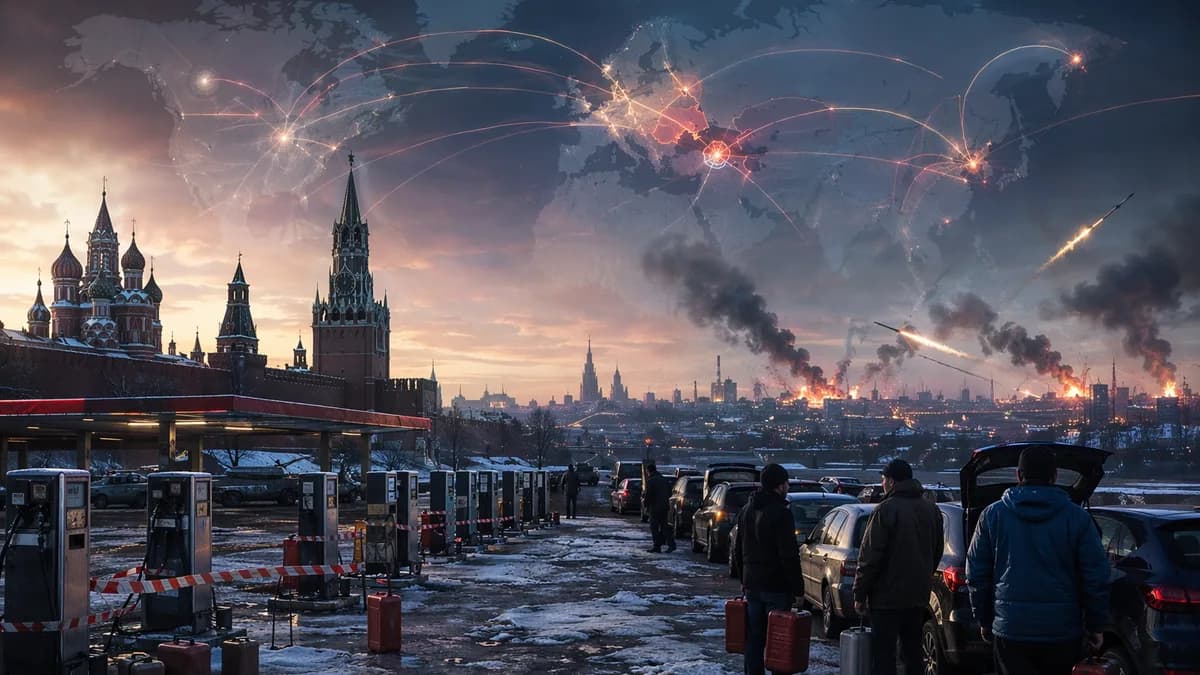
Putin’s dismissal of Russia fuel shortages signals a harder truth: Moscow is treating visible pain at home as tolerable as long as it can keep escalating the war in Ukraine. Severe shortages, refinery damage, rationing and fuel lines have not pushed President Vladimir Putin toward a ceasefire, according to ABC International. They have coincided with one of the deadliest Russian attacks on Kyiv since the full-scale invasion began.
XOOMAR Intelligence
Analyst Take
The contradiction is the story. Ukraine is hitting Russian oil refineries and energy facilities more often, while Russia is answering with deeper attacks on Ukrainian cities and infrastructure. Putin has called the refinery strikes “not critical,” described shortages as “temporary,” and rejected ceasefire proposals unless Kyiv accepts terms it has already refused.
Putin is betting Russians will tolerate fuel lines if the war machine keeps moving
Russia fuel shortages now sit at the center of a political test Putin does not want to acknowledge. The AP report says he chaired a government meeting last weekend on the issue, admitted Russia was going through a “difficult period,” and promised faster repairs at damaged energy facilities. He also said Russia could consider importing gasoline.
That is not the language of a leader ignoring the problem. It is the language of a leader trying to shrink it.
“We will not give them that chance,” Putin said, portraying Ukrainian strikes as an effort to divide Russian society, halt Moscow’s offensive and force negotiations on “terms advantageous to our adversary.”
XOOMAR analysis: Putin’s public posture is not just about fuel. It is about credibility. If a major oil-producing state cannot keep gasoline flowing to drivers, the war becomes harder to frame as distant and controlled. Still, the source does not show that the shortages have threatened Putin’s authority directly. The pressure is visible, but visibility is not the same as political rupture.
Russia’s response on the battlefield reinforces that point. Overnight into Thursday morning, its military launched an 11-hour barrage on Kyiv that killed at least 21 people, according to the report. That timing matters. Moscow is not signaling restraint in response to energy pressure. It is signaling escalation.
Ukraine’s refinery strikes hit a chokepoint crude production can’t solve
The refinery campaign matters because crude oil alone does not fuel cars, trucks, aircraft or battlefield logistics. Refineries turn crude into usable products. When they are damaged, a country can still pump oil while facing shortages of gasoline and other refined fuels.
Since March, there have been more than 50 reported Ukrainian attacks on oil refineries and other energy facilities in Russia and occupied Crimea, according to the AP account. Ukrainian leaders have said the strikes are intended to pressure Moscow to end the war.
The strongest version of Kyiv’s logic is clear from the target set described in the source: make the war more expensive for Russia by hitting energy assets, many of them far from the front. That shifts pressure from trenches and occupied cities to industrial sites inside Russia. It also punctures the Kremlin’s preferred story that ordinary Russians can remain insulated from the war.
A useful contrast:
| Pressure point | What the AP source shows |
|---|---|
| Russian battlefield claims | Putin says Russian forces are advancing across the roughly 1,000 kilometer-long (620 mile-long) front line |
| Western military analysis | Analysts say Russian advances have been stymied in recent months, with mid-range strikes hampering logistics and slowing the tempo |
| Ukrainian long-range strikes | More than 50 reported attacks on Russian refineries and energy sites since March |
| Civilian effect inside Russia | Rationing in many regions, hours-long fuel lines, and halted gasoline sales to individuals in Crimea |
The counterpoint is important. Refineries can be repaired. Russia has a state-directed system with tools to manage shortages, at least temporarily. The AP source does not prove that refinery strikes are crippling Russian military operations. Putin explicitly claims the long-range strikes “have absolutely no effect on the situation at the front.”
That claim is too neat. The reported shortages show the campaign is affecting Russia’s domestic fuel system, even if the source does not establish a direct collapse in military logistics.
The numbers show disruption, not yet breakdown
The available figures point to serious stress. Chris Weafer, CEO of Macro-Advisory, estimates that one-third of Russia’s refining capacity has been cut off. Government statistics cited in the report show gasoline production reduced by roughly 17% to 850,000 barrels a day.
A top refinery in Moscow has been hit twice despite significant air defenses around the capital. The second strike, on June 18, set it ablaze and damaged equipment that will reportedly take until the end of the year to repair.
Crimea has suffered the worst shortages. Gasoline sales to individuals have been halted there altogether. In other regions, rationing has been introduced and motorists have waited in line for hours.
Those figures make the phrase “not critical” sound less like an assessment and more like political containment. Still, the source does not provide confirmed data on price increases, export restrictions, seasonal demand, harvest demand, refinery maintenance schedules, sanctions-linked repair constraints or budget revenue effects. Any stronger claim about those channels would go beyond the evidence supplied.
For readers following how states are adapting under pressure across security domains, XOOMAR has also covered Space Force letting private satellites stalk targets in orbit and Russian Signal phishing hijacking VIP accounts in a support scam. Those are separate stories, but they reflect the same broader reality: pressure now moves through infrastructure, networks and systems civilians depend on.
Kremlin calm collides with queues, rationing and Kyiv’s message
The stakeholder split is stark. Putin projects control. Regional authorities deal with shortages. Drivers sit in lines or face rationing. Ukraine presents strikes on Russian energy facilities as a way to force Moscow toward ending the war.
Moscow’s messaging has a built-in risk. Calling shortages temporary may work if repairs advance and supply normalizes. It gets harder if outages spread, queues persist or new strikes keep hitting facilities thought to be protected.
The Kremlin has also paired domestic reassurance with maximalist diplomacy. Putin has rejected a truce backed by Kyiv and Western allies, arguing it would let Ukrainian forces rest and regroup. He has made a ceasefire conditional on Ukraine withdrawing from the part of Donetsk it still controls, a demand Ukraine rejects. He has also said a final peace deal must require Ukraine to abandon its bid to join NATO, reduce its military and protect Russian language and culture.
Putin said Ukraine had privately offered to limit fighting to the four regions Russia annexed but never fully captured: Donetsk, Luhansk, Kherson and Zaporizhzhia. The Kremlin said that proposal came through confidential channels, while Ukrainian officials have not publicly discussed it.
“Saving the Kyiv regime is not part of our plans,” Putin said.
That sentence explains why fuel pressure has not translated into diplomacy. Moscow is still framing negotiation as something to resist unless it locks in Russian terms.
Russia’s refinery pain changes the risk map, but the evidence has limits
The AP report supports one narrow but consequential conclusion: Russia fuel shortages are now a visible domestic consequence of Ukraine’s long-range strike campaign. It does not support a broader claim that Russia’s economy is near collapse, that elites are turning against Putin, or that military fuel supplies are failing.
That distinction matters. Overstating the impact helps Moscow dismiss outside analysis as wishful thinking. Understating it misses the fact that one of the world’s leading oil-producing countries is rationing gasoline in many regions and halting sales to individuals in Crimea.
For oil traders, defense planners and European policymakers, the practical implication is not that Russian crude output has stopped. It is that refined fuel infrastructure has become a recurring target, and disruptions there create different risks from crude supply shocks. The AP source does not quantify global market effects, so the safe conclusion is narrower: sustained refinery attacks can complicate Russia’s domestic distribution and repair burden even if crude production continues.
The next phase hinges on whether shortages stay temporary
Putin can shrug off Russia fuel shortages for now because the source shows pain, not breaking point. The stronger test comes next: whether repairs keep pace with new attacks, whether rationing spreads, and whether fuel stress begins to affect sectors the Kremlin cannot easily dismiss.
Russia has already said it will boost production of air defense systems to fend off future Ukrainian strikes. That is the clearest forward signal in the report. Ukraine, meanwhile, has shown that Russian energy infrastructure is reachable and politically sensitive.
The evidence that would weaken this analysis is straightforward: rapid repairs, shorter queues, restored sales in Crimea and fewer successful strikes. The evidence that would strengthen it is just as clear: more refinery outages, longer repair timelines, wider rationing and any sign that fuel shortages are no longer merely inconvenient but operationally disruptive.
Putin’s bet is that Russians will absorb the cost while the war continues. Each successful strike makes that bet harder to hide.
The Stakes
- Fuel shortages show the war is creating visible strain inside Russia despite Putin’s efforts to downplay it.
- Moscow’s continued attacks suggest domestic economic pain is not yet changing Kremlin strategy.
- The cycle of refinery strikes and urban attacks raises the risk of further escalation for both countries.
Escalation Pattern in the Russia-Ukraine War
| Ukraine's Pressure | Russia's Response |
|---|---|
| Striking Russian oil refineries and energy facilities more often | Launching deeper attacks on Ukrainian cities and infrastructure |
| Aiming to disrupt fuel supplies and expose domestic pressure inside Russia | Portraying shortages as temporary and not critical |
| Seeking leverage toward negotiations | Rejecting ceasefire proposals unless Kyiv accepts Moscow's terms |
Primary Sources & Disclosures

Written by
XOOMAR Insights Team
Research and Editorial Desk
The XOOMAR Insights Team pairs automated research with human editorial judgment. We track hundreds of sources across technology, fintech, trading, SaaS, and cybersecurity, cross-check the facts, and explain what happened, why it matters, and what to watch next. We do not just rewrite headlines. Every article is fact-checked and scored for reliability before it goes live, and we link back to the original sources so you can verify anything yourself.