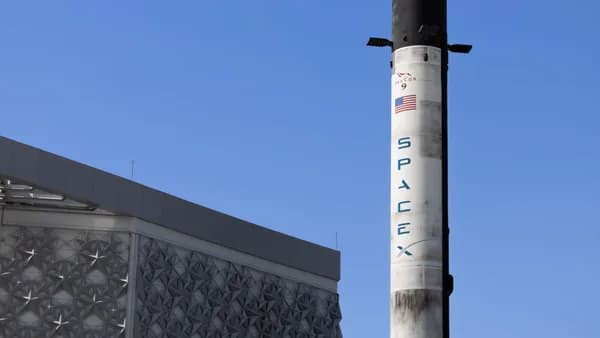
SpaceX AI device speculation matters because the company already owns the hard parts of a connected AI product, but has not proved anyone needs another gadget in their pocket.
XOOMAR Intelligence
Analyst Take
That tension sits under the report that SpaceX showed investors a prototype AI device before its June 2026 IPO, according to PYMNTS. The reported prototype was described as slimmer than an iPhone, built around xAI software, running a proprietary operating system and using a Qualcomm Snapdragon chipset. SpaceX also reportedly told investors the project was early, the design could change and production was not guaranteed.
Then Elon Musk denied it.
“Utterly false”
That denial, posted on X on July 1, hit the stock narrative fast. Forbes reported that SpaceX shares fell about 7% after Musk’s response, per the PYMNTS summary.
SpaceX has the rails for an AI hardware play, but no breakout device to ride them
The useful read is not “SpaceX is building a phone.” The sources don’t establish that. The sharper read is that SpaceX has assembled an unusual stack: Starlink, direct-to-cell connectivity and Grok through xAI. A consumer endpoint would connect those pieces.
That’s why the reported prototype, even if disputed, is a signal worth parsing. SpaceX does not need to announce a finished product for investors to ask whether the company is becoming more than launch and broadband infrastructure. A device in the pitch deck frames SpaceX as a vertical platform company.
XOOMAR analysis: the device gap is real, but engineering is not the hardest problem. The hard part is use case discipline. Consumers have already rejected plenty of futuristic hardware that did not beat the phone at a specific job.
That’s the thread we examined in SpaceX AI Device Pulls Starlink Toward Your Pocket. The strategic question is whether SpaceX wants to build the endpoint itself, supply connectivity to someone else’s device or make investors value Starlink as the missing distribution layer for AI.
Starlink, direct-to-cell and xAI create a stack Apple and OpenAI can’t easily copy
SpaceX controls Starlink, a satellite broadband network described by PYMNTS as having global coverage, which is why Rocket Lab’s Iridium grab is aimed at a strategically important moat. It is also building direct-to-cell service that lets phones connect to satellites without a terrestrial carrier. The February merger with xAI valued the combined company at roughly $1.25 trillion, CNBC reported in the source material, giving SpaceX direct access to Grok.
That combination matters because most AI hardware startups sit on someone else’s rails.
| Company or effort | Reported hardware angle | Strategic constraint from sources |
|---|---|---|
| SpaceX | Reported early prototype AI device | Musk denied the report, production not guaranteed |
| OpenAI and io | Post-smartphone AI device | First consumer device delayed until 2027, per PYMNTS |
| Apple | Apple Intelligence inside existing products | AI is positioned as an OS-level capability, not a standalone gadget |
| Snap SPECS | AR glasses at $2,195 | Stock dropped 5% on launch day, per PYMNTS |
TF International Securities analyst Ming-Chi Kuo wrote that a full AI agent service needs control of both hardware and operating system because a software layer on someone else’s platform remains bounded by that platform’s rules. That view explains why OpenAI bought Jony Ive’s io startup for $6.4 billion, and why Apple is embedding Apple Intelligence into its own operating system layer.
SpaceX’s twist is different. It could pair the AI interface with the network itself.
XOOMAR analysis: that gives SpaceX a distribution argument Apple and OpenAI do not have in the same form. But owning the network does not prove demand for the endpoint. Infrastructure can remove friction. It cannot create a daily habit by itself.
The numbers expose both the ambition and the weak spots
The concrete figures in the source tell a story of ambition, not certainty.
Reported scale markers include:
- June 2026: SpaceX went public in a record-setting IPO, per PYMNTS.
- February: SpaceX merged with xAI in a deal valuing the combined company at roughly $1.25 trillion, per CNBC as cited by PYMNTS.
- July 1: Musk denied the AI device report on X.
- 7%: Forbes reported SpaceX shares fell about this much after the denial, per PYMNTS.
- $6.4 billion: OpenAI’s acquisition price for Jony Ive’s io startup, per PYMNTS.
- $2,195: Snap’s SPECS launch price, according to CNBC in the source material.
- 5%: Snap’s stock drop on the day SPECS launched, per PYMNTS.
The missing numbers matter too. The supplied source does not provide Starlink subscriber counts, satellite counts, device bill of materials, AI compute costs or expected pricing. That limits any hard business-case math.
XOOMAR analysis: if a SpaceX AI device exists someday, device revenue may be less important than attached services. A bundle could include satellite connectivity, premium AI features or enterprise service plans. But the source does not confirm such a pricing model, and the company has not announced one.
The cost side is also only partly visible. AI spending pressure is already a broader issue for companies trying to turn model access into profitable products, as we covered in Runaway AI Spending Forces a Return to Cloud Controls. For SpaceX, the question would be whether Starlink plus xAI can make the unit economics cleaner than a standalone gadget company can manage.
AI gadgets keep stumbling because smartphones already won the pocket
Humane is the warning label. Its AI Pin was switched off last year after its maker sold assets to HP, according to PYMNTS. Snap’s SPECS arrived with a high price and an immediate market wobble. Google Glass remains part of the same cautionary pattern cited by PYMNTS.
The lesson is blunt: consumers don’t buy hardware because it looks post-smartphone. They buy it when it solves a problem better than the device they already carry.
A SpaceX AI device could have a more credible answer than most: connectivity outside normal coverage. That might matter for remote workers, travelers, emergency users or field teams. But the source material does not show that SpaceX has validated those users, priced a product for them or committed to production.
XOOMAR analysis: the first successful version, if one appears, probably should not try to replace the smartphone. It should attack the places where the smartphone is weakest. That is a narrower market, but a more believable one.
Customers, carriers and investors would each price the risk differently
Consumers would judge a SpaceX AI device on ordinary hardware terms: battery life, form factor, reliability, price and trust. The sources do not provide specs beyond the reported slim design, proprietary OS, xAI software and Qualcomm chipset, so those questions remain open.
Carriers face a different ambiguity. PYMNTS says SpaceX is building direct-to-cell service, while TechCrunch reported that Starlink Mobile could become a potential competitor to Verizon and AT&T. A SpaceX-branded endpoint would make that tension harder to ignore, though the sources do not show any carrier response to the reported prototype.
Investors may care most about narrative discipline. A device can expand the story around SpaceX’s addressable market. It can also invite pressure over hardware margins, timelines and execution outside the company’s core reported businesses.
That explains the market sensitivity around Musk’s denial. If the prototype was real, it suggested vertical ambition. If it was not, the market had to reprice the rumor.
SpaceX changes the AI hardware distribution problem more than the chatbot problem
The AI device race is often framed around model quality or industrial design. SpaceX pushes the question elsewhere: who controls access when the device is away from ordinary networks?
That’s the real strategic pressure. Apple owns the OS layer. OpenAI is trying to build dedicated hardware with Jony Ive’s team. SpaceX, if it ever ships or enables an AI endpoint, would bring the network layer into the product itself.
The next useful evidence will not be another rumor. It will be harder proof: regulatory progress for direct-to-cell service, named hardware partners, developer commitments, pricing, battery specs or enterprise pilots. Any of those would strengthen the SpaceX AI device thesis.
Without them, the cleaner interpretation is this: SpaceX does not need to build the next iPhone for the strategy to matter. It needs to prove AI becomes more valuable when it stays online where phones still fail.
The Bottom Line
- SpaceX already controls key infrastructure pieces, including Starlink, direct-to-cell connectivity and xAI software.
- A consumer AI device could reposition SpaceX from a launch and broadband company into a vertical platform business.
- The main risk is whether consumers need another AI gadget when smartphones already dominate daily use.
Reported SpaceX AI Device vs. Musk’s Denial
| Item | Reported Prototype | Musk Response / Status |
|---|---|---|
| Device status | Shown to investors before the June 2026 IPO, according to PYMNTS | Elon Musk called the report “Utterly false” on X |
| Design | Described as slimmer than an iPhone | Design and production not confirmed |
| Technology stack | Reportedly used xAI software, a proprietary OS and Qualcomm Snapdragon chipset | No confirmed product roadmap |
Reported SpaceX Share Move After Musk Denial
Primary Sources & Disclosures

Written by
XOOMAR Insights Team
Research and Editorial Desk
The XOOMAR Insights Team pairs automated research with human editorial judgment. We track hundreds of sources across technology, fintech, trading, SaaS, and cybersecurity, cross-check the facts, and explain what happened, why it matters, and what to watch next. We do not just rewrite headlines. Every article is fact-checked and scored for reliability before it goes live, and we link back to the original sources so you can verify anything yourself.