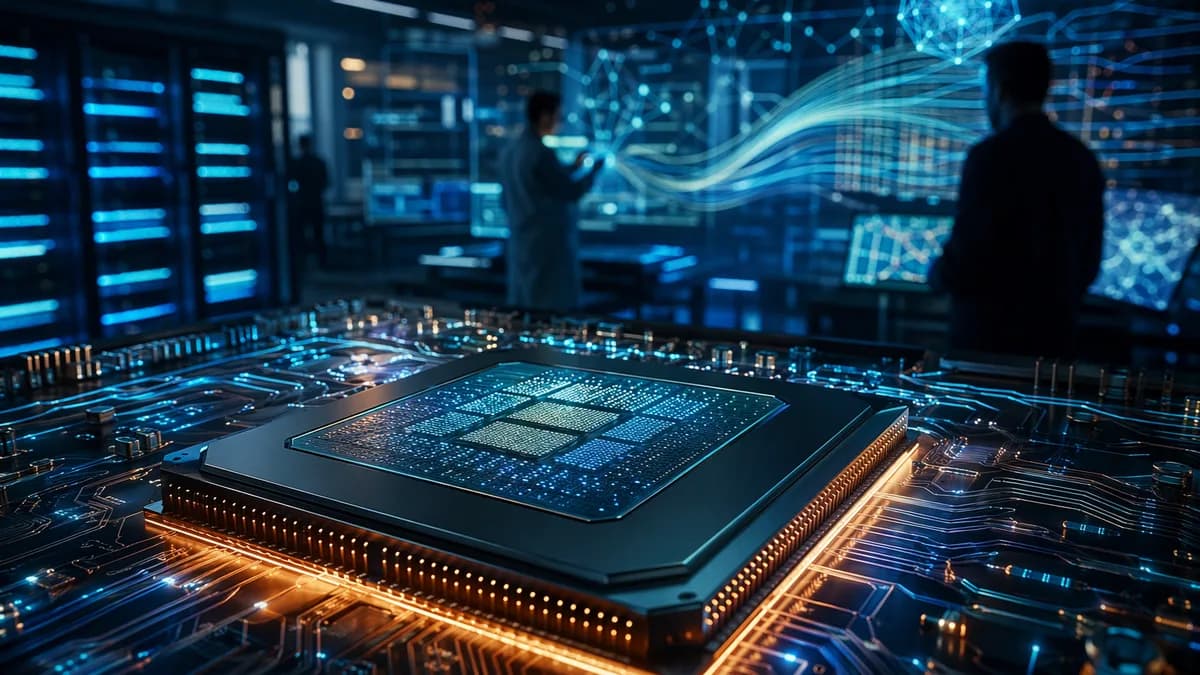
Etched was supposed to be fighting Nvidia from the outside. Instead, the Etched AI chip story now looks more specific and more dangerous: a startup is attacking the costliest part of running AI models, not trying to replace every GPU in the data center.
XOOMAR Intelligence
Analyst Take
TechCrunch reports that Etched has booked $1 billion in contract orders for full inference systems powered by its chip, after TSMC successfully manufactured the chip earlier this year. The company also disclosed $800 million in total funding, including a previously unannounced $500 million round closed in December at a $5 billion post-money valuation.
That’s the tension. Etched isn’t yet proving it can beat Nvidia everywhere. It’s trying to prove something narrower: that AI companies will pay real money for specialized systems if those systems make inference faster, cheaper, and less power-hungry.
Etched AI chip orders target the spending pain Nvidia customers hate most
Training gets the glory. Inference gets the bill.
Etched calls its systems “frontier inference clusters”, bundles that include chips, custom-designed racks, and software. The company says they are built to help frontier models run inference faster, more cheaply, and with better power efficiency than rival systems.
That claim lands because inference is where AI products become expensive at scale. Every prompt, every generated answer, every agentic loop creates a serving cost. A demo can tolerate ugly economics. A mass-market AI product can’t.
Etched says it has already booked $1 billion in contract orders for full systems powered by its chips.
XOOMAR analysis: The important signal isn’t that Etched has “beaten Nvidia.” The source material does not show that. The signal is that buyers are willing to sign contracts before Etched has publicly proven broad production deployment. That suggests the market is hungry for a different inference cost curve.
This fits a wider AI infrastructure debate we’ve tracked in Anthropic Samsung Chip Talks Threaten Nvidia's Grip, where the strategic question is less “who makes the fastest chip?” and more “who controls the cost of serving models?”
The hard arithmetic behind Etched’s $5B valuation and $1B order book
The headline number needs careful handling. $1 billion under contract is not the same as recognized revenue. It is not the same as profit. It does not tell us how much has shipped, how much has been paid upfront, or how much can be canceled.
Still, the figure matters because hardware startups rarely get this kind of commercial signal before they have scaled.
Here’s the before-and-after implied by Etched’s update:
- Before: In 2023, the founders said every major investor they pitched passed, even after they circulated a 30-page memo arguing AI would need specialized chips.
- After: Etched says it has raised $800 million total and closed a $500 million round at a $5 billion post-money valuation.
- Before: The company was reportedly operating month-to-month and close to running out of cash.
- After: Its investor list includes VentureTech Alliance, Jane Street, Hudson River Trading, Two Sigma, Ribbit Capital, and Stripes, with Stripes leading the latest round.
- Before: Etched had raised more than $125 million by 2024.
- After: It says TSMC has manufactured the chip and customer testing is underway.
The open financial questions are the ones investors will care about next:
| Question | Why it matters |
|---|---|
| Customer concentration | A $1 billion order book means different things if it comes from one buyer or many. |
| Delivery timing | Contracts only become proof when systems land and run in production. |
| Margins | Custom racks, chips, software, and supply commitments can burn cash before they generate durable profit. |
| Cancellation terms | The source does not say how binding the orders are. |
| Supply execution | TSMC manufacturing is a milestone, but production scale is a separate test. |
The valuation says investors are paying for category potential, not mature earnings. That’s rational only if Etched can turn customer tests into repeat deployment.
Sohu’s transformer-focused design gives Etched speed, and a narrow lane
Etched’s technical bet is specialization. A related technical summary describes Sohu as an ASIC focused on transformer workloads, rather than a flexible GPU built for many compute jobs, according to n1n.ai.
That matters because today’s dominant frontier models rely heavily on transformer architectures. If a chip is designed around that workload, it can cut overhead that comes with general-purpose programmability. In theory, that can mean lower latency, better performance per watt, and lower cost per token.
But the tradeoff is brutal.
A flexible GPU can survive shifts in model design. A specialized chip has to be right about the workload it is built for. If model architectures change, if customers need broader compute support, or if software support lags, specialization can become a trap.
XOOMAR analysis: Etched’s best case is not “GPU replacement.” It is workload capture. The Etched AI chip can win if it becomes the obvious choice for high-volume transformer inference where cost and latency dominate the buying decision.
Cloud giants, AI labs, startups, and Nvidia each face a different Etched problem
For AI labs and app companies, the appeal is simple: lower serving costs can make heavier usage more practical. Chatbots, coding tools, search features, and enterprise copilots all become more expensive as usage rises. If Etched’s claims hold up, it attacks that margin pressure directly.
For cloud providers, the source material shows a clear direction: Amazon, Google, and Microsoft all build in-house AI chips, while OpenAI announced its first custom chip, built by Broadcom. Etched sits in that same strategic current, where buyers and builders are testing alternatives to general-purpose GPU dependence.
For Nvidia, the risk is not that one startup clones its platform. The risk is narrower erosion. Specialized inference systems can carve away specific workloads if they deliver better economics.
For investors, Etched is now in the same conversation as other AI infrastructure bets. TechCrunch notes Cerebras had the first breakout IPO of the year and Groq raised $650 million. XOOMAR has also covered the funding appetite around AI infrastructure in Together AI Snags $800M as Valuation Rockets to $8.3B.
The pattern is clear from the supplied facts: capital is chasing the layer where AI demand turns into compute spend.
Custom AI silicon keeps running into the same software wall
AI hardware challengers have long promised better performance than general-purpose GPUs for specific jobs. The source names Groq, Cerebras, hyperscaler chips, and OpenAI’s Broadcom-built custom chip as part of the current race.
The recurring failure mode is not always silicon. It’s adoption.
Hardware needs compilers, model support, developer tooling, cloud integration, support teams, and predictable supply. Nvidia’s advantage is not just chips. It is the accumulated trust around running real workloads.
That does not make Etched’s push futile. Timing matters. The company is arriving when inference is described in the source as both the biggest bottleneck and the biggest cost center for AI companies serving customers at scale.
XOOMAR analysis: Earlier AI chip bets often had to convince buyers that specialized silicon would matter. Etched is selling into a market where the pain is already visible. That improves the pitch, but it does not remove the execution risk.
Etched’s $1B contract claim tells AI buyers that inference margins are now strategic
Enterprise buyers should read Etched’s update as a procurement warning. Inference cost, chip availability, and workload portability are no longer back-office infrastructure issues. They shape product margins.
If Etched succeeds, more buyers will split compute by job type: training on one class of hardware, batch inference on another, real-time inference on specialized systems, and possibly edge deployment elsewhere.
But diversification is not automatic savings. Moving away from Nvidia-centered infrastructure can add testing costs, integration work, vendor risk, and operational complexity. A cheaper chip can still be expensive if it breaks workflows or requires deep rewrites.
For readers who need cleaner language around vendor claims, our AI Glossary Cuts Through the Jargon Vendors Hide Behind is useful context. The Etched pitch depends on terms like inference, frontier models, ASICs, and cost per token becoming boardroom issues.
Pilots come first, then the software reckoning
Etched’s next test is not another funding announcement. It is customer proof.
The company is currently testing its first product with customers, according to TechCrunch. That makes pilots the near-term scoreboard. The evidence that would strengthen Etched’s case is straightforward: shipped systems, repeat orders, visible production deployments, and customers saying the economics work outside benchmarks.
The evidence that would weaken it is just as clear: delayed deliveries, unclear margins, software friction, limited model support, or contracts that fail to convert into scaled deployments.
Nvidia and cloud providers do not need to panic for Etched to matter. They only need to respond if specialized inference starts winning high-volume workloads one use case at a time.
That is the real watch item. Etched has shown there is appetite for an Nvidia alternative in inference. Now it has to ship, support, and scale before the market decides the order book was a signal, not proof.
The Bottom Line
- Etched’s $1 billion in orders suggests AI buyers are willing to bet on specialized inference hardware.
- The startup is targeting inference costs, one of the biggest economic pressures in scaling AI products.
- Its $5 billion valuation shows investor confidence that Nvidia’s dominance may face focused competition.
Etched vs. Nvidia in AI Infrastructure
| Category | Etched | Nvidia |
|---|---|---|
| Market focus | Specialized frontier inference systems | Broad GPU-based AI infrastructure |
| Strategy | Targeting faster, cheaper, more power-efficient inference | Dominant platform across training and inference workloads |
| Current signal | $1 billion in contract orders before broad public deployment | Incumbent customers face high inference costs at scale |
Etched Funding, Orders, and Valuation
Primary Sources & Disclosures

Written by
XOOMAR Insights Team
Research and Editorial Desk
The XOOMAR Insights Team pairs automated research with human editorial judgment. We track hundreds of sources across technology, fintech, trading, SaaS, and cybersecurity, cross-check the facts, and explain what happened, why it matters, and what to watch next. We do not just rewrite headlines. Every article is fact-checked and scored for reliability before it goes live, and we link back to the original sources so you can verify anything yourself.