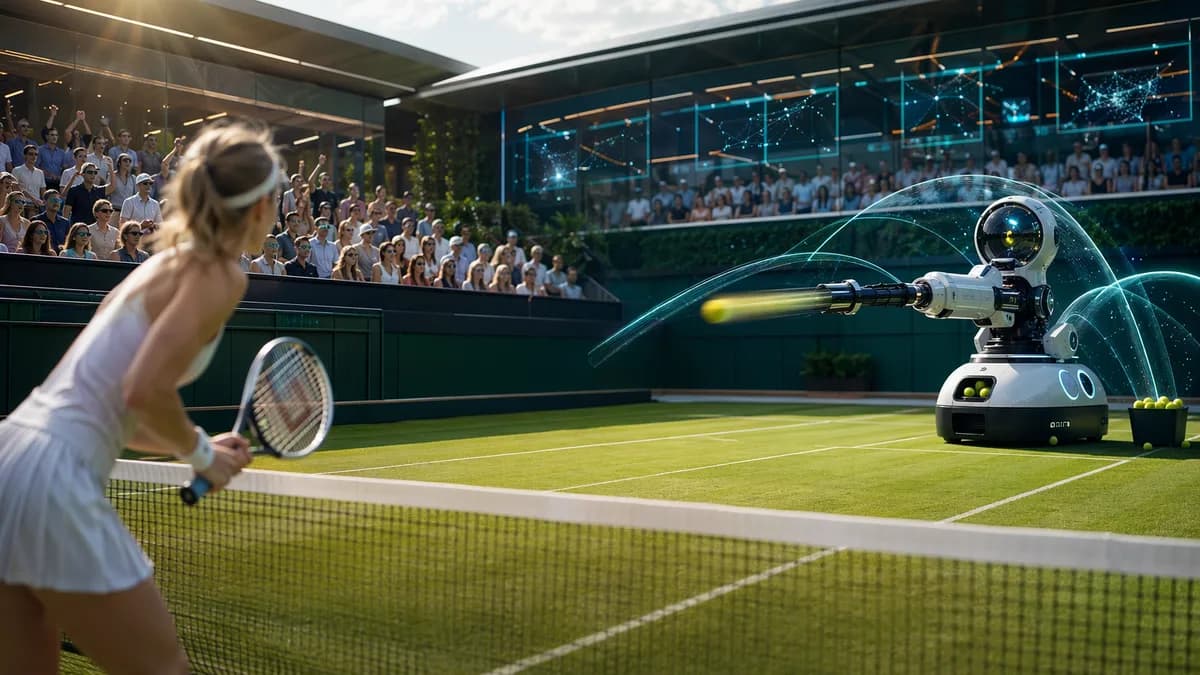
A robot at Wimbledon is firing Giovanni Mpetshi Perricard-style 153mph serves at attendees, turning Centre Court-level speed into something spectators can fail to return in person.
XOOMAR Intelligence
Analyst Take
The Wimbledon robot serving machine lets tournament visitors face simulated deliveries inspired by players including Emma Raducanu, Andy Murray, John McEnroe, Elina Svitolina, Jannik Sinner, Roger Federer and Andy Roddick, according to Guardian World. The point is blunt. A serve-speed graphic tells you a number. A ball coming at you from a machine tells you how little time that number leaves.
Why are Wimbledon fans queuing to face a 153mph robot tennis serve?
For many attendees, the attraction has been a break from camping in the queue for next-day tickets. For others, it has been a fast lesson in how much violence sits inside elite tennis.
The source examples frame the challenge clearly:
| Player-style challenge | Reported speed or detail |
|---|---|
| Emma Raducanu | 110mph serve |
| Andy Murray | 145mph stroke |
| Giovanni Mpetshi Perricard | 153mph torpedo, which broke Wimbledon records last year |
| John McEnroe | Simulated serve returned by one attendee |
| Elina Svitolina | Simulated serve that same attendee could not get near |
That last contrast matters. Fans often read speed as the full story. The Guardian report suggests the machine is built to recreate more than raw pace, including speed, angle and trajectory.
“It felt like pressure to be honest, it’s almost like I’m playing at Wimbledon, but it was enjoyable. It definitely shows how competitive it is at the real level.”
That was Alex Ellis, who said he got one simulated Sir John McEnroe serve over the net but “couldn’t get anywhere near” Svitolina’s.
How does the Wimbledon robot serving machine recreate famous players' serves?
The machine is described as a first-of-its-kind robot that recreates the speed, angle and trajectory of serves from top players. It also uses the 5G network to connect with real-time data from Centre Court.
That does not mean a humanoid robot is playing points. The better mental model is a programmable serving arm, tuned to fire balls in repeatable patterns that resemble particular player deliveries.
Vodafone is attached to the project, and Oliver Kibblewhite, whose 5Gs agency created the machine for Vodafone, said the robot arm was built “very stout” so it could handle faster serves than a normal tennis serving machine.
The source does not disclose every technical parameter. It does not say exactly how the system handles spin, placement variation, release height or bounce behavior. So the safe conclusion is narrower: the Wimbledon robot serving machine is reported to reproduce speed, angle and trajectory, while using 5G-linked Centre Court data as part of the experience.
XOOMAR analysis: That restraint is important. The most interesting part is not whether the machine perfectly clones a player. It is that Wimbledon is turning elite match data into a physical fan experience. That makes the gap between watching and returning a serve painfully obvious.
Why does a 110mph Emma Raducanu serve still punish amateurs?
Raducanu’s 110mph serve has proven the most popular challenge, Kibblewhite said. The Guardian does not say why, so any explanation for that popularity would be guesswork.
What the source does support is the wider lesson: even serves below the biggest men’s speeds can overwhelm ordinary players. Around half of punters were able to return at least one of three serves, according to Kibblewhite. That means a large share could not manage even one successful return across three attempts.
A 110mph serve is not just a speed reading. For an amateur, it compresses the whole return into a tiny decision window: pick the line, move, set the racket and make contact. If the ball also arrives at an unfamiliar angle or height, the usual club-player rhythm disappears.
The machine makes that problem clean. There is no scoreboard, no roaring court, no opponent staring you down. Yet people still miss. That is the useful part of the demo.
What happened when visitors faced McEnroe, Svitolina, Sinner and Roddick?
The best mini case study in the source is not a fantasy matchup with Murray or Perricard. It is the set of real visitors who tried the machine and walked away with a clearer sense of the sport.
Alex Ellis managed to return the simulated McEnroe serve. Svitolina’s was another matter. He said he “couldn’t get anywhere near it.”
Arthur Culicovschi, a tennis coach, called the experience “a reality check.” He returned a serve from Jannik Sinner, the Italian No 1 seed, but missed attempts from Roger Federer and former US star Andy Roddick.
Then there was Mori Arathoon from Germany. He said the serve came from a much higher point than in his tennis league, resembling something struck from a second storey.
“Now I can relate to [professional players] a bit,” he said.
That is the machine’s value in one sentence. It gives spectators a bodily reference for something television flattens. From the stands, a return can look late or casual. From the return position, the same ball can feel gone before the decision has formed.
Why Wimbledon is pairing 5G serve tech with shade, roofs and tougher grass
The serve robot is only one part of the on-site story. Wimbledon is also preparing for an extended heatwave starting on Friday, after temperatures in the area reached 35C (95F) a week earlier.
Michelle Dite, the tournament’s operations director, said “this is how it is now,” after describing the qualifying championships as “hotter than the surface of the sun.” Wimbledon has increased shade and shelter for the public, including a new retractable roof on the tea lawn, plus covered social spaces in the southern village and the “Henman Hill” area.
That heat thread sits outside the robot demo, but it affects the same audience. XOOMAR’s consumer tech desk has separately tracked heat-related products in 43% Off SweetNight CoolNest Mattress Takes On Heat, and event-goers watching their own gear choices may also find context in Camera Deals Up to $600 Off Steal Target's July 4 Sale.
Wimbledon’s longer-term concern is the grass. Chief executive Sally Bolton said the tournament is thinking carefully about what an English summer garden looks like when water is harder to come by, with Met Office predictions that temperatures in England will rise to 45C by 2056.
Neil Stubley, the venue’s head of courts and horticulture, said he is looking five to 10 years ahead to protect “probably the most scrutinised piece of turf in the world.” He said selected grasses are becoming more drought-tolerant and wear-tolerant, although overnight temperatures of 30C would limit recovery.
Can robot serving machines move beyond the Wimbledon fan zone?
The Wimbledon robot serving machine is entertainment first. It gives fans a story to tell and a missed return to laugh about.
But it also points to a practical direction for tennis tech: repeatable, data-shaped practice. If a machine can reliably reproduce specific serve profiles, players could use similar systems to drill the same return problem again and again, such as a fast first serve, a higher contact point or a particular angle.
The limits are just as clear. A machine can fire speed, angle and trajectory. It cannot fully recreate match pressure, player disguise, tactical shifts or the feeling of facing someone who changes patterns because they see what you fear.
The next question is whether Wimbledon treats this as a one-off fan attraction or folds it into a broader model for explaining elite tennis. If future versions reveal more about how the machine maps player data into each delivery, the demo could become more than a novelty. It could become a clearer bridge between the numbers on Centre Court and the split-second skill those numbers demand.
Key Takeaways
- The robot experience gives fans a physical sense of how little reaction time elite tennis allows.
- It shows that professional serves depend on angle and trajectory as well as raw speed.
- The attraction turns Wimbledon spectatorship into an interactive lesson in the difficulty of top-level play.
Wimbledon Robot Player-Style Challenges
| Player-style challenge | Reported speed or detail |
|---|---|
| Emma Raducanu | 110mph serve |
| Andy Murray | 145mph stroke |
| Giovanni Mpetshi Perricard | 153mph torpedo that broke Wimbledon records last year |
| John McEnroe | Simulated serve returned by one attendee |
| Elina Svitolina | Simulated serve the same attendee could not get near |
Reported Speeds in Wimbledon Robot Challenge
Primary Sources & Disclosures

Written by
XOOMAR Insights Team
Research and Editorial Desk
The XOOMAR Insights Team pairs automated research with human editorial judgment. We track hundreds of sources across technology, fintech, trading, SaaS, and cybersecurity, cross-check the facts, and explain what happened, why it matters, and what to watch next. We do not just rewrite headlines. Every article is fact-checked and scored for reliability before it goes live, and we link back to the original sources so you can verify anything yourself.