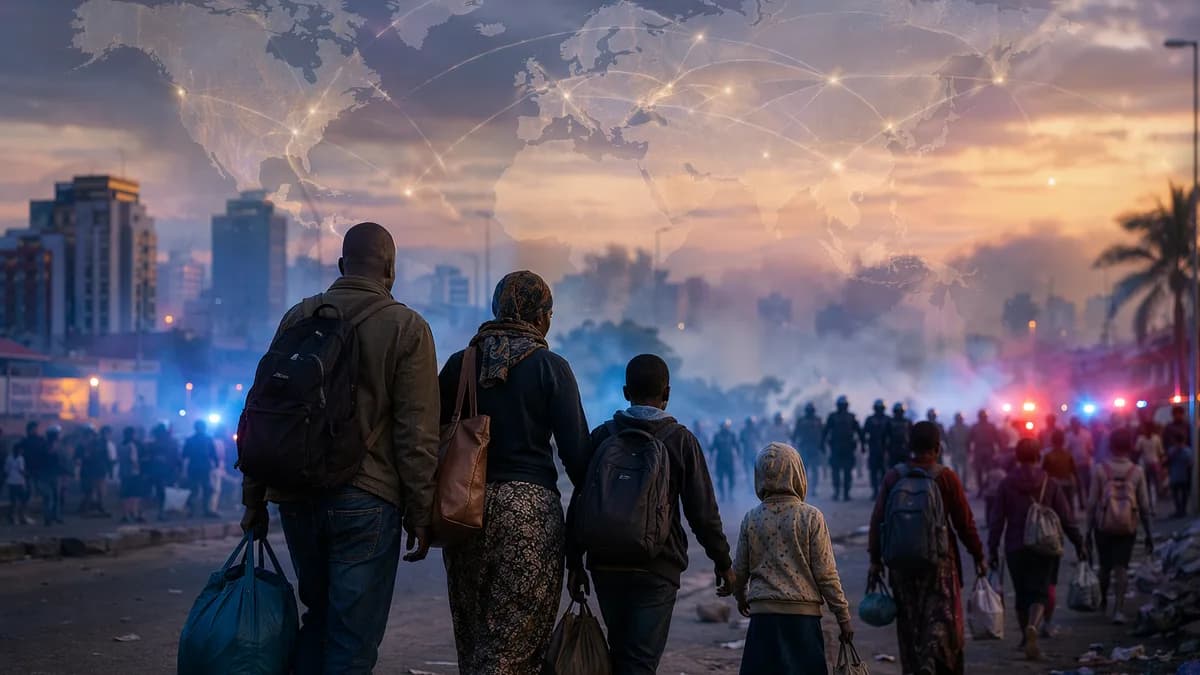
More than 2,000 anti-foreigner protesters marched through Durban as a self-imposed migrant “deadline” expired, turning South Africa anti-foreigner protests into an immediate security test for police, city authorities and frightened immigrant communities.
XOOMAR Intelligence
Analyst Take
The march followed weeks of intimidation and violence that have left at least four people dead and pushed tens of thousands to flee homes, shops and informal settlements, according to Guardian World.
South Africa anti-foreigner protests shutter Durban as more than 2,000 march
Durban’s city centre went quiet before the march. Shops shut. Streets emptied. Residents stayed indoors because violence had been widely feared after campaign groups told undocumented migrants to leave South Africa by 30 June.
Several thousand protesters, many in Zulu attire, moved through the city carrying sticks and clubs. They shouted “Abahambe!”, meaning “They must go!” in isiZulu, a slogan that has become the campaign’s rallying cry.
That deadline has no official legal force. Its danger comes from enforcement by crowds.
Immigrants, especially undocumented migrants and foreign shopkeepers, are now exposed in the most practical sense. Being visible at a taxi rank, in a shopfront or at home in an informal settlement can make someone a target.
“They said the deadline is the 30th, so they will attack me if I stay,” Jackson Makungwa, a 29-year-old Malawian migrant, told the Guardian.
Police and private security deployed heavily in Durban. Helicopters circled overhead and armoured vehicles watched the march route. Organisers urged supporters to avoid looting, but some marchers made threats about what would happen after the cutoff.
The scene matters beyond Durban. South Africa anti-foreigner protests are now tied to a date, a slogan and a visible street movement. That combination can turn anger into instruction, especially in neighbourhoods where migrants already fear door-to-door intimidation.
Immigrants flee homes and businesses after weeks of threats
The Durban march did not erupt in isolation. It followed a weeks-long campaign against foreigners that has already driven thousands from homes and workplaces.
In the days before the deadline, migrants slept on pavements, in open fields and in makeshift camps while trying to secure transport home. Several African governments arranged buses or planes for their citizens, as thousands sought repatriation or safer shelter.
In Pietermaritzburg, about 50 miles from Durban, families camped outside an abandoned building after a 29-year-old Malawian national was killed by a mob following a protest on 19 June. On the eve of the deadline, people queued through an overgrown garden to board buses heading toward South Africa’s northern border.
Makungwa stood in line with two small bags after 10 years in South Africa. He had lived there legally, he said, but had been unable to renew his work permit for two years.
“It’s not like I want to be illegally in the country, but the system doesn’t allow me to be here legally,” he said.
He also left behind a two-month-old son born to a South African mother because he could not secure travel documents in time.
Zimbabwean migrant Lydia Mpingashato said she had been dismissed from her job as a cleaner and threatened while waiting for a shared taxi in the township where she had lived for 17 years.
“He said he would burn my house and kill my family,” she said. “Now I have no plan; I’m just going home to be safe.”
XOOMAR analysis: The immediate economic damage is not abstract. When migrants flee, businesses close, workers disappear and landlords, employers and customers lose normal transactions overnight. During South Africa anti-foreigner protests, foreign-owned shops often become first-line targets because they are visible, fixed and easy for mobs to identify.
The political symbolism is just as blunt. A deadline set by activists is now competing with state authority. That is the part officials cannot ignore.
Migrant anger is colliding with South Africa’s weak enforcement record
Many protesters blame immigrants from elsewhere in Africa for unemployment, crime and pressure on public services. Those claims are politically powerful, but the available source material does not establish them as fact.
What is established is that scapegoating foreigners has repeatedly preceded violence in South Africa. The country’s 2008 xenophobic riots killed 62 people and displaced more than 150,000. Another wave of attacks in 2015 left at least five people dead.
South Africa is home to about 2.4 million foreigners, documented and undocumented, according to 2022 census data cited by the Guardian. Police say more than 50,000 undocumented migrants have been arrested since January, as the government tries to show it is acting on migration enforcement.
| Actor | Stated position or action | Immediate risk |
|---|---|---|
| Protest groups | Set a 30 June deadline for undocumented migrants to leave | Crowd enforcement and vigilantism |
| Migrants | Fleeing homes, camps and businesses for safety or repatriation | Displacement, family separation, loss of work |
| Government and police | Heavy deployments, arrests of undocumented migrants, warning against “vigilantism” | Appearing either absent or complicit if attacks continue |
President Cyril Ramaphosa met some protest leaders on Monday night and warned against “vigilantism.” That warning now faces a street-level test.
Mukandjwa Shomri of the Southern Africa Refugee Organisations Forum said the state is failing to hold perpetrators accountable.
“When you try to open a case with the police, they will first ask for your papers,” he said. “We are being attacked in the streets, in the community and administratively.”
That accusation cuts to the center of the crisis. If migrants believe reporting threats could expose them to immigration enforcement, attackers gain space to operate.
For more on South Africa’s broader political fault lines, XOOMAR has tracked domestic tensions in Jacob Zuma Dares South Africa in Ajay Gupta Temple Photo. The pressure on asylum and migration systems also echoes debates covered in 55% Still Stay After Article 8 Asylum Reforms Clamp Down, though the South African crisis is being shaped by street mobilisation as much as formal policy.
The next flashpoints are shelters, shops and police choices
The danger after the deadline is not one single march. It is the spread of smaller confrontations into townships, transport hubs, informal settlements and foreign-owned businesses.
Police now face two linked questions. Do they focus on crowd control and preventing looting, or do they move against those making threats and enforcing the deadline? The first response manages disorder. The second challenges the campaign’s authority.
Displaced migrants face their own hard choices. Some will board buses or planes home. Others may remain in shelters, churches, mosques or safe houses. Some may try to return quietly to jobs and homes if the streets calm.
Leon, an asylum seeker from the Democratic Republic of the Congo who has been in South Africa since 2014, went into hiding after his shop was attacked on 19 June. He asked to be identified only by his first name.
“After 30 June, it will be even worse,” he said.
That is the scenario authorities must now prevent. If officials act only after attacks begin, South Africa anti-foreigner protests could harden into a wider security and humanitarian crisis. The practical watch items are clear: whether police protect displaced migrants, whether embassies keep repatriation channels open, and whether protest leaders face consequences if the expired deadline becomes a license for violence.
Impact Analysis
- The violence has created an immediate safety crisis for immigrants and foreign-owned businesses.
- A self-imposed migrant deadline with no legal force is increasing the risk of mob enforcement.
- The unrest is testing South African police and city authorities amid wider anti-foreigner sentiment.
Reported Scale of Durban Anti-Foreigner Unrest
Primary Sources & Disclosures

Written by
XOOMAR Insights Team
Research and Editorial Desk
The XOOMAR Insights Team pairs automated research with human editorial judgment. We track hundreds of sources across technology, fintech, trading, SaaS, and cybersecurity, cross-check the facts, and explain what happened, why it matters, and what to watch next. We do not just rewrite headlines. Every article is fact-checked and scored for reliability before it goes live, and we link back to the original sources so you can verify anything yourself.