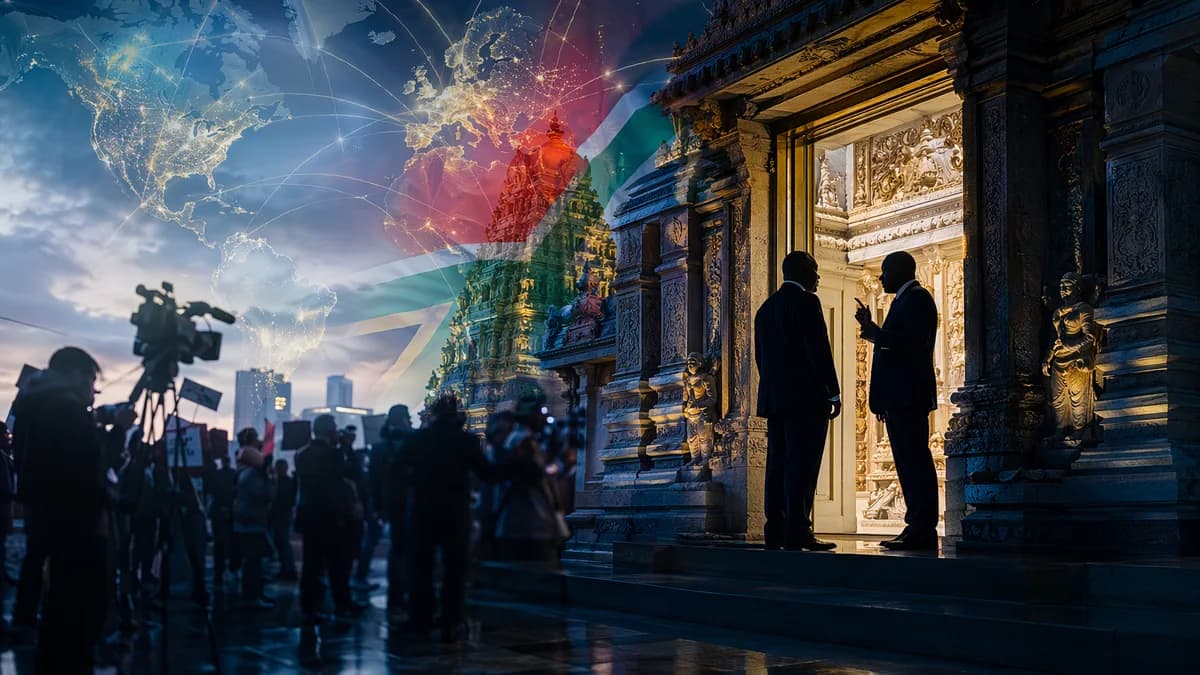
If the Jacob Zuma Ajay Gupta meeting can happen in public while Zuma reportedly talks about running South Africa again, what did the country’s state capture reckoning actually settle?
XOOMAR Intelligence
Analyst Take
A photograph of Jacob Zuma with Ajay Gupta at an Indian temple was shared by Indian media this week, according to BBC World. The image reopened one of South Africa’s deepest political wounds: the allegation that the Gupta family profited from its links to Zuma and influenced policy during his presidency. Zuma and the Guptas have denied wrongdoing.
Why does the Jacob Zuma Ajay Gupta meeting land as defiance rather than private travel?
Because the Gupta name is not neutral in South Africa. It is shorthand for state capture, the phrase used for allegations of massive fraud involving political influence, state power, and private gain.
The photograph matters because Zuma is not a retired politician fading from view. He now heads the uMkhonto weSizwe (MK) party and, after the temple meeting in India, reportedly said he would stand for re-election in South Africa’s next elections. That turns the image from a personal encounter into a political signal.
Cabinet minister Khumbudzo Ntshavheni framed it in brutal terms at a Friday press briefing:
"very disturbing that a former state president openly and unapologetically shows the middle finger to South Africans who have lost a lot of money through the Gupta brothers' shenanigans"
XOOMAR analysis: the anger is not only about who Zuma met. It is about where the meeting sits in the public memory. Zuma was forced out of office in 2018 after a string of corruption allegations. The Gupta family left South Africa the same year after a judicial commission began investigating state capture allegations. Seeing Zuma beside Ajay Gupta now reads, to critics, as a refusal to treat that history as politically disqualifying.
Why does the Gupta name still detonate South African politics?
The scandal still burns because South Africans never saw a clean public break between the Zuma era and the people accused of benefiting from it.
Around a decade ago, the Gupta brothers were accused of profiting from their close relationship with then-President Zuma and influencing South African policy. The BBC reports that both parties denied wrongdoing. That denial matters legally. But politically, the allegations stuck because they attached themselves to the presidency itself.
The timeline keeps the wound open:
| Event | Source-backed detail |
|---|---|
| State capture allegations | Gupta brothers accused of profiting from Zuma links and influencing policy |
| 2018 | Gupta family left South Africa after a judicial commission began investigating allegations |
| 2018 | Zuma was forced out of office after corruption allegations |
| 2023 | A court in the UAE turned down South Africa’s extradition request for Atul and Rajesh Gupta |
| Now | Zuma photographed with Ajay Gupta in India |
The harder question is not whether one photograph proves anything new. It doesn’t. The harder question is whether South Africa’s anti-corruption process has produced enough visible consequence to make old networks look politically costly.
Right now, Pretoria’s own language suggests frustration. International relations minister Ronald Lamola said South Africa will investigate the meeting. He also said it seemed Zuma was running “a parallel foreign policy”.
Which facts, not missing damage estimates, make this episode politically toxic?
The supplied sources do not provide a verified rand figure for losses tied to state capture, so XOOMAR won’t invent one. The available numbers are procedural and political, but they still explain why the Jacob Zuma Ajay Gupta meeting is toxic.
First, Zuma is 84 and still reportedly claiming he wants to run South Africa again. Ntshavheni said he “continues to show a middle finger and claim that he wants to run this country again”.
Second, the Gupta family left South Africa in 2018, the same year Zuma exited the presidency. That gives the controversy a frozen quality. The main figures did not simply disappear from public memory. They moved into a long-running argument over accountability.
Third, the extradition record is messy. The two younger Gupta brothers, Atul and Rajesh, went to the United Arab Emirates, where a court in 2023 rejected South Africa’s request to extradite them. South African authorities cancelled their arrest warrant for Ajay Gupta the year after the family left South Africa, according to the BBC.
Daily Maverick also reported that the National Prosecuting Authority confirmed there is no warrant of arrest against Ajay and no active extradition proceedings against any of the three brothers. That legal status complicates the politics. Critics can rage at the optics, but officials still have to operate inside the limits of warrants, extradition requests, and prosecutorial decisions.
How do Zuma, Pretoria, and voters read the same photograph?
Zuma’s side is not directly quoted in the supplied material responding to this latest criticism. He has long denied wrongdoing. That leaves the public with competing interpretations of the image.
Pretoria’s interpretation is clear. Ntshavheni called it a “disgrace” that South Africa’s high commissioner to India, Anil Sooklal, had accompanied Zuma to the meeting with Gupta. Daily Maverick reported that photos showed Zuma, Sooklal and Gupta with Swami Kailashanand Giri at a prayer meeting at the Sidipeeth Shri Dakshin Kali Temple in Haridwar, India, on 26 June.
She also said:
“It is a level of disgrace that our own employee, the representative of the government of South Africa, hobnobs with criminals instead of doing his work to ensure that the fugitives are brought back into South Africa so that they can face criminal charges”
That quote is politically explosive, but it also raises a legal tension. Ajay Gupta is accused in the broader state capture narrative, yet the NPA status reported by Daily Maverick means officials cannot pretend the legal machinery is in a different place than it is.
XOOMAR analysis: this is why the episode cuts so sharply. Zuma’s critics see elite impunity. Zuma’s supporters may see another round of political targeting. Government officials see diplomatic discipline at risk. Ordinary citizens are being asked to absorb a distinction between moral outrage and legal process, a distinction that feels thin when the same names keep returning to the center of politics.
Where did the accountability machine hit its visible limits?
The visible limits are cross-border enforcement, slow institutional follow-through, and the awkward gap between public findings and courtroom outcomes.
The judicial commission into state capture began after years of allegations. Zuma left office. The Gupta family left South Africa. Yet the extradition effort against Atul and Rajesh failed in the UAE in 2023, and Ajay’s arrest warrant was cancelled after the family’s 2018 departure.
That does not prove impunity as a legal matter. It does show why the politics remains combustible. A country can hold inquiries, issue findings, and condemn conduct, but if the public sees few courtroom consequences, symbolic moments carry extra weight.
For XOOMAR readers tracking accountability fights beyond South Africa, this sits alongside wider questions raised in cases like the Daphne Caruana Galizia trial, where public trust depends on whether institutions can answer politically charged allegations in court, not just in speeches. The same public-cost question appears in a different form in 1% Emissions Excuse Shields Rich Nations from Cuts, where responsibility and burden-sharing drive the politics.
What risks does this create for politics, diplomacy, and business confidence?
The immediate risk is political. The Jacob Zuma Ajay Gupta meeting gives Zuma’s opponents a clean image to use: the former president, the Gupta brother, India, and the suggestion of a comeback. No long explanation required.
The diplomatic risk sits with Sooklal. Lamola has ordered an investigation, and Ntshavheni said government officials abroad are expected to uphold South Africa’s laws. Daily Maverick reported that Lamola requested an internal report on Sooklal’s presence at the event.
For business readers, the signal is institutional rather than market-based. The sources do not report investor reaction, capital flows, or pricing moves. But when a cabinet minister says a former president appears to be running “a parallel foreign policy”, the concern is obvious: policy credibility depends on a state speaking with one voice, especially on law enforcement and international cooperation.
XOOMAR analysis: the scandal’s staying power comes from that gap. South Africa’s government wants to project control over accountability and diplomacy. Zuma’s public posture suggests he does not accept that control as politically binding.
Which evidence will show whether this was only a scandalous photo or something bigger?
Three things will decide whether this fades or hardens into a larger political fight.
Investigation: Lamola’s inquiry into the India meeting needs to clarify what Sooklal did, who authorized any official support, and whether former-president privileges were involved.
Legal status: Any update from prosecutors on Gupta-linked matters will matter more than another round of denunciations. The current record, as reported, includes no arrest warrant against Ajay and no active extradition proceedings against the three brothers.
Election messaging: If Zuma keeps presenting himself as a future ruler while standing beside figures tied to state capture allegations, rivals will use the image as proof that the past is not past.
The test is not whether South Africans are angry. Ntshavheni’s comments show that anger is already official. The test is whether the state can turn outrage into clear administrative action, legal clarity, and a foreign-policy line that Zuma cannot blur.
Impact Analysis
- The meeting revives South Africa’s unresolved anger over state capture allegations tied to Zuma and the Gupta family.
- Zuma’s continued political ambitions make the encounter more than symbolic, potentially reshaping voter perceptions ahead of future elections.
- The public reaction shows that accountability for past corruption claims remains a central issue in South African politics.
Primary Sources & Disclosures

Written by
XOOMAR Insights Team
Research and Editorial Desk
The XOOMAR Insights Team pairs automated research with human editorial judgment. We track hundreds of sources across technology, fintech, trading, SaaS, and cybersecurity, cross-check the facts, and explain what happened, why it matters, and what to watch next. We do not just rewrite headlines. Every article is fact-checked and scored for reliability before it goes live, and we link back to the original sources so you can verify anything yourself.