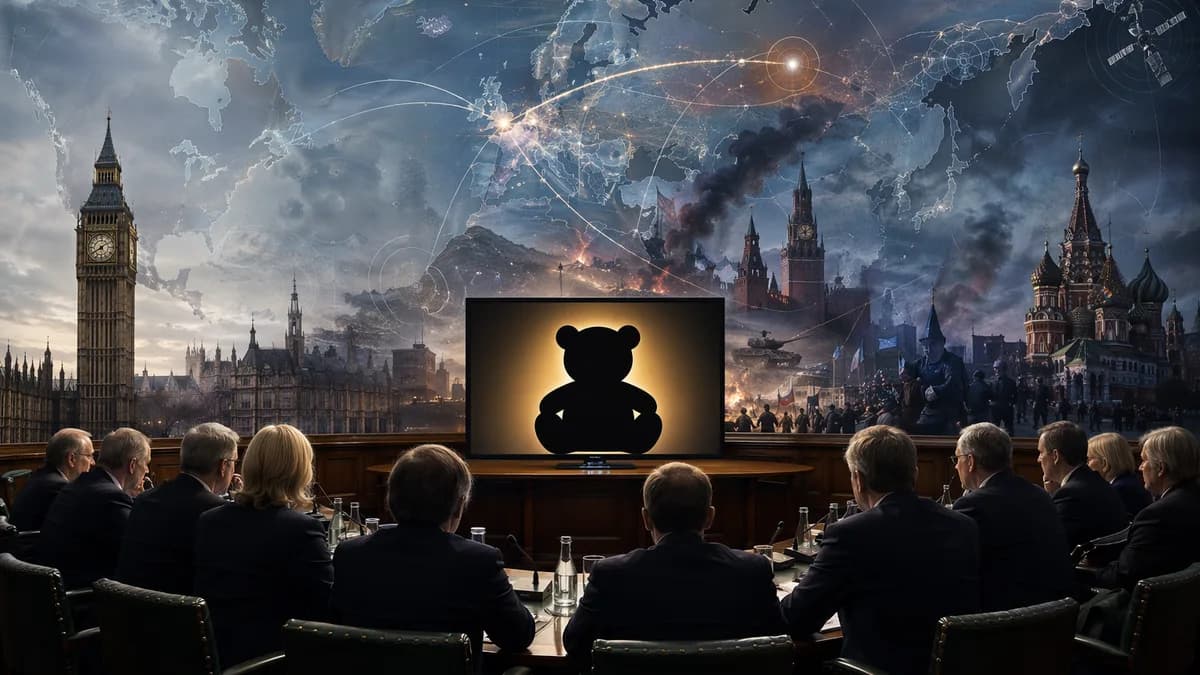
The UK should not let Masha and the Bear become the test of its resolve against Russian influence. More than 50 MPs from a cross-party group have asked ministers to examine whether the Russian preschool cartoon can be stopped from UK broadcast, according to Guardian World. They’re right to scrutinize Russian soft power. They’re wrong if this becomes a push for cartoon censorship.
XOOMAR Intelligence
Analyst Take
The show is not marginal. Masha and the Bear is one of the most popular shows of all time on YouTube, one seven-minute episode, Recipe for Disaster, has more than 4.6bn views, and the series has recently been recommissioned for Netflix. It is also available on ITVX.
That scale justifies attention. It does not automatically justify a ban.
Banning Masha and the Bear would hand Moscow an easy propaganda win
The MPs’ complaint is not absurd on its face. They argue that some episodes contain Soviet military imagery that young children are unlikely to understand but may absorb as cheerful costume play. Their letter points to one scene where Masha appears in a tank-crew hat and Soviet-era uniform, and another where she wears what MPs describe as a Soviet border guard’s cap associated with the NKVD.
That is serious imagery. The MPs say the NKVD was “responsible for mass deportations, executions and the persecution of tens of millions of people.”
But the remedy matters. If ministers try to pull Masha and the Bear from UK screens, Britain risks looking brittle: a liberal democracy rattled by a mischievous animated girl and a retired circus bear. That’s exactly the optics hostile states enjoy. They can point at the West and say its free-speech principles collapse when challenged.
The smarter answer is scrutiny, transparency, and media literacy. Not a headline-friendly ban.
Russian soft power is real, but this preschool cartoon is a weak target
Russian soft power is not imaginary. The show has been criticised by Ukraine’s Center for Countering Disinformation, which is backed by the Ukrainian government, and by Margus Tsahkna, Estonia’s minister of foreign affairs.
The Ukrainian body called Masha and the Bear:
“not just a cartoon, but an instrument of Russian soft power”
It argued the series features “the mockery of other nations’ traditions through Masha’s behaviour, and the normalisation of Soviet symbols and militaristic themes.”
Tsahkna went further after the Netflix deal was announced:
“Masha and the Bear is part of the Kremlin’s soft power, embedding pro-Kremlin and militaristic messaging in children’s entertainment.”
Those objections deserve a hearing. Culture can carry power without campaign slogans. A cute character, a familiar uniform, a gentle bear, and a repeated moral universe can do work that a government press release never could.
Still, not every Russian cultural export is operational propaganda. Treating all Russian-made children’s entertainment as if it were an active Kremlin instrument blurs the line between influence, identity, nostalgia, commercial entertainment, and state messaging. That line is where serious policy lives.
A UK ban on a preschool cartoon would invite ridicule instead of resilience
A ban would risk turning Masha and the Bear into a free-speech talking point instead of a case study in platform scrutiny. That risk is not a prediction about audience behavior. It is a political reading of the source material: Russian state media have already ridiculed the idea that the show features propaganda.
MPs should not make that job easier.
Government intervention in children’s media should clear a high bar. Parents already choose what their children watch. Broadcasters and platforms also make catalog decisions. Whitehall sources told the Guardian it was up to broadcasters what they featured, provided content stayed within broadcasting rules overseen by Ofcom.
That position is not cowardice. It is institutional discipline.
A stronger approach would ask sharper questions:
| Response | What it tests | Main risk |
|---|---|---|
| Broadcast ban | Whether ministers can remove the show | Looks censorious unless direct harm is proven |
| Platform scrutiny | Ownership, licensing, funding, distribution, and editorial context | Slower, less theatrical |
| Parental transparency | Whether families can make informed choices | Depends on clear disclosures |
| Media literacy | Whether children and adults can read symbols critically | Requires sustained effort |
The boring tools are usually the better ones.
Ofcom and broadcasters have better tools than cartoon censorship
The UK does not need to invent a special regime for animated bears. It can examine the real mechanics: who owns the rights, who funds production, who licenses distribution, how platforms describe the show, and whether political or military imagery is presented in a way that breaches existing rules.
The MPs’ own letter points to distribution as the core issue. They wrote:
“British parents have a right to expect that content reaching their children through licensed platforms has been subject to proper scrutiny, especially where credible concerns about state propaganda have been raised by our allies.”
That is the strongest part of their argument. It focuses on scrutiny, not panic.
Analysis: Platforms such as Netflix and ITVX should be expected to know what they are carrying, especially when a children’s title comes with objections from allied governments or state-backed bodies. If there are meaningful state-linked financing or distribution ties, those should be clear. If there are none, that should also be clear.
Animaccord, the studio behind the show, strongly disputes the allegations. Its spokesperson Melanie Bonvicino told the Guardian:
“My client categorically rejects the false and defamatory suggestion that Masha and the Bear is associated with propaganda.”
She added:
“For nearly two decades, Masha and the Bear has entertained families in more than 100 countries through universal themes of friendship, kindness and imagination. The series contains no political messaging, and any claim to the contrary is wholly unsupported by its content.”
That denial matters. Evidence should decide policy, not vibes.
The serious case against Masha and the Bear cannot be waved away
The best argument for intervention is not that preschoolers understand the NKVD. They don’t. The better argument is that children’s media works through repetition, affection, and trust. Parents may not expect geopolitical messaging inside harmless-looking entertainment, and they should not need a degree in Soviet iconography to evaluate a cartoon.
Russia’s war against Ukraine gives allied governments every reason to inspect commercial and cultural channels that may benefit Russian influence. When Estonia’s foreign minister says Soviet symbols represent “occupation, mass killings, deportations and crimes against humanity,” UK lawmakers should listen.
There is also a public-symbol dimension here. XOOMAR readers have seen how cultural decisions can become proxy fights over values in our coverage of the Tom Stoppard Theatre taking the Duke of York’s West End spot, and how policy flashpoints can turn quickly into tests of political nerve, as in Labour’s UK asylum reforms fight. Masha and the Bear is a different kind of dispute, but the same warning applies: symbolic fights can crowd out harder governance.
Britain should answer Russian influence with judgment, not cartoon bans
The affirmative case is simple. Teach children, parents, and schools how stories shape loyalty, authority, humor, fear, and national image. Give families better information. Ask platforms harder questions. Require broadcasters to show their work when concerns are credible.
That approach is tougher than a ban because it cannot be solved with one ministerial gesture. It asks Parliament to build public judgment rather than outsource judgment to the state.
Practical steps ministers can take without overreaching:
- Review: Examine the specific episodes, imagery, licensing route, and platform compliance record.
- Publish: Release clear findings so parents are not left with rumor, denial, and political theatre.
- Disclose: Push platforms to explain meaningful funding, ownership, or distribution links where they exist.
- Scrutinize: Keep Ofcom’s role focused on rules and evidence, not ideological taste.
- Educate: Treat media literacy as a defence mechanism, not a classroom luxury.
Let families switch off Masha and the Bear if they don’t like it. Let broadcasters drop it if the evidence justifies that decision. But ministers should resist symbolic bans unless direct harm is proven.
A confident democracy can spot propaganda without behaving like the regimes it criticizes. Parliament’s job is to defend children from manipulation by strengthening public judgment, not by treating them as too fragile to watch a cartoon.
Impact Analysis
- The debate tests how the UK balances national security concerns with free-expression principles.
- Masha and the Bear has huge reach, including a YouTube episode with more than 4.6bn views.
- A ban could amplify Russian propaganda claims that Western democracies censor opposing cultural content.
Possible UK responses to Masha and the Bear
| Approach | Potential benefit | Risk |
|---|---|---|
| Broadcast ban | Signals a tougher stance on Russian influence | Could hand Moscow a propaganda win and raise censorship concerns |
| Scrutiny, transparency and media literacy | Addresses soft-power concerns without suppressing content | May be seen as a weaker response by critics |
Primary Sources & Disclosures
- [1]Guardian World
- [2]MPs seek to end UK broadcast of Russian ‘soft power’ cartoon Masha and the Bear
- [3]British Lawmakers Call for Ban on "Masha and the Bear" Over Russian Propaganda Claims
- [4]British MPs demand Russian 'propaganda' cartoon Masha and the Bear be removed from streaming services — Novaya Gazeta Europe

Written by
XOOMAR Insights Team
Research and Editorial Desk
The XOOMAR Insights Team pairs automated research with human editorial judgment. We track hundreds of sources across technology, fintech, trading, SaaS, and cybersecurity, cross-check the facts, and explain what happened, why it matters, and what to watch next. We do not just rewrite headlines. Every article is fact-checked and scored for reliability before it goes live, and we link back to the original sources so you can verify anything yourself.