
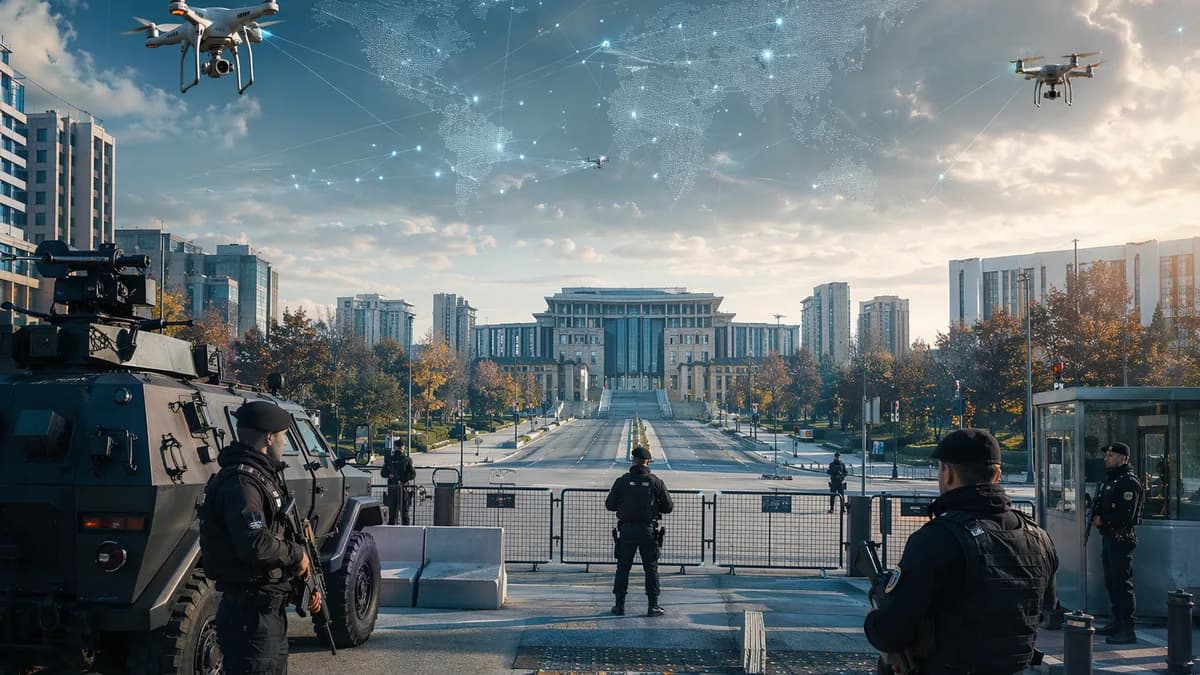
A summit built to project NATO unity is turning Ankara into a controlled security zone, and that tension is the real story of the Turkey NATO summit.
Global TrendsJuly 1, 2026· 8 min read· By XOOMAR Insights Team
Locked-Down Ankara Flexes Before Turkey NATO Summit
Updated on July 1, 2026
XOOMAR Intelligence
Analyst Take
57/ 100
4 sources analyzedLow confidenceTrend10Freshness98Source Trust85Factual Grounding91Signal Cluster20
Turkey is deploying tens of thousands of police, putting air defenses on high alert, banning public gatherings, and restricting access across parts of the capital before leaders from all 32 NATO member states arrive on July 7 and 8, according to ABC International. The official logic is protection. The political signal is broader: Ankara wants to show allies that it can secure the alliance’s most sensitive table while insisting it won’t behave like a junior partner inside it.
Turkey turns NATO summit security into a message of state power
The Turkey NATO summit was expected to center on alliance cohesion, defense spending, and the U.S. role under President Donald Trump. Instead, the host city itself has become part of the message.
Ankara is not treating the summit as routine diplomatic theater. It has unveiled a new VIP airport, converted from a former military airfield, specifically to receive NATO leaders. It is tightening access around airports, major roads, the presidential complex, and delegation hotels. It has also banned demonstrations, concerts, and graduation ceremonies during the summit period.
That combination matters. XOOMAR analysis: Turkey is using summit security as a performance of state capacity. The visible policing, mobility controls, and air-defense readiness tell NATO partners that Turkey can manage risk at scale. They also tell domestic audiences that the state, not the street, defines the terms of public order during a global event.
The contradiction is sharp:
- Expected frame: A diplomatic summit about NATO unity.
- Revealed reality: A controlled capital where security, dissent, and alliance politics collide.
- Political payoff: Turkey gets to present itself as indispensable, disciplined, and hard to ignore.
Thousands of police, protest bans, and restricted streets reshape Ankara before the NATO gathering
The measures go well beyond motorcades and sealed hotel perimeters. Authorities are placing parts of Ankara, a city of nearly 6 million, under strict access limits. Non-essential state employees have been placed on leave to ease congestion. Security units have detained more than 200 people suspected of links to extremist groups, including the Islamic State group, authorities said.
Media reports cited in the source said activists, lawyers, and an academic were among those caught up in the sweep. A Turkish court also blocked access to websites critical of NATO and the summit on security and public order grounds, according to Engelli Web, which tracks blocked websites in Turkey. Several journalists from opposition-leaning Turkish media organizations were denied accreditation, drawing criticism from media rights groups.
“In the history of the organization, we have never witnessed security measures as stringent and suffocating in a host city for a summit as we are seeing this time in Ankara,” wrote Namik Tan, a former Turkish ambassador and legislator from Turkey’s main opposition party.
XOOMAR analysis: Large summits always bring layered security. The difference here is the breadth of social restrictions. Banning public gatherings and limiting media access changes the summit from a protected event into a test of political space.
Ankara’s NATO message: loyal ally, regional heavyweight, hard negotiator
Turkey enters this summit with a complicated NATO record. It has been a member since 1952, has the alliance’s second-largest army after the United States, and sits at the junction of Europe, the Middle East, the Black Sea, and the Caucasus.
That makes Ankara valuable. It also makes it difficult.
Turkey has refused to participate in sanctions on Russia, clashed with Greece, and bought Russian missile defense systems, a decision that led to its expulsion from the U.S.-led F-35 program in 2019. It delayed Finland and Sweden’s NATO membership until it secured concessions on counter-terrorism cooperation and the lifting of arms export restrictions. It also blocked the appointments of NATO chiefs Anders Fogh Rassmussen in 2009 and Mark Rutte in 2024 until demands were met.
Yet the same independent streak has given Turkey diplomatic room. The source notes its role in brokering a deal to ship grain across the Black Sea between Ukraine and Russia in 2022, and its support for recent initiatives aimed at ending the war in Iran.
“Turkey wishes to distinguish itself as a foreign policy actor that is independent of NATO and the West,” wrote Hamish Kinnear, principal Middle East and North Africa analyst at Verisk Maplecroft. “While Turkey is not abandoning its balancing approach, it is tilting closer to the West, primarily because of NATO.”
That is the core of Ankara’s pitch: Turkey may be difficult, but it is too central to sideline.
From failed coup aftershocks to modern summit policing, Turkey defaults to high-alert control
Turkey’s summit posture also reflects its own security memory. Ankara has cited a history of terrorist attacks, and the source says the capital is no stranger to tight security. But the measures around this NATO event appear to go beyond the usual.
The aftershocks of the failed 2016 coup attempt still shape how Ankara views risk and alliance solidarity. The source notes Turkey’s frustration with NATO allies over what it saw as a lack of support after the coup attempt, as well as arms sales restrictions imposed after Turkey’s intervention in Syria.
That grievance feeds Turkey’s diplomatic style. Murat Aslan, an analyst at the Ankara-based SETA think tank, said Turkey learned to “play it alone” because of turbulent relations with the United States and Europe. He added that Europe is now also discussing “strategic autonomy” from the U.S.
For readers tracking the defense side of this debate, XOOMAR has covered related political fights over military spending in Rutte Boxes Burnham in on UK Defence Spending Pledge and the fiscal pressure described in £4.7bn Hole Haunts Starmer Defence Investment Plan. Those disputes sit outside the Ankara security file, but they underline why NATO’s spending agenda is politically sensitive across member states.
Trump’s attendance turns the Turkey NATO summit into a U.S.-Europe stress test
The summit’s strategic stakes rise because Trump is expected to attend. His threats to withdraw from NATO and reduce U.S. troop levels have cast uncertainty over the alliance’s future, according to the source.
Turkey’s role as host appears to have helped secure his presence.
“Well, except for the fact that it was being held in Turkey by President Erdogan, I don’t think I would have gone to it,” Trump told reporters after meeting NATO Secretary General Mark Rutte at the White House.
That comment gives President Recep Tayyip Erdogan leverage as host. The main agenda will center on unity after Trump criticized allies for failing to support the U.S.-led war on Iran and efforts to reopen the Strait of Hormuz.
Fatih Ceylan, a former Turkish ambassador to NATO and security analyst at the Ankara Policy Center, framed the summit’s realistic ceiling clearly:
“The important aspect of the meeting is to what extent the rift between the United States and Europe can be healed or narrowed during the summit,” Ceylan said. “We should not expect miracles, but nonetheless if there is a convergence of ideas emphasizing the importance of NATO, that should be seen as a success.”
The security model tests Turkey’s alliance credibility and civil-liberties image
The security plan gives Turkey a chance to reassure NATO that it can protect leaders during a volatile period. The Iran war sharpened that point. The source says alliance missile defenses intercepted four missiles fired from Iran into Turkish territory, and that Italy and Germany deployed air defense systems weeks before the summit to help Turkey respond to heightened threats.
That supports Ankara’s argument that NATO still matters directly to Turkish security.
But the civil-liberties tradeoff is visible. Demonstration bans, blocked websites, denied accreditation, and mass detentions can feed criticism that Turkey’s public space narrows when political stakes rise. The summit is meant to display unity among democracies. The host-city experience may instead expose how differently NATO members define acceptable limits on protest, media access, and public order.
XOOMAR analysis: The risk for Ankara is not that allies object to security. They won’t. The risk is that the image of control overwhelms the message of confidence.
Turkey’s NATO summit playbook points to tougher policing and sharper bargaining after delegations leave
The evidence to track after the Turkey NATO summit is not just the final communiqué. Watch how Ankara handles dissent during the summit window, whether blocked media and websites remain restricted afterward, and whether Erdogan converts the event into diplomatic gains on defense procurement, counter-terrorism demands, or regional crisis management.
A smooth summit would strengthen Turkey’s case that its high-control model works. Visible overreach would renew scrutiny of civil liberties and give critics a cleaner argument: Ankara can secure NATO leaders, but at a cost to open public politics.
Turkey is not merely hosting. It is staging an argument about power, reliability, and who gets to define security inside a tense alliance.
Impact Analysis
- Turkey is using summit security to project strength to NATO allies and domestic audiences.
- Restrictions on gatherings and movement highlight the tension between public order and civil freedoms.
- The summit underscores Ankara’s effort to show commitment to NATO without appearing subordinate inside the alliance.
Summit Framing vs. On-the-Ground Reality
| Expected/Official Frame | Revealed Signal |
|---|---|
| NATO unity and diplomatic coordination | A heavily controlled capital shaped by security restrictions |
| Protection for leaders from 32 NATO member states | A display of Turkish state capacity and control |
| Routine summit logistics | A political message that Ankara is a powerful, independent NATO actor |
Sources

Written by
XOOMAR Insights Team
Research and Editorial Desk
The XOOMAR Insights Team pairs automated research with human editorial judgment. We track hundreds of sources across technology, fintech, trading, SaaS, and cybersecurity, cross-check the facts, and explain what happened, why it matters, and what to watch next. We do not just rewrite headlines. Every article is fact-checked and scored for reliability before it goes live, and we link back to the original sources so you can verify anything yourself.
Explore More Topics
Related Articles
 Global Trends
Trump Ties South Korea Drills To Iran Feud
President Trump is slashing joint military exercises with South Korea as a direct punishment for Seoul's refusal to support U.S. pressure on Iran, turning allia
Aug 16, 20267 min
 Global Trends
Trump Halts $20 Billion 50% Tariff Hours From Deadline
Donald Trump paused a 50% tariff on $20 billion of Canadian imports at the eleventh hour, claiming a deal was reached after tensions over autos and dairy.
Aug 19, 20264 min
 Global Trends
Trump’s Sudden Drill Cut Sparks Seoul Security Crisis
Trump's abrupt order to gut US-South Korea joint drills aligns with President Lee Jae Myung's stated goals, but its unilateral nature has triggered a profound c
Aug 19, 20265 min
 Global Trends
Gas Hits $4.06, a Record Tax on Failed Diplomacy
The failure of US-Iran peace talks has directly spiked gas prices to a record $4.06 per gallon for August, turning stalled diplomacy into a new consumer tax.
Aug 17, 20268 min
 Global Trends
Incheon Airport Crowned World's Busiest by Iran War
South Korea's Incheon International Airport became the world's busiest for international passengers in early 2026, a surge directly fueled by flight diversions
Aug 16, 20266 min
 Technology
Amazon Drone Swarm Targets 500 U.S. Cities by Late 2026
Amazon plans a massive sixfold expansion of its Prime Air drone delivery service, aiming to operate in nearly 500 U.S. cities by the end of 2026.
Aug 19, 20265 min
 Trading
Silver Stalls as Inflation Threat Turns Against It
Silver's rally fizzled at $66.50 as the inflationary risks that typically boost it are now creating uncertainty, keeping buyers on the sidelines ahead of the Fe
Aug 19, 20266 min
 Cybersecurity
U.S. Charges Iran in Multi-Billion Dollar Hacking Heist
U.S. prosecutors charged 17 Iranians with stealing over $3 billion in intellectual property from American universities and companies for Iran's Revolutionary Gu
Aug 19, 20265 min
 Global Trends
Russian Missile Assault Targets Kyiv Civilian Lifelines
Russia has shifted its tactics, launching a missile assault on Kyiv designed not to win territory, but to systematically grind down civilian infrastructure and
Aug 20, 20265 min
 Technology
Reach Capital VCs Place $265 Million Bet on Human-First AI
Reach Capital raised $265 million in an AI fund focused on startups that augment human potential in work, education, and health, signaling a niche-driven ventur
Aug 20, 20264 min
Don't miss the signal
Get our weekly roundup of the stories that matter across tech, fintech, and trading. No noise, just signal.
Free forever. No spam. Unsubscribe anytime.