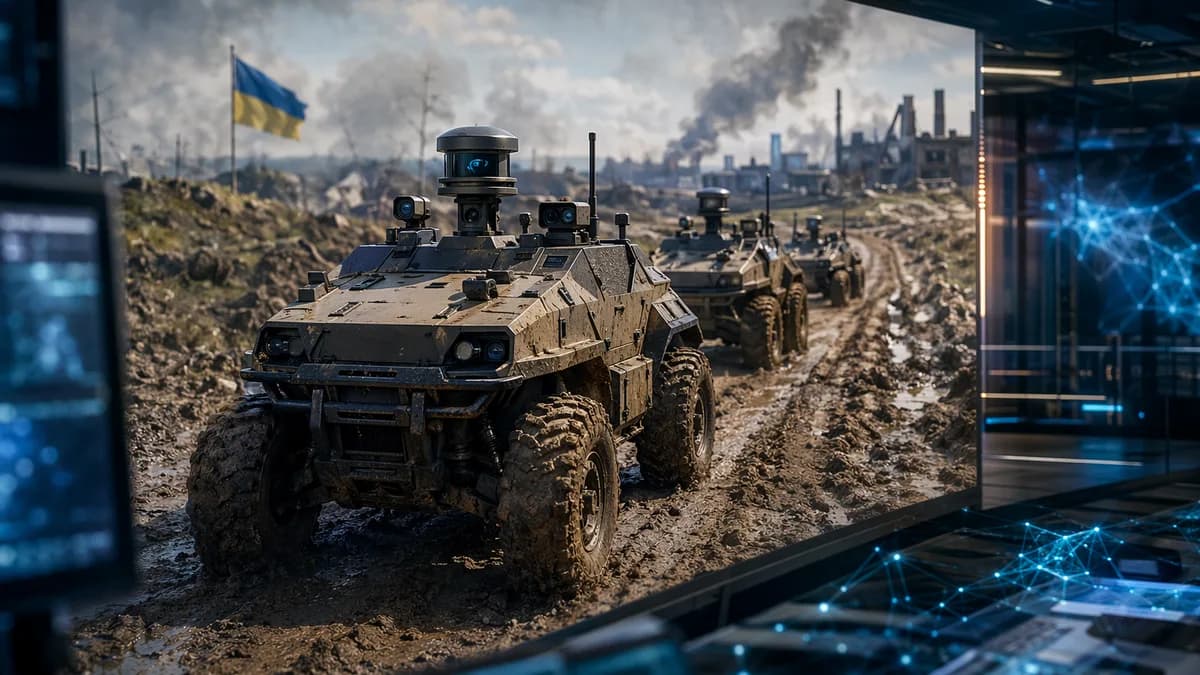
If more than 100 American autonomous ground vehicles in Ukraine are already taking real battlefield risks, are they changing this war now, or mainly training the next one?
XOOMAR Intelligence
Analyst Take
Forterra, a US autonomous vehicle company, has deployed more than 100 self-driving ATVs in Ukrainian conflict zones over the past nine months, according to TechCrunch. The company believes it is the largest combat deployment of autonomous ground vehicles by any US defense tech company.
That claim matters less as a trophy than as a test. Ukraine has become the place where military robotics leaves the demo range and meets mud, artillery, electronic warfare, exhausted troops, and vehicles that can be lost for good.
“I believe this to be true of every defense technology that’s ever been created—until you hit the realities of combat, you’re just not going to know,” Scott Sanders, Forterra’s chief growth officer and a former US Marine officer, told TechCrunch.
The central tension is blunt: land autonomy has lagged aerial drones because the ground is uglier. A drone can crash and be replaced. A ground robot can get stuck, captured, targeted, or become another logistics problem. Ukraine is forcing that gap to close.
Are Forterra’s Ukraine vehicles combat tools or data collectors with wheels?
They are both, and that’s the point.
Forterra’s Lancer vehicles are based on Polaris ATVs, fitted with a custom sensor and compute stack, and powered by gas rather than batteries. That gives them a major payload edge over many Ukrainian-built ground robots cited by TechCrunch. A Ukrainian soldier who has worked with UGVs told the outlet that local battery-powered systems typically carry up to 250 kilograms, while Forterra’s Lancers can carry 750 kilograms.
That changes the mission profile. A heavier vehicle can move more ammunition, supplies, equipment, or casualties through exposed areas where human movement has become brutally dangerous.
The numbers show this is no token deployment:
| Forterra Ukraine metric | Reported figure |
|---|---|
| Vehicles deployed | More than 100 |
| Time in Ukraine conflict zones | Nine months |
| Distance driven | More than 2,500 miles |
| Missions completed | More than 1,100 |
| Total weight carried | 777,440 pounds |
| Casualty evacuations | 52 |
The Ukrainian soldier’s verdict was not polished procurement language.
“The bottom line is that this UGV for logistics and just maintaining our defense is the most important UGV in Ukraine,” the soldier said. “It’s fucking fantastic, and we are dying to get more.”
XOOMAR analysis: the most important metric here is not autonomy purity. It is whether a vehicle removes soldiers from exposed movement. In Ukraine, logistics is combat. A machine that repeatedly carries weight across the last dangerous stretch can matter more than a vehicle that performs a perfect autonomous demo under controlled conditions.
That war-wide pressure sits alongside the broader Ukrainian fight XOOMAR has tracked, including Deadly Kyiv Strikes Corner NATO on Ukraine Air Defenses and Ukraine Drones Strike St. Petersburg Oil Terminal Again. Forterra’s deployment belongs to that same hard pattern: Ukraine is turning every survivable movement, strike, and resupply route into a technology problem.
Why is ground autonomy harder in Ukraine than the marketing suggests?
Because the vehicle is not just driving. It is surviving.
Aerial drones have dominated public attention in Ukraine, but TechCrunch’s reporting shows why ground systems are now drawing urgency. Surveillance from above has created extensive no-go zones where being seen can quickly mean being hit.
Sergeant Major Corey Wilkens, who leads a US Army program developing autonomous vehicles and tactics, put it plainly:
“There’s nowhere to hide,” Wilkens said. “You become very, very vulnerable to be able to be attacked by [first-person view drones], other sorts of drones dropping munitions, artillery, mortar, the full range of things that they have.”
That environment punishes fragile systems. Forterra has lost some vehicles in combat, especially when they got stuck in deep mud or terrain where Russian forces could target them. That detail is critical. A ground robot’s failure mode is not a software bug in a lab. It can become a visible, immobile asset waiting to be destroyed.
Electronic warfare adds another constraint. Forterra has learned lessons about electronic warfare, remote software updates, maneuvering in difficult conditions, and keeping vehicles from breaking down, according to TechCrunch. The company also had to adapt its systems for Ukraine. One important modification was adding a Starlink satellite internet antenna.
XOOMAR analysis: Ukraine is testing the full stack, not just the vehicle. Mobility, communications, repairability, software updates, operator workflow, and cost all collapse into one battlefield question: can the system keep moving when conditions are bad and people are under pressure?
Why are soldiers still teleoperating vehicles that are supposed to be autonomous?
Because battlefield autonomy is not the same as route navigation.
TechCrunch reports that Ukrainian soldiers have mainly been teleoperating Forterra’s vehicles in combat zones. The reasons are practical. The vehicles are valuable, and current autonomy is not ready to handle every combat surprise.
The Ukrainian soldier explained the core limitation:
“We actually need to be able to respond to the enemy threats, live, while it’s in front of the enemy, which the autonomy doesn’t know how to do yet.”
That line cuts through the hype. A vehicle may navigate diverse terrain autonomously, but war demands judgment under hostile uncertainty. Unexpected enemy forces are not traffic cones. They are dynamic threats.
Forterra is trying to bridge that gap by combining older self-driving algorithms with newer generative AI software that can respond more generally to surroundings. Sanders told TechCrunch the data problem is different from civilian autonomy.
“There’s a lot of things you have to do that aren’t available in an open source model because they’re not things that humans do, whether that’s figuring out how to navigate a minefield or [operating] a weapon system,” Sanders said. “You need to be able to turn the dials and some things more of a classical robotics approach, and then leverage AI where you need to.”
The use of “leverage” is Sanders’ word, not ours. The underlying point is sound: military autonomy cannot simply import civilian driving models and call the job done. The battlefield contains tasks that normal human driving data does not capture.
Who has the most at stake if Forterra proves this works?
Different groups are watching different scoreboards.
For Ukrainian soldiers, the question is immediate. Can the robot carry enough weight? Can it get through mud? Can it bring out a wounded soldier? Can it keep humans off roads watched by drones?
For commanders, the value is endurance. Ukraine is already building its own UGVs for moving supplies, munitions, and wounded personnel. Forbes reported that President Volodymyr Zelensky ordered the military to field at least 50,000 UGVs in 2026, and that Ukrainian UGVs carried out more than 10,000 missions in April, mostly delivering supplies to frontline positions, according to Forbes.
For Forterra, the stakes are commercial and strategic. The company has raised more than $500 million in venture funding from investors including XYZ Venture Capital and Moore Strategic Partners. Real combat logs could strengthen its case for national security contracts. Bad logs would do the opposite.
Rivals are not absent. TechCrunch names Scout AI, which raised $100 million earlier this year to train foundation models and build military autonomous platforms including UGVs. Field AI and Overland AI are also trialling UGVs with the US military.
The US Army has been moving in the same direction. Small Wars Journal reported that the Army is pursuing commercial autonomous robotic capabilities and has shown interest in small UGVs as Ukraine reshapes battlefield robotics, according to Small Wars Journal.
Will armies buy smarter robots or cheaper ones they can afford to lose?
Ukraine’s answer is already visible: cheaper matters.
Forterra’s Lancers are not described by TechCrunch as expensive for their category, partly because they use Polaris’ commercial supply chain for the base vehicle. But they are still too valuable to use as freely as aerial drones.
The Ukrainian soldier put the procurement problem in one sentence:
“Attrition is just a fact of this battlefield, and we have lost a few at this point, and it hurt, and we need more, and therefore we need them cheaper.”
That is the buyer’s dilemma. A ground robot must be capable enough to be useful, rugged enough to survive, and cheap enough that losing it does not paralyze commanders. Too much sophistication can become a liability if it prices the vehicle out of attrition warfare.
XOOMAR analysis: the near-term market for American autonomous ground vehicles in Ukraine will likely reward practical logistics platforms before armed robotic assaults. The evidence in the source points that way. Forterra’s most praised value is cargo movement and casualty evacuation, not independent combat decision-making.
Scott Philips, Forterra’s chief innovation officer, visited a Ukrainian unit’s operations center and came away focused on workflow gaps.
“What struck me most was seeing exactly where the seams are: which steps are still manual, where data has to be re-entered or re-verified by hand, and where the team has already found ways to automate or speed things up,” Philips told TechCrunch.
That’s where the next fight sits. Not in a slick video. In the seams.
Which evidence will decide whether these robots become battlefield infrastructure?
The next phase will be judged by boring data.
Watch mission completion rates, vehicle losses, recovery rates, repair cycles, operator workload, software update speed, and performance when communications are degraded. Watch whether Forterra can cut cost without weakening payload, mobility, or reliability. Watch whether autonomy expands beyond navigation into threat-aware behavior that soldiers actually trust.
If future logs show fewer exposed troop movements, faster resupply, and repeatable casualty evacuation under pressure, Forterra Ukraine autonomous ground vehicles will look less like experimental hardware and more like battlefield infrastructure.
If losses climb, links fail, costs stay high, or operators keep carrying too much cognitive load, the lesson will be narrower: Ukraine gave the Pentagon and defense startups priceless data, but not yet a scalable answer.
The first American autonomous ground vehicles in Ukraine won’t settle the future of land warfare. They will help decide whether ground robots become a routine part of military logistics, or remain expensive machines that work best when the battlefield is less real.
Impact Analysis
- Ukraine is becoming a real-world testbed for autonomous ground warfare under combat conditions.
- Forterra’s deployment suggests US defense tech is moving beyond prototypes into active battlefield use.
- Higher-payload autonomous vehicles could reshape how armies move supplies, ammunition, and equipment under fire.
Forterra Lancer vs. Ukrainian Battery-Powered UGVs
| System | Base/Power | Reported Payload | Role |
|---|---|---|---|
| Forterra Lancer | Polaris ATV with gas power, custom sensors and compute | 750 kg | Autonomous logistics and battlefield data collection |
| Typical Ukrainian battery-powered UGVs | Battery-powered ground robots | Up to 250 kg | Local robotic support systems |
Reported Payload Capacity of Ground Vehicles in Ukraine
Primary Sources & Disclosures

Written by
XOOMAR Insights Team
Research and Editorial Desk
The XOOMAR Insights Team pairs automated research with human editorial judgment. We track hundreds of sources across technology, fintech, trading, SaaS, and cybersecurity, cross-check the facts, and explain what happened, why it matters, and what to watch next. We do not just rewrite headlines. Every article is fact-checked and scored for reliability before it goes live, and we link back to the original sources so you can verify anything yourself.