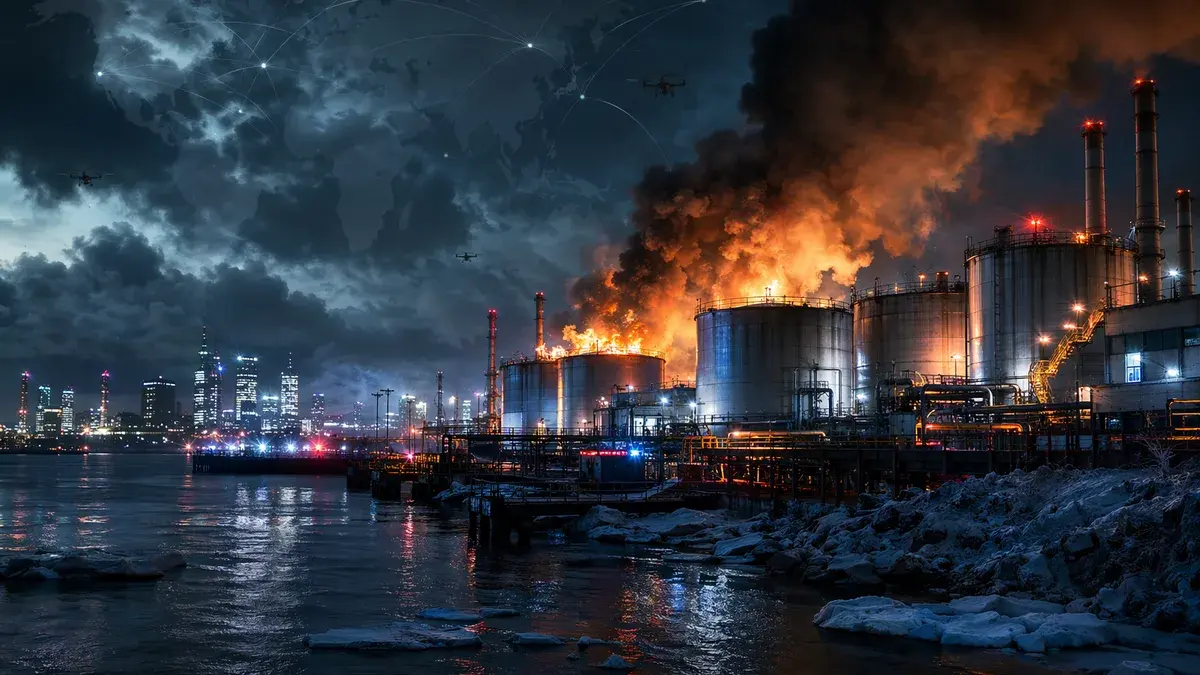
On Saturday, Ukrainian drones hit a St. Petersburg oil terminal, pushing Kyiv’s long-range campaign deeper into Russia’s energy system as the war enters its fifth year.
XOOMAR Intelligence
Analyst Take
Russian officials said the strike hit the Kirovsky district of Russia’s second-largest city, located on the Baltic Sea, according to ABC International. Gov. Alexander Beglov said Russian air defenses shot down 72 Ukrainian drones across St. Petersburg and the surrounding region.
July 4 strike puts St. Petersburg oil terminal back in Ukraine’s drone campaign
The St. Petersburg oil terminal attack marks another long-range Ukrainian strike on Russian oil infrastructure, an area Kyiv has targeted almost daily, according to the Associated Press report carried by ABC International.
Beglov said the Kirovsky district was hit. The source material does not confirm the scale of damage at the oil terminal, whether fires broke out, or whether the facility’s operations were disrupted. No casualty figure was reported for the St. Petersburg strike in the supplied material.
Ukraine did publicly claim the broader operation. President Volodymyr Zelenskyy described the attack as part of Ukraine’s “long-range sanctions” against Russia and said Ukrainian forces also hit a military target on Kronstadt, an island just off the coast of St. Petersburg.
“The Ukrainian defense forces hit the port oil infrastructure, which earns money for the Russian war,” Zelenskyy said in a post on Telegram.
The current hit follows an earlier strike on St. Petersburg’s Kirovsky district in June, ahead of the St. Petersburg International Economic Forum, Russia’s flagship investment event. Related AP reporting cited by CBC and NPR said Ukrainian drones in that earlier June attack flew more than 1,000 kilometres to reach the city and struck an oil terminal.
That distance matters. St. Petersburg is far from the main front line, and repeated attacks there show Ukraine can still reach high-profile Russian territory even as Moscow claims large drone interceptions.
Zelenskyy calls the strikes “long-range sanctions” as Russia reports 72 drones downed
The immediate information battle is sharp. Russia emphasized air defense activity. Ukraine emphasized economic pressure.
| Issue | Russian account | Ukrainian account |
|---|---|---|
| St. Petersburg hit | Beglov said Kirovsky district was struck | Zelenskyy said port oil infrastructure was hit |
| Drone interceptions | Beglov said 72 Ukrainian drones were shot down across the city and region | No matching Ukrainian interception count in the supplied material |
| Kronstadt | No detailed Russian confirmation in the supplied material | Zelenskyy said an “important military target” was hit |
| Damage | No confirmed damage assessment in the supplied material | Ukraine framed the target as infrastructure funding Russia’s war |
The source material supports a narrow but important conclusion: Ukraine is trying to impose costs on Russia’s oil-linked infrastructure, while Russia is trying to show it can absorb or blunt the strikes.
That fits the wider pattern described in the report. Almost daily long-range attacks on Russian oil facilities have created a fuel crisis and increased political pressure on the Kremlin. XOOMAR has tracked that pressure in Russia Fuel Shortages Fail to Crack Putin's War Bet, which examined why fuel strain has not yet translated into a visible break in Putin’s war posture.
The clearest sign of stress in the supplied material is Crimea, the peninsula Russia annexed in 2014. Heavy strikes there have led local authorities to suspend gasoline sales to civilians. On Saturday, a Ukrainian attack killed one person and injured two more, including a 10-year-old child, Moscow-installed Gov. Sergei Aksyonov said.
Putin has dismissed Ukraine’s energy strikes as “not critical” and said the war will continue until Russia’s goals are met. He has described attacks on Russian energy as an attempt by Ukraine to divert attention from battlefield losses, though the AP report says analysts believe Russian advances have been stymied in recent months.
Kostyantynivka claims sharpen the battlefield dispute behind the oil strikes
The St. Petersburg oil terminal strike landed as Moscow and Kyiv traded conflicting accounts over Kostyantynivka, a transport and industrial hub in Ukraine’s Donetsk region.
Putin visited the Russian military headquarters directing the war in Ukraine on Friday and received a report on the capture of Kostyantynivka after weeks of intense street battles. Wearing military fatigues, he called the capture of the city a step toward taking Sloviansk and Kramatorsk, the key remaining strongholds in the so-called “forest belt” of heavily fortified cities in Donetsk that remain under Ukrainian control.
He called Kostyantynivka’s capture “major strategic importance.”
Ukraine denied that Russia had taken the city. Speaking with Ukrainska Pravda, General Staff spokesperson Maj. Andriy Kovalev accused Moscow of spreading “outright disinformation” and said Russian forces had not succeeded in capturing Kostyantynivka.
That dispute matters because the oil strikes are not happening in isolation. Kyiv is hitting deep Russian infrastructure while contesting Moscow’s claims of gains in eastern Ukraine. XOOMAR’s coverage of Zelenskyy Turns Ireland EU Presidency Into Ukraine Test also sits in that broader wartime frame: Ukraine is pressing military, economic, and diplomatic fronts at once.
Belgorod loses power and Zaporizhzhia is hit as strikes widen on both sides
The war’s reach widened again Saturday.
The Russian border city of Belgorod, repeatedly targeted by Ukrainian drone strikes, was left almost completely without power after overnight attacks, local media reported. The supplied material does not provide a casualty count for Belgorod or a confirmed timeline for restoration.
Inside Ukraine, Russian strikes continued. Eight people were wounded after a Russian attack hit residential buildings in the southeastern region of Zaporizhzhia, including two children, local authorities said Saturday.
These parallel strikes underline the practical problem for both governments. Russia must protect cities, oil sites, border regions, and military facilities across a growing zone of vulnerability. Ukraine, meanwhile, still faces Russian attacks on civilian areas while seeking more ways to pressure Russia beyond the front line.
For markets, the responsible read is limited. The source confirms a hit on oil infrastructure and a broader fuel crisis linked to repeated strikes. It does not confirm a supply disruption from Saturday’s St. Petersburg attack, a terminal shutdown, or any immediate export impact.
The next signals are concrete ones: official damage assessments at the St. Petersburg oil terminal, any temporary restrictions around the Kirovsky district facility, updated casualty figures from Crimea and other strike zones, and whether Russian authorities report further infrastructure disruption. Until then, the strategic message is clearer than the operational damage: Ukraine is keeping Russian energy assets under threat deep inside Russian territory, and Moscow has not yet shown that it can make those attacks politically or economically irrelevant.
The Stakes
- Ukraine is extending its drone campaign deeper into Russia’s energy infrastructure.
- Oil facilities are central to Russia’s wartime revenue, making them strategic targets for Kyiv.
- The strike underscores the growing reach of Ukrainian long-range attacks as the war enters its fifth year.
St. Petersburg strikes referenced in the report
| Strike | Target/area | Reported details |
|---|---|---|
| July 4 attack | Kirovsky district oil terminal; military target on Kronstadt | Russia said 72 Ukrainian drones were shot down across St. Petersburg and the surrounding region; damage and casualties were not confirmed. |
| Earlier June attack | Kirovsky district oil terminal | Related reporting said Ukrainian drones flew more than 1,000 kilometres to reach the city ahead of the St. Petersburg International Economic Forum. |
Ukrainian drones Russia said were shot down near St. Petersburg
Primary Sources & Disclosures

Written by
XOOMAR Insights Team
Research and Editorial Desk
The XOOMAR Insights Team pairs automated research with human editorial judgment. We track hundreds of sources across technology, fintech, trading, SaaS, and cybersecurity, cross-check the facts, and explain what happened, why it matters, and what to watch next. We do not just rewrite headlines. Every article is fact-checked and scored for reliability before it goes live, and we link back to the original sources so you can verify anything yourself.