
109 degrees Fahrenheit is the number that turns New York’s coming heat from uncomfortable to dangerous: the city may get close to 100 degrees Fahrenheit, but humidity could make the New York heat index feel like 109 degrees Fahrenheit, according to Wired.

Global TrendsJuly 4, 2026· 8 min read· By XOOMAR Insights Team
109 Heat Index May Trap New York in Dangerous Humidity
Updated on July 4, 2026
XOOMAR Intelligence
Analyst Take
57/ 100
4 sources analyzedLow confidenceTrend10Freshness97Source Trust88Factual Grounding90Signal Cluster20
That’s the real story beneath the Phoenix comparison. New York may not post the same air temperatures as the desert Southwest, but humid heat attacks the body differently. It slows the one cooling mechanism people rely on most: sweat evaporating off skin. XOOMAR analysis: this is less a freak holiday inconvenience than a warning shot for cities where heat risk depends on moisture, nighttime lows, and whether people can actually get cool.
A 109-degree New York heat index makes humidity the threat, not just temperature
The headline number is simple. New York is expected to approach 100 degrees Fahrenheit (38 degrees Celsius), while humidity could push the felt temperature to 109 degrees Fahrenheit (43 degrees Celsius). Other cities, including Detroit, Washington, DC, and Boston, are expected to run 20 degrees Fahrenheit above normal as the holiday weekend nears.
That “feels like” number matters because it tracks human stress better than the thermometer alone. A dry 100-degree day and a humid 95-degree day do not hit the body the same way.
“When there’s high humidity, especially in a heat wave, it’s much more difficult for the body to physiologically cool off,” says Richard Allan, a climate scientist at the University of Reading.
The source does not provide local dew point readings or an hourly risk table, so the cleanest read is this: the air temperature tells you how hot the air is, while the heat index tells you how hard the body has to work under heat plus humidity. In this case, the New York heat index is the number to watch.
Phoenix will be hotter on paper, but New York’s wet heat is harder to shed
The Phoenix comparison lands because it flips a familiar assumption. Desert heat is dangerous, but humidity changes the physics of cooling.
| City comparison | What the source supports | Human risk signal |
|---|---|---|
| Phoenix | Higher actual temperatures than New York | Dry heat still dangerous, but sweat can evaporate more readily |
| New York | Near 100 degrees Fahrenheit, feeling like 109 degrees Fahrenheit with humidity | Sweat evaporation becomes less effective, raising heat stress |
| Eastern US cities | Detroit to Washington, DC, to Boston may run 20 degrees Fahrenheit above normal | Broad regional exposure, not a single-city event |
The body cools itself by sweating. Sweat removes heat when it evaporates. In humid air, evaporation slows because the atmosphere is already loaded with vaporized water. That’s why a New York day in the high 90s can feel more punishing than the raw temperature suggests.
The bluntest line in Wired is also the clearest physical description: stepping outside may feel like “hanging out inside a dog’s mouth.” One analogy is enough. The point is that wet heat surrounds the body and refuses to let it dump heat efficiently.
Overnight lows may be the most dangerous part of the forecast
Daytime highs will grab attention. The National Weather Service warning is more focused on duration and recovery.
“Several days in a row of hot temperatures with little relief from overnight low temperatures can increase heat stress on the human body,” the NWS warned in its forecast.
That sentence is doing a lot of work. A single hot afternoon is one kind of event. A run of hot days with warm nights is another. The body needs nighttime relief. Without it, heat stress compounds.
The National Weather Service map is described as a patchwork of reds and pinks, with extreme heat warnings and watches raised. That confirms this is not just a local New York discomfort story. The eastern US is moving into a broader heat event.
New York mayor Zohran Mamdani also urged residents in a social post to make a heat plan. The advice cited in the source is practical and narrow: find access to air conditioning, check on neighbors, and pay special attention to people with illnesses that could make them vulnerable to heat-related health issues.
That makes the risk profile uneven. The source specifically points to people with illnesses. XOOMAR analysis: the next layer of evidence to monitor would be whether city agencies report rising heat-related calls, medical strain, or access problems for people who cannot easily reach cooled indoor space. The supplied material does not report those outcomes yet.
The holiday weekend turns exposure into the multiplier
Timing matters. The heat is expected as the holiday weekend approaches, when more people are likely to be outside, moving around, or away from normal routines. The source does not list specific events, transit conditions, or workplace disruptions, so those should not be treated as confirmed impacts.
The confirmed exposure risk is simpler: “anyone venturing outside” faces oppressive humid heat. That includes residents who may underestimate the danger because the air temperature itself is not as high as Phoenix.
This is where public messaging has to be precise. “Near 100” sounds severe. “Feels like 109” sounds worse. But the most useful message is behavioral: get into air conditioning, reduce exposure, and check on vulnerable neighbors.
For more city-level heat context, XOOMAR recently covered how a holiday heat setup can turn routine movement into risk in July Fourth Heat Dome Turns NYC Holiday Into a Trap. The same practical lesson applies here, headlines about temperature matter less than whether people can cool down before heat stress compounds.
Fossil-fueled warming and El Niño raise the odds that this is not a one-off
The source ties this eastern US heat blast to a wider sequence. Europe dealt with record-shattering temperatures a week earlier, and it also saw blistering temperatures and high humidity in late May. That context matters because the pattern is not limited to New York.
Richard Allan puts the climate link directly:
“The warming from rising greenhouse gases is clearly adding to global temperature, and that adds extra heat to the heat waves,” Allan says. “It promotes moderate heat to become extreme heat … These humid conditions may be more likely to be promoted into a hot, humid heat wave rather than just humid and warm.”
XOOMAR analysis: the phrase “promotes moderate heat to become extreme heat” is the core signal. The danger is not only that peaks get hotter. It’s that marginally uncomfortable humid spells can be pushed into a public-health category.
The source also points to El Niño, declared earlier this month, as another possible contributor. El Niño forms every few years in the tropical Pacific and can affect weather around the world, including helping boost temperatures across the northern tier of the US and parts of Canada. The current iteration is expected to be particularly potent and to strengthen as summer goes on.
This follows the broader heat pattern we covered in England's Hottest June Forces Red Heat Alert Reckoning, where the policy problem was similar: once high heat and humidity stop behaving like rare exceptions, emergency planning has to move faster than public expectations.
The evidence that would confirm New York’s heat risk is escalating
The strongest source-supported thesis is this: humid heat, not just headline temperature, is becoming the more dangerous summer signal for New York and the eastern US.
What would confirm that thesis over the next stretch?
- Heat index: More days where New York’s felt temperature climbs far above the air temperature.
- Nighttime relief: Continued warm overnight lows, the condition the NWS singled out as raising heat stress.
- Warning persistence: More extreme heat warnings and watches across the eastern US.
- Climate drivers: A strengthening El Niño layered on top of warming from rising greenhouse gases.
- Public-health signals: Official reports of heat-related illness, if agencies release them.
What would weaken it? A sharp drop in humidity, cooler overnight lows, or a quick end to the heat event before stress accumulates over several days.
For residents, the immediate playbook is not complicated: treat the New York heat index as the operative number, not the thermometer; prioritize air conditioning; check on vulnerable neighbors; and take the NWS warning about hot nights seriously. For city officials, the watch item is whether heat planning is still built around daytime highs, or whether it fully accounts for the humid, overnight, multi-day stress that makes 109 degrees Fahrenheit feel like more than a weather headline.
Impact Analysis
- Humidity can make New York’s heat more dangerous than the thermometer suggests.
- A 109°F heat index raises the risk of heat stress, especially for people without reliable cooling.
- Cities outside the desert Southwest are facing growing heat threats tied to moisture and nighttime temperatures.
New York Heat Risk: Thermometer vs. Heat Index
| Measure | Article figure | What it means |
|---|---|---|
| Air temperature | Approaching 100°F | How hot the air is expected to get in New York. |
| Heat index | Up to 109°F | How hot it may feel once humidity is factored in. |
New York Forecast Heat vs. Felt Heat
Air temperature
°F100
Heat index
°F109
Sources

Written by
XOOMAR Insights Team
Research and Editorial Desk
The XOOMAR Insights Team pairs automated research with human editorial judgment. We track hundreds of sources across technology, fintech, trading, SaaS, and cybersecurity, cross-check the facts, and explain what happened, why it matters, and what to watch next. We do not just rewrite headlines. Every article is fact-checked and scored for reliability before it goes live, and we link back to the original sources so you can verify anything yourself.
Explore More Topics
Related Articles
 Global Trends
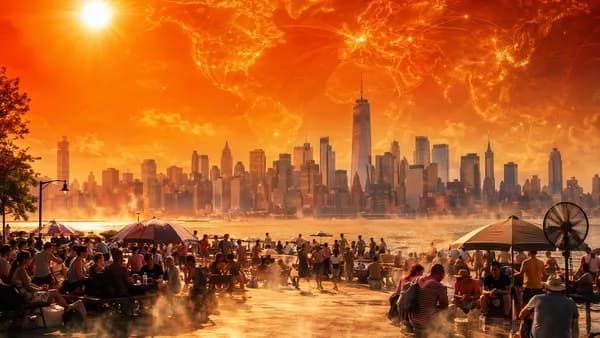
July Fourth Heat Dome Turns NYC Holiday Into a Trap
NYC faces a 110 heat index as July Fourth crowds, alcohol and long outdoor events turn extreme heat into a public-health threat.
Jul 2, 20268 min
 Global Trends
400 Cases Send CDC Chasing 18-State Cyclospora Trail
More than 400 cyclospora cases across 18 states have no confirmed source, leaving the CDC chasing scattered food-safety clues.
Jul 3, 20268 min
 Global Trends
England's Hottest June Forces Red Heat Alert Reckoning
England logged its hottest June since 1884 as three straight red heat alerts exposed how poorly the UK is built for dangerous heat.
Jul 1, 20267 min
 Global Trends
$5M Carroll Verdict Sticks as Supreme Court Spurns Trump
The Supreme Court let Trump’s $5m Carroll verdict stand, ending his bid to reopen the civil sexual abuse and defamation case.
Jun 29, 20268 min
 Global Trends
2,025 France Heatwave Deaths Sound Europe’s Next Alarm
France logged 2,025 excess deaths in a June heatwave, and officials warn the early toll is likely too low.
Jul 3, 20266 min
 Technology
Fanfiction AI Detector Throws AO3 Writers Into Panic
A Claude paste artifact sparked an AO3 panic, but the detector may threaten human fanfic writers more than it exposes AI cheats.
Jul 4, 20268 min
 Global Trends
Russ Vought Grabs the Keys to Intelligence Budgets
Russ Vought now has hands-on control over classified intelligence budgets, pulling OMB deeper into CIA and NSA spending fights.
Jul 4, 20268 min
 Global Trends
No 10 North Eyes Manchester Site That Won’t Open Until 2028
No 10 North is heading for an Ancoats brownfield hub, but the permanent Manchester base won’t be ready before 2028.
Jul 4, 20266 min
 Global Trends
Ukraine Drones Strike St. Petersburg Oil Terminal Again
Ukrainian drones hit a St. Petersburg oil terminal, pushing Kyiv's campaign deeper into Russia's energy system.
Jul 4, 20266 min
 Future Fiction
The Orchard That Voted Back
After climate-adaptive food systems make calories nearly free, former economist and displaced orchard keeper Mina Sayegh enters a decentralized digital nation called Root, whose treasury is run by public ledgers, regenerative assets, and rotating citizen juries. When an autonomous grove she helped design begins generating surplus wealth and casting governance signals through ecological data, Mina must decide whether prosperity should be distributed by human votes, market flows, or the needs of the living systems that sustain them.
Jul 4, 202615 min
Don't miss the signal
Get our weekly roundup of the stories that matter across tech, fintech, and trading. No noise, just signal.
Free forever. No spam. Unsubscribe anytime.